Why Most AI SaaS Ads Fail (And How Emerging Startups Are Fixing It)
Built for your product category
Turn your product page into category-specific Meta ads
Paste your URL and generate angles, visuals, headlines, and copy grounded in the offer customers will actually see.
Free to try No prompt writing

Most AI-powered SaaS ads fail because they focus on surface-level metrics like clicks and engagement rather than driving meaningful conversions. AI tools often produce generic ads that fail to stand out, struggle with long SaaS sales cycles, and rely on outdated templates that lead to wasted budgets. However, emerging startups are addressing these issues by:
- Simplifying ad targeting to let Meta’s algorithm find buyers.
- Producing static ads at scale for faster testing and lower costs.
- Crafting ad creatives that address specific customer pain points.
- Shifting focus from ROAS to metrics like CAC, SQL quality, and NRR.
- Using closed-loop reporting to connect ad spend to actual revenue.
These strategies help SaaS advertisers improve performance, reduce costs, and align ad spend with long-term growth goals.
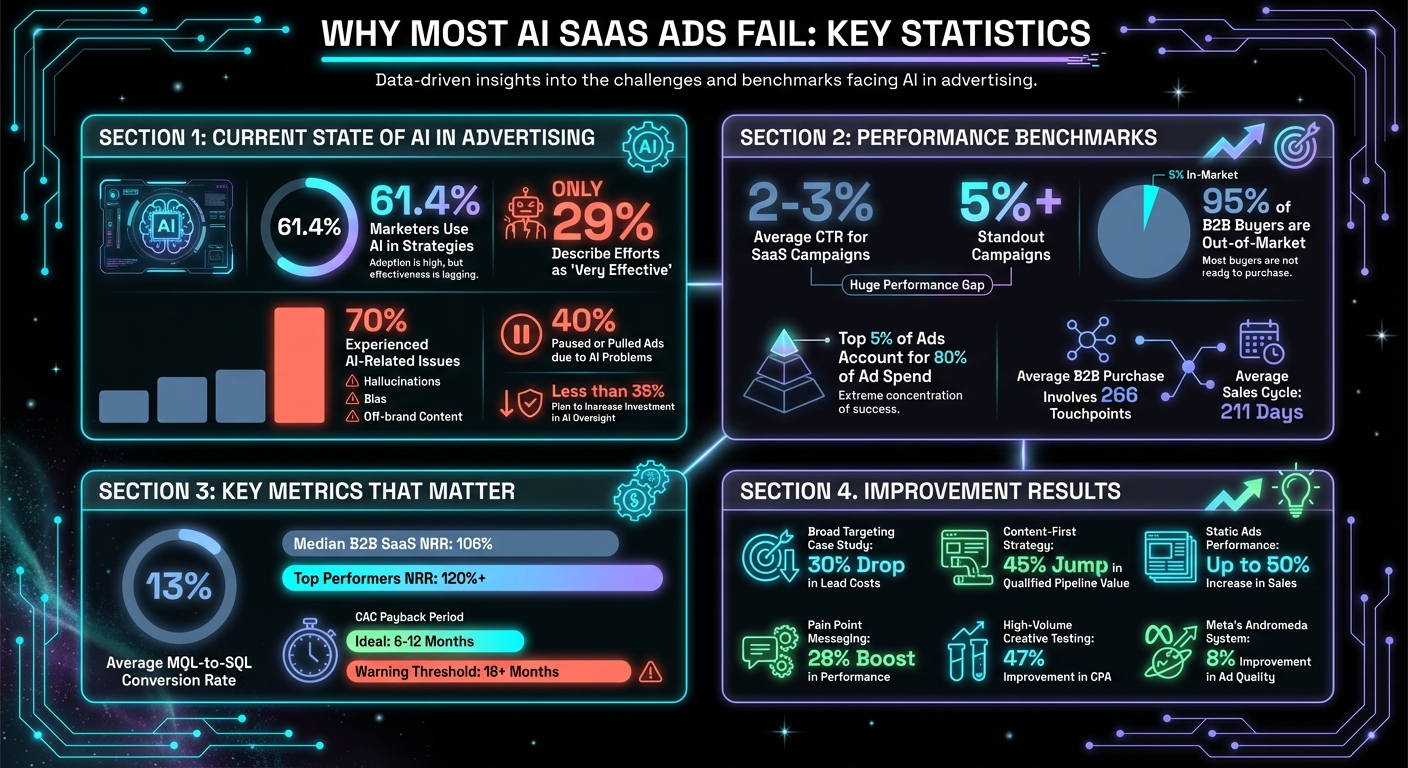
AI SaaS Advertising Performance Statistics and Key Metrics
Why Most AI SaaS Ads Fail: The Core Problems
Optimizing for Clicks Instead of Qualified Leads
AI-driven ad tools often focus on clicks and engagement, but for SaaS companies, this approach can be misleading. Sure, clicks are easy to measure and might seem like progress, but what good is a click if it doesn't lead to a qualified lead? It’s like celebrating a packed restaurant where no one orders food.
Here's the reality: the average click-through rate (CTR) for SaaS campaigns hovers between 2-3%, with standout campaigns hitting 5% or more. Meanwhile, 61.4% of marketers already use AI in their strategies, yet only 29% describe their efforts as "very effective". Why the disconnect? AI tools focus on optimizing for what’s statistically common - clicks - not what actually moves prospects through the funnel.
And here’s another harsh truth: 95% of B2B buyers are out-of-market at any given time. They’re not actively looking to buy. AI sees a click as a victory, even if that person never had any intention of booking a demo or starting a trial. As Trisha Gallagher, SVP Marketing at Marketri, explains:
"Too many teams think a single white paper or blog will convert tomorrow. But actually, 95% of B2B buyers are out-of-market at any given time, so the goal is to educate, build credibility, and stay top-of-mind."
When marketing teams chase lead volume while sales teams track closed deals, this disconnect creates friction. AI tools inadvertently prioritize low-quality clicks, clogging your pipeline and leaving your sales team frustrated. The result? Misaligned metrics that make it harder to analyze CPA for Meta ads and track meaningful customer engagement.
The Attribution Problem in SaaS
Even beyond click metrics, tracking the customer journey in SaaS is notoriously tricky. SaaS sales cycles are long and complex. A potential buyer might see your ad in January, download a whitepaper in March, attend a webinar in May, and finally book a demo in July. Add to that the involvement of multiple stakeholders - end users, managers, and CFOs - and you’ve got a tangled web of touchpoints that AI struggles to untangle.
Platforms like Meta optimize for immediate outcomes, showing your ad to people likely to click right now. But SaaS purchases don’t happen instantly. The person clicking today might not be the one signing the contract six months later. This creates a serious mismatch between what AI deems successful and what actually drives revenue.
The problem deepens as AI tools rely on their own outputs. When every SaaS company uses similar AI-generated ads, it creates a "feedback loop of sameness." Daniel Rozin, CMO and Co-founder of AdGPT, describes this phenomenon as a "death spiral of sameness", where ads are "visually consistent, copy-competent, utterly forgettable". This creative uniformity makes it nearly impossible to identify which ads genuinely contribute to closed deals, further complicating attribution.
Generic Creatives That Burn Budget
Another major pitfall of AI-generated ads is their tendency to churn out safe, generic creatives that fail to stand out. Sure, the visuals are polished, and the copy is error-free, but the message often lacks any real impact.
Consider this: 70% of marketers have experienced AI-related issues in their advertising, such as hallucinations, bias, or off-brand content. Even worse, 40% have had to pause or pull ads because of these problems. Despite these challenges, less than 35% of marketers plan to increase investment in AI oversight. It’s a recipe for wasted budget.
Overused templates and repetitive themes lead to audience fatigue. While your CPMs might look good at first, engagement quickly drops as users scroll past yet another cookie-cutter SaaS ad. You’re paying for impressions that leave no lasting impression, and this fatigue can tank your campaign ROI fast.
What’s more, AI lacks the contextual awareness to adapt to changes - whether it’s a shift in the economy, new industry challenges, or evolving audience priorities. Human marketers instinctively adjust to these shifts, but AI keeps running the same playbook until someone steps in. This defeats the whole point of automation.
To tackle these challenges, tools like Aden's Lab aim to simplify the ad creation process. By automating creative optimization - just drop in a link, get ads, and launch on Meta - it takes some of the guesswork out of crafting campaigns that actually resonate.
Put the playbook to work
Apply this playbook to your page
Paste your website and the Lab will turn the strategy you are reading into a ready-to-test ads.
Free to try No prompt writing
What Emerging Startups Are Doing Differently
Using Broad Targeting to Let Meta Find Buyers
Some startups are rethinking their ad targeting strategies by simplifying audience parameters. Instead of piling on multiple interests, behaviors, and lookalike audiences, they’re opting for broad targeting - focusing on basics like age, location, and language. This approach allows Meta's algorithm to take the wheel.
Why does this work? Meta’s system is incredibly precise, predicting purchase intent up to four times better than manual targeting methods. By avoiding overly restrictive audience definitions, you give the algorithm room to analyze data and find the right buyers. For example, in early 2026, a major fintech company shifted 80% of its ad budget to broadly targeted Meta campaigns. They tested over 50 unique video variations and saw a 30% drop in lead costs within just one quarter.
Here’s the trick: the creative becomes the key targeting tool. When your ad resonates with a specific audience, Meta’s algorithm identifies those engagement patterns and automatically delivers the ad to similar users. As Karan Aiyappa from iCert Global explains:
"The algorithm now handles the 'who' and 'where' with incredible precision, but it remains dependent on the 'what' - the message and the offer".
This approach relies on two critical elements: feeding high-quality conversion data through Meta's Conversions API (CAPI) so the system knows what’s valuable, and offering a variety of creative options for the algorithm to explore. One SaaS company adopted a "Content-First" strategy, using educational video case studies to engage broad audiences. Only after users showed strong interest did they move them into lead generation. The result? A 45% jump in qualified pipeline value compared to their previous search-focused strategy.
Broad targeting isn’t about taking shortcuts - it’s about giving Meta’s advanced systems, like Andromeda (which has scaled model capacity by 10,000x), the data they need to work effectively. This system has already improved ad quality by 8%, proving that a wider data pool helps identify high-intent buyers faster than manual methods ever could.
Producing Static Ads at Scale
Creative production is another area where startups are gaining an edge. While video ads often dominate attention, many are finding success with static ads. Why? Static ads are faster to produce, less expensive to test, and easier to scale.
In some campaigns, static ads have driven sales up by as much as 50%, while also securing lower CPMs in retargeting and user-generated content (UGC) placements. Their quick production time lets marketers test new ideas far more rapidly than video. With Meta's algorithm doing the heavy lifting, having 8–12 distinct creative concepts - each with unique angles, hooks, and value propositions - becomes essential.
The best-performing teams don’t settle for minor tweaks, like changing colors or button placements. Instead, they break ads into core elements - hooks, visuals, and calls-to-action (CTAs) - to identify what drives results. Tools like Aden's Lab streamline this process, generating multiple static ad variations optimized for Meta in just minutes.
As one marketer from Superads.ai puts it:
"Static means fast-loading, cost-efficient, and creatively agile - especially when executed with precision".
For brands managing large budgets, the ability to churn out dozens of fresh static ads weekly is a game-changer. It not only boosts testing capabilities but also helps combat creative fatigue. AI-powered insights can even detect when an ad’s performance starts to dip, allowing advertisers to replace it with new creatives before costs rise, ensuring consistent CPAs as they scale.
Testing Creatives Around Specific Pain Points
One of the biggest mistakes startups make with AI-generated ads is relying on generic messaging. Even the most polished visuals and flawless copy will fail if they don’t address real customer concerns.
The most effective startups dig deep into customer data - analyzing support tickets, chat logs, and reviews - to understand the exact language and objections their audience uses. Then, they craft ads that directly tackle these pain points. For instance, one advertiser swapped a headline from "Maximize Your Returns" to "Stop Leaving Money on the Table" and saw a 28% boost in performance. The product didn’t change, but the message struck a chord.
Top teams also test a high volume of creatives. Instead of making small adjustments to a single concept, they experiment with up to 15 completely different ideas - ranging from lifestyle imagery to UGC. This approach led to a 47% improvement in cost per acquisition compared to testing minor variations. Interestingly, AI-generated combinations that might seem unconventional - like pairing a technical product image with an emotional headline - outperformed more traditional pairings by 31%.
Daniel Rozin, CMO of AdGPT, explains it best:
"Weak ads usually begin with features. The majority of good product ads begin with the customer situation".
Focusing on customer outcomes - like “work all day without finding an outlet” instead of “10-hour battery life” - helps ads resonate on a personal level.
Platforms like Aden’s Lab make this process easier by analyzing landing pages and creating ads tailored to specific value propositions and pain points. Instead of starting from scratch, marketers get ready-to-test ads that directly address buyer objections, saving time and improving results.
Measuring What Matters: Moving Beyond ROAS
Why ROAS Doesn't Tell the Full Story
Many advertisers look at a 400% ROAS on Meta and assume they’ve struck gold. But here’s the catch: ROAS only measures gross revenue - not actual profit. It skips over key factors like your cost of goods, operational expenses, and whether your customers stick around for more than a month.
Take this example: a campaign with a 600% ROAS might still lose money if the product margins are razor-thin after factoring in support costs and customer churn. On the flip side, a campaign showing just 150% ROAS could be a long-term winner if it brings in loyal customers who stay for years. This is especially important in SaaS, where customer lifetime value (CLV) plays a huge role.
Another challenge is attribution inflation. When a single conversion involves multiple channels, platforms often double-dip, each claiming credit. This leaves fewer than 50% of advertisers confident about their true profitability. Leigh Buttrey, Senior PPC Strategist, sums it up perfectly:
"ROAS tells you how much revenue you made, not how much money you actually earned".
Focusing solely on ROAS can also limit growth. Meta’s algorithm will zero in on easy, near-term buyers, leaving untapped potential on the table.
The Right Metrics for SaaS Advertisers
If ROAS isn’t giving you the full picture, it’s time to shift your focus to more meaningful metrics:
- Customer Acquisition Cost (CAC) and the CAC payback period: CAC tells you how much it costs to acquire a customer, while the payback period shows how long it takes to recoup that cost through subscription revenue. Ideally, you want a payback period of 6–12 months. If it stretches beyond 18 months, it’s a sign you’re relying on external funding rather than revenue.
- SQL quality and win rate: With an average MQL-to-SQL conversion rate of just 13%, high lead volume doesn’t always mean success. What matters is whether those leads turn into real opportunities.
- Net Revenue Retention (NRR): This metric reveals if customers stick around and increase their spending over time. For B2B SaaS, the median NRR is 106%, while top performers reach 120% or more. If your Meta campaigns attract customers with an NRR of 80%, you’re likely losing revenue faster than you can replace it.
- Marketing Efficiency Ratio (MER): This metric looks at total revenue divided by total ad spend. Unlike ROAS, which isolates individual campaigns, MER gives you a big-picture view of your overall marketing performance.
These metrics only matter if they’re directly tied to the revenue you close.
Connecting Ad Spend to Actual Revenue
The toughest part? Linking ad spend to real revenue. This is where closed-loop reporting comes in. By connecting your CRM to your ad platform, you can feed offline conversion data - like closed deals, retained customers, and expansion revenue - back into Meta. This helps the algorithm optimize for outcomes that truly matter, not just demo requests.
For high-value SaaS deals, the buying journey is anything but simple. On average, a B2B purchase involves 266 touchpoints and takes 211 days. Multiple decision-makers within the same account might engage with your ads, read your content, and attend webinars before making a decision. That’s why account-based attribution, which aggregates all touchpoints across the buying committee, is so powerful.
If your deals have an average contract value (ACV) between $20,000 and $100,000, set your attribution window to at least 180 days. This ensures you capture early-stage interactions that lay the groundwork for trust and awareness.
Ultimately, if you can’t tie ad spend to closed deals, you’re flying blind. Tools like Dreamdata and HubSpot Marketing Hub Enterprise can help automate this process. But success hinges on clean data - deduplicating records, standardizing names, and syncing your CRM with ad platforms are non-negotiable steps.
Conclusion: Building a Scalable AI SaaS Ad Strategy
Key Lessons for SaaS Advertisers
AI SaaS ad campaigns often falter when approached like e-commerce campaigns. Common pitfalls include chasing short-term metrics like ROAS, relying on overly narrow targeting that clashes with Meta's algorithm, and producing creatives too slowly - leading to quick creative fatigue. To succeed, focus on three critical shifts: prioritize meaningful metrics, create scalable static ads, and align ad spend with revenue.
First, track metrics that drive sustainable growth, such as CAC payback periods and closed-won revenue. If your CAC payback period stretches beyond 18 months, you're relying on external funding rather than building a sustainable customer base.
Second, adopt broad targeting strategies. Meta's Andromeda system thrives on creative content rather than rigid audience definitions. Provide it with diverse concepts that address different customer pain points to maximize results.
Third, understand that creative volume is your strongest competitive advantage. The top 5% of ads account for 80% of ad spend, so finding those top-performing ads requires large-scale testing.
"Creative is your biggest leverage on Meta, and also the biggest bottleneck for most companies."
– Sasha, Co-founder, Spiral.ad
These insights lay the foundation for actionable steps to scale your campaigns effectively.
Next Steps for Implementing These Strategies
To put these lessons into action, start by evaluating your current creative output. Are you launching 10 genuinely distinct ads or just minor variations of one concept? If your team is producing only one or two creatives a week, you're already lagging. Set a clear goal to increase output by about 10% weekly as your processes improve.
To tackle creative fatigue, consider leveraging a tool to produce Meta ads on autopilot. For example, Aden's Lab simplifies the process by generating high-performing static Meta ads from a single product link - no prompts, setup, or learning curve required. Just drop in a link, and it delivers ready-to-launch ads. With the Apex Mode plan at $0.90 per ad, you can produce 200 unique ads monthly - at a fraction of the cost of agency-designed content. By removing creative bottlenecks, you can test ideas faster, scale successful campaigns, and directly connect ad spend to revenue.
How to run better Ads for your SaaS with AI
FAQs
What should I optimize for instead of clicks on Meta?
Focus on metrics that truly measure performance, such as conversion rates, cost per acquisition (CPA), and return on investment (ROI). These metrics offer a more accurate view of your campaign's profitability and overall success. Unlike clicks, which can be misleading, these indicators tie directly to meaningful outcomes and long-term growth.
How broad should my targeting be for B2B SaaS ads?
When defining your audience, focus on your ideal customer profile (ICP), but don’t make it so narrow that you exclude valuable opportunities. Start with a broad enough group to create awareness and gather performance data. From there, you can fine-tune your targeting based on what works. This way, you minimize wasted budget on unqualified leads while still reaching a substantial pool of potential customers.
How do I connect Meta ad spend to closed-won SaaS revenue?
To tie Meta ad spend directly to closed-won SaaS revenue, you'll need to set up multi-touch attribution. This approach connects ad interactions to actual purchase values, providing insights into which channels contribute to revenue - not just conversions. By understanding what truly drives results, you can allocate your ad budget more effectively and focus on strategies that impact your bottom line.
Your next ad batch starts here
Finish with a ready-to-test ad batch
Paste your website to generate static creatives. Drop the link → get ads in about 90 seconds → upload them to Meta → scale.
Free to try No prompt writing