The Retention Flywheel: Turn First Time Buyers Into Repeat Buyers on Autopilot
Turn the strategy into creatives
Create Meta ads for your product
Paste your product page. ADEN'S LAB turns the offer, audience, and positioning into complete ready-to-use Meta static ads.
Free to try No prompt writing

Want to grow profits without constantly chasing new customers? Here’s the key: Turn first-time buyers into repeat customers with automated retention strategies. This approach not only saves money but also builds a self-sustaining cycle of growth.
Key Takeaways:
- Retention is cheaper than acquisition: Retargeting costs 40–60% less and delivers higher ROAS (4x–10x vs. 1x–2x for cold audiences).
- Phased retention strategy: Focus on onboarding (Days 1–7), trust-building (Days 8–21), and upsells/referrals (Days 22–45).
- Use customer data effectively: Segment buyers into Custom Audiences and set up automated retargeting campaigns.
- Combat ad fatigue: Rotate new ad content every 10–14 days to maintain engagement.
- Leverage user-generated content (UGC): Ads featuring reviews and testimonials outperform polished designs by 4x.
By blending acquisition with retention and keeping your campaigns updated, you can maximize lifetime customer value and scale profitably. Let’s break down how to set this system up.
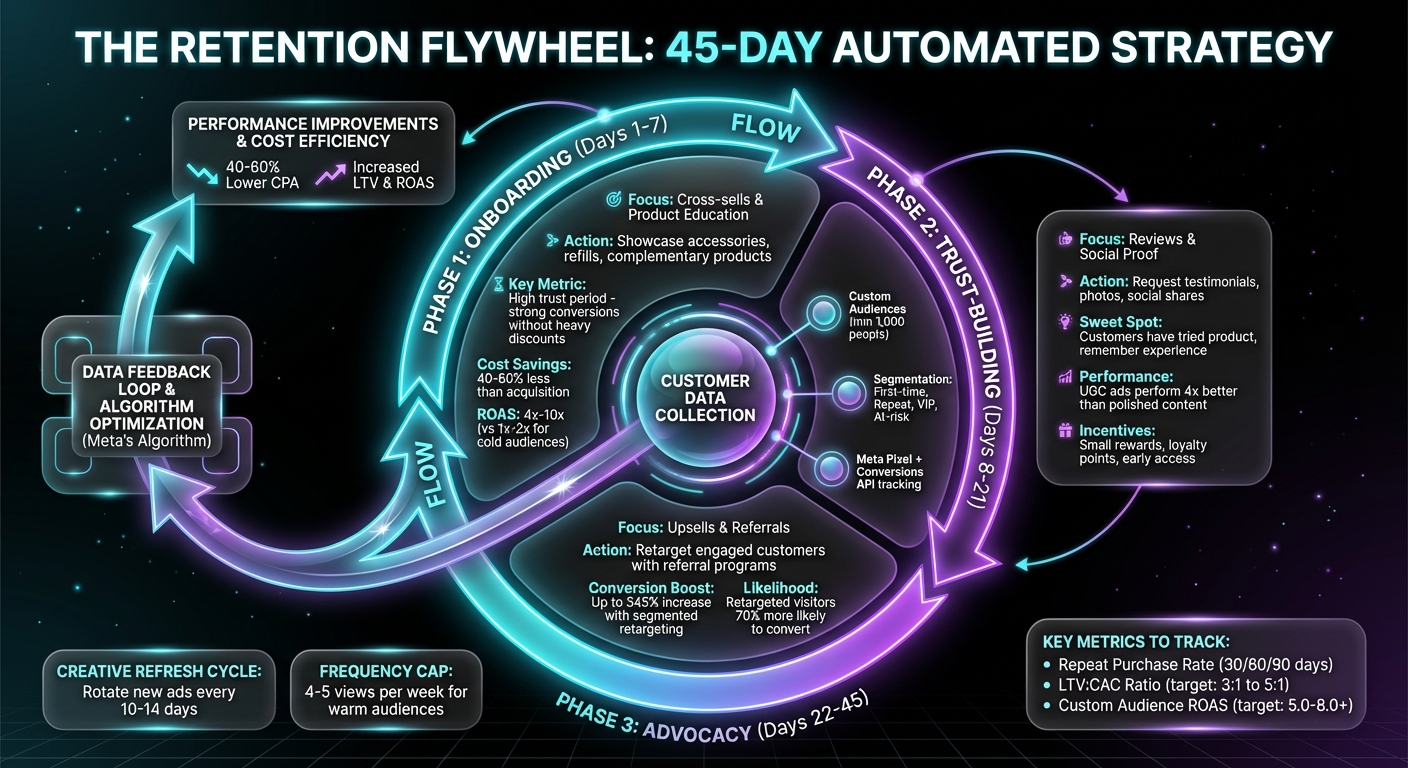
The 45-Day Retention Flywheel Strategy for E-commerce
Boost Retention & Loyalty with Smart Automations
Put the playbook to work
Apply this playbook to your page
Paste your website and the Lab will turn the strategy you are reading into a ready-to-test ads.
Free to try No prompt writing
Why Retention Costs Less and Scales Better Than Acquisition
Many advertisers pour too much of their budget into targeting brand-new audiences. But here's the kicker: retargeting existing customers can cost 40–60% less per acquisition compared to prospecting for new ones. Why? Repeat buyers already know your brand, which means less convincing and more converting.
Retention also has another big advantage: repeat purchases feed high-quality data into Meta's algorithm. Retargeted visitors are 70% more likely to convert than cold traffic, creating a feedback loop that strengthens your automated retention system over time.
Separating acquisition and retention budgets can be a costly misstep. Brands focused solely on new customer acquisition often overlook the potential of maximizing lifetime value. Retargeting campaigns, when segmented effectively, can boost conversions by up to 345% because you're engaging people who are already familiar with your brand.
The Real Numbers: Acquisition vs. Retention Costs
The numbers speak for themselves. Cold prospecting ads typically deliver a ROAS (Return on Ad Spend) of 1x–2x, meaning you earn one to two dollars for every dollar spent. Retargeting, on the other hand, can push ROAS up to 4x–10x+, thanks to the trust and familiarity your audience already has with your brand.
Retention efforts also have a more efficient cost structure. Cold audiences require heavy investment in brand education - expensive creatives and higher cost-per-clicks. In contrast, retention campaigns can focus on targeted benefits or exclusive offers, leveraging the trust you've already built. This approach often reduces cost per acquisition (CPA) by 40–60%.
More importantly, repeat buyers help improve Meta's algorithm by providing valuable behavioral data. This allows you to create better Lookalike Audiences, which can even enhance your cold prospecting campaigns. When you understand these numbers, you're better equipped to design retargeting campaigns that truly deliver results.
Next, we'll explore how to turn this cost-efficient strategy into action immediately after a purchase.
Why Most Advertisers Fail at Scaling Meta Ads
Even with these advantages, many advertisers stumble when it comes to retention strategies. A common mistake? Treating customer lists as static files - uploaded once and then ignored. Post-purchase engagement often gets overlooked, leaving money on the table.
Another frequent error is failing to exclude recent buyers from acquisition campaigns. Meta doesn't automatically filter out recent purchasers, so you need to set up manual exclusions. Without this step, you're essentially bidding against yourself, which unnecessarily drives up customer acquisition costs.
Creative inefficiency is another roadblock. While retention campaigns are more stable and scalable, they still require a steady stream of fresh creatives to stay effective. This is where tools like ADEN's LAB can be game-changers. With the ability to generate dozens of high-performing Meta ads in minutes from a single product link, these platforms eliminate creative bottlenecks and keep your retention strategy running smoothly.
Step 1: Collect and Organize Buyer Data Right After Purchase
After a purchase is made, it’s essential to immediately collect and organize buyer data. Skipping this step means risking wasted ad spend - like targeting customers who just bought or missing opportunities to re-engage those ready to purchase again.
There are a few key types of data you’ll need:
- Customer identity data: Emails and phone numbers form the backbone of Meta Custom Audiences.
- Purchase behavior data: This helps you identify first-time buyers, repeat customers, high-value buyers, and those who haven’t purchased in over 45 days.
- Engagement data: Includes actions like video views or ad clicks from users who haven’t converted yet.
- Exclusion data: Ensures you’re not targeting recent purchasers, saving money and avoiding customer frustration.
This data fuels an automated retention system, setting the stage for repeat purchases. Many advertisers make the mistake of treating these data points as a one-time task. Buyer behavior changes frequently, so updating your lists weekly or biweekly is crucial for staying relevant. Segment your customers into categories like first-time buyers, repeat buyers, VIPs (high lifetime value), and at-risk customers (those inactive for 45+ days). Each group requires a tailored approach: first-time buyers might need onboarding, while repeat buyers may be ready for a new offer.
To ensure accurate tracking, integrate both browser- and server-side systems. Use the Meta Pixel (browser-side tracking) alongside the Conversions API (server-side tracking) to capture all purchase events. Relying only on the Pixel could leave gaps in your retargeting data.
How to Upload Customer Lists to Meta Custom Audiences
Start by exporting your customer list from your CRM or e-commerce platform. At the very least, include email addresses and phone numbers. Meta will hash (encrypt) this data and match it to Facebook and Instagram profiles to create a Custom Audience.
Here’s how to set it up in Meta Ads Manager:
- Go to the Audiences section and create a new Custom Audience.
- Choose "Customer List" as the source and upload your CSV file.
- For best results, aim for at least 1,000 people in an audience before launching retargeting campaigns.
Segmentation is key. Instead of uploading one large list, break it into smaller groups like first-time buyers, repeat buyers (2+ purchases), high-value customers (top 20% by spend), and at-risk customers. Clearly label these lists (e.g., "Purchasers_FirstTime" or "Purchasers_VIP") to make campaign setup faster and more organized.
Don’t forget to exclude recent purchasers when running acquisition campaigns targeting new audiences. This avoids wasting ad spend and keeps your messaging relevant.
Another important detail: use Standard Events like ViewContent, AddToCart, and Purchase on your site. These events help Meta understand user behavior, powering Dynamic Product Ads with personalized recommendations. Without mapping these events to product IDs, your retargeting efforts may feel generic and less effective.
Using Thank-You Pages to Drive Immediate Upsells
The thank-you page is often overlooked, but it’s a golden opportunity. Right after a purchase, customer trust is at its peak. This is the perfect time to deepen the relationship and even boost sales.
Here’s how to make the most of your thank-you page:
- Suggest relevant products: Tailor recommendations to what the customer just bought. For example, if they purchased running shoes, offer socks or a water bottle as add-ons.
- Encourage engagement: Invite customers to join your Facebook Group or follow you on Instagram. This builds a warm audience for future retargeting.
- Track purchases accurately: Use the Conversions API to trigger a server-side Purchase event. This bypasses ad blockers and iOS restrictions, ensuring your retargeting lists capture as many buyers as possible. Include an event_id parameter to avoid double-counting events from both the Pixel and the API.
Lastly, use the thank-you page to kick off a sequenced post-purchase strategy. This keeps customers engaged without overwhelming them and feeds valuable behavioral data back into Meta for smarter retargeting over time.
Step 2: Set Up Automated Retargeting Campaigns
Once you've organized your buyer data, the next move is to set up automated retargeting campaigns. These campaigns aim to deliver personalized messages automatically, based on how recently a customer made a purchase.
Why does retargeting work so well? It's much easier (and cheaper) to convert someone familiar with your brand than to convince a new prospect. Studies show that retargeted visitors are three times more likely to click on your ads. Plus, retargeting campaigns often deliver conversion rates three to five times higher, with ROAS ranging from 3x to 10x - compared to only 1x–2x when targeting fresh audiences.
Many advertisers miss out on these benefits because they treat retargeting as a one-size-fits-all campaign. But timing matters. Someone who purchased just two days ago requires a very different approach than someone who bought weeks ago.
Building Retargeting Campaigns That Work Automatically
Start by creating a timeline for your retargeting efforts based on how recently a customer purchased. This timeline should be built using the structured buyer data you’ve already organized.
- First 7 Days Post-Purchase: Focus on cross-sells and product education. Showcase items like accessories, refills, or complementary products that pair well with their recent purchase. Trust is still high during this period, so you can see strong conversion rates without relying on heavy discounts.
- Days 8 to 30: Shift your messaging to highlight testimonials, user-generated content, and social proof. By now, customers have had time to experience your product. Reinforcing their decision with reviews and real-life examples can strengthen loyalty and encourage a second purchase.
If you're running Advantage+ Shopping campaigns, Meta’s machine learning can handle much of the heavy lifting - like identifying high-converting audiences and managing ad spend. However, it’s crucial to keep your Custom Audiences updated with clean, accurate data.
Also, monitor ad frequency. If your audience sees the same ad more than four times in a week without converting, it’s time to adjust. Set frequency caps at three to four impressions per week.
With timing-based campaigns in place, your next challenge is keeping your ad creative fresh and engaging.
Avoiding Creative Fatigue with High-Volume Ad Production
When your audience sees the same ad too often, it leads to ad blindness. This is especially true for smaller, more focused audiences. Over time, viewers simply start ignoring repetitive creative.
"High frequency is the number one killer of ad performance. It's a clear signal that your audience is too small for your budget... or your creative has gone stale."
– AdStellar AI
The solution isn’t to pause successful ads but to refresh them regularly. Rotate in new creative every two weeks. Ideally, you should have 3–5 unique ads ready to keep your campaigns performing without disrupting the algorithm's learning phase. This consistent rotation helps maintain strong ROAS over time.
The real challenge? Producing enough creative quickly. Hiring designers for $30–$50 per ad can slow you down, especially when scaling requires dozens of variations. That’s where ADEN's LAB comes in. Just drop in your product link, and it generates high-converting static Meta ads in under 90 seconds - no prompts, no setup, no back-and-forth. This lets you launch fresh creative as often as needed to match the pace of your campaigns.
Step 3: Turn Customers Into Advocates with User Content
Your best-performing ads often come straight from your customers' real experiences, not from polished designs.
Right after a purchase, take advantage of the trust customers feel by encouraging them to leave reviews, share photos, or refer friends. This kind of user-generated content (UGC) can be repurposed into ads that consistently outperform traditional ones. In fact, UGC ads perform four times better than polished content. Why? Because they feel genuine and relatable, cutting through the noise on platforms like Meta in ways that stock photos or overly designed ads simply can't.
Timing is everything. Between 8 and 21 days after a purchase, customers have had enough time to try your product but still remember their buying experience. This is the sweet spot for running post-purchase ads that encourage reviews, photo shares, or community engagement - like joining a Facebook group. Sweeten the deal with small incentives like early access to products, loyalty points, or discounts on their next order. The goal isn't just to gather content; it's to identify your most enthusiastic customers and retarget them later with referral campaigns. This approach builds a highly effective Engagement Custom Audience, ready to drive conversions.
Getting Reviews and Social Shares Through Post-Purchase Ads
If you're just waiting for reviews to roll in, you're missing out. You need to ask - and at the right time.
Create a Custom Audience of customers who purchased 8–21 days ago. Then, run simple ads asking them to share a photo, leave a review, or post about their experience on social media. Make your request clear and offer a small reward, like a $10 credit or entry into a giveaway.
When customers engage - whether by leaving a review or sharing a post - add them to an Engagement Custom Audience. These customers are your warmest leads for referral campaigns. They've already endorsed your brand publicly, so now you can retarget them with ads that encourage referrals. For example, you could offer milestone-based rewards like, "Refer 3 friends and get $30 off".
This creates a powerful cycle: buyers become reviewers, reviewers become advocates, and advocates bring in new customers. Once set up, this system can essentially run itself.
After gathering this authentic customer content, the next step is scaling it into effective ads.
Turning Testimonials Into Scalable Static Ads
Once you've collected reviews and testimonials, the challenge becomes turning them into ads by automating Meta ad production. Custom-designed ads for every testimonial can be expensive and time-consuming, often missing the best testing window.
This is where ADEN's LAB steps in. By simply dropping in your product link, the tool generates high-converting static Meta ads in under 90 seconds - no prompts, no setup, no back-and-forth. You can take a single testimonial and create multiple versions in minutes, tweaking hooks, background colors, or layouts. This allows you to test the same review across different formats without slowing down your campaigns.
The standout feature? A "variation matrix" that pairs one strong review with 3–5 different hooks or visuals. The algorithm then identifies the combination that performs best. Considering that top-performing campaigns refresh their creative every 10.4 days on average, having a system to generate fresh testimonial ads on demand keeps your campaigns running smoothly without creative fatigue dragging down your ROAS. This is also a critical time to analyze CPA for Meta ads to ensure your retargeting remains profitable.
"Creative is the new targeting. Meta analyzes your ad content - text, visuals, audio - and uses it to figure out who should see it."
– Spiral Team
Step 4: Scale Using ROAS Data and Automated Creative Rotation
Once your retention campaigns are converting reliably, it's time to scale using ROAS (Return on Ad Spend) data to guide your decisions. Many advertisers make the mistake of scaling by trial and error or simply repeating past strategies, which often leads to higher CPAs (Cost Per Acquisition) and underperforming campaigns as budgets grow. Instead, let ROAS be your compass. For example, if an ad set consistently achieves your target return - say, 3.5x or higher - and has delivered at least 10 conversions, it’s a strong candidate for scaling.
When scaling, increase budgets gradually - about 20% every 2–3 days. This prevents Meta’s algorithm from resetting its learning phase, which can happen if you raise budgets too quickly. A sudden jump makes Meta treat your campaign as a new launch, potentially derailing performance. Another strategy is duplicating successful ads and targeting them across different audience segments or regions. For instance, if a retention ad performs well with a 30-day buyer list, try using the same creative with a 60-day or 90-day audience. You can also segment geographically - targeting North, South, East, or West regions - to find untapped audiences with lower CPMs. One cosmetics retailer saw a 46% boost in ROAS by using Meta’s ROAS optimization for first-time buyers.
If an ad set consistently underperforms, don’t hesitate to shut it down to avoid wasting your budget.
"ROAS is the heavyweight champion of Facebook Ads metrics... if ROAS looks bad, other campaign metrics become less relevant."
– Jay Kang, Swydo
The key to scaling successfully is to balance your budget adjustments with creative updates. ROAS helps you identify winners, but keeping your creative fresh ensures your campaigns stay optimized without requiring a full reset.
Preventing Ad Fatigue with Frequency Caps and Fresh Creatives
Even the best-performing ads will eventually hit a wall. Overexposure leads to lower engagement, as audiences grow tired of seeing the same creative. When this happens, Meta’s algorithm flags the ad as low-quality and increases the cost to show it.
For warm audiences, aim to keep ad frequency at around 4–5 views per person per week. Once frequency exceeds 6, click-through rates drop, CPAs increase, and ROAS takes a hit. Meta may even warn you in Ads Manager with labels like "Creative Fatigue" when CPAs double compared to previous performance.
The solution? Refresh your creatives regularly - before fatigue sets in. On average, top-performing campaigns update their ads every 10.4 days, with high-spend campaigns needing updates as often as every 7 days.
This is where tools like ADEN’s LAB can make a difference. Instead of waiting for a designer to create new variations, you can generate multiple ad versions in under 90 seconds by simply inputting your product link. Adjust the hook, swap out the background, or experiment with a new layout - all while keeping your campaigns running smoothly. The variation matrix allows you to pair one strong concept with different hooks or visuals, letting Meta’s algorithm determine the best-performing combination. This keeps your ads fresh and engaging, preventing fatigue from dragging down your ROAS.
"The brands that win aren't the ones with one great ad - they're the ones who can produce fresh creative faster than their ads can fatigue."
– AdMake AI Team
For cold audiences, set frequency caps at 2–3 views per person per week. For warm audiences, stick to 4–5, and refresh your creatives before performance starts to slide. This proactive approach ensures your campaigns remain effective and your audience engaged.
How to Measure and Improve Your Retention Flywheel
Once your retention campaigns are up and running, the next step is making sure they perform at their best. Measuring the right metrics and refining your approach is what keeps your retention flywheel spinning effectively.
Start by focusing on your Repeat Purchase Rate - this shows the percentage of customers who return within 30, 60, or 90 days. If this number is low, it’s a clear sign that your retention strategy needs work, and no amount of extra ad spend can fix that. Another key metric is your LTV:CAC Ratio. A healthy benchmark is 3:1, meaning every dollar spent on acquiring customers should return three dollars in lifetime value. If you’re achieving a ratio of 5:1 or higher, it might actually indicate underinvestment - consider scaling your budget to capture more opportunities. Finally, keep an eye on your Custom Audience ROAS. Retargeting campaigns should ideally deliver a return of 5.0–8.0+. If your ROAS drops below 4.0, it could signal issues like creative fatigue or a mismatch in your messaging.
Tracking these metrics helps you identify what’s working and where you need to make adjustments. The beauty of a retention flywheel is that it builds momentum over time. Every retained customer adds to a larger pool you can retarget at a lower cost. But for this system to keep thriving, you need to regularly refresh your ads to maintain audience interest. Investing in automation to lower CPA and consistently producing new creative materials ensures your flywheel keeps gaining strength.
"The formula for scaling in 2025 = quantity × diversity of ads. Growth comes from consistently feeding the system fresh inputs and letting it learn."
– Sasha, Co-founder, Spiral.ad
If you’re spending more than $10,000 per month on Meta, implementing the Conversions API (CAPI) is essential. It enhances signal quality and improves targeting precision. Struggling to keep up with creative production? ADEN's LAB can generate fresh static ad variations quickly, so your retention campaigns stay sharp without delays. The brands that win are the ones that produce new creative faster than their ads wear out. Feeding these insights back into your creative process ensures every part of your flywheel operates at full capacity.
FAQs
How should I split my budget between retention and acquisition?
A typical approach is to allocate 70% of your budget to acquisition (prospecting) and 30% to retention (retargeting). This setup balances the push for new customer growth while still giving attention to nurturing existing customers. However, you can tweak this ratio depending on your objectives. For example, focus more on acquisition if you're scaling or entering new markets, while a retention-heavy strategy works better if you already have a strong, loyal customer base. Keep a close eye on metrics like ROAS (Return on Ad Spend), CPA (Cost Per Acquisition), and LTV (Lifetime Value) to guide adjustments as your data and business priorities shift.
What audiences should I exclude to avoid wasted spend?
To make your campaigns more effective, it's important to avoid targeting groups that are less likely to convert or are already overexposed to your messaging. These groups include:
- Existing customers (unless you're running campaigns specifically designed for retention).
- Inactive customers (unless you have a clear plan to re-engage them).
- Overly broad or untargeted audiences that don't match your ideal customer profile.
By steering clear of these groups, you can direct your budget toward prospects with higher potential, ensuring your resources are used more efficiently.
How do I refresh creatives without breaking performance?
To keep your ads fresh and performing well, make updates before creative fatigue kicks in - usually every 2–4 weeks, depending on your budget and audience size. Small adjustments, such as tweaking the hook, changing visuals, or refining calls-to-action, can help maintain relevance without disrupting performance. For more substantial changes, consider introducing entirely new concepts on a regular basis. Keep an eye on metrics like click-through rate (CTR) and frequency to identify signs of fatigue early and make timely updates.
Your next ad batch starts here
Finish with a ready-to-test ad batch
Paste your website to generate static creatives. Drop the link → get ads in about 90 seconds → upload them to Meta → scale.
Free to try No prompt writing