Retargeting Windows for Meta Ads by AOV and Buying Cycle
Turn the strategy into creatives
Create Meta ads for your product
Paste your product page. ADEN'S LAB turns the offer, audience, and positioning into complete ready-to-use Meta static ads.
Free to try No prompt writing

Want better results from your Meta Ads? Here's the key: adjust your retargeting windows based on customer behavior.
Most advertisers use a one-size-fits-all retargeting approach. But not all visitors are ready to buy at the same time. By tailoring retargeting windows to match your audience’s buying cycle and average order value (AOV), you can lower costs and boost conversions.
Key Takeaways:
- Short windows (1–7 days): Ideal for cart abandoners or high-intent actions. Focus on urgency and quick conversions.
- Medium windows (7–30 days): Best for product viewers or pricing page visitors. Use social proof and benefits-driven messaging.
- Long windows (30–180 days): Target general visitors or blog readers. Build trust with educational content and brand storytelling.
- AOV matters: Low-priced items need shorter windows, while high-ticket products benefit from longer retargeting timelines.
- Segment audiences: Divide users into tiers (high, mid, low intent) and tailor your ads for each group. Exclude recent buyers to avoid wasting budget.
- Frequency caps: Avoid ad fatigue by limiting impressions (e.g., 4–7 per week for cart abandoners).
By combining these strategies with tools like Meta’s Pixel and Conversions API, you can refine your audience targeting, improve ROI, and reduce wasted ad spend.
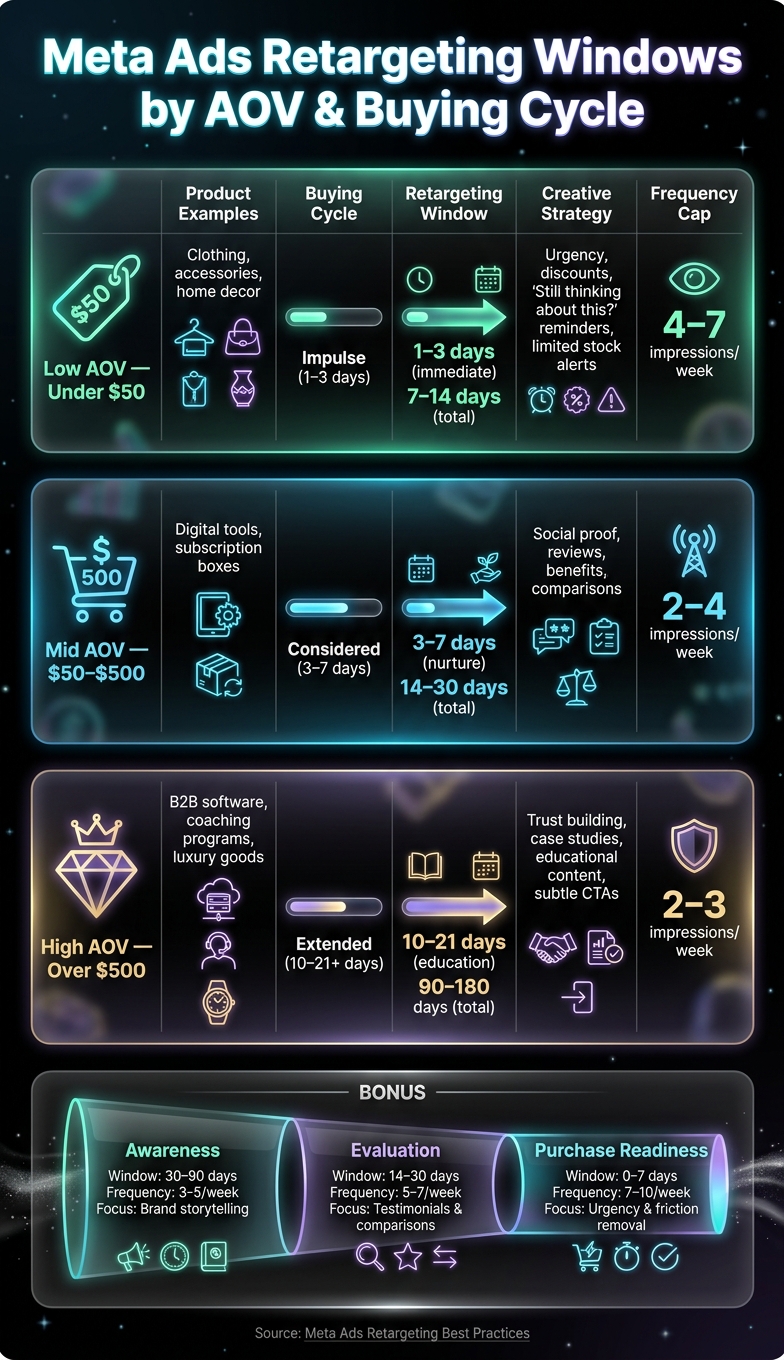
Meta Ads Retargeting Windows by AOV & Buying Cycle
The Only Facebook Retargeting Funnel You’ll Ever Need
Put the playbook to work
Apply this playbook to your page
Paste your website and the Lab will turn the strategy you are reading into a ready-to-test ads.
Free to try No prompt writing
Retargeting Window Basics
A retargeting window is the time frame during which a user remains part of a Custom Audience after interacting with your website - whether that’s visiting a page, viewing a product, or adding an item to their cart. This window begins the moment they leave your site. Over time, their memory of your brand and their willingness to engage naturally decline.
This drop-off, called intent decay, happens quickly. For instance, someone who visited your product page yesterday is far more likely to make a purchase than someone who browsed weeks ago. Choosing the right retargeting window ensures your ads reach potential buyers while their interest is still fresh, rather than after they’ve moved on. Let’s break down how short, medium, and long windows align with buyer intent.
Short, Medium, and Long Retargeting Windows Explained
The length of your retargeting window should match where the buyer is in their decision-making process. Here’s how the three main types of windows typically work:
| Window Type | Duration | Ideal For | Key Message |
|---|---|---|---|
| Short | 1–7 days | Cart abandoners, checkout initiators | Focus on urgency, offer incentives, and address friction points |
| Medium | 7–30 days | Product viewers, pricing page visitors | Highlight social proof, reviews, and testimonials |
| Long | 30–180 days | All site visitors, blog readers | Share your brand story, educational content, or cross-sell opportunities |
Each type of window works best for specific products and buyer behaviors.
But there’s more to it. The actions buyers take on your site can further refine how long you should retarget them.
How Purchase Behavior Shapes Retargeting Timelines
Buyer behavior plays a huge role in determining the timing and intensity of your retargeting efforts. High-intent actions call for shorter, more immediate retargeting. For example, if someone abandons their cart, you might retarget them within 24 hours with reminders about your return policy or secure checkout process. On the other hand, someone who simply viewed a product page might be better targeted within a 7–30 day window, using ads that feature customer reviews or testimonials.
"A 7-day cart abandoner is much more likely to convert than a 60-day cart abandoner - the former is still actively shopping while the latter has likely either purchased elsewhere or moved on." - benly.ai
Even smaller actions, like saving an item to a wishlist or selecting a shipping date, can indicate higher intent compared to a casual homepage visit. By tracking these micro-behaviors through tools like pixels or the Conversions API, you can fine-tune your audience targeting and set retargeting windows that match the pace of your buyer’s decision-making process.
Matching Retargeting Windows to AOV Tiers
Fine-tuning retargeting windows based on AOV (Average Order Value) adds precision to your campaign strategy. The price tag on a product plays a big role in determining how long you should retarget potential buyers. Think about it: a $15 candle and a $2,500 coaching program call for entirely different approaches in both timing and messaging.
Low AOV: Quick Decisions, Quick Retargeting
For lower-priced items - like clothing, accessories, or home decor - purchases are often driven by emotion and impulse. These decisions happen fast, so your retargeting window should match that urgency. A 1–3 day window works best for capturing immediate interest. If you want to extend engagement, you can stretch the retargeting period to 7–14 days, but beyond that, you’re likely wasting resources and driving up acquisition costs. Keep your ads focused on urgency: emphasize limited stock, small discounts, or a simple nudge like, "Still thinking about this?"
Mid to High AOV: Nurturing the Decision Process
Mid-range products, such as subscription boxes or digital tools, often require a bit more thought. Buyers might be comparing options or waiting for a specific moment - like their next paycheck. A 3–7 day window helps re-engage leads while they’re still considering, and extending retargeting to 30–60 days ensures your brand stays on their radar during their evaluation phase. This is the perfect time to lean on social proof, like customer reviews, and highlight benefits that answer the key question: "Why this product?"
Luxury and Very High AOV: Patience Pays Off
When it comes to high-ticket items - think luxury goods, B2B software, or premium coaching programs - the buying process is much more deliberate. These buyers do their homework, compare options, and often consult others before making a decision. In these cases, aggressive "buy now" ads won’t work.
"The duration of the retargeting window should reflect the buying cycle of the product or service. High-ticket items may require longer windows, while impulse buys may benefit from shorter, more immediate windows." - FasterCapital
Start with a 10–21 day window focused on educational content to build trust early in the decision-making process. Then, extend your total retargeting period to 90–180 days to remain top-of-mind. Use case studies, client success stories, and subtle calls-to-action like "Explore more" to nurture interest. Keep ad frequency low - around 2–3 impressions per week - to avoid overwhelming your audience during this longer timeline.
| AOV Tier | Product Examples | Recommended Window | Primary Messaging Focus |
|---|---|---|---|
| Low AOV | Clothing, accessories, home decor | 1–3 days (immediate) / 7–14 days (total) | Urgency, direct reminders, discounts |
| Mid AOV | Digital tools, subscription boxes | 3–7 days (nurture) / 30–60 days (total) | Benefits, comparisons, social proof |
| High / Luxury AOV | B2B software, coaching, luxury goods | 10–21 days (education) / 90–180 days (total) | Trust building, case studies, education |
Aligning Retargeting Windows with Buying Cycle Stages
Fine-tuning retargeting campaigns involves more than just setting timeframes based on Average Order Value (AOV). By aligning retargeting windows with the distinct stages of the buyer's journey, you can ensure your messaging speaks directly to where a potential customer is in their decision-making process. After all, someone casually reading a blog post needs a very different nudge than someone who left items in their cart. Let’s dive into how this strategy plays out across the buyer's journey, starting with new visitors.
Awareness Stage: Re-Engaging New Visitors
These are the folks who’ve recently stumbled upon your site, often without any clear intention to buy. They’re exploring, learning, and just starting to familiarize themselves with your brand. For this group, a retargeting window of 30–90 days works well. This timeframe gives you room to stay on their radar as their initial interest fades.
Keep ad frequency low - about 3–5 impressions per week - to avoid overwhelming them. The focus here isn’t on pushing a sale but on building recognition and trust. Use ads featuring educational content or compelling brand stories that stick in their minds. To maintain this volume without manual overhead, many teams automate Meta ad production to keep creative fresh. From here, we move to those who are actively weighing their options.
Evaluation Stage: Nurturing Interested Prospects
When a visitor starts spending time on product pages or exploring specific offerings, they’re signaling deeper interest. For these prospects, a shorter 14–30 day window is ideal. This ensures your ads stay timely and relevant as they deliberate.
Shift your creative approach to showcase testimonials, product benefits, or comparisons that help build confidence in your brand. You can also increase ad frequency to 5–7 impressions per week to stay visible during this critical phase.
"Retargeting is the highest-ROI channel in digital advertising when you do it right. The difference between lazy retargeting and smart retargeting is segmentation, creative specificity, frequency discipline, and proper exclusions." - Deepanshu Udhwani, Founder, itsdeep.io
Now, let’s address those who are closest to making a purchase.
Purchase Readiness Stage: Converting High-Intent Users
Cart abandoners and checkout initiators are your golden audience - they’ve already demonstrated strong purchase intent. For this group, timing is everything. A 0–7 day window is key because interest tends to fade quickly.
Dynamic Product Ads are particularly effective here, as they allow you to remind users of the exact items they left behind. Pair this with urgency-driven messaging, like limited-time offers, low-stock alerts, or free shipping incentives. You can also increase frequency to 7–10 impressions per week to drive conversions. However, avoid offering immediate discounts, as this might encourage unnecessary delays in their purchase.
Summary Table: Retargeting by Buyer Stage
Here’s a quick overview of how to adjust your retargeting strategy based on the buyer’s journey:
| Funnel Stage | Audience Segment | Window | Creative Focus | Frequency Cap |
|---|---|---|---|---|
| Awareness | All visitors, blog readers | 30–90 days | Brand storytelling, educational content | 3–5/week |
| Evaluation | Product page viewers, engaged users | 14–30 days | Testimonials, benefits, comparisons | 5–7/week |
| Purchase Readiness | Cart/checkout abandoners | 0–7 days | Urgency, friction removal, purchase reminders | 7–10/week |
Audience Segmentation for Retargeting Campaigns
Once you've set up optimized retargeting windows, the next step is audience segmentation. Proper segmentation ensures your ads reach the right people at the right time, maximizing their effectiveness. Without it, you might end up showing the same ad to someone casually browsing your homepage and someone who almost completed a purchase. This not only wastes budget but also misses key opportunities to convert potential customers. Below, we’ll explore how to divide your audience into tiers based on their purchase intent and engagement.
Key Audience Segments to Target
To make your retargeting efforts effective, it’s helpful to divide your audience into three tiers, each defined by how likely they are to purchase and how recently they interacted with your site.
-
Tier 1: High-Intent Users
This group includes checkout initiators and cart abandoners from the last 7 days. These people are closest to making a purchase, so your messaging should focus on removing any barriers to conversion. -
Tier 2: Mid-Intent Users
These are visitors who viewed product pages or browsed categories in the last 14–30 days. They’ve shown interest but may still be in the decision-making phase. Your ads should address their hesitations or provide additional information. -
Tier 3: Broad Audience
This tier consists of general site visitors and social media engagers from the past 60–180 days. These users are less likely to convert right away, so your focus should be on reinforcing brand awareness and keeping your business top of mind.
Conversion rates vary significantly across these tiers. Cart abandoners (Tier 1) typically convert at 8–12%, product viewers (Tier 2) at 3–5%, and general site visitors (Tier 3) at 1–2%. These numbers highlight the importance of allocating your budget and creative resources where they’ll have the most impact.
Another critical factor is the accuracy of your retargeting pools. If you’re relying solely on the Meta Pixel, you could be missing 30–60% of your actual visitor base, especially in iOS-heavy markets. By implementing the Conversions API (CAPI) alongside the Pixel, you can recover this lost data and grow your audience sizes by 25–45% within 30 days.
Avoiding Audience Overlap and Improving Ad Delivery
Effective segmentation also means ensuring that your audience tiers don’t overlap. This is where exclusion stacking comes into play. By excluding higher-intent audiences from lower-intent tiers, you can prevent ad delivery from becoming inefficient.
| Audience Tier | Window | Exclude From This Tier | Weekly Frequency Cap |
|---|---|---|---|
| Tier 1 (Highest) | 1–7 Days | Purchasers | 4–6 impressions |
| Tier 2 (Mid) | 14–30 Days | Tier 1 + Purchasers | 2–4 impressions |
| Tier 3 (Broad) | 60–180 Days | Tier 1 + Tier 2 + Purchasers | 1–2 impressions |
Frequency caps are essential to avoid overwhelming your audience. For Tier 1, aim for 4–6 impressions per week, Tier 2 should see 2–4 impressions, and Tier 3 just 1–2. Additionally, update your purchaser exclusion list weekly using first-party data or Pixel/CAPI events to ensure converted users are promptly removed from your retargeting pools.
To fine-tune your segmentation, use Meta’s Audience Overlap tool. If two segments share more than 70% of users, it’s a sign you may need to tighten your retargeting windows or restructure segments based on user behavior rather than just visit dates. With proper exclusions and messaging, you could see a 40–80% increase in retargeting ROAS within 60 days.
Budget, Frequency, and Retargeting Efficiency
Getting the balance right between budget, frequency, and retargeting windows is key to making your campaigns work harder and deliver better ROI. The way you allocate your budget using AI-driven budget methods and manage ad frequency can determine whether your retargeting efforts drive results or just waste money.
Allocating Budget Across Retargeting Windows
One of the most common pitfalls in retargeting is spreading your budget too evenly. High-intent users - those closer to converting - should get a larger share of your budget since they convert at much higher rates. However, audience size plays a big role in how much budget you can allocate before efficiency drops due to overexposure.
Here’s a practical guideline: if your Tier 1 audience (e.g., cart abandoners) is under 5,000 people, keep that ad set’s daily budget below $100. Spending more can lead Meta’s algorithm to repeatedly show ads to the same users, which reduces performance. For combined Tier 1 and Tier 2 audiences under 20,000 people, total retargeting spend should stay within $200–$300 per day.
If a particular retargeting window is performing well, scale your budget gradually. A 10–20% increase at a time allows Meta’s algorithm to adjust without forcing a full learning phase reset. And don’t give up on a new audience segment too quickly - run it for at least 14 days to allow for a complete creative refresh cycle and to see its real potential.
Once your budget is under control, the next step is carefully managing ad frequency.
Frequency Capping to Prevent Ad Fatigue
Retargeting audiences are finite, unlike prospecting pools that naturally grow over time. This means ad fatigue hits faster, and high frequency can quickly erode your budget.
Most accounts see diminishing returns after 3–4 impressions:
"In nearly every account, CPA bottoms out at 3–4 impressions then rises sharply above 6. This tells you exactly where diminishing returns begin." - Larry, Practitioner’s Guide
Below is a quick reference table for managing frequency across different audience tiers:
| Audience Tier | Intent Level | Weekly Frequency Cap | Refresh Frequency |
|---|---|---|---|
| Tier 1 (1–7 days) | Highest (Cart Abandoners) | 4–7 impressions | Every 10–14 days |
| Tier 2 (14–30 days) | Mid (Product Viewers) | 2–4 impressions | Every 3–4 weeks |
| Tier 3 (60–180 days) | Low (Site Visitors) | 1–2 impressions | Every 4–6 weeks |
If you notice a declining click-through rate (CTR) alongside rising CPM or CPA, it’s a sign that your ad frequency is too high. To reset engagement, try switching to a video format. If performance doesn’t improve within a week, pause the ad set altogether.
For Tier 1 audiences, where precision is critical, consider using Meta’s Reach & Frequency buying type. This option gives you more control over how your ads are delivered and enforces strict frequency caps, which is especially helpful when dealing with small, high-value audiences.
A Framework for Choosing the Right Retargeting Window
Once you've nailed down your budget and frequency, it's time to bring everything together into a structured approach. The right retargeting window depends on four key factors: your product's average order value (AOV), the customer buying cycle, traffic volume, and audience intent signals. This framework ties earlier insights about AOV timings and frequency into a cohesive strategy aimed at boosting ROI while keeping customer acquisition costs (CAC) under control.
Integrated AOV and Buying Cycle Recommendations
Start by anchoring your retargeting window to your product's AOV, then adjust based on how long customers typically take to make a decision. Here's a quick guide that combines AOV tiers with buying cycle insights to help you set the right retargeting window and creative focus:
| AOV Tier | Buying Cycle | Retargeting Window | Primary Creative Strategy |
|---|---|---|---|
| Low (under $50) | Impulse (1–3 days) | 7–14 days | Direct reminders, urgency-focused ads, "back in stock" messages |
| Mid ($50–$500) | Considered (3–7 days) | 14–30 days | Highlight benefits, share reviews, and use social proof |
| High (over $500) | Extended (10–21+ days) | 30–180 days | Offer educational content, case studies, and trust-building materials |
Traffic volume is another critical piece of the puzzle. Platforms like Meta require at least 100 people in a Custom Audience to serve ads, but the sweet spot for performance is closer to 1,000 individuals. If your high-intent audience - like 7-day cart abandoners - is too small, consider extending your retention window or broadening your criteria to include more product viewers. This ensures your audience size meets that optimal threshold.
With these recommendations in mind, let's explore some tactical strategies and Meta ads automation to fine-tune your campaigns.
Retargeting Tips for Performance Marketers at Any Scale
Once you've established your framework, use these actionable tips to optimize your campaign's performance:
- Distribute your budget by intent: Allocate 40–50% to cart abandoners, 25–35% to product viewers, and 10–20% to broader site engagers. This breakdown reflects how likely each group is to convert.
-
Sequence your messaging: Instead of running the same ad repeatedly, structure your creative into a timeline. For example:
- Days 1–3: Focus on product recall.
- Days 4–6: Share reviews or social proof.
- Days 7–10: Introduce urgency or a specific offer.
- Time your discounts wisely: Avoid offering discounts in the first 1–3 days after a cart abandonment. Save them for Days 8–14, when hesitation is more likely.
"Retargeting is the highest-ROI channel in digital advertising when you do it right. The difference between lazy retargeting and smart retargeting is segmentation, creative specificity, frequency discipline, and proper exclusions." - Deepanshu Udhwani, itsdeep.io
If you're working with limited tracking data due to iOS privacy updates, focus on engagement-based audiences. These include users who watched 75% or more of your videos, visited your Instagram profile, or engaged with your Facebook Page. Since these audiences rely on Meta's first-party data, they remain fully addressable without needing browser-side pixel tracking.
Conclusion: Getting More from Your Retargeting Windows
This framework ties together AOV tiers and buying cycles to optimize every stage of your campaign. The idea is simple: align your retargeting window with how long your customers typically take to decide. For instance, a $25 impulse purchase and a $2,000 furniture investment require entirely different approaches. Short windows (7–14 days) work well for low-AOV items, while high-consideration purchases thrive with longer windows, ranging from 60 to 180 days. This alignment creates the groundwork for better audience segmentation.
Segmentation is the real game-changer. Treating all visitors as a single group can either inflate your costs or - when done right - unlock a 47% lower cost per acquisition. The key is tailoring your messaging to fit where each customer stands in their buying journey.
Another critical tactic? Exclude recent buyers (those who purchased within the last 7–30 days) to avoid wasting ad spend. With iOS privacy changes shrinking addressable audiences, combining your Meta Pixel with the Conversions API (CAPI) helps keep your audience data accurate and actionable.
"If you run retargeting in 2026 without CAPI, you are working with incomplete data and building audiences from a fraction of your actual visitors." - Adligator Team
To take things further, move beyond repetitive ads and adopt sequential messaging. This strategy builds trust by guiding prospects through stages like recall, social proof, and ultimately, a clear reason to act. By pairing your Meta Pixel with CAPI, excluding recent buyers, and tailoring retargeting windows to AOV, you can turn retargeting into one of the most profitable components of your Meta Ads strategy.
FAQs
How do I choose a retargeting window if my AOV varies a lot by product?
When average order value (AOV) differs greatly by product, it's smart to adjust retargeting windows based on how customers behave and their purchase intent. For products with a high AOV - often requiring more thought and research - extend the retargeting window to something like 60–180 days. On the flip side, for lower AOV items or impulse buys, shorter windows, such as 1–3 days, tend to work better.
Also, consider segmenting your audience. For example, you could create groups like general visitors or cart abandoners and then tailor retargeting durations to fit where they are in the buying process. This approach helps ensure your strategy aligns with customer needs and maximizes effectiveness.
What should I do when my retargeting audiences are too small to scale?
If your retargeting audiences feel too limited to achieve meaningful scale, consider adjusting your approach. Start by broadening your targeting parameters or creating lookalike audiences modeled after your high-value customers. This allows you to expand your reach while maintaining relevance.
Another key strategy is to refine your retargeting windows. Align these with your customers' purchase cycles and average order value (AOV) to ensure you're reaching them at the right time. Finally, put effort into optimizing your creative and messaging. Tailored, engaging content can make even smaller audiences more effective, helping you boost engagement and grow your campaigns.
How can I tell when ad frequency is hurting performance?
Ad frequency can backfire when it leads to audience fatigue, which often results in reduced engagement and fewer conversions. Key warning signs include a decline in ROAS (Return on Ad Spend) and increasing ad costs without delivering matching results. Keep a close eye on these metrics to spot when higher frequency starts to harm your campaign's performance.
Your next ad batch starts here
Finish with a ready-to-test ad batch
Paste your website to generate static creatives. Drop the link → get ads in about 90 seconds → upload them to Meta → scale.
Free to try No prompt writing