The Lead Gen Ad System Agencies Use to Book Calls Daily Without Raising CPL
Turn the strategy into creatives
Create Meta ads for your product
Paste your product page. ADEN'S LAB turns the offer, audience, and positioning into complete ready-to-use Meta static ads.
Free to try No prompt writing

Want to book calls consistently without seeing your cost per lead (CPL) spiral out of control? Here's the key: successful agencies use streamlined systems to counter ad fatigue, filter out low-quality leads, and scale budgets effectively. After analyzing over $100M in Meta ad spend, it's clear that rising CPL is often caused by market saturation, outdated creatives, and poor targeting - not a lack of effort.
What Works:
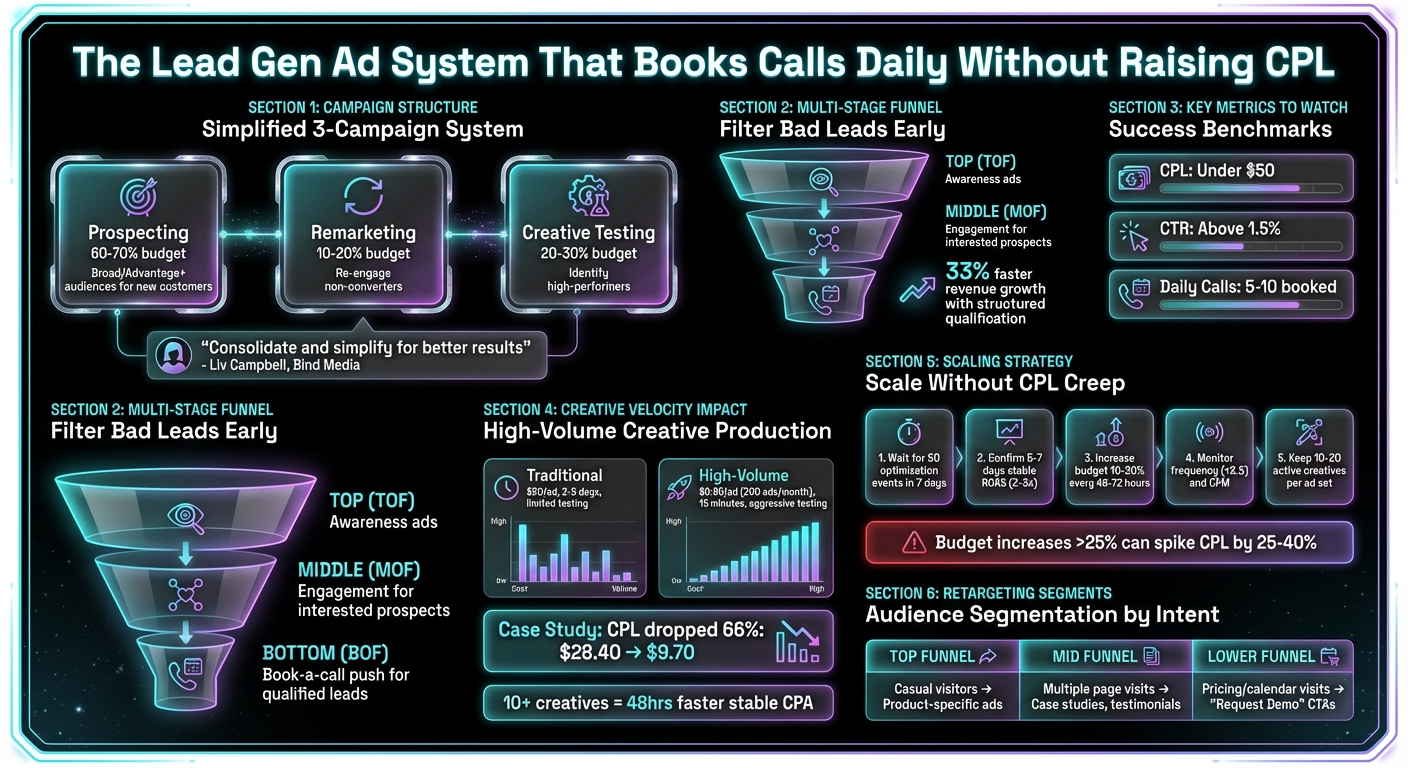
- Simplified Campaign Structures: Focus on 2–3 campaigns (Prospecting, Remarketing, Creative Testing) to keep Meta's algorithm efficient.
- Multi-Stage Funnels: Qualify leads at each step to avoid wasting time on unqualified prospects.
- High-Volume Ad Production: Rapidly test multiple ad variations to stay ahead of audience fatigue.
- Smart Retargeting: Use segmented ads tailored to user behavior to re-engage leads effectively.
- Data-Driven Scaling: Gradually increase budgets while monitoring CPL and ROAS to avoid performance dips.
Tools That Help:
- Platforms like ADEN's Lab can produce up to 200 ad variations per month for as little as $0.90 per ad, cutting production time from days to minutes.
Key Metrics to Watch:
- CPL under $50
- CTR above 1.5%
- 5–10 booked calls daily
Bottom line? A systematic approach - backed by efficient tools and data-driven decisions - can help you maintain steady CPLs while scaling lead generation.
Complete Lead Gen Ad System: Campaign Structure, Budget Allocation & Scaling Strategy
Get High Quality Leads with Meta Ads (FULL 2026 COURSE)
Put the playbook to work
Apply this playbook to your page
Paste your website and the Lab will turn the strategy you are reading into a ready-to-test ads.
Free to try No prompt writing
Why Lead Gen Campaigns on Meta Ads Stop Working
Campaigns rarely fail because of one glaring mistake. Instead, it's usually a series of smaller missteps that snowball over time. Issues like overly broad targeting, stale ad creatives, and mismatched landing pages can quietly drain your budget and drive up your cost per lead (CPL). When left unchecked, these problems can make an otherwise promising campaign unprofitable.
Targeting That's Too Broad or Vague
Casting too wide a net - like targeting everyone aged 18 to 65+ across all devices and regions - forces Meta's algorithm to work in an overly diluted pool. This often leads to your budget being spent on cheaper, but less qualified, audiences. The algorithm struggles to zero in on high-intent users, making it harder to optimize your campaign.
Another common mistake? Running too many ad sets with small budgets. For example, splitting $500 across ten ad sets often keeps each one stuck in its learning phase, which inflates your CPL. On top of that, failing to exclude people who've already converted means you're wasting money on impressions that bring no additional value to your campaign.
Creative Fatigue Can Sneak Up on You
Ad fatigue doesn’t announce itself - it creeps in slowly. When the same creatives are shown repeatedly, audiences lose interest, and your CPL starts climbing. The tricky part is that this often happens before it becomes obvious in your metrics.
Many advertisers fall behind because they don’t refresh their creatives often enough. Traditional design workflows can be slow and expensive, with costs averaging $50 per ad. If you’re only rolling out a few new ads each month, you’re not keeping pace with audience expectations. Agencies that consistently maintain steady CPLs often launch dozens of fresh ads monthly to stay ahead.
Disconnect Between Ads and Landing Pages
When your ad promises one thing, but your landing page delivers something else, it creates confusion - and confusion kills conversions. For instance, if your ad promotes a "Free Strategy Call", but your landing page focuses on general service details, visitors are likely to bounce. This mismatch, often referred to as poor messaging alignment, is a fast track to wasted ad spend.
Directing traffic to your homepage instead of a dedicated landing page only adds to the problem. Homepages are typically cluttered with too many links and excess information, which dilutes the clear, singular message needed to drive conversions. And don't overlook page speed - just a one-second delay in loading can slash conversion rates by 12%. Even more alarming, 53% of mobile users will abandon a page that takes longer than three seconds to load.
The Campaign Structure That Keeps CPL Flat While Booking Calls Daily
Many advertisers make the mistake of overcomplicating their ad accounts, often running too many ad sets and getting stuck in the learning phase. Agencies that consistently book calls without increasing their cost-per-lead (CPL) focus on keeping things simple.
A modern Meta ad setup typically revolves around 2–3 core campaigns: Prospecting, Remarketing, and Creative Testing. Here's how each works:
- Prospecting: Broad targeting or Advantage+ audiences are used to find new potential customers.
- Remarketing: Re-engages visitors who didn't convert the first time.
- Creative Testing: Helps identify high-performing ads that can handle a bigger budget.
This streamlined approach gives Meta's algorithm the volume it needs to learn faster and optimize better.
"One of the first things we look to do when taking over a new account is to consolidate and simplify, as we have consistently seen better results when we combine audiences and campaigns." – Liv Campbell, Senior Paid Media Executive, Bind Media
This structure not only speeds up learning but also keeps your campaigns laser-focused on driving real conversions.
When setting up campaigns, focus on performance goals, not just the campaign objective. If your goal is to book calls, optimize for specific conversion events like "Leads" or "Schedule." Avoid generic metrics like link clicks or page views - Meta’s algorithm will deliver exactly what you ask for, so make sure you're asking for booked calls.
How Multi-Stage Funnels Filter Out Bad Leads Early
A simple campaign structure lays the groundwork for better lead qualification.
Relying on a single-stage funnel - where every click goes straight to a "Book a Call" page - might seem efficient, but it often results in unqualified leads. A multi-stage funnel works better by filtering out less serious prospects at each step. Here's how it breaks down:
- Top-of-Funnel (TOF): Ads designed to build awareness.
- Middle-of-Funnel (MOF): Engages prospects who show interest.
- Bottom-of-Funnel (BOF): Pushes qualified leads to book a call.
Clear messaging and retargeting are key to this process. For instance, a landing page that mentions services starting at $5,000/month or being ideal for teams of 50+ will naturally deter leads who don’t fit the criteria. Adding tools like ROI calculators or quick surveys can help you gather better data and identify serious prospects. Businesses that use structured lead qualification processes see revenue grow 33% faster than those that don’t.
How to Split Your Budget Effectively
Once your campaigns are running smoothly, allocating your budget wisely ensures every phase contributes to keeping CPL low.
Budgeting isn’t about equal distribution - it’s about prioritizing based on performance. A common split looks like this:
- 60–70% for Prospecting: This drives new leads and requires the biggest share.
- 10–20% for Remarketing: Targets a smaller, more qualified audience.
- 20–30% for Creative Testing: Ensures you find winning ads without overinvesting.
For smaller budgets (under $1,000/month), use Campaign Budget Optimization (CBO) with one broad ad set. This allows Meta to automatically allocate funds to the best-performing ads and placements. If you’re working with a larger budget, Ad Set Budget Optimization (ABO) is better for creative testing. This ensures each new ad gets an equal chance to prove itself without skewing results. The key is to avoid spreading your budget so thin that your campaigns stay stuck in the learning phase.
Why High-Volume Creative Production Lowers CPL
The difference between agencies that maintain steady CPLs and those that see costs climb often comes down to creative velocity. Meta's algorithm favors accounts that quickly test and identify effective hooks by experimenting with multiple creative angles. For example, ad sets featuring 10 or more distinct creatives achieve stable CPAs 48 hours faster than those using just one or two designs. This high-volume testing approach can significantly reduce CPL with AI. One lead-generation account slashed its average CPL by 66% - dropping from $28.40 to $9.70 - simply by transitioning from a slow creative process to a high-volume workflow.
Testing a wide variety of creative versions increases your chances of finding a high-performing hook before audience fatigue sets in. Sticking to the same visuals repeatedly can lead to diminishing returns, but many teams still rely on outdated, manual workflows that hinder performance.
Why Designer Workflows Slow You Down and Cost More
Traditional creative pipelines often prioritize perfection over speed, which can hurt your ad performance. The typical process - briefing a designer, waiting for drafts, and providing feedback - can stretch across 3 to 5 days for a single batch. During this time, ad fatigue can kick in, and CPMs may rise. This slow process becomes even more unsustainable when you’re trying to test multiple concepts at scale. For agencies managing several clients, this model severely limits how quickly you can experiment with new ideas.
Take the Athletic Training Center as an example. From January to May 2025, they struggled with this very issue. Using just one stock-photo ad, they were stuck at 42 weekly leads. Owner T Adil wanted to experiment with different creative angles but couldn’t afford to hire additional freelancers. By switching to an automated workflow that generated 150 variations with diverse hooks and social proof elements, their weekly leads skyrocketed to 186 - a 343% increase. Their CPL dropped from $45 to $12.60 in just two weeks.
"What used to take three freelancers I now do on a lunch break." – T Adil, Owner, Athletic Training Center
How ADEN's Lab Removes the Creative Bottleneck
Eliminating slow and costly creative cycles requires a fully automated solution, and that’s where ADEN's Lab comes in. This platform addresses the dual challenges of speed and cost with a streamlined approach. Simply upload your landing page link, and within minutes, you’ll receive high-performing static Meta ads - no need for briefs, revisions, or back-and-forth communication. Unlike traditional workflows, ADEN's Lab focuses on creating ads optimized for performance, not just aesthetics.
The cost savings are compelling. While traditional design processes can cost around $50 per ad, ADEN's Lab produces ads for as little as $0.90 each with the Apex Mode plan (200 ads/month for $179). Even the entry-level Lift Off plan offers affordable options, averaging $1.97 per ad ($59/month for 30 ads). This efficiency allows for aggressive testing without draining your budget.
Beyond cost, the platform drastically cuts production time. Instead of waiting days, you can generate ads in just 15 minutes. This quick turnaround lets you test new creative angles and refine strategies based on real-time data, enabling Meta’s algorithm to identify winning hooks and keep your CPL low.
Retargeting That Turns Leads Into Booked Calls
Retargeting plays a key role in turning interested visitors into booked calls instead of losing them along the way. Imagine someone visiting your landing page, even filling out a form, but then vanishing. The problem often lies in treating every lead the same. Retargeting shines when you tailor your ads based on behavior and where a lead is in their decision-making process. When done right, it nudges leads toward booking calls without optimizing your Meta Ads CPL at the expense of volume.
How to Segment Audiences by Intent Level
To make retargeting work, divide your audience into three tiers based on their intent: top, mid, and lower funnel.
- Top Funnel: These are casual visitors, maybe just browsing. Keep your brand visible by showing them product-specific ads that remind them of what you offer.
- Mid Funnel: These users are more engaged - perhaps they’ve explored multiple pages or downloaded something. Build trust here with ads featuring case studies, testimonials, or white papers.
- Lower Funnel: These leads are high-intent. They’ve visited pricing pages, started filling out forms, or even checked your calendar but didn’t book. Use direct calls-to-action like "Request a Demo" to push them over the line.
You can also create custom audiences using behavioral triggers. For example, target users who abandoned your calendar page or searched for terms like "pricing" or "implementation". If someone looked up pricing but didn’t book, an ad highlighting ROI or offering a limited-time discount could be the nudge they need.
Another effective strategy is using Remarketing Lists for Search Ads (RLSA) to reach visitors who are now searching for competitor brands. This helps you win back leads who are comparison shopping and bring them back into your funnel.
With these segmented audiences, you can fine-tune your retargeting efforts and set the stage for dynamic ad strategies.
Using Dynamic Ads to Re-Engage Leads
Once your audience segments are set, dynamic ads can take your retargeting to the next level. These ads automatically adjust based on user behavior, showcasing services, social proof, or addressing specific objections.
However, even the smartest dynamic ads can lose their impact if the creative gets stale. Reusing the same ads over and over leads to ad fatigue - your audience starts ignoring them. That’s why producing fresh creative content regularly is essential. High-volume creative production allows you to test different messages and keep your campaigns engaging without driving up your CPL.
For instance, if someone abandoned your calendar page, you could test three ad variations: one focusing on speed ("Book in 60 seconds"), another highlighting social proof ("Join 500+ companies"), and a third tackling objections ("No credit card required"). Instead of spending days and $50 per ad on designer updates, tools like Aden's Lab can generate up to 200 ad variations per month in minutes, keeping your campaigns fresh and effective.
| Funnel Stage | User Behavior | Recommended Retargeting Content |
|---|---|---|
| Top Funnel | Home page visit, single product view | Brand awareness ads, specific product images |
| Mid Funnel | Multiple page visits, info gathering | Case studies, white papers, testimonials |
| Lower Funnel | Sales/form page visits, abandoned cart | "Request a Demo", "Free Trial", "Contact Us" |
How to Scale Spend Without CPL Creep
Scaling ad spend can be tricky. Push too hard, and you might see your cost per lead (CPL) spike, even for campaigns that were performing well. The main culprits? Scaling too fast or applying budget increases without aligning them to the right targets. To avoid this, focus on a gradual, data-driven approach. By carefully monitoring key metrics, you can scale without overwhelming Meta’s delivery system or saturating your audience.
When and How to Scale Based on Data
Before scaling, ensure your campaign has exited the learning phase and is delivering consistent results. Meta's algorithm typically needs 50 optimization events within seven days to move past the learning phase. Once you're out of that phase, look for 5 to 7 days of steady performance - stable return on ad spend (ROAS) and CPL without major fluctuations. Watch frequency and CPM closely, too. If frequency creeps past 2.5 on cold audiences or CPM rises sharply, it could indicate market saturation or increased competition. Scaling at this point might hurt performance, so wait until the data supports growth.
Your ROAS should sit comfortably above your break-even point - ideally, in the 2x to 3x range - before increasing budgets. When the numbers align, increase your budget incrementally, by about 10% to 20%, every 48 to 72 hours. Scaling too quickly can reset the learning phase and cause CPL to jump by 25% to 40%. If you’re planning a larger budget increase, consider duplicating the ad set with the higher budget instead of editing the original. This preserves the performance history and minimizes disruptions.
You can also automate scaling through Ads Manager. For instance, set rules like, “If ROAS exceeds 3.0 for two days, increase the budget by 15%,” or “Pause the ad set if CPL exceeds the target by 30%”.
"To avoid spooking the algorithm and triggering wild performance swings, the golden rule is to increase your budget by no more than 20-25% every 24-48 hours." – Silver Spoon Agency
A/B Testing to Find Ads That Can Handle More Budget
Not all ads can scale effectively, so A/B testing Meta ads is key. Once you’ve identified a successful ad, run controlled experiments to see how it performs at higher spend levels. Test multiple creatives with smaller budgets to find which ones keep a stable CPL as you scale. If an ad’s CPL jumps by 20% to 30% above your target, it might have too narrow an audience or lack the creative appeal needed for broader reach.
Creative fatigue can also drive up CPL during scaling. One advertiser reduced their cost per conversion by 83.9% - from $86 to $13.87 - simply by adding eight fresh creatives within 24 hours. To avoid fatigue, keep 10–20 active creatives per ad set, so you can quickly replace underperforming ones.
High-volume creative production becomes essential here. Instead of waiting for a designer to produce one expensive ad, tools like Aden's Lab let you generate dozens of variations quickly. For example, you can create 30, 50, or even 200 ads per month, depending on your plan. This ensures you always have fresh options to test and scale without bottlenecks.
When you find ads that maintain a stable CPL at scale, move them into a Campaign Budget Optimization (CBO) structure. This allows Meta to dynamically allocate budget to your top-performing ads. Use Ad Set Budget Optimization (ABO) for controlled testing of new creatives, then transition the winners into CBO for scaling. If vertical scaling hits a ceiling, consider horizontal scaling by duplicating successful ads into new audiences, such as 3%, 5%, or 10% lookalikes, or by experimenting with broad targeting.
"Scaling Facebook ads today is less of a budget or targeting problem and more of a creative-volume problem." – Silver Spoon Agency
Building a System That Books Calls Daily Without Raising CPL
To consistently book calls without driving up your CPL, you’ll need a well-thought-out system that combines precise targeting, efficient creative production, and smart retargeting. Start by auditing your targeting and analyzing your CPA early on. This prevents wasted clicks and ensures that you're focusing on the right audience from the start. Then, roll out multi-stage campaigns aimed at warm audiences who’ve already shown interest.
One common roadblock is creative production. Traditional workflows can be slow and expensive, making rapid testing almost impossible. That’s where Aden's Lab comes in. By simply dropping in your landing page link, you can generate fresh static Meta ads in just 90 seconds. On the Apex Mode plan, you can produce up to 200 ads per month at $0.90 per ad, allowing you to outpace entire creative teams while keeping your CPL steady - even as you scale.
Keep a close eye on key metrics to measure success: aim for a CPL under $50, a CTR above 1.5%, and 5–10 calls daily. Use A/B testing to identify high-performing ads, then gradually increase your budget by 20–50% weekly as long as your ROAS stays above 3x. To ensure quality leads, track call durations (aim for over 60 seconds) and use call tracking tools to refine your audience targeting based on actual qualifications.
Retargeting is another critical piece. Segment your audiences based on intent. For example, one eCommerce client slashed their cost-per-lead by 42% by optimizing retargeting for "Add to Cart" events and managing ad frequency.
FAQs
How do I keep my ad creatives fresh and engaging to avoid audience fatigue?
Regularly updating your ad creatives is essential to keep your audience engaged. One effective approach is to use automated tools that can quickly produce multiple variations of your ads. These tools make it easier to test and rotate creatives at scale, ensuring your campaigns remain engaging and relevant without requiring constant hands-on management.
Keep an eye on your campaign metrics - declining click-through rates (CTR) or rising cost per lead (CPL) are clear signals that your audience might be losing interest in your ads. Don’t wait for performance to drop significantly. By introducing new visuals and messaging proactively, you can sustain engagement and keep your costs in check. Updating your creatives frequently not only prevents fatigue but also boosts the overall effectiveness of your campaigns.
How can I effectively segment my audience for retargeting on Meta ads?
To retarget effectively on Meta, start by grouping your audience based on their behavior and engagement. For example, create segments for users who visited your website but didn’t make a purchase, added items to their cart but didn’t complete the checkout, or engaged with your ads without taking further action. These segments allow you to tailor your messaging to fit each group’s level of interest and familiarity with your brand.
Another powerful approach is time-based segmentation. You can target users based on how recently they interacted with your content - such as those who engaged in the past 7 days versus those who did so 30 days ago. Recent audiences often respond better, so adjusting your ads and offers to match their activity can lead to improved results. For even more precise targeting, combine behavioral data with factors like age, location, or interests.
The goal is to align these segments with the various stages of the customer journey. By doing so, you can deliver personalized, relevant ads that guide users toward conversion while keeping your cost-per-lead (CPL) manageable.
How can I scale my ad spend without driving up my cost per lead?
To grow your ad spend without driving up your cost per lead (CPL), the trick is to focus on creating a larger variety of ad creatives. By doing this, you give Meta's algorithm more options to test, allowing it to quickly zero in on the ads that perform best. When the algorithm identifies top performers faster, it helps keep your CPL consistent, even as your budget increases.
Automated tools can simplify the process of generating a range of high-quality creatives. The goal is to test different angles and formats efficiently, helping you figure out what connects with your audience while avoiding unnecessary costs. Regularly updating your ad creatives also prevents ad fatigue, keeping your campaigns effective as you scale.
Your next ad batch starts here
Finish with a ready-to-test ad batch
Paste your website to generate static creatives. Drop the link → get ads in about 90 seconds → upload them to Meta → scale.
Free to try No prompt writing