30 Retargeting Prompts for Meta Ads You Can Copy and Paste Today
Use the prompts on your real offer
Generate these ad angles for your product
Skip the blank prompt box. Paste your product page and ADEN'S LAB applies the angles to your offer, images, headlines, and copy.
Free to try No prompt writing

Most website visitors don’t buy on their first visit - only 2–4% convert right away. For the rest, retargeting on Meta platforms (Facebook and Instagram) can bring them back. Retargeting ads target people who’ve already interacted with your brand, like visiting a product page or abandoning their cart. These audiences are familiar with you, making them easier and cheaper to convert.
The challenge? Writing the right ad copy with AI tools for Meta ads. Warm audiences need tailored, specific messaging - not generic ads. This article provides 30 ready-to-use prompts for retargeting ad copy that you can customize for e-commerce, SaaS, and lead generation. From handling objections to building trust with social proof, these prompts help you reconnect with potential customers and drive conversions.
Key categories include:
- Warm Audience Reminders: Simple nudges for people who’ve already shown interest.
- Objection Handling: Address concerns like price or trust.
- Social Proof: Testimonials, stats, and user-generated content to build credibility.
- Cart-Abandonment Recovery: Tactics to win back high-intent shoppers.
- Lead-Form Recovery: Re-engage users who started but didn’t complete forms.
- Recency-Based Targeting: Tailor ads based on how recently someone interacted with your site.
These prompts are structured to save time, improve ad performance, and align with your audience’s decision-making process. You can also A/B test Meta ads to see which prompts resonate best. Whether it’s a soft reminder or an urgent incentive, you’ll find practical ideas to boost conversions today.
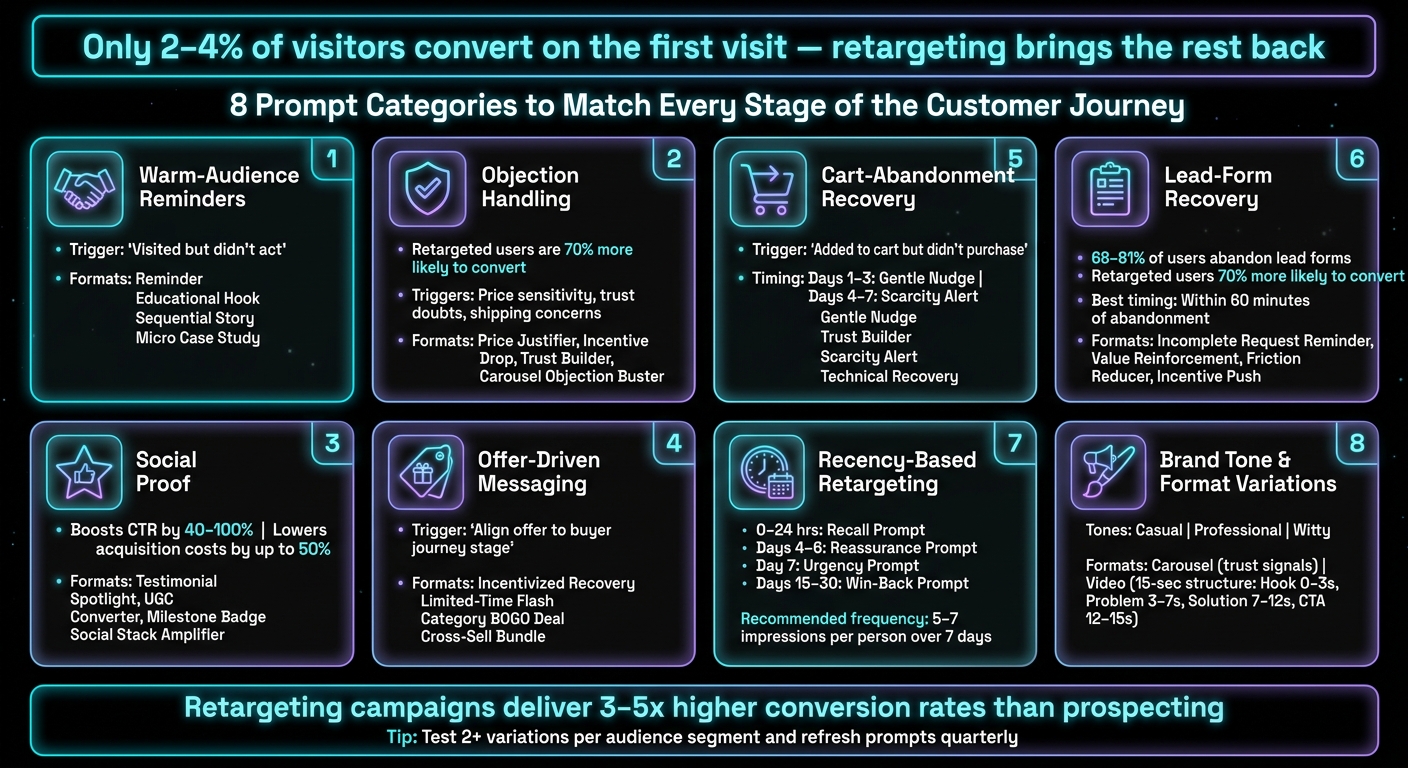
Meta Ads Retargeting: 8 Prompt Categories & When to Use Them
The ONLY Facebook Ads Retargeting Strategy You Need in 2026
Put the playbook to work
Apply this playbook to your page
Paste your website and the Lab will turn the strategy you are reading into a ready-to-test ads.
Free to try No prompt writing
1. Warm-Audience Reminders
Warm-audience ads are all about reconnecting with people who already know your brand. These ads remind them of their interest and nudge them toward taking action. As Brian Yam, Founder of Paragon, explains:
"Retarget the heck out of them with like case studies objection handlers right and really convince them here's why you should buy."
Here are four practical ad copy ideas you can put to use right away:
-
The "You Were Here" Reminder
"Write a Meta ad for someone who visited [product/service page] but didn't take action. Use a helpful, not pushy tone. Remind them of their interest with a noticeable benefit. Keep the primary text under 125 characters before the first line break."
A simple reminder like this can rebuild trust and keep your offer top-of-mind. -
The Educational Hook
"Write a Meta ad that opens with 'Most [target audience] don't know this:' and provides a key insight about [product/service]. End with a soft CTA that invites them back to learn more."
Opening with curiosity grabs attention and encourages further engagement. -
The Sequential Story Ad
"Create a 3-part sequential ad series for warm audiences. Ad 1 introduces the problem. Ad 2 presents our solution with one specific benefit. Ad 3 shows a real customer result and includes a clear CTA with urgency."
This approach keeps your message fresh, gradually building interest while avoiding ad fatigue. -
The Micro-Case-Study
"Write a Meta ad using a before/after format. Show how a customer similar to [target audience] went from [problem state] to [result] using [product/service]. Keep it to 3–4 sentences and end with a direct CTA."
A quick success story adds credibility and resonates with potential buyers who may still be on the fence.
2. Objection Handling
When visitors hesitate to convert, it’s often due to concerns like price, doubts about the product, distractions, or shipping costs. Retargeted ads can be a game-changer here - people who see them are 70% more likely to convert than those who don’t. Below are four tailored prompts designed to tackle these common objections head-on, offering practical solutions.
-
The Price Justifier
"Write a Meta retargeting ad targeting price-sensitive visitors who browsed [product] but didn’t buy. Lead with a specific value statement - highlighting materials, a performance metric, or a measurable result - that makes the price feel justified before it’s mentioned. Avoid generic phrases like 'premium quality.' Conclude with a direct CTA."
Specific details make all the difference. As SurePrompts notes: "Convey quality through specificity, not adjectives". -
The Incentive Drop
"Write a Meta retargeting ad offering [specific discount or free shipping] to visitors who abandoned their cart. Open with the offer rather than the product name. Keep the tone direct and the CTA urgent by mentioning a deadline or quantity limit using a real number."
Since shipping costs are a leading cause of cart abandonment, addressing this upfront with a discount or free shipping can immediately reduce friction. -
The Trust Builder
"Write a Meta retargeting ad that opens with a one-sentence customer testimonial highlighting [specific result]. Follow with a brief explanation of how [product/service] delivers that result. Close with a low-friction CTA like 'See how it works' or 'Read more stories.'"
Incorporating real customer testimonials builds trust and reassures hesitant buyers, showing them that others have benefited from your product. -
The Carousel Objection Buster
"Create copy for a 5-card Carousel ad for visitors who didn’t convert. Each card should address one common objection: price, shipping, quality, trust, and time. Use a single benefit statement per card and a consistent CTA across all cards."
Carousel ads are a versatile way to tackle multiple concerns in a single unit, meeting users wherever their hesitation may lie.
3. Social Proof
Social proof is a powerful tool for boosting conversions. It can increase click-through rates by 40–100% and lower acquisition costs by up to 50%. By building on existing engagement, social proof helps address hesitations and encourages potential customers to take action.
Here are four ad prompts tailored to different types of social proof, each designed to meet specific retargeting goals:
-
The Testimonial Spotlight
"Create a Meta retargeting ad that starts with a one-sentence quote from a real customer who achieved [specific result] using [product/service]. Include the customer's name and role or location if available. Follow with two sentences explaining how the product delivers that result. End with a low-friction call-to-action (CTA) like 'See their full story.'"
This approach works because it relies on specifics to establish trust. A named customer with a clear, measurable outcome is far more convincing than a generic five-star review. -
The UGC Converter
"Write copy for a Meta retargeting ad featuring a short video of a real customer using [product] in their everyday life. The headline should address the audience's main hesitation. The body copy should explain what viewers will see in the video and why it’s meaningful. Conclude with a CTA that feels like a natural next step rather than a hard sell."
User-generated content (UGC) adds authenticity to your brand, especially for those already familiar with it. As Yang He, Founder of Hui Creative, explains:"Social proof is the not-so-secret weapon that a skilled Meta ads agency wields to build trust, drive engagement, and increase revenue."
-
The Milestone Badge
"Develop a Meta retargeting ad that highlights a credibility stat - such as '[X]+ customers served' or 'Featured in [publication]' - for visitors who browsed but didn’t convert. Add one sentence connecting that milestone to the visitor's specific interest. End with a direct CTA."
Stats like "10,000+ customers served" are especially effective for warm audiences who need a quick trust boost before committing. -
The Social Stack Amplifier
"Design a Meta retargeting ad that can be reused across multiple audience segments using the 'Use Existing Post' feature in Ads Manager. The copy should resonate with both warm leads and past site visitors. Avoid language that limits its relevance to specific groups. Include a CTA that fits any stage of the funnel."
Reusing the same Post ID consolidates engagement metrics, such as likes and comments. Keep in mind that editing the post after publishing resets these counters.
4. Offer-Driven Messaging
Once you've built trust with your audience, the next step is to motivate them with a clear, tailored offer. The key to success here is aligning your message with the user's stage in their buying journey. A casual browser requires a different nudge than someone who abandoned their cart at checkout.
Here are four targeted approaches to match specific user behaviors:
-
The Incentivized Recovery
"Write a Meta retargeting ad for a user who added [product] to their cart but didn't complete the purchase. Start by directly addressing the abandoned item, then offer a specific incentive - like 10% off or free shipping - to make the deal feel exclusive. Wrap up with a frictionless CTA, such as 'Claim your discount' or 'Complete your order.'" Expert tip: "Use Dynamic Product Ads (DPA) in Meta for these cart abandoners with the same products... To spice it up a bit, you can try retargeting them with a discounted price." - Shalini Vijayakumar, Content Marketer at CustomerLabs -
The Limited-Time Flash
"Create a Meta retargeting ad for a checkout abandoner with a 24-hour deadline. Reference the specific product or category they viewed in the headline. Clearly state the offer in the body copy, emphasizing urgency with time- or stock-based warnings (e.g., 'Only a few left'). Finish with a single, time-sensitive CTA." A hard deadline - like "10% off if you complete your order within 24 hours" - can push users to act by highlighting the cost of waiting. -
The Category BOGO Deal
"Write a Meta retargeting ad aimed at users who browsed [product category] but didn’t view a specific product. Open with a 'Buy One, Get One' or a category-wide discount. Ensure the copy applies broadly to the collection. Use a CTA like 'Shop the deal' or 'See what's included' to encourage exploration." Since these users haven’t committed to a single product, a category-level offer feels more relevant. It also avoids pushing a specific item, which might come off as overly assumptive. -
The Cross-Sell Bundle
"Develop a Meta retargeting ad for a customer who recently purchased [hero product]. Start by acknowledging their purchase and suggesting the next logical step. Highlight a bundle with clear value (e.g., 'Complete the set and save 15%'). Finish with a CTA that focuses on enhancing their experience, not just buying more." This strategy boosts Average Order Value (AOV) by targeting customers who already trust your brand. As Adrianne Austin, Growth Strategist at Common Thread Collective, notes:"Use your ads to highlight more information that will convince them that those products will improve their image, identity, or lifestyle... and it can be purchased through this offer."
5. Cart-Abandonment Recovery
Cart abandoners represent a high-potential audience. Shalini Vijayakumar, Content Marketer at CustomerLabs, explains it perfectly:
"Checkout abandoners are one of the highest-intent audiences you'll encounter in your retargeting campaign. They are users who reach the final checkout page but do not initiate payment... just a little push will make them purchase."
To address this, well-crafted cart-abandonment prompts can help tackle those last-minute hesitations and encourage customers to complete their purchases. Here are four effective ad creative concepts tailored to different scenarios of cart abandonment:
-
The Gentle Nudge
"Create a Meta retargeting ad for a user who added [product] to their cart but didn’t check out. Start with a friendly, low-pressure reminder like 'Hey, you left something behind.' Use a warm, approachable tone, and finish with a simple CTA such as 'Pick up where you left off.' This approach works best within 1–3 days after the cart was abandoned, as a soft reminder often outperforms aggressive tactics early on." -
The Trust Builder
"Write a Meta retargeting ad for users who abandoned checkout and might need reassurance. Begin with a customer review or a trust signal, such as 'Secure checkout guaranteed.' Reinforce confidence with a clear CTA like 'See why 10,000+ customers love it.'"
This is especially effective for first-time buyers. Including secure payment details or a transparent return policy can ease any lingering doubts. -
The Scarcity Alert
"Develop a Meta retargeting ad for a user who hasn’t returned to their cart in 4–7 days. Emphasize urgency by mentioning limited availability, such as 'Only a few left in stock' or 'This item is selling fast.' Keep the message short and finish with a direct CTA like 'Grab yours before it’s gone.'"
Scarcity messages are most effective after an initial reminder has been sent, offering a stronger incentive to act quickly. -
The Technical Recovery
"Create a Meta retargeting ad for users who may have experienced technical issues at checkout. Acknowledge the potential problem and offer reassurance with a smooth checkout process and accessible support. Use CTAs like 'Try again - we’ve got you' or 'Complete your order in seconds.'"
This approach is ideal when technical glitches or website errors might have disrupted the purchase process.
6. Lead-Form Recovery
Bringing back users who abandon lead forms is a key strategy for converting potential customers. Studies show that 68%–81% of users abandon lead forms. These individuals are often highly interested, making them ideal candidates for retargeting efforts.
Here’s the upside: Retargeted users are 70% more likely to convert. Even recovering a small percentage of these users can lead to a noticeable boost in your results. As LeadsuiteNow explains:
"If 75% of your form starters abandon, recovering even 20% of them through retargeting and follow-up sequences doubles your effective conversion rate."
To help with this, here are four specific approaches for recovering abandoned lead forms:
-
The Incomplete Request Reminder
"For users who started but didn’t submit a lead form for [service/offer], use a clear and direct headline such as: 'Your [request name] is still waiting.' Keep the message simple and pressure-free, with a CTA like 'Pick up where you left off.' Send this within 60 minutes of abandonment for the best results." -
The Value Reinforcement
"Target users who abandoned because they didn’t see enough value. Highlight a specific benefit or result, such as 'Get the free [resource] that shows you exactly how to [result].' Avoid generic CTAs like 'Submit.' Instead, use something actionable like 'Get My Free Guide' or 'See My Results.'" -
The Friction Reducer
"For users who dropped off due to lengthy forms or sensitive questions (like phone numbers or budgets), emphasize how quick and easy it is to complete. Use phrases like 'Takes less than 30 seconds - no phone number needed.' Pair this with a CTA like 'Try again - it’s quick,' and use Meta ads automation tools like Instant Forms with prefilled fields to minimize effort." -
The Incentive Push
"For users who abandoned 4–7 days ago and haven’t returned, offer an incentive to complete the form. This could be a free consultation, discount, or exclusive resource. Add urgency with copy like 'This offer expires Friday' and include a CTA such as 'Claim Your Free Session.' Limit retargeting to 5–7 impressions per week to avoid overwhelming your audience."
7. Recency-Based Retargeting
Timing can make or break your retargeting efforts. Impulse buys often happen within 1–3 days, while more considered purchases may take 3–7 days to convert. If your timing is off, brand recall fades fast, and your ad spend ends up doing double the work for half the results.
Recency-based retargeting helps you stay relevant by tailoring your messaging to how recently a user engaged with your site. By syncing your ads with their decision-making timeline, you can deliver messages that feel timely and impactful.
Strategies for Recency-Based Retargeting
-
The 24-Hour Recall Prompt
For users who visited a specific product or service page in the last 24 hours, remind them of what caught their eye. Use messaging like: "Still thinking about [product name]? Here's why it's a fan favorite." Keep the call-to-action simple and direct, such as "Take another look." Limit impressions to 1–2 per day to stay visible without feeling intrusive. -
The Days 4–6 Reassurance Prompt
If someone visited your pricing or product page 4–6 days ago but hasn’t taken the next step, use this window to build trust. Share a testimonial, like: "Over [X] customers love [product] - here's what they're saying." This approach reinforces credibility during their evaluation stage. -
The Day 7 Urgency Prompt
When a user first visited 7 days ago and hasn’t converted, it’s time to create urgency. Phrases like "Last chance - offer ends tonight" or "Only a few left at this price" can encourage action. Pair these with a strong call-to-action like "Grab It Now." -
The 15–30 Day Win-Back Prompt
For users who browsed your site 15–30 days ago but didn’t show strong purchase intent, entice them back with an incentive. Offer a discount or free resource with messaging such as: "We've been thinking about you - here's 15% off to come back." Use exclusion audiences to avoid overlapping with higher-intent segments.
"Retargeting that converts doesn't chase people - it meets them where they are in their decision journey." - LeadEnforce
To optimize results, aim for 5–7 impressions per person over 7 days. For cart abandoners, increase frequency to 2–3 impressions daily during the first 3 days to stay top of mind.
8. Brand Tone and Format Variations
To make your Meta ads more impactful, it's not just about the message - how you say it matters just as much. The tone and format of your ads should reflect your brand's personality while aligning with your target audience's expectations. A consistent tone that matches your website's voice creates familiarity and builds trust with potential customers.
Here are two practical prompts to help you tailor your brand's voice and ad format and optimization effectively:
- The Multi-Tone Persona Prompt
This approach lets you experiment with different brand voices to see what resonates best. Simply paste this prompt into your AI tool:
"Act as a Meta Ads copywriter. Write 3 variations of primary text for a retargeting ad for [Product]. Target: Users who viewed [Product] but didn't buy. Tone: [Casual / Professional / Witty]. Key benefit: [Solution]. Include a CTA to [Action]."
For example, a casual tone might say, "Still eyeing it? Your cart misses you," while a professional tone might focus on highlighting clear benefits. Testing these variations side by side allows you to pinpoint the tone that clicks with your audience.
Additionally, pairing the right tone with the right ad format strengthens brand consistency and improves engagement.
- The Format-First Retargeting Prompt
The format you choose can significantly influence how your message lands. For instance, carousel ads are fantastic for showcasing multiple trust signals - like pairing product images with a money-back guarantee or customer testimonials - making them perfect for addressing last-minute doubts. On the other hand, video ads are great for demonstrating product simplicity or creating an emotional connection.
Try this prompt for format-specific ad copy:
"Write ad copy for someone who visited [Page] but didn't [Convert]. Address likely objections: [List]. Offer: [Incentive]. Tone: [Helpful / Professional]. Structure copy into Hook, Problem, Solution, and CTA."
For a 15-second video, you can break it down like this:
- Hook (0–3 seconds): Grab attention immediately.
- Problem (3–7 seconds): Identify the user's pain point.
- Solution (7–12 seconds): Show how your product solves the issue.
- CTA (12–15 seconds): End with a clear call to action.
For carousel ads, start with a scroll-stopping first slide and use the following cards to tackle objections like shipping costs or checkout speed by emphasizing perks like free shipping or fast processing.
"The difference between marketers who save 10 hours a week with AI and those who get mediocre results comes down to one thing: prompt quality." - Amir Hassan, AI Prompt Engineer
Conclusion
These prompts provide a roadmap for building a retargeting strategy that covers every stage of the customer journey - from introducing your brand to addressing last-minute objections. They’re designed to eliminate the guesswork, offering a structured framework to refine your messaging.
Of course, no single prompt works for every situation. Think of them as flexible templates: customize them with your product name, address specific concerns your audience might have, and adjust the tone to reflect your brand’s personality. The more context you provide, the better the results. As Amir Hassan, an AI Prompt Engineer at Aibrify, explains:
"A well-crafted prompt gives AI the context it needs to produce content you can actually use - not the generic filler that screams 'a robot wrote this.'" - Amir Hassan, AI Prompt Engineer, Aibrify
Retargeting campaigns consistently outperform prospecting efforts, often delivering 3–5x higher conversion rates. However, success depends on aligning your messaging with where users are in their decision-making process. To maximize results, test at least two variations for each audience segment - perhaps one with an emotional appeal and another focused on results - and use performance data to refine your approach. This includes learning how to analyze CPA for Meta ads to identify which prompts drive the most profitable conversions.
To keep your strategy effective, integrate these prompts into your broader campaign and revisit them quarterly. Regular updates ensure your messaging stays relevant as audience behaviors and algorithms evolve.
FAQs
Which retargeting prompt should I use for each audience segment?
When it comes to retargeting, tailoring your approach to match user behavior is key. Here’s how you can refine your strategies for different audience segments:
- For users who added items to their cart: Use dynamic product ads (DPAs) to showcase the exact products they left behind. This personalized reminder can nudge them toward completing their purchase.
- For visitors who browsed but didn’t add to cart: Highlight the value of your products by emphasizing benefits, limited-time deals, or exclusive offers. These tactics can help capture their interest and push them closer to a decision.
- For highly engaged users who haven’t converted: Leverage social proof, such as reviews or testimonials, or offer discounts to build trust and motivate action.
- For past customers: Suggest complementary products or provide loyalty rewards to encourage repeat purchases and strengthen brand loyalty.
If you’re looking for a head start, ADEN'S LAB offers ready-to-use templates designed to drive high conversions with minimal effort.
How do I set retargeting windows and ad frequency without annoying people?
To keep your audience engaged without overwhelming them, it's important to strike the right balance between relevance and user experience. For example, set retargeting windows that align with your sales cycle - typically, 7 to 14 days after a user’s last interaction works well. Additionally, limit your ad frequency to 2–3 views per user each day. This ensures your ads remain noticeable without crossing the line into annoyance. Always keep an eye on performance metrics, and be ready to tweak your settings if you notice a drop in engagement or if your ads start to get ignored.
How can I personalize these prompts using Meta pixel events and page visits?
To create tailored prompts, leverage data from the Meta pixel. This tool tracks user actions such as page visits, product views, and items added to carts. With this information, you can set up dynamic ads that display products users have already interacted with. Additionally, you can segment audiences based on behaviors like abandoning a cart. By aligning prompts with users’ previous actions, your ads become more relevant, boosting both engagement and conversions.
Your next ad batch starts here
Finish with a ready-to-test ad batch
Paste your website to generate static creatives. Drop the link → get ads in about 90 seconds → upload them to Meta → scale.
Free to try No prompt writing