Product Page to Meta Ad Brief Template for Lean Teams
Turn the strategy into creatives
Create Meta ads for your product
Paste your product page. ADEN'S LAB turns the offer, audience, and positioning into complete ready-to-use Meta static ads.
Free to try No prompt writing

Want to turn your product page into a high-performing Meta ad in minutes? This guide shows how lean marketing teams can quickly extract key details from product pages and structure them into actionable Meta ad briefs. With 70–80% of Meta ad performance relying on creative strength (2025 AppsFlyer report), a strong brief is essential for driving conversions.
Key Takeaways:
- Focus on what matters: Identify conversion-critical info like price, pain points, unique value, proof, and risk reducers.
- Keep it concise: Distill long product descriptions into four short lines: what it does, who it’s for, what makes it different, and the outcome.
- Structure your brief: Answer five key questions - objective, audience, message, offer, and placement.
- Test multiple angles: Use frameworks like PAS (Problem, Agitation, Solution) or AIDA (Attention, Interest, Desire, Action) to create ad variations.
- Leverage AI tools: Use platforms like ADEN's LAB to generate, test, and optimize Meta ads efficiently.
By following this process, small teams can cut campaign build time from 90 minutes to just 15–25 minutes, while improving ad performance. Ready to streamline your Meta ad workflow? Let’s dive in.
How To Write An Effective Creative Brief For Your Facebook Ads
Put the playbook to work
Apply this playbook to your page
Paste your website and the Lab will turn the strategy you are reading into a ready-to-test ads.
Free to try No prompt writing
Extracting Key Details from a Product Page
Most product pages are packed with information, but not all of it is useful for crafting a Meta ad. The real challenge? Picking out the details that matter most for driving conversions before you even start the brief.
Identifying Conversion-Critical Information
Think of the product page as raw data. Your job is to pull out the bits that actually inspire someone to click. These details usually fall into a few key categories: what problem the product solves, what sets it apart, proof it delivers results, and ways to reduce buyer hesitation.
Here’s a quick checklist to stay on track:
- Price in USD: Be exact - don’t use a price range.
- Primary pain point: What issue does the product solve?
- Unique value proposition (UVP): A single, brand-specific sentence that highlights its uniqueness.
- Proof points: Think certifications, ingredients, third-party testing, or even customer stats like "50,000+ customers."
- Risk reducers: Money-back guarantees, free returns, or trial periods.
"A truly powerful brief answers the question: 'What problem is our customer trying to solve in their life, and how does our product fit into that story?'" - Project Aeon Team
You’ll also want to consider which ad format best suits the product. For example, a Carousel works well for products with multiple features or steps. A single Image ad shines when there’s one clear benefit and strong visuals. And for products that need to showcase movement? Go with a Video.
Once you’ve identified these key points, condense them into a format that’s ready for creative use, or use an ad copy idea generator to jumpstart the process.
Condensing Product Descriptions for Ad Use
Long product descriptions might work on a product page, but Meta ads demand brevity. To make them ad-ready, distill the description into four concise lines covering the essentials: function, audience, differentiators, and outcome.
- What it does: Explain the functional benefit in straightforward terms.
- Who it’s for: Be specific - describe a person or situation, not a generic demographic.
- What makes it different: Highlight one or two standout features.
- The outcome: Focus on how the customer feels or benefits after using it.
"A vague product description gives you vague output. Take your existing description and strip it down to the essentials." - Just Bab
Personalized hooks like "If you run a small café and you're tired of..." tend to perform better than generic ones because they feel tailored. Keep Meta’s character limits in mind - 125 characters for primary text, 40 for headlines, and 30 for descriptions - to minimize the need for revisions later.
Ranking Product Details for Lean Workflows
Prioritizing the right details keeps your brief sharp and focused. The table below offers a quick way to rank product page information:
| Priority | Detail Type | Examples |
|---|---|---|
| High Priority | Conversion-critical | Price (USD), primary pain point, UVP, certifications, proof points |
| Nice to Have | Supporting validation | Secondary benefits, press logos, lifestyle imagery, multiple CTA options |
| Skip | Low-signal noise | Ambiguous claims, lengthy technical specs, generic seasonal messaging |
The "Skip" column is more important than it might seem. Generic claims or overly technical details don’t just fail to add value - they can hurt performance. Meta’s algorithm thrives on specificity and quality signals. If a detail doesn’t clearly communicate who the product is for or why it’s worth clicking, leave it out of the brief entirely.
Building a Meta Ad Brief Template
Once you've organized and prioritized your product details, the next step is to structure them into a clear and actionable brief. A Meta ad brief isn’t about showcasing creativity - it's a decision-making tool. It should guide anyone (or any AI) on exactly what to create and why.
Core Fields Every Meta Ad Brief Needs
Every effective brief must answer five critical questions before any creative work begins:
- What’s the campaign objective?
- Who is the audience?
- What’s the core message?
- What’s the offer?
- Where will the ad appear?
For objectives, be as specific as possible. For example, instead of a vague goal like "increase sales", aim for something measurable, such as “achieve a 3.5x ROAS on retargeting campaigns” or “maintain a CPA under $28.”
"A well-structured brief gives a creative team - whether it's a person or an AI - enough strategic direction to be effective but enough freedom to be innovative." - Project Aeon Team
When defining your audience, go beyond basic demographics like age and gender. Include details about their awareness level and key challenges. For instance, instead of saying "females aged 25–45", specify something like "problem-aware, solution-unaware women in their 30s who’ve tried other skincare products without success." This level of detail makes the brief far more actionable.
Once these strategic fields are in place, you can move on to outlining the creative elements and copy inputs.
Writing Creative and Copy Inputs
For static ads, clarity about the visual and copy elements is essential. Specify the mood (e.g., "clean and clinical" or "warm and lifestyle"), the color palette, and whether the product should be the centerpiece or part of a broader context. On-image text should be written out in the brief exactly as it should appear - don’t leave it open to interpretation.
When it comes to the copy, include:
- Primary text: Limited to 125 characters.
- Headline: A concise 40-character maximum.
- Description field: A short supporting line.
"With AI, the brief is not the starting point of collaboration. It is the entire instruction set." - AdCreate Team
Providing detailed creative inputs ensures that tools like ADEN's LAB can produce ads that are not only on-brand but also aligned with your performance goals.
Adding Variations for Testing
After defining the core fields and creative inputs, take your brief a step further by incorporating multiple ad angles for testing. Each angle represents a distinct approach to the ad’s messaging. Below is a table showing five angles worth testing, along with their ideal use cases:
| Ad Angle | Core Focus | Best Use Case |
|---|---|---|
| Problem First | Highlights pain or frustration | Skincare, tools, software, supplements |
| The Outcome | Focuses on the end result | Lifestyle or emotional products |
| The Comparison | Old way vs. new, easier way | Innovative upgrades or new product categories |
| The Specific Person | Targets a narrow scenario | Niche audiences (e.g., "If you run a small café…") |
| The Straight Sell | Direct and factual | Cold audiences unfamiliar with the brand |
Meta’s Dynamic Creative Optimization (DCO) allows you to test up to 5 headlines, 5 primary texts, and 5 descriptions per ad, enabling over 125 possible combinations for the algorithm to analyze. By building these variations into the brief from the start, you create a testing matrix that simplifies ad optimization across campaigns.
"The brief is the bottleneck. It always was - AI just made the cost of a bad brief visible faster than before." - Murat Bock, Founder
Preparing Briefs for AI Input with ADEN's LAB
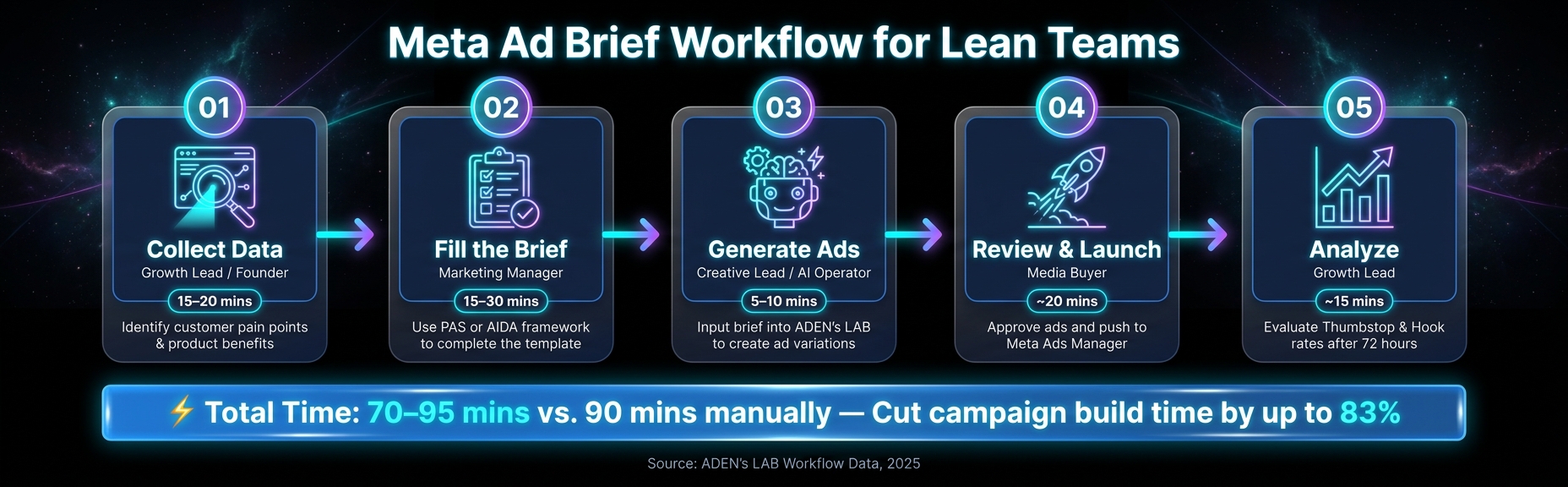
Meta Ad Brief Workflow for Lean Teams: From Product Page to Live Ad
A brief is only effective if it gives an AI clear, actionable instructions. With ADEN's LAB, the objective is straightforward: supply the platform with structured information to create static Meta ads that align with your brand, focus on conversions, and are ready for testing.
Mapping Brief Fields to AI Inputs
AI struggles with vague or incomplete briefs. This is why many teams are turning to AI platforms for Meta ads to standardize their creative output.
"A human creative team can fill in gaps, ask clarifying questions, and make intuitive leaps when a brief is vague. AI cannot." - AdCreate Team
When you provide your product URL to ADEN's LAB, the platform scans the page in three ways: visual (like hero images and brand colors), content (such as benefits, reviews, and pricing), and structural (category positioning). This scan gives the AI a baseline, but your brief adds critical details that may not be obvious on the page - like audience awareness, the copywriting framework, and the hook strategy for the first few seconds of the ad.
Choosing the right copy framework is key. For example, PAS (Problem, Agitation, Solution) works well for audiences already aware of a problem, while AIDA (Attention, Interest, Desire, Action) is better suited for cold audiences at the top of the funnel. Including this in your brief helps ADEN's LAB craft ads that match your campaign goals. Once inputs are mapped, they need to be adjusted to meet Meta ad specifications.
Aligning Brief Elements with Meta Ad Specs
After mapping your brief, the next step is ensuring it fits Meta’s ad requirements. Overly long text can hurt performance, especially on mobile where most impressions happen.
| Element | Character Limit | Best Practice |
|---|---|---|
| Primary Text | 125 characters | Highlight the main benefit or pain point |
| Headline | 40 characters | Use a curiosity hook or social proof |
| Description | 30 characters | Add urgency or reinforce the offer |
| Aspect Ratio (Vertical) | 9:16 | Required for Reels and Stories |
| Aspect Ratio (Square) | 1:1 | Standard for Facebook and Instagram Feeds |
To maximize placement options, always create ads in multiple aspect ratios - 1:1, 4:5, and 9:16. This prevents issues like black bars or awkward cropping. If formats aren’t specified, the tool may guess, which can lead to placement problems.
Once you’ve checked the specs, you can move on to generating and launching ads using a simple, efficient workflow.
A Simple Workflow for Lean Teams
Here’s a streamlined process to help small teams create and launch ads quickly:
| Step | Action | Role | Estimated Time |
|---|---|---|---|
| 1. Collect Data | Identify customer pain points and product benefits | Growth Lead / Founder | 15–20 mins |
| 2. Fill the Brief | Use the PAS or AIDA framework to complete the template | Marketing Manager | 15–30 mins |
| 3. Generate Ads | Input the brief into ADEN's LAB to create variations | Creative Lead / AI Operator | 5–10 mins |
| 4. Review & Launch | Approve ads and push them to Meta Ads Manager | Media Buyer | ~20 mins |
| 5. Analyze | Evaluate Thumbstop and Hook rates after 72 hours | Growth Lead | ~15 mins |
Step 5, the 72-hour review, is crucial. Early performance metrics like Thumbstop rate (how many people pause on the ad) and Hook rate (how many watch beyond three seconds) provide insights into what’s working. This feedback can then guide your next brief, ensuring your campaigns continually improve.
Scaling and Updating Briefs Across Campaigns
Building Reusable Briefs for Multiple Products
Streamline your process with a master template that includes two key layers: evergreen fields (like brand voice, target audience, Meta specs, and copywriting framework) and swappable fields (such as the hook, offer, key benefits, and seasonal angles). This way, when you’re working with a new product, you’re simply filling in specific details instead of starting from scratch. It’s a time-saver, especially when managing multiple products through ADEN's LAB in a single month.
Keep a Winners Hub to store your best-performing hooks, CTAs, and angles. This acts as a go-to resource for creative inspiration and helps you refine future briefs. Use a standardized naming system (e.g., [Date]_[Objective]_[Audience]_[Format]_[Variant]) to make tracking and referencing easier.
"Update your brief whenever you learn something new about what works... Over time, your brief becomes a living document that encodes your accumulated creative intelligence." - AdCreate Team
Once your reusable template is ready, take it a step further by tailoring your messaging to align with each stage of the customer journey.
Aligning Briefs with Meta Funnel Stages
A reusable template is a great starting point, but it becomes even more effective when adjusted for where your audience is in the funnel. Someone encountering your brand for the first time needs a very different message than someone ready to make a purchase. Treating these groups the same is a common mistake that can hurt your campaign’s performance.
Here’s how you can tailor your briefs based on funnel stages (Data source:):
| Brief Component | Top of Funnel (Awareness) | Bottom of Funnel (Retargeting) |
|---|---|---|
| Primary KPI | Thumbstop Ratio, Hook Rate | ROAS, Cost Per Purchase |
| Core Message | Problem education, brand story | Overcoming objections, urgency |
| Creative Type | Founder stories, PAS demos | UGC testimonials, social proof |
| CTA | "Learn More" | "Shop Now" |
One critical point: make sure your top-of-funnel brief excludes warm and hot audiences. If you don’t, your cold prospecting ads might compete with retargeting ads in the same auction, which can increase CPMs.
By tailoring your briefs to specific funnel stages, you ensure your message resonates with the right audience. From there, performance data can guide further refinements.
Updating Briefs Based on Campaign Data
After running a campaign for 7–10 days, you’ll start seeing performance data that highlights what’s working and what isn’t. Use these insights to fine-tune your creative elements. Instead of just judging performance, focus on diagnosing the issues. This approach is a key AI trick for cutting Meta CPA by identifying exactly where the funnel is leaking.
"The most valuable data comes from diagnosing performance, not just judging it. A low CTR isn't a failure; it's a clear signal that your hook needs work." - Project Aeon Team
Here are four key metrics to guide your adjustments:
| Metric | What It Tells You | Adjustment |
|---|---|---|
| Low Thumbstop Ratio | The opening visual isn’t grabbing attention | Test a new first-frame visual or pattern interrupt |
| Low Hook Rate | The opening line of copy isn’t connecting | Rewrite the hook to better resonate with the audience |
| Low Hold Rate | The pacing or narrative loses viewers halfway | Shorten the script or strengthen the agitation section |
| Low CTR | The offer or CTA isn’t compelling enough | Experiment with a more direct or urgency-driven CTA |
(Data source for metrics:)
When making updates, focus on changing one element at a time - whether it’s the hook, CTA, or visual direction. This allows you to clearly measure the impact of each adjustment.
Conclusion: Running a Faster Meta Ad Process with ADEN's LAB
The process boils down to three key steps: pulling the right details from your product page, creating a structured Meta ad brief, and using ADEN's LAB to quickly generate and scale static ads. Each step builds upon the previous one. Accurate extraction leads to well-crafted briefs, which in turn drive better-performing ads. This smooth workflow - from gathering details to AI-powered execution - delivers the efficiency lean teams thrive on.
As Murat Bock, Founder of adlibrary.com, explains:
"The brief is the bottleneck. It always was - AI just made the cost of a bad brief visible faster than before."
By following this streamlined approach, you can not only speed up the ad creation process but also stay ahead of Meta's demand for fresh creatives. On Meta, speed is critical - new, engaging content gets rewarded. Thanks to AI-assisted workflows, what used to take a week (like producing 24 ad variants) can now be done in a single day. ADEN's LAB produces static Meta ads in under 90 seconds at a fraction of the cost, making it feasible to run continuous creative tests without straining your budget.
The teams that dominate Meta in 2026 won’t necessarily have the deepest pockets - they’ll be the ones who write smarter briefs, test faster, and iterate without losing momentum. By sharpening your extraction, briefing, and AI workflows, you establish a winning formula for Meta ad success.
"The marketer who runs AI-assisted Meta ads well in 2026 isn't the one who uses the most tools - it's the one who writes better briefs than the people who don't." - Murat Bock, Founder, adlibrary.com
FAQs
What info from my product page matters most for Meta ads?
When creating Meta ads, it's crucial to pull the most impactful details from your product page. These include:
- Key Features: Highlight the standout aspects of your product that make it appealing.
- Unique Selling Points: What sets your product apart from competitors? Make these clear.
- Target Audience Insights: Understand who you're speaking to - what they need, want, or struggle with.
- Visual Elements: High-quality images or videos that showcase your product in action.
These elements are the foundation for shaping your campaign's strategy, messaging, and creative direction. Keep the focus on content that emphasizes the benefits of your product and connects with your audience. This ensures your creative brief is well-organized and effectively supports your ad objectives.
How do I pick the best ad angle for my audience stage?
To craft the most effective ad, match your message to where your audience is in their journey - whether they're in the awareness, consideration, or decision stage. Tapping into psychological triggers can make all the difference. Address their pain points, showcase the benefits they care about most, or build trust through social proof.
When creating your ad, ensure your creative brief clearly defines the audience's stage. This helps your message hit home and stay relevant to the people you're targeting.
Which Meta specs should I check before generating ads in ADEN's LAB?
Before creating ads in ADEN's LAB, take a moment to review Meta's ad specifications. Pay attention to key details like dimensions, aspect ratios, resolution, file types, and maximum file sizes. Make sure your creatives align with Meta's standards for various placements, including feed, stories, reels, carousel, and Messenger. Checking these format and placement requirements ensures your ads are optimized for performance and stay within Meta's guidelines.
Your next ad batch starts here
Finish with a ready-to-test ad batch
Paste your website to generate static creatives. Drop the link → get ads in about 90 seconds → upload them to Meta → scale.
Free to try No prompt writing