Performance Creative Generator: AI Built Static Ads Optimized for ROAS and CPA
Build the ads while the examples are fresh
Turn your product page into static ad creatives
Paste your product URL and generate scroll-stopping images, headlines, and primary text—ready for your next Meta creative test.
Free to try No prompt writing

Static ads outperform videos and carousels for Meta campaigns. They load faster, cost less, and drive higher engagement because they align with user behavior on feeds. However, ad fatigue and slow production often hurt results.
Here’s the solution: ADEN's Lab automates static ad creation. Drop a product link, and in 90 seconds, you get ready-to-launch ads. With plans starting at $59/month, it’s cheaper and faster than agencies or freelancers. Brands using this tool report lower CPAs, higher ROAS, and faster scaling by testing more ad variations daily.
Key takeaways:
- Static ads: 152% higher click-through rates and 20% lower costs than other formats.
- ADEN's Lab: Generate 200 ads/month for $179 - far less than agency costs.
- Faster testing: Identify winning ads 3x quicker, reduce costs, and avoid ad fatigue.
If you’re scaling Meta campaigns, constant ad updates are non-negotiable. ADEN's Lab simplifies this process, helping you stay competitive while cutting costs.
The ULTIMATE Guide to using AI to make Facebook Ads (Full Step-by-Step Walkthrough)
Put the playbook to work
Apply this playbook to your page
Paste your website and the Lab will turn the strategy you are reading into a ready-to-test ads.
Free to try No prompt writing
Why Static Ads Beat Video and Carousel Formats
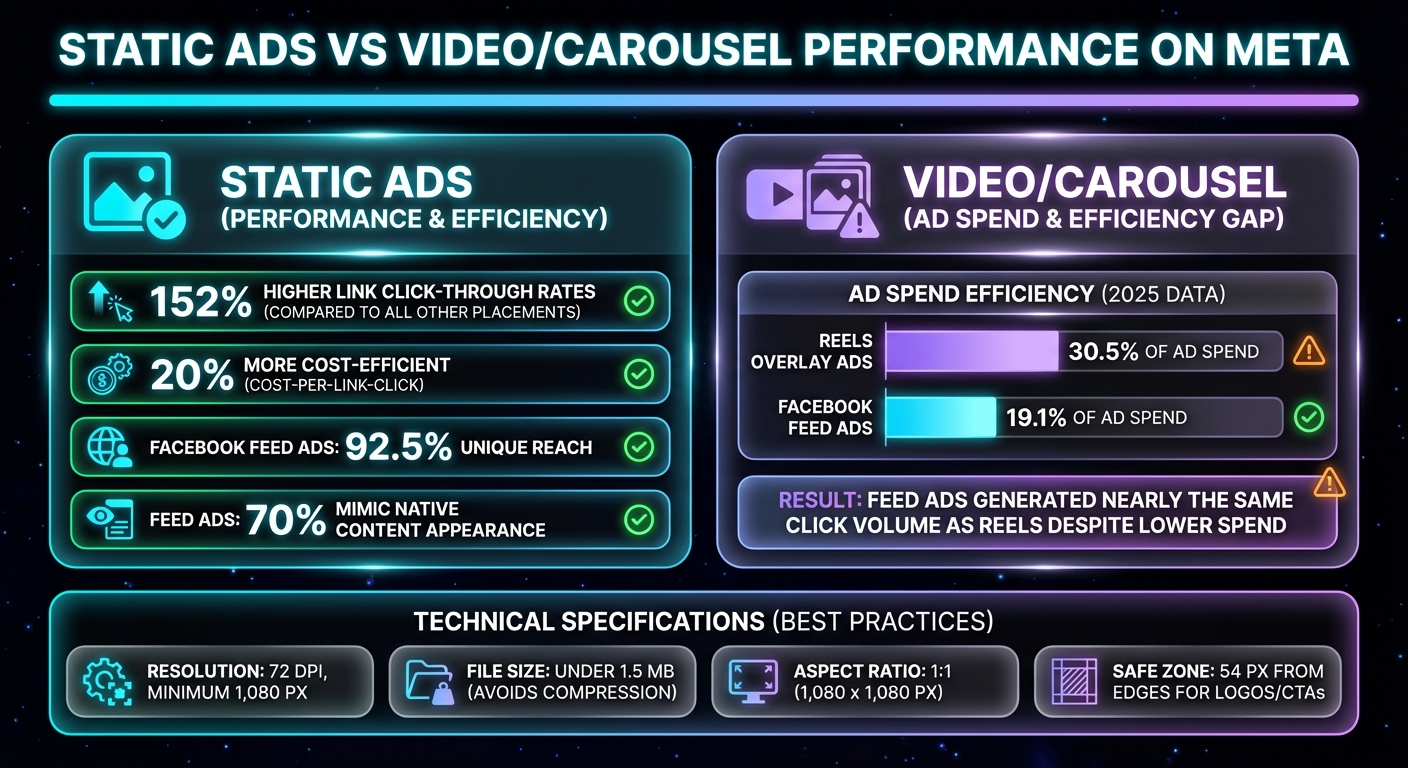
Static Ads vs Video/Carousel Performance: Cost and Engagement Comparison
When it comes to Meta advertising, static ads consistently outperform video and carousel formats, and the reasons boil down to user behavior and platform performance metrics.
The Advantage of Static Ads
Static ads load instantly, making them ideal for fast conversions. Despite the trend of advertisers sinking money into elaborate video productions, simple static images often deliver better results. Why? Because they align with how users scroll through their feeds.
On Facebook, feed ads show a 152% increase in link click-through rates compared to all other placements combined. They’re also 20% more cost-efficient in terms of cost-per-link-click. In 2025, Facebook Feed ads generated nearly the same volume of clicks as Reels Overlay ads, even though they only received 19.1% of ad spend compared to Reels’ 30.5%. This efficiency gap highlights how static ads can deliver more for less.
Static ads also blend seamlessly into the feed, appearing more like organic posts. When users scroll through their main feed, they’re in an active "tap-and-read" mode, unlike the passive swiping seen in Reels or Stories. This behavior leads to higher intent and better conversion rates. A clean product image combined with clear text provides immediate value without asking users to spend time watching or swiping. Formats like text wall ads and infographics are thriving because they feel genuine, not overly polished.
"Statics naturally appear more on the Facebook feed... You'll be surprised how often Facebook is more profitable than Instagram and how much better older age groups with high acquisition costs perform." - Marcus Burke, Independent Meta Ads Consultant
Another key advantage? Static ads under 1.5 MB maintain clarity and avoid the compression issues that often plague video formats. Meta’s algorithm rewards ads that drive quick engagement, and static images deliver exactly that - clean, simple visuals that don’t complicate the process.
The Algorithm Loves Static Ads
Meta’s delivery system prioritizes predicted action rates and ad quality. Static ads simplify this process, allowing the algorithm to focus solely on user response. There’s no need to evaluate video completion rates, carousel swipes, or sound-on versus sound-off behavior.
With a 92.5% unique reach on the Facebook Feed, static ads can target nearly every daily active user without quickly hitting frequency caps. This expansive reach is critical for scaling campaigns, as it avoids the limitations of formats that only work in specific placements.
Static ads also generate strong engagement signals. Users pause, read, and interact with these ads instead of scrolling past them. Around 70% of feed ads mimic the look and feel of native content, encouraging genuine interaction rather than the reflexive swiping often seen with videos. The algorithm picks up on this behavior, rewarding these ads with better delivery and reduced costs.
Where Advertisers Go Wrong With Creative Testing
Despite the clear advantages of static ads, many advertisers continue to overinvest in complex creatives like videos and carousels.
One of the biggest missteps is spending heavily on video production, which often fails to outperform a well-crafted static ad. Videos take longer to produce, limiting the ability to test and adapt quickly. In contrast, a static image with a strong angle and clear benefit statement can go live within minutes.
Another common mistake is failing to rotate creatives frequently. Videos exacerbate this problem due to their higher production costs and longer timelines. Static ads, on the other hand, allow for constant refreshes - new layouts, angles, and hooks can be tested rapidly without slowing down momentum.
Carousel formats are another area where budgets are often wasted. Most users don’t swipe through multiple images, meaning the message gets lost after the first card. Static ads deliver the same message more directly, making them a better choice for broad variation strategies. By creating 100+ variations of static ads, advertisers can let Meta’s algorithm identify the winners and cut the underperformers immediately. This level of testing is far more efficient than relying on videos or carousels.
Technical Tips for Static Ads
To maximize performance, follow these guidelines for static ad design:
- Export ads at 72 dpi with a minimum resolution of 1,080 px.
- Keep file sizes under 1.5 MB to avoid compression issues.
- Use a 1:1 ratio (1,080 x 1,080 px) to ensure compatibility across mobile and desktop platforms.
- Place logos, prices, and CTAs at least 54 px away from the edges to prevent UI elements from obscuring key information.
These technical details ensure your ads load quickly, look sharp, and display correctly, giving you the best chance to engage users and drive results. Static ads might not be flashy, but their simplicity is precisely what makes them so effective.
Why Most Campaigns Fail to Scale: The Creative Production Problem
Campaigns often hit a wall - not because of limited budgets or poor targeting - but due to a lack of fresh creative content. Without new ads to optimize, Meta's algorithm stagnates, leading to declining performance and rising costs. This bottleneck is worsened by slow, manual workflows that drive up expenses and limit flexibility.
The Hidden Costs of Manual Creative Workflows
Traditional ad creation is anything but fast. The process typically involves briefing a designer, waiting weeks for revisions, and receiving just a handful of ads. By the time these ads are ready, market trends may have shifted, and budgets have already been spent on outdated content. Agencies often charge over $1,000 for 10 ads - roughly $100 per ad - while taking weeks to deliver.
Fashion Forward Co. learned this the hard way. Their agency required three weeks to create a small batch of ads. Frustrated, CMO Sarah Chen turned to automated creative tools, enabling the production of over 200 ad variations in a single day. The results? A 340% boost in ROAS and an additional $2.3 million in revenue.
"ADEN'S LAB generated 200+ ad variations in one day. Our previous agency took 3 weeks for 10 ads. The AI-created ads outperformed our human-created ones by 340%."
- Sarah Chen, CMO, Fashion Forward Co.
TechGadget Pro faced a similar challenge. Growth Director Mike Rodriguez was spending $50,000 monthly on agencies, limiting their ad output. After adopting AI-powered creative production, they cut costs to $500 per month, tested 100 times more ad variations, and saw a 520% increase in CTR. This approach generated $1.8 million in additional revenue.
The inefficiency of manual workflows creates a serious bottleneck. High-performing accounts often require 8–12 active creative variations per campaign to maintain momentum. Waiting weeks for just a few creatives makes scaling nearly impossible.
But the financial and time costs are only part of the problem. A lack of fresh ads also leads to something even more damaging: creative fatigue.
How Creative Fatigue Drains Campaign Performance
When audiences are repeatedly exposed to the same ad, engagement inevitably drops. While slow production inflates costs, stale creatives erode interest even faster. Research shows that 90% of failing Meta campaigns are caused by creative fatigue - not targeting or budget issues.
Signs of creative fatigue include ad frequency exceeding 4.0 or a CTR drop of more than 20% over two weeks.
"Creative fatigue is not a maybe. It is a guarantee."
- Ivan Teh, Advisible
This issue becomes even more pronounced when scaling. Increasing budgets without introducing fresh creative forces Meta to recycle the same ads, leading to higher CPMs and reduced reach. The algorithm struggles to match repetitive ads with diverse audience segments, creating what’s often referred to as the "cost of repetition".
Take Wellness Plus as an example. By replacing their $10,000-per-month agency with AI-generated creative, Founder Dr. Amanda Foster quickly produced hundreds of ad variations tailored to emotional triggers. The results were striking: a 280% boost in ROAS, $3.1 million in additional revenue, and a 72% reduction in CAC.
Without a steady stream of new creative, scaling campaigns effectively becomes an uphill battle. Fresh ads aren’t just helpful - they’re essential for keeping performance on track.
How ADEN's Lab Generates High-Performance Static Ads Automatically
Most creative tools still demand hours of manual input, but ADEN's Lab flips the script. With just one action - dropping a link - you can have fully built ads in less than 90 seconds. No need for briefing documents, endless revisions, or waiting. The platform scrapes your landing page, analyzes key conversion signals, and churns out Meta-ready static ads. This streamlined approach simplifies the entire creative workflow.
Drop a Link → Get Ads
Here’s how it works: paste your product or landing page URL into ADEN's Lab, and the platform does the rest. It pulls images, customer reviews, product positioning, and key benefits directly from your page. Then, using performance-tested insights, it identifies hooks optimized for conversions. Unlike standard templates, the system digs into product-specific details like benefits, potential objections, and social proof to craft unique ad angles. The result? Fully built ad creatives, complete with headlines, body copy, visuals, and calls-to-action - all ready to go live on Meta. And the best part? No prompt engineering or extra inputs are needed - your link is all it takes.
Why Automation Outperforms Manual Design
Speed and volume are game-changers. ADEN's Lab can produce over 100 Meta-ready ads per day, enabling you to test multiple hooks, layouts, and angles simultaneously. Compare that to the weeks it often takes to manually create and test a single batch. The platform relies on proven ad strategies and buyer insights, not guesswork or intuition.
Cost savings are another huge win. While traditional agencies charge upwards of $1,000 for 10 ads - and take weeks to deliver - ADEN's Lab delivers the same volume in just 90 seconds for $9. That’s a 95% reduction in cost and a complete removal of the design bottleneck.
What the Numbers Actually Show
The results speak for themselves. Automation translates into measurable performance gains. Here’s the logic: more ad variations mean faster testing, which lowers CPAs and boosts ROAS. With the ability to test 100x more ad variations than competitors, ADEN's Lab users identify winning ads faster, giving Meta’s algorithm more data to work with.
The numbers back it up: AI-generated ads on the platform have shown an average performance increase of 340% compared to human-created ads. Users also report an average ROI of 25x.
How to Scale Meta Campaigns with Creative Volume and Lower Costs
Scaling Meta campaigns requires a steady flow of new creatives to maintain low CPAs and consistent performance. Slow production not only drives up costs but also hinders growth. The key is constant creative refreshment, a challenge that ADEN's Lab addresses head-on. Without a reliable pipeline of fresh ads to replace underperforming ones, CPAs rise, and scaling efforts falter. ADEN's Lab offers a solution by combining pricing efficiency with rapid production to keep campaigns running smoothly.
ADEN's Lab Pricing Breakdown
ADEN's Lab provides three pricing options tailored to different campaign needs and stages of growth:
- Lift Off Plan: For $59 per month, you get 30 ads - about $1.97 per ad. This plan works well for early-stage testing and offer validation.
- Hyperstream Plan: At $89 per month for 50 ads (around $1.78 per ad), this tier is perfect for brands running consistent campaigns that need regular creative updates.
- Apex Mode Plan: Designed for aggressive scaling, this plan delivers 200 ads monthly for $179, reducing the cost per ad to just $0.90.
To put this into perspective, freelance designers typically charge $50 to $200 per static ad, while agencies often bill $1,000 or more for a set of ten ads. ADEN's Lab offers substantial savings and instant production. For instance, one e-commerce brand cut its CPA by 20–30% while scaling spend - something traditional workflows, which max out at 20–30 ads per month for over $2,000, can’t match.
How Constant Creative Flow Solves the Scaling Problem
Beyond cost benefits, fast creative production is critical for keeping CPAs low and ROAS high. Regularly updated creatives keep Meta's algorithm engaged and audiences interested. ADEN's Lab automates the process, generating 10 to 20 new ad variants daily from a single product link. This allows advertisers to test over 50 different angles at once, identifying top-performing creatives three times faster than manual methods. With this speed, budgets can scale by 20–50% weekly without the usual performance drops caused by production delays.
More variants mean more data for Meta's algorithm, which often results in 25–40% lower CPAs and around 15% higher ROAS. Sticking with the same five to ten creatives for too long can lead to audience fatigue, doubling CPAs and wasting up to 40% of the ad spend. Experienced media buyers understand that generating over 100 fresh creatives weekly is essential for scaling success. ADEN's Lab eliminates this bottleneck by delivering high-quality, ready-to-use ads in seconds, mirroring the strategies of top-performing agencies.
The process is simple: drop your product link, generate a batch of 20 ads, launch the five best-performing ones in dedicated ad sets, and rotate in fresh variants daily. This streamlined workflow cuts production time from days to seconds, enabling constant testing and reducing CPA by 15–30% compared to manual methods.
Conclusion
When creative production slows down, testing suffers, CPAs rise, and scaling grinds to a halt. For many advertisers, the issue isn't poor targeting - it’s running out of fresh, engaging ads to test.
That’s where ADEN's Lab steps in. By automating the ad creation process, it removes the need for manual work. Simply drop in a product link, and within 90 seconds, you’ll have conversion-ready static ads. No setup headaches, no steep learning curve. And at just $0.90 per ad under the Apex Mode plan, you can produce 200 ads a month - far cheaper than what most freelancers charge for just one.
This automation isn’t just about saving time. It fuels performance. With more ads to test, you gather data faster, helping Meta’s algorithm optimize campaigns more effectively. The result? Lower CPAs and higher ROAS. By consistently refreshing your ad creatives instead of recycling old ones, you avoid the 10–25% CPA increases tied to creative fatigue.
FAQs
How many new static ads should I test each week on Meta?
Testing at least 50 new ads each week is a solid guideline for staying ahead. This approach helps you quickly pinpoint what resonates, avoid creative burnout, and adjust to how your audience reacts. Tools like Aden’s Lab make it easier to produce and test a high volume of ads efficiently, ensuring your campaigns stay dynamic and effective.
When should I rotate creatives to avoid fatigue?
To keep your campaigns fresh and effective, make it a habit to rotate your creatives every 1 to 2 weeks. Watch for telltale signs of fatigue, like a drop in click-through rates (CTR), an increase in cost-per-click (CPC), or a dip in overall engagement. Keeping an eye on key metrics like CTR, CPC, and ad frequency can help you catch these issues early. A good rule of thumb? Review your creatives weekly and plan to switch things up every couple of weeks to ensure your campaigns stay on track and perform well.
What URL works best for generating ads in ADEN’s Lab?
The most effective URL for generating ads in ADEN’s Lab is one that leads to a website with clear and relevant content. This ensures the platform can instantly produce high-performing Meta ads without needing additional prompts or configurations. Just paste the link, and the system takes care of everything else.
Your next ad batch starts here
Finish with a ready-to-test ad batch
Paste your website to generate static creatives. Drop the link → get ads in about 90 seconds → upload them to Meta → scale.
Free to try No prompt writing