Problem-Solution Meta Ad Prompts for Ecommerce Brands With Examples
Use the prompts on your real offer
Generate these ad angles for your product
Skip the blank prompt box. Paste your product page and ADEN'S LAB applies the angles to your offer, images, headlines, and copy.
Free to try No prompt writing

If your Meta ads aren’t performing, the issue likely lies with your ad messaging - not your budget or targeting. A powerful way to fix this is by using problem-solution prompts: start with a customer pain point and position your product as the solution. This approach helps create direct, effective ad copy that connects with your audience and drives results.
Key takeaways:
- Why Meta ads matter: They’re a top tool for e-commerce brands but require strong ad messaging to stand out.
- Problem-solution framework: Focus on customer pain points using proven structures like PAS (Problem-Agitate-Solution), BAB (Before-After-Bridge), and AIDA (Attention-Interest-Desire-Action).
- Common challenges: Low click-through rates (CTR), high customer acquisition costs (CAC), and creative fatigue can derail campaigns.
- Tools like ADEN'S LAB: Generate ready-to-test static ads in under 90 seconds, making it easier to test and refresh ad creatives.
This article breaks down how to craft prompts that address these challenges and includes actionable examples to improve your Meta ad results.
Facebook Ads Suddenly Stopped Working? Here’s How to Fix It
Put the playbook to work
Apply this playbook to your page
Paste your website and the Lab will turn the strategy you are reading into a ready-to-test ads.
Free to try No prompt writing
Core Problems E-commerce Brands Face with Meta Ads
E-commerce brands often face three recurring challenges with Meta ads: failing to grab attention, high costs to acquire customers, and creative content that becomes ineffective too quickly. These issues require focused strategies to tackle them head-on. By using a problem-solution framework, brands can address these pain points effectively and breathe new life into their campaigns. Let’s break these down in detail.
Low Click-Through Rates (CTR)
If your ad isn’t getting clicks, chances are it’s not catching the viewer’s attention. This often happens when the ad’s hook is too bland, the message doesn’t connect with the audience, or the copy focuses more on the brand than the customer’s actual needs. On Meta, where users scroll quickly, your ad has only moments to make an impact.
Using problem-solution ad copy ideas can transform your copy by starting with a relatable customer pain point. For example, instead of generic messaging, you might say: "Still dealing with sunscreen that leaves a white cast?" This approach feels personal and relatable, making it more likely to stop a user mid-scroll and boost your CTR.
High Customer Acquisition Costs (CAC)
When your ad copy prioritizes features over benefits or lacks clarity, you end up paying for clicks that don’t convert. This inefficiency drives up your customer acquisition costs because missed conversions mean wasted ad spend.
"Your ad does the targeting now. The days of laser-focused targeting based on demographics, interests, and lookalikes are fading." - Kim, Growth Strategist, Utopiads
Problem-solution prompts can help here by opening with a recognizable pain point, addressing objections like cost or trust, and providing clear reassurances - such as offering a 30-day money-back guarantee. This approach creates ad copy that not only attracts clicks but also converts them, reducing CAC without requiring a larger budget.
But even with optimized costs, there’s another hurdle: creative fatigue.
Creative Fatigue and Scaling Limitations
For e-commerce brands, ad creatives lose their effectiveness quickly, especially when campaigns scale up. The more exposure an ad gets, the faster its performance declines. This often results in lower CTRs, followed by a spike in acquisition costs.
"Fatigue starts showing in CTR days before it shows in CPA. If you only monitor CPA, you're always reacting too late." - Losid Berberi, CMO, TheOptimizer.io
A key indicator of creative fatigue is when your 3-day CTR drops 20–30% below the baseline established in the first 3–5 days. At this point, new creative is critical. Tools like ADEN’S LAB can automate Meta ad production to produce fresh variations in under 90 seconds, ensuring your campaigns stay effective before performance dips too far.
Problem-Solution Prompt Frameworks for Meta Ads
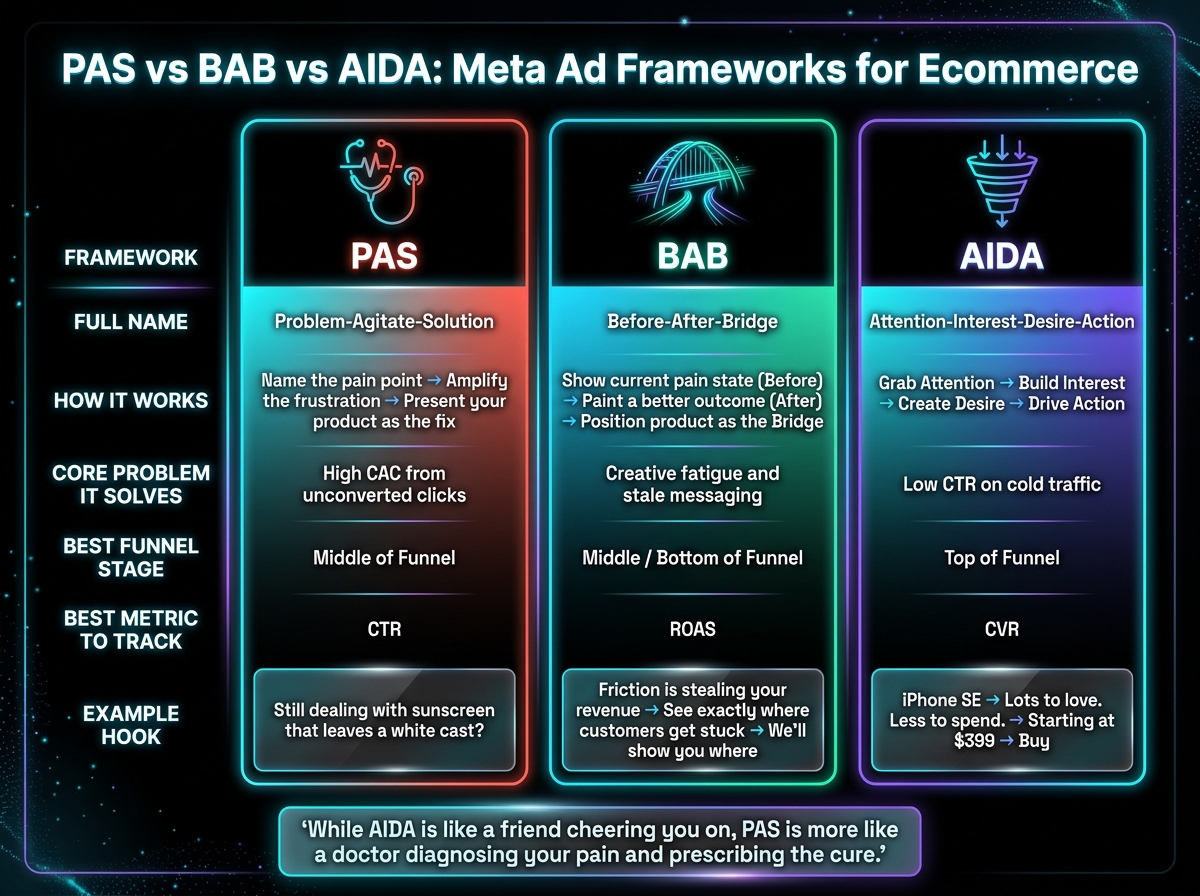
PAS vs BAB vs AIDA: Meta Ad Frameworks for Ecommerce
Now that you’ve identified what’s holding your campaigns back, it’s time to choose the right structure to fix it. When it comes to Meta ad copy, three frameworks do most of the heavy lifting: PAS, BAB, and AIDA. These approaches are designed to grab attention and drive action, addressing challenges like low click-through rates (CTR), high customer acquisition costs (CAC), and creative fatigue. Each framework aligns with a specific challenge and stage of the buyer’s journey.
3 Ad Copy Frameworks: PAS, BAB, and AIDA
-
PAS (Problem-Agitate-Solution)
This framework starts with the problem. It names the pain point, amplifies the frustration, and positions your product as the solution. PAS is particularly effective at tackling high CAC by focusing on what’s not working for the customer and offering a clear fix. -
BAB (Before-After-Bridge)
BAB focuses on transformation. It highlights the customer’s current state (Before), paints a picture of a better outcome (After), and presents your product as the bridge to get there. For example, Blue Triangle uses this method: "Friction is stealing your revenue" (Before), "See exactly where customers get stuck and what to fix" (After), and "We'll show you where" (Bridge). This structure is excellent for refreshing fatigued creatives since you can tweak the “After” without rebuilding the entire ad. -
AIDA (Attention-Interest-Desire-Action)
AIDA uses a storytelling approach to guide the audience. It starts by grabbing Attention, builds Interest, creates Desire, and ends with a strong Action. Apple’s iPhone SE campaign is a great example: the product name grabs Attention, “Lots to love. Less to spend” builds Interest, “Starting at $399” sparks Desire, and “Buy” closes the deal. AIDA works best at the top of the funnel when the goal is to capture attention quickly.
"While AIDA is like a friend cheering you on, PAS is more like a doctor diagnosing your pain and prescribing the cure." - Sanjay Shukla, Content Strategist
| Framework | Core Problem It Solves | Best Funnel Stage |
|---|---|---|
| AIDA | Low CTR on cold traffic | Top of Funnel |
| PAS | High CAC from unconverted clicks | Middle of Funnel |
| BAB | Creative fatigue and stale messaging | Middle / Bottom Funnel |
How to Structure an Effective Ad Prompt
Vague prompts lead to vague results. For effective ad copy, your prompt needs to be specific and include four elements: the framework, product detail, audience, and goal.
Here’s an example:
"Write a PAS-style Meta ad for a mineral sunscreen that leaves no white cast, targeting women 25–40 dissatisfied with drugstore SPF; goal: drive clicks to a product page with the CTA: Get Unstuck."
Two practical tips can further refine your prompts:
- Hook your audience in the first two lines. Meta often truncates ad copy, so your Problem (PAS) or Attention (AIDA) must hit hard immediately.
- Focus on benefits, not features. Instead of listing product specs, highlight how it improves the customer’s life. Match your CTA to the framework - for example, a PAS ad might convert better with a CTA like "Get Unstuck" rather than a generic "Learn More."
Next, let’s explore how ADEN'S LAB transforms these prompts into static, high-performing Meta ads.
Pairing Prompts with ADEN'S LAB for Static Ad Output
Great copy needs to translate into visuals quickly for testing. Once you’ve nailed down your headline and body copy, ADEN'S LAB can turn it into a polished Meta ad in under 90 seconds. Designed for Facebook and Instagram, the platform uses direct-response principles to create static ads ready for immediate testing. You can experiment with multiple framework variations, refresh BAB scenarios, and generate enough creative diversity to help Meta’s algorithm identify top-performing ads efficiently.
Problem-Solution Prompt Examples for E-commerce Meta Ads
Crafting effective ads starts with well-thought-out prompts. By building on frameworks like PAS, BAB, and AIDA, you can tackle common ad challenges with precision. Below are tailored prompts designed to address specific e-commerce advertising goals.
Prompts for Boosting CTR on Cold Traffic Campaigns
When targeting cold traffic, your ad needs to grab attention immediately. These users are unfamiliar with your brand, so crafting using a compelling headline generator is key. A headline matrix that uses different psychological triggers can help Meta's algorithm quickly identify what resonates.
"Bad prompts produce generic copy that sounds like every other store. Good prompts produce copy that sells." - SurePrompts Team
Here’s a prompt to generate multiple attention-grabbing headlines in one go:
"Write 8 ad headlines (max 40 characters each) for cold traffic on Meta. Each headline should use a different psychological mechanism: 1. Curiosity gap, 2. Social proof, 3. Negative reversal, 4. Specificity anchor, 5. Identity claim, 6. Pain-first, 7. Outcome-first, 8. Contrarian."
For example, a skincare brand targeting women aged 25–40 might produce headlines like:
- "The reason your SPF isn't working..." (curiosity gap)
- "Stop using drugstore sunscreen for your skin." (negative reversal)
This variety gives Meta’s Andromeda system enough data to pinpoint the best-performing approach quickly.
To complement the headline matrix, use this body copy prompt:
"Write a Facebook/Instagram ad for [PRODUCT NAME]. Lead every version with a key benefit or customer pain point. Provide: Primary text in 3 versions (short: 40 words, medium: 80 words, long: 125 words)."
When CTR improves, the next challenge is lowering CAC by refining your conversion strategy.
Prompts for Lowering CAC with Conversion-Focused Copy
Lowering CAC often means addressing customer doubts head-on. A PAS-based prompt can help by combining a problem, agitation, and solution with social proof and a low-risk call-to-action (CTA):
"Write a PAS Meta ad for [PRODUCT NAME]. Problem: [specific customer pain point]. Agitate: [why the current solution fails them]. Solution: [how your product fixes it]. Include one line of social proof (e.g., number of customers or a review snippet) and end with a CTA focused on low risk, such as 'Try it free' or 'Free shipping, no minimums.'"
This structure helps guide potential customers from hesitation to action in just one ad. Shopify data shows that returning customers are 50% more likely to convert than first-time buyers. To nurture this advantage, consider a follow-up prompt like:
"Write a short follow-up ad for customers who bought [PRODUCT] 30 days ago, focused on replenishment and loyalty."
By planning for repeat purchases, you can maximize value from each customer while keeping CAC low.
Prompts for Refreshing Ads When Creative Fatigue Sets In
When CTR drops and ad frequency rises, it’s time to refresh your creative. Instead of starting from scratch, tweak proven elements for a fresh perspective. Use this prompt for new angles:
"Write a TikTok/Meta video ad script for [PRODUCT NAME]. Hook (first 3 seconds): Stop the scroll. One line. Problem/setup (next 5 seconds): Why they should care. Solution (next 10–15 seconds): Show the product in action."
Once you’ve refreshed the copy, tools like ADEN'S LAB can quickly adapt it into new static ad formats, enabling you to test multiple creatives before fatigue affects your budget.
How to Put Problem-Solution Prompts to Work with ADEN'S LAB
Turning Prompts into Testable Ad Batches
Once you’ve nailed down a solid problem-solution prompt, the next step is to quickly transform it into testable ad batches. That’s where ADEN'S LAB comes in. Simply input your product link, and the platform generates high-performing Meta ads in under 90 seconds.
Here’s how it works: start with a proven framework - like PAS (Problem-Agitate-Solution) for cold traffic campaigns - and let ADEN'S LAB produce multiple ad variations in one go. Each variation becomes a testable candidate, allowing Meta’s algorithm to determine which headline or creative performs best using real-world spend data. For instance, with the Apex Mode plan costing $0.90 per ad, you can generate 10 to 20 variations at a fraction of the cost of hiring a designer. This quick turnaround matters because Meta’s Andromeda system favors creative diversity. The more unique variations you provide early on, the better your chances of maximizing efficiency.
Once your test batch is live, keep an eye on its performance to guide your next steps.
Using Performance Data to Refine Your Prompts
After running your batch for about 14 days, export your performance data from Meta Ads Manager as a CSV file. This makes it easier to spot trends. Focus on three key metrics: CTR (Click-Through Rate), CPA (Cost Per Acquisition), and CTR relative to reach expansion.
Here’s a quick tip: if you see high CTR but low conversions, the issue might lie with your landing page rather than the ad itself. On the other hand, if CTR is low from the start, your prompt’s hook may need tweaking. Use a simple "If-Then-Because" logic to refine your approach. For example:
"If we start with a pain-first hook instead of a curiosity gap, we expect higher CTR because the audience will immediately identify with their problem."
"The signal that an ad is tiring isn't always frequency - it's the ratio of click-through rate week-over-week relative to reach expansion." - Murat Bock, Founder, adlibrary.com
When you find a winning prompt, scale it carefully. Increase your budget by 20% every 48 hours to allow Meta’s system time to adjust without triggering a reset in the learning phase. As results roll in, feed the insights back into ADEN'S LAB to refine your prompts and create even better ad batches.
Comparing Prompt Performance Across Frameworks
Once you’ve fine-tuned your prompts, it’s time to compare how different frameworks perform. Testing variations like PAS, BAB (Before-After-Bridge), and AIDA (Attention-Interest-Desire-Action) can help you uncover which narrative resonates most with your audience. Each framework taps into a different emotional or persuasive angle, so their success metrics will vary:
| Framework | Core Focus | Best Metric to Track |
|---|---|---|
| PAS (Problem-Agitate-Solution) | Emotional pain and relief | CTR |
| BAB (Before-After-Bridge) | Transformation and results | ROAS |
| AIDA (Attention-Interest-Desire-Action) | Linear persuasion journey | CVR |
After two weeks, gather your raw data - Ad ID, headline, CTR, CPA - and feed it back into your prompt workflow. ADEN'S LAB can then help identify which narrative themes are scaling effectively and which are losing steam. This feedback loop ensures sharper prompts, leaner ad batches, and a lower cost per winning ad.
"If it doesn't sell, it isn't creative." - David Ogilvy
Conclusion: How to Scale Meta Ad Results with Problem-Solution Prompts
Scaling Meta ads doesn’t mean you need to pour more money into campaigns or expand your team - it’s about working smarter with your creative strategy. The problem-solution framework offers e-commerce brands a clear way to tap into their customers’ emotions, leading to more clicks, lower customer acquisition costs (CAC), and better return on ad spend (ROAS). All of this is achieved by systematically using problem-solution prompts.
Successful brands don’t rely on guesswork. They use structured testing and performance data to refine their approach. As Ethan Kramer, Partner and Social Commerce Practice Leader at Agital, explains:
"Running a Meta Ads account without clear goals is like driving a car without a destination - you’re just hoping to find what you need by chance. But with clear goals, it’s like using GPS."
Problem-solution prompts act as that GPS, providing a clear path forward. By applying strategies like PAS, BAB, or AIDA alongside real performance data - and leveraging tools like ADEN'S LAB to create static ad variations in under 90 seconds - you eliminate the guesswork. Instead of hoping an ad works, you build a repeatable system that shows why it works.
A staggering 62% of e-commerce brands struggle to achieve meaningful results from Meta Ads, often due to errors in ad setup or strategy. Brands that succeed focus on increasing creative output and running intentional tests. At just $0.90 per ad with ADEN'S LAB’s Apex Mode plan, generating 10 to 20 new variations weekly becomes both cost-effective and essential for keeping Meta’s algorithm engaged.
Start with one framework, address a real customer pain point, and let performance data guide your adjustments. Over time, this approach compounds into stronger, scalable results.
FAQs
How do I choose between PAS, BAB, and AIDA for my Meta ads?
When it comes to crafting persuasive messaging, selecting the right framework can make all the difference. Here’s a breakdown of three popular methods and when to use each:
- PAS (Problem-Agitate-Solution): This approach zeroes in on pain points. First, you identify the problem your audience faces. Then, you amplify the emotional weight of that issue (agitate), making it feel urgent or pressing. Finally, you present your solution as the answer. PAS works best when you want to evoke emotional responses and connect deeply with your audience's struggles.
- BAB (Before-After-Bridge): This framework is all about transformation. You start by painting a picture of the "before" state - what life looks like without your product or service. Then, you highlight the "after" state, showcasing the benefits or improvements. The "bridge" is your offering, the tool that takes them from point A to point B. BAB is ideal for demonstrating change and emphasizing the value of your solution.
- AIDA (Attention-Interest-Desire-Action): AIDA provides a structured, step-by-step flow. First, grab your audience's attention with something striking. Then, build interest by showcasing why your offering matters. Next, create desire by focusing on specific benefits or emotional appeals. Finally, guide them to take action, whether it's making a purchase, signing up, or clicking through. This method is perfect for campaigns designed to drive conversions.
Each framework has its strengths, so the key is to match the method to your campaign's goal. Use PAS for emotional resonance, BAB for showcasing transformation, and AIDA when you need a clear, action-driven structure. Aligning the framework with your audience and objectives ensures your message hits the mark.
What should I include in an ad prompt to get non-generic copy?
To write ad copy that grabs attention, focus on specifics rather than generic phrases like "premium quality." Highlight exactly how the product solves a problem or improves the customer’s life. Include details that show benefits, offer proof, and create a sense of urgency to encourage immediate action. Clearly outline the benefit, define who it’s for, and emphasize what makes it stand out. This approach ensures your copy is engaging, relatable, and memorable.
How do I know when an ad is fatigued and needs new creative?
Tracking key performance indicators can help you identify ad fatigue. A drop in click-through rate (CTR) - often noticeable after 5-10 days of strong results - could mean your audience is seeing the ad too often. Keep an eye on your frequency score; if it exceeds 3-4 impressions per user, it might be time to make changes. Also, reduced engagement (fewer likes, comments, and shares) is another red flag. Pay attention to negative feedback, such as users hiding your ad, as it clearly indicates the need for fresh creative content.
Your next ad batch starts here
Finish with a ready-to-test ad batch
Paste your website to generate static creatives. Drop the link → get ads in about 90 seconds → upload them to Meta → scale.
Free to try No prompt writing