Do Performance Ads Really Need a Designer? A Hard Look at What Actually Moves CPA
Try the workflow instead of comparing it
See what an AI ad generator makes from your product
Paste your product page and get a complete Meta ad batch—creative concepts, images, headlines, and copy—without another tool stack.
Free to try No prompt writing

Hiring a designer won’t automatically reduce your cost-per-acquisition (CPA). What matters most for performance ads is how well they engage users - not how polished they look. Here’s what truly impacts CPA:
- Speed: Launching ads quickly helps you gather data faster and optimize sooner.
- Volume: Testing many ad variations increases your chances of finding winners.
- Creative Fatigue: Regularly refreshing ads prevents performance drops from overexposure.
User-generated content (UGC) often outperforms polished ads, with a 2.4% click-through rate (CTR) compared to 1.2% for branded designs. AI-generated static ads, like those from Aden’s Lab, offer a faster, cheaper, and more scalable solution for testing high volumes of ads.
Key takeaway: Instead of focusing on design perfection, prioritize speed, volume, and consistent testing to lower CPA and improve ad performance.
What Actually Lowers CPA: The Real Performance Drivers
After managing over $100 million in Meta ad spend, I’ve noticed three consistent factors that drive CPAs down: speed, volume, and creative refresh cycles. Surprisingly, design quality doesn’t make the cut.
Speed: Launch Quickly, Learn Faster
Chasing perfection delays progress. Every day spent tweaking designs is a missed opportunity to gather valuable performance data. Why? Because real-world results always outweigh subjective design opinions. When you launch quickly, you discover what resonates with your audience - not just what looks good on paper.
Here’s the formula: faster launches mean more testing cycles. More cycles lead to quicker insights, allowing you to optimize based on actual performance metrics like clicks and conversions - not guesswork. As Three Chapter Media puts it:
"You can polish a dud forever; it'll still be a dud."
The winning approach? Start with multiple rough concepts at the beginning of the week, analyze performance data mid-week, and refine or scrap ideas by Friday. This rapid cycle allows you to act on insights while traditional workflows are still bogged down in revisions.
Launching fast also sets the stage for testing a higher volume of ideas, which is another essential element in reducing CPA.
Testing Volume: Why More Variants Matter
In performance marketing, failure is the norm - roughly 90% of creative ideas won’t succeed. But that’s not a reflection of your skills; it’s just the nature of the game.
This is why volume is so important. Testing a large number of creative variations increases your chances of finding the rare winners that can drive real results. For example, in May 2025, Creative Ad Lab reported on an e-commerce brand that tested 80 ad variations. Most failed, but the winners they uncovered generated $400,000 in revenue with a 4.25 ROAS.
Static ads are particularly effective for high-volume testing. They’re quicker and cheaper to produce than videos, making it easier to experiment with different hooks, angles, and offers without overspending on production.
Creative Fatigue: The Silent CPA Killer
When your audience sees the same ad too many times, engagement drops, CPC rises, and CPA inevitably increases - even if nothing else in your campaign changes.
The numbers back this up: CTR tends to drop by 9% once an ad hits a frequency of 2, while CPC can jump by as much as 50% at the same point. To combat this, high-spend accounts typically need 6–20 new ad concepts every month, while even lower-spend accounts eventually face the same challenge.
This constant need for fresh creatives highlights the importance of fast, high-volume testing. Traditional workflows - filled with lengthy briefing, revision, and approval processes - simply can’t keep up. By the time your new ad is ready, your old one has already fatigued, and your CPA has climbed. The solution? A steady stream of fresh creatives to keep Meta’s algorithm engaged and your costs under control - not just a periodic refresh every quarter.
Put the playbook to work
Apply this playbook to your page
Paste your website and the Lab will turn the strategy you are reading into a ready-to-test ads.
Free to try No prompt writing
Why Designer Workflows Hurt Meta Ad Performance
On paper, traditional designer workflows might seem like a solid plan. But when it comes to running Meta ads, these lengthy processes can seriously slow down your ability to gather performance data and adapt quickly.
Delays and Missed Timing
Quick testing is crucial for Meta ads, but drawn-out designer workflows can drag the process down. Every extra day spent waiting for revisions is a missed chance to test new creative ideas. These delays often leave the algorithm stuck in its learning phase, and by the time your ad finally launches, its frequency might already hit 2.0. At this point, your click-through rate (CTR) could drop by about 9%, while cost-per-click (CPC) might spike by as much as 50%.
To make things worse, these elongated workflows often lead teams to focus on small tweaks - like adjusting colors - just to meet volume goals. But minor changes rarely prevent creative fatigue. What’s needed are bold, fresh ideas to keep performance strong.
High Costs Without Better Performance
Designer-created ads come at a price, typically $30–$50 per static ad. And since about 90% of new ad ideas fail, you might have to test around ten concepts to find one that works. As Nathan Hudson, Founder of Perceptycs, explains:
"Often we see simple, ugly creatives that took minutes to produce outperform Spielberg-esque creatives."
Meta's algorithm prioritizes genuine engagement over polished visuals. Ads that look like user-generated content often perform better, with click-through rates reaching 2.4% - double the 1.2% average of highly polished brand ads. The high cost of designer-created ads discourages teams from experimenting with bold new ideas, instead pushing them to stick with small iterations of past winners. This approach limits testing opportunities and reduces the chances of discovering ads that lower cost-per-acquisition (CPA). And even the most compelling ad will eventually lose its edge, making it essential to have a steady flow of fresh concepts to keep CPAs under control.
Inconsistent Styles Confuse Meta's Algorithm
When your ads lack a cohesive style - whether it’s mismatched fonts, colors, or overall design - Meta's algorithm struggles to figure out which elements are driving results. Changing too many variables at once makes it harder for the system to optimize effectively.
This inconsistency can also create a disconnect between your ad and its landing page. When the look and feel don’t match, it can lead to wasted clicks and higher CPAs. Scaling becomes even more challenging, as you’re unable to maintain stable performance when increasing budgets.
To address this, Meta now offers tools like branding settings, where you can upload logos, set brand colors, and choose fonts to ensure a consistent visual identity. This helps the algorithm optimize delivery more effectively. Automated creative tools, like Aden's Lab, also play a key role by generating consistent and timely ad variations, reducing the risks of inconsistency and wasted spend.
Why AI-Generated Static Ads Work Better: Speed, Scale, and Consistency
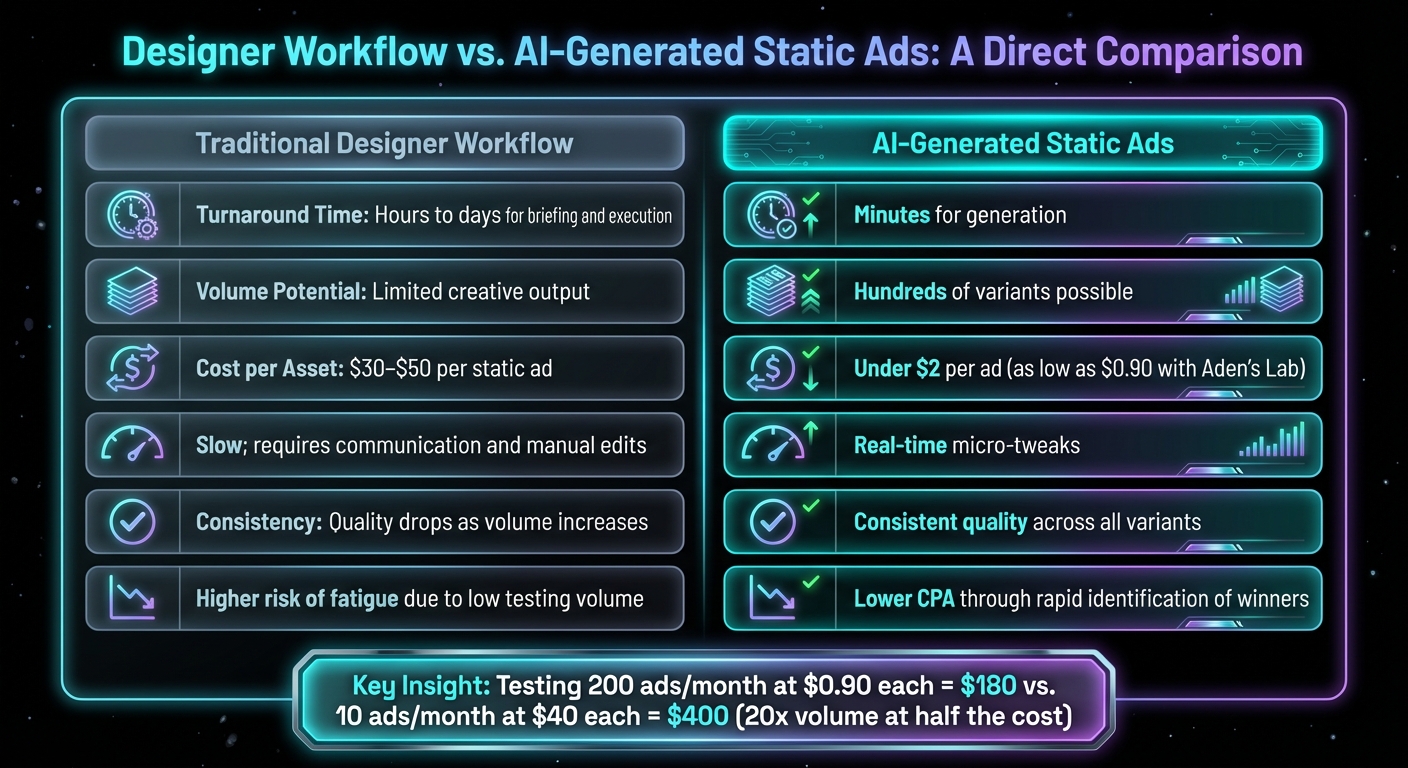
Designer Workflow vs AI-Generated Ads: Cost, Speed & Volume Comparison
Traditional workflows often hit a wall when it comes to speed and volume, creating structural challenges that limit the ability to find winning ads. AI-generated static ads tackle these issues head-on. They deliver what human teams simply can't: a massive output of high-quality creatives in a fraction of the time - minutes instead of days.
How AI Uses Speed and Volume to Lower CPA
AI tools can churn out dozens of ad variations in just minutes, allowing marketers to test and refine strategies at a scale that's impossible for traditional methods. Take the example of an app founder who needed to sustain Meta ad performance. They tested approximately 15,000 ads per month, which breaks down to 500 new ads every single day. No human team could achieve this without sacrificing quality.
Here's the math: with a 10% success rate, testing ten ideas typically yields one winner. AI makes this level of testing financially feasible. Instead of paying $30–$50 per static ad through a designer, AI platforms can produce hundreds of variations for a flat monthly fee. This approach shifts the focus from conserving creative resources to letting data determine what works.
AI also eliminates the delays that often hurt campaign performance. For instance, waiting two weeks for new ads from a designer can lead to a frequency increase and a 9% drop in click-through rates (CTR) once you hit a frequency of 2.0. With AI, you can launch fresh variants the same day you notice fatigue, keeping your campaigns ahead of performance dips. This speed not only solves logistical challenges but also ensures consistent creative quality.
Consistent Quality Without Delays
Human designers often struggle to maintain quality when tasked with producing large volumes of ads. As Nathan Hudson, Founder of Perceptycs, explains, teams may resort to "creative rationing", making minor adjustments - like shifting colors by a few pixels - just to meet volume demands. Unfortunately, these small tweaks don't offer fresh concepts that combat ad fatigue.
AI, on the other hand, delivers consistent quality across all generated variants, regardless of volume. Unlike manual revisions, which can lead to style inconsistencies, AI ensures a uniform aesthetic - matching fonts, colors, and overall design. This consistency is crucial because platforms like Meta rely on clean performance signals to optimize campaigns.
The usual production bottlenecks disappear entirely. There's no need for briefing, revision rounds, or back-and-forth discussions about minor design details. You simply provide a link, and within minutes, you have ready-to-test ads. This efficiency isn't just convenient - it directly impacts your CPA by enabling faster discovery of winning creatives and scaling them before they lose effectiveness.
Designer Workflow vs. AI Static Generation: A Direct Comparison
| Feature | Traditional Designer Workflow | AI-Generated Static Ads |
|---|---|---|
| Turnaround Time | Hours to days for briefing and execution | Minutes for generation |
| Volume Potential | Limited creative output | Hundreds of variants possible |
| Cost per Asset | $30–$50 per static ad | Under $2 per ad (as low as $0.90 with Aden's Lab) |
| Iteration Speed | Slow; requires communication and manual edits | Real-time micro-tweaks |
| Consistency | Quality drops as volume increases | Consistent quality across all variants |
| CPA Impact | Higher risk of fatigue due to low testing volume | Lower CPA through rapid identification of winners |
The contrast is more than just operational - it’s a game-changer for strategy. When you can produce dozens or even hundreds of ads each month without blowing your budget, creative stops being a limited resource. You can afford to test bold ideas, quickly retire underperformers, and double down on winners. This is how you drive CPA down and keep campaigns performing at their best.
Why Aden's Lab Solves the Meta Ad Creative Problem
Slow turnarounds, high costs, creative fatigue, and limited testing capacity can wreak havoc on your CPA and make scaling a real challenge. Aden's Lab was designed to tackle these issues head-on, giving Meta advertisers AI tools for Meta ads to move quickly and test extensively. It's all about speed and volume - two essentials we’ve already touched on.
Drop a Link, Get Static Ads in Minutes
With Aden's Lab, creating static Meta ads is as simple as dropping a link. No lengthy briefs, no extra steps. Just paste your product or landing page link, and within 90 seconds, you’ll have high-converting, ready-to-launch ads. The platform pulls everything it needs directly from your link, using proven direct-response techniques to craft ads that perform. It’s like having a creative engine that gets you from idea to execution in record time.
Built for High-Volume Ad Testing
Aden's Lab is built to handle the kind of ad volume that keeps Meta campaigns competitive. Depending on your plan, you can generate anywhere from 30 to over 200 ads each month, with costs as low as $0.90 per ad under the Apex Mode plan. This matters because performance relies on constant rotation - CTR typically drops by 9% when ad frequency hits 2. Instead of waiting days or weeks for new creatives, Aden's Lab lets you respond instantly to performance dips by generating fresh variants on demand.
Another key advantage is the platform’s ability to deliver creative diversity. Rather than overusing a single winning concept until it burns out, you can test entirely new ideas, messaging strategies, and visual styles. No need to wait on designers or blow through your budget. This approach mirrors what top brands do - testing hundreds of ads daily to let the data reveal the winners.
Real Results: Lower CPA and Higher ROAS
By making high-volume testing fast and affordable, Aden's Lab directly supports rapid creative iteration. Consider this: paying $30–$50 per ad for just 10 monthly tests adds up to $300–$500. Compare that to Aden's Lab at $179/month for 200 ads - that’s 20 times the volume for a fraction of the cost. More tests mean more chances to identify winning ads, which ultimately lowers your CPA.
Improving CTR has a direct impact on your cost per acquisition. For example, boosting creative to optimize CTR can slash CPA by up to 40%. With the ability to test dozens of ads weekly, you can quickly spot high-CTR performers, cut underperformers before they drain your budget, and scale winners while they’re still effective - before frequency rises and results start to dip.
The true edge isn’t just in saving money; it’s in outpacing competitors. While others are stuck testing 10 ads a month, you could be testing 50, 100, or more. That means finding winners faster, scaling more effectively, and keeping your creatives fresh enough to maintain momentum. That’s the formula for success on Meta.
Designers vs. AI: What Actually Lowers Your CPA
Here’s the bottom line: speed, volume, and consistency are the keys to success. While designers excel at crafting brand stories, their slower workflows can drive up your CPA when fast results are critical. Think about it - designer revisions can cost $30–$50 per ad and take days to complete. Compare that to AI-generated static ads, which are ready in just 90 seconds and cost as little as $0.90. That’s the difference between testing a handful of ads and scaling ad testing to hundreds of variations.
When you can test more ads at a higher volume, you identify top performers faster, refine your campaigns, and scale efficiently. Interestingly, it’s often the simple, no-frills creatives that grab attention and drive conversions better than expensive, high-production assets. AI tools focus on direct-response strategies, ensuring every creative is designed to lower your CPA by encouraging clicks and conversions.
The real edge? Staying ahead of the competition with speed and consistency. While others wait for manual revisions, you’re launching fresh creatives daily. This approach lets you replace fatigued ads before they hurt your performance and scale up your winners while they’re still effective. By maintaining this rapid pace, you combat rising CPAs and creative fatigue - two major challenges that can drain your budget and slow your growth.
Aden's Lab offers a solution tailored for this need: drop a link, get static ads in minutes, and churn out more winning creatives at an unmatched scale.
FAQs
When should I hire a designer for Meta ads?
If you're aiming for high-quality, eye-catching visuals to make your Meta ads stand out, hiring a designer can be a game-changer. This is especially useful if you're dealing with creative fatigue - when your current ads no longer grab attention - or if you lack the in-house resources to produce fresh designs. A skilled designer can also help you quickly test multiple creative variations, giving you a better chance to discover what resonates most with your audience.
How many new ad creatives should I launch each week?
Launching 3 to 5 new ad creatives each week is a great baseline to keep your campaigns fresh and avoid creative fatigue. That said, the exact number can vary depending on factors like your budget, the size of your target audience, and the goals of your campaign. Keep an eye on performance metrics and adjust as needed, especially if you notice your current creatives aren't resonating as strongly anymore.
What’s the best way to spot and fix creative fatigue fast?
To detect signs of creative fatigue, keep an eye on critical metrics such as a drop in click-through rates (CTR), an increase in ad frequency, or rising costs per result. If you notice these trends, it’s time to refresh your ads. This might involve rotating ad creatives, updating visuals or messaging, or leveraging dynamic creative tools to keep content engaging. Implementing frequency caps can also help prevent the audience from seeing the same ad too often. By staying on top of performance data and making timely adjustments, you can ensure your campaigns remain engaging and cost-effective.
Your next ad batch starts here
Finish with a ready-to-test ad batch
Paste your website to generate static creatives. Drop the link → get ads in about 90 seconds → upload them to Meta → scale.
Free to try No prompt writing