Why Most Ad Designers Optimize for Looks - Not Conversions
Try the workflow instead of comparing it
See what an AI ad generator makes from your product
Paste your product page and get a complete Meta ad batch—creative concepts, images, headlines, and copy—without another tool stack.
Free to try No prompt writing

Most ads fail because they prioritize looks over performance. Brands often spend money on visually appealing ads that don't convert, leading to higher costs and lower returns. Here's why this happens and how to fix it:
- Designers focus on aesthetics, not results: Designers are trained to create visually appealing ads, but Meta's algorithm rewards ads that drive actions like purchases or sign-ups.
- Polished ads often fail to stand out: Overly refined ads blend into users' feeds, while casual, natural-looking ads perform better.
- Metrics matter more than looks: Click-Through Rate (CTR), Cost Per Acquisition (CPA), and Return on Ad Spend (ROAS) reveal an ad's true performance.
- Ad fatigue hurts campaigns: Ads stop performing after repeated exposure, and slow production cycles make it hard to keep up.
- Speed is key: Fast ad production ensures campaigns stay effective and scalable.
The solution? Focus on ads designed to convert, not just impress, and streamline production to avoid creative fatigue. Tools like ADEN's LAB can help by generating conversion-focused ads quickly and affordably.
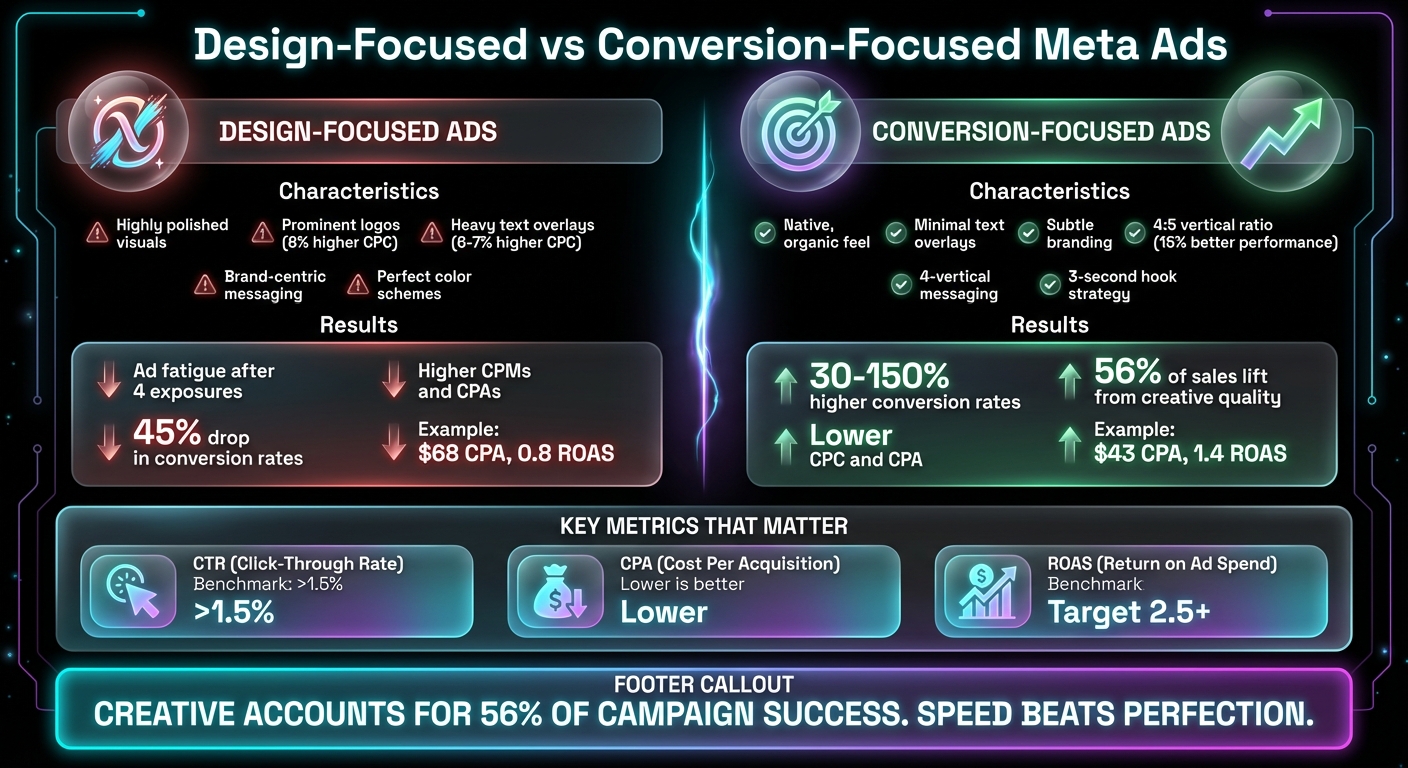
Design-Focused vs Conversion-Focused Meta Ads Performance Comparison
Why Beautiful Ads Don't Always Make Money
Designers Are Trained to Impress, Not Convert
Most designers are taught to create work that wows clients or looks great in presentations. But here's the thing: what impresses a client and what drives conversions on platforms like Meta are two entirely different goals.
Designers focus on crafting polished, on-brand visuals with cohesive color schemes and perfectly placed logos. While these elements are visually appealing, they rarely translate into ads that grab attention and drive clicks. Design education prioritizes aesthetics and visual hierarchy over direct-response essentials like urgency, clear offers, or social proof - the very things that actually get people to take action.
"Investing in top-dollar design can be an expensive detour on the way to conversions." - Dark Roast Copy Co
The result? Ads that blend into the feed instead of standing out. For instance, in a test of 48 ads, those without text overlays performed 6-7% better in Cost Per Click (CPC) compared to those with text. Why? Because users instantly recognized the text-heavy ads as promotions and scrolled past. Similarly, ads with subtle logos achieved an 8% lower CPC than those where the logo took center stage. When the focus is on making the brand the star, the ad becomes less effective - and more expensive to run.
Polished Ads Get Ignored in the Feed
While designers aim for perfection, mobile users behave differently. Most people scrolling on their phones have developed "ad blindness", a tendency to ignore anything that looks like a traditional ad. Since over 70% of Meta traffic comes from mobile devices, this behavior is critical to understand. With only 1–2 seconds to catch someone's attention, overly refined ads often fail to disrupt the fast-moving feed.
Highly polished ads tend to blend in rather than stand out. On the other hand, content that looks like it was casually shot on a smartphone often outperforms expensive, high-budget productions. Why? Because it feels more natural and less like an ad. This is why many brands now generate Facebook ads that prioritize speed and conversion over high-end production.
Another issue is the "scent" problem. A visually stunning ad might create excitement, but if the landing page doesn’t match the ad’s tone, design, or message, users quickly lose interest and leave. This disconnect is costly, especially when 97% of first-time visitors don’t convert. A beautiful ad that lacks alignment with the next steps in the funnel means wasted clicks and wasted budget.
"Ads that look like ads get ignored. Native content that provides value gets engagement AND sales." - Inbound Agency Dubai
Ultimately, ads need to be designed to convert - not just to impress. Otherwise, you're just paying for pretty pictures that don’t deliver results.
Put the playbook to work
Apply this playbook to your page
Paste your website and the Lab will turn the strategy you are reading into a ready-to-test ads.
Free to try No prompt writing
The Numbers That Actually Predict Ad Success
CTR Shows If Your Ad Stops the Scroll
CTR (Click-Through Rate) is the first hurdle your ad needs to clear. Without clicks, your creative isn’t doing its job. A CTR below 1.5% often signals that your ad isn’t grabbing enough attention to make people stop and engage. Even the most stunning visuals mean little if no one clicks.
That said, CTR measures interest, not purchase intent. For example, an ad with a 44% hook rate (the percentage of viewers who watch the first three seconds) might still result in a $68 cost per acquisition (CPA), while another with a slightly lower 41% hook rate could deliver a more efficient $43 CPA. Rahul Mondal from Ideon Labs sums it up best:
"High engagement does not guarantee high conversions. Meta only reveals true profitability through conversion data."
CTR is a solid indicator of how well your ad grabs attention, but it’s the CPA and ROAS (Return on Ad Spend) metrics that tell you whether your campaign is actually profitable.
ROAS and CPA Reveal If You're Making Money
ROAS and CPA are the ultimate measures of success, showing whether your ads are converting attention into revenue. While eye-catching creatives are great for engagement, these metrics confirm whether your ad truly delivers results.
Take this example from a supplement brand in late 2025: they launched six ads simultaneously. One ad, despite high engagement, had a $68 CPA and a 0.8 ROAS - essentially losing money. Worse, it pulled impressions away from a proven ad with a $43 CPA and a 1.4 ROAS, dragging down the campaign’s overall performance. After pausing the underperformers and focusing on their top 10 ads, the account bounced back to a 2.50 ROAS and a $29 CPA in just five days.
The lesson? High engagement doesn’t always translate to high conversions. Before making decisions, let your ads gather enough data - ideally 10 to 15 conversions - to accurately assess CPA and ROAS. Jumping to conclusions too early can lead to wasted budget on ads that look promising but fail to deliver, or worse, cutting ads that could have succeeded with more time. To avoid these pitfalls, use a Facebook ad budget calculator to plan your spend based on data-driven goals.
How to Get More Conversions from Facebook Ads (Proven Framework)
This framework relies on A/B testing Meta ads to identify which high-performance creatives actually drive the lowest CPA.
Why Even Good Ads Stop Working After a Few Days
You’ve got a winning ad. It’s performing like a dream - high CTR, solid ROAS, everything’s clicking. But then, just days later, the magic fades. CPMs spike, your cost per acquisition shoots up, and that once-golden ad starts to underperform.
This isn’t just bad luck. It’s creative fatigue, a natural consequence of how Meta’s algorithm operates. When people see the same ad too many times, they tune it out. They scroll past it without a second thought. This lack of engagement triggers Meta to reduce the ad’s reach, hike CPMs, and shift your budget elsewhere. On average, ad fatigue kicks in after a user sees the same ad about four times, and when it does, conversion rates can plummet by as much as 45%. Recent privacy updates have only made this worse. With smaller audience pools, your ads are shown to the same people more frequently, speeding up the burnout cycle.
And here’s the kicker: slow creative production makes the problem even harder to solve.
Slow Creative Production Kills Campaigns
The real issue isn’t that ads eventually fatigue - it’s that most advertisers can’t create new ads quickly enough to stay ahead of it. Standard design workflows are just too sluggish. A single ad can take 3–5 days to produce, and if you’re working with an agency, you’re looking at even longer delays due to revisions and approvals. By the time you finally get a handful of fresh ads, your “winner” has already run its course.
This delay isn’t just frustrating - it’s costly. If your cost per acquisition jumps from $43 to $68, every day you’re stuck running fatigued ads eats into your profitability. But you can’t just stop running ads altogether while you wait for new creative - you need those campaigns to keep generating revenue. So, you’re forced to keep running ads that no longer perform, draining your budget in the process.
The numbers paint a bleak picture. Let’s say your designer charges $50 per ad and takes a week to deliver 10 ads. That’s $500 and seven days spent just to have enough creative to test. Meanwhile, Meta’s algorithm is already deciding which of those 10 ads will get any budget - and in high-spend accounts, up to 90% of new ads might never even get a fair shot if they don’t immediately show promise.
The bottom line? If you’re not refreshing creative fast enough, your campaigns will struggle to scale.
Scaling Requires Volume, Not Perfection
In the world of Meta ads, creative volume is a game-changer. Brands that succeed are the ones that consistently scale ad testing and launch new ads every week. Meta’s algorithm thrives on novelty and variety. The more fresh creative you feed it, the better it can match your message to the right audience.
"The goal of creative testing is to find new winners. It's not about hitting an arbitrary number of creatives tested."
To stay ahead of creative fatigue, you need a system that churns out ads faster than they wear out. If your top-performing ad lasts two weeks, you’ll need to launch at least two or three new concepts each week just to maintain your campaign’s stability. And if you’re scaling aggressively, you may need to roll out dozens of ads weekly to keep the algorithm engaged and your performance steady.
This is where traditional workflows fall apart. A designer producing five ads a week at $50 each adds up to around $1,000 per month. But if you’re spending $150,000 monthly on Meta ads, creative accounts for 56% of your campaign’s success. Underspending on creative production is a surefire way to limit your growth. Winning brands don’t treat creative as a one-off task - they treat it as a repeatable, scalable process. That’s how they stay ahead.
How to Build Ads That Convert Instead of Just Look Good
Shifting focus from design-first to conversion-first doesn’t mean sacrificing aesthetics - it’s about prioritizing what drives real action. High-converting Meta ads aren’t just visually appealing; they’re crafted with a deep understanding of psychology and platform dynamics.
What High-Converting Meta Ads Actually Include
Successful Meta ads start with choosing the right format. The 4:5 vertical ratio isn’t just a stylistic choice - it performs up to 15% better in Feeds compared to square formats because it takes full advantage of mobile screen space. This ensures your ad grabs attention right from the start.
Another critical element is the 3-second hook. There’s no time for a slow build-up - your ad needs to grab attention immediately. Whether it’s through dynamic motion, bold claims, or eye-catching reveals like a "masking effect" that highlights a product feature, the first few seconds are make-or-break.
Next, think about copy structure. The MECLABS framework offers a straightforward formula: Conversion = Motivation + Value – Friction. To succeed, your ad should:
- Tap into user motivation.
- Clearly communicate the value of your offer.
- Minimize any hesitation or barriers to action.
For example, cold audiences often respond well to light, emoji-friendly text paired with perks like free shipping. On the other hand, warm audiences might react better to urgency-driven language and social proof, such as testimonials or reviews.
Finally, presentation matters. Ads with minimal text overlays tend to perform better, reducing cost per click (CPC) by 6–7%. Similarly, ads with overly prominent logos can increase CPC by about 8%. Keeping a native, organic feel helps your ad blend seamlessly into users’ feeds.
"Creative is the most important lever you have. Budget adjustments and targeting tweaks cannot fix tired creative."
- Ivan Teh, Advisible
These principles lay the groundwork for ads that convert. Now, let’s look at how automation can bring this approach to life.
How ADEN's LAB Automates Conversion-Focused Ad Creation
Producing ads manually often can’t keep up with the pace required for Meta campaigns. For example, if a designer charges $50 per ad and takes a week to deliver 10 ads, that’s $500 spent and critical time lost - delays that can stall your campaign.
ADEN's LAB produces ads on autopilot, offering a faster solution. By simply entering a product or landing page URL, the platform generates static Meta ads in minutes, using proven conversion strategies. It automates key elements like clear value propositions, attention-grabbing visuals, and triggers such as urgency and social proof. No need for creative briefs, endless revisions, or back-and-forth communication.
Pricing starts at $59 per month for 30 ads (about $1.97 per ad) and scales up to 200 ads at $0.90 per ad. For brands heavily investing in Meta ads - where creative quality directly impacts performance - this kind of speed and efficiency can be a game-changer.
This isn’t about replacing creativity with automation - it’s about eliminating production delays that can derail campaigns. With the ability to generate fresh ads weekly, brands can avoid creative fatigue, keep Meta’s algorithm engaged, and maintain ad effectiveness. The faster you test and iterate, the quicker you can scale and succeed.
Conclusion
Most ad designers focus on creating visually appealing ads because that's what they've been trained to do - impress peers, win awards, and build their portfolios. But here's the catch: polished ads often blend into the feed, causing banner blindness and failing to grab attention. On the flip side, "ugly" ads - those that prioritize performance over aesthetics - can boost conversion rates by 30% to 150% compared to overly polished ones.
Metrics like CTR (Click-Through Rate), ROAS (Return on Ad Spend), and CPA (Cost Per Acquisition) expose the true effectiveness of an ad, proving that looks alone don't drive results. In fact, creative quality contributes to 56% of sales lift in Meta campaigns, but only when that creative is designed to convert, not just to look good. A stunning ad that doesn’t convert is simply a waste of your budget. Using AI to optimize Meta ads can help bridge this gap by focusing on performance data rather than just aesthetics.
The real challenge isn’t about finding talented designers - it’s about speeding up production. If a designer takes a week to create 10 ads at $50 each, you're already falling behind. Meta campaigns demand constant creative updates to combat ad fatigue, and delays in revisions can derail momentum. That’s where ADEN's LAB steps in, delivering conversion-focused static Meta ads directly from a single URL within minutes. No briefs, no revisions, no waiting. Prices start at $1.97 per ad and drop to $0.90 per ad for higher volumes.
Speed isn’t just a convenience - it’s a necessity for maintaining ad performance. The ability to produce fresh creatives quickly is what keeps campaigns successful. So, shift your mindset: it’s not about what looks good in a portfolio - it’s about what performs in the auction. Test relentlessly, measure results, and prioritize production speed over perfection. The brands dominating Meta today aren’t the ones with the prettiest ads - they’re the ones cranking out ads faster than their competition.
FAQs
How can I tell if an ad is ‘pretty but unprofitable’?
An ad can be "pretty but unprofitable" when it looks visually appealing but fails to deliver results. This often happens when the ad doesn’t connect with the audience’s needs, the messaging is unclear, or it falls victim to creative fatigue - where even a great design loses its impact over time. Ultimately, it’s not just about aesthetics; the real question is whether the ad engages the audience and prompts them to take action.
How often should I refresh Meta ad creative to avoid fatigue?
Refreshing your Meta ad creative every 3 to 7 days is a smart way to avoid creative fatigue. When ads go stale, they often lose relevance and fail to engage your audience, which can drag down performance. Regularly updating your ads keeps them fresh, grabs attention, and ensures your campaigns stay effective.
What’s the fastest way to produce more conversion-focused ads?
Creating ads that drive conversions doesn’t have to be a time-consuming process. With a fully automated creative engine, you can produce high-quality, attention-grabbing ads in less than 90 seconds. All it takes is a single website link, and the system takes care of the rest. This means you can test ideas and scale campaigns quickly - without wasting time on manual tasks.
Your next ad batch starts here
Finish with a ready-to-test ad batch
Paste your website to generate static creatives. Drop the link → get ads in about 90 seconds → upload them to Meta → scale.
Free to try No prompt writing