Meta Ad Variations Generator: Create New Angles, Hooks, and Creatives Without Hiring an Agency
Turn the idea into a testing batch
Generate new hooks and angles from your product page
Paste your URL to create multiple ready-to-test concepts instead of adapting generic examples by hand.
Free to try No prompt writing

Struggling with Meta ad performance dropping after just a few days? The solution is simple: create and test more ad variations - faster. Instead of waiting weeks for new creatives from agencies or freelancers, brands are now using automated tools to produce dozens of ad variations in minutes, keeping campaigns effective and costs low.
Why it matters:
- Meta ads fatigue quickly: Engagement drops after users see the same ad repeatedly, leading to higher costs (CPC) and lower click-through rates (CTR).
- Traditional ad production is slow and costly: Agencies charge thousands and take weeks, while freelancers and in-house teams often can't keep up with demand.
- Automation changes the game: Tools like Aden's Lab let you generate 100+ ad variations instantly, helping you test faster, maintain performance, and scale ad spend.
Key stats:
- Brands using automated ad generation report:
- Up to 520% higher CTR.
- 40–45% lower CPC.
- Millions in additional revenue within days.
Takeaway: To keep Meta ad campaigns profitable, you need to refresh ads regularly with new angles and hooks. Automation makes this process fast, cost-effective, and scalable.
How To Build a Meta Ad Creative Machine (Step-by-Step)
Put the playbook to work
Apply this playbook to your page
Paste your website and the Lab will turn the strategy you are reading into a ready-to-test ads.
Free to try No prompt writing
Why Traditional Ad Production Slows You Down
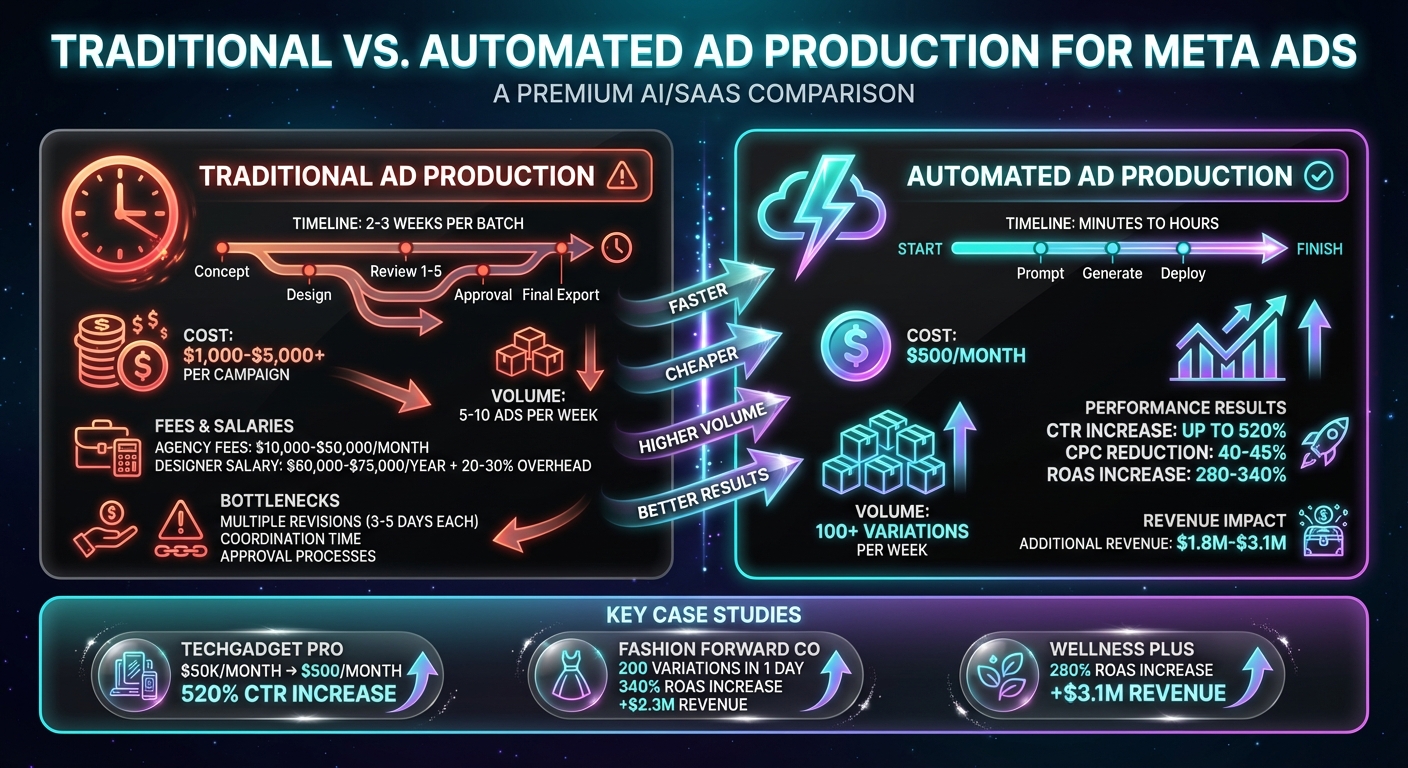
Traditional vs Automated Meta Ad Production: Cost and Performance Comparison
Many advertisers underestimate the hidden costs and delays tied to traditional ad production. It's not just about paying for the ads themselves - you're also funding a process that's riddled with inefficiencies. Agencies often involve large teams and lengthy brainstorming sessions. Freelancers juggle multiple projects, delaying deliverables. In-house designers get stuck in endless revision cycles and approval processes. By the time your ads are ready, market conditions may have shifted, and you've missed the chance to act quickly.
Take this scenario: A creative agency charges over $1,000 for 10 ads and takes two weeks to deliver. This doesn't even account for time spent drafting briefs, reviewing designs, managing revisions, and chasing final files. For instance, Sarah Chen, CMO of Fashion Forward Co., dealt with a three-week timeline for just 10 ads. After switching to an automated system, she produced over 200 variations in a single day, which increased her ROAS by 340% and added $2.3 million in revenue.
Scaling only makes things harder. Imagine spending $500 daily on Meta ads, only to see your best-performing creative lose effectiveness after a few days. If your designer is unavailable to create new ads, the impact can be severe - your CTR might drop from 2.1% to 0.9%, and your CPC could double. TechGadget Pro faced this exact issue, spending $50,000 per month on creative agencies but struggling to keep up with demand. Switching to AI-generated creatives slashed their costs to $500 per month, boosted their CTR by 520%, and reduced their CPC by 45%.
The hidden costs don’t stop there. Time spent recruiting, onboarding, and managing teams adds up. Campaigns delayed due to production bottlenecks represent lost opportunities. Wellness Plus, a health brand, spent $10,000 monthly on agency fees. But when Founder Dr. Amanda Foster adopted an automated approach, she saw a 280% increase in ROAS and generated $3.1 million in additional revenue with ads that connected better with her audience.
Speed is more important than perfection. When you're limited to producing 10 ads every two weeks, you're forced to gamble on a small set of ideas. If those ideas fail, you're stuck waiting while competitors test and adapt quickly. These delays drive up costs and disrupt your ability to test and optimize effectively - something we’ll explore further.
What It Actually Costs to Produce Ads the Old Way
The inefficiencies of traditional ad production are not just frustrating - they're expensive. Beyond the $1,000+ baseline for a small campaign, a full campaign with multiple angles can easily exceed $5,000. But the invoice doesn’t tell the whole story.
Initial drafts rarely hit the mark, leading to multiple rounds of revisions. Each round can add three to five days to your timeline. Meanwhile, competitors are already testing and refining their campaigns.
Freelancers may seem like a cheaper alternative, charging $30 to $50 per ad. However, managing multiple contractors introduces its own headaches, from inconsistent quality to added coordination time. Some freelancers might perfectly align with your brand, while others miss the mark, leaving you bogged down in management rather than focusing on your campaigns.
In-house teams come with their own set of costs. A mid-level U.S. designer typically earns $60,000 to $75,000 annually, with an additional 20% to 30% in overhead for benefits, software, and training. Even the most talented designer can only handle so much work before quality suffers or burnout sets in.
The biggest cost, however, is missed opportunity. Every day spent waiting on creatives is a day not spent testing, learning, and scaling. This delays your feedback loop, slowing down your campaign’s progress and momentum.
Why Your Ads Stop Working After a Few Days
Meta’s algorithm is designed to prioritize immediate engagement. When a new ad launches, it targets the audience most likely to interact with it. In the beginning, your CTR is high, CPC is low, and conversions come steadily.
But as users see the same ad repeatedly - usually after one to three views - engagement starts to decline. Once ad frequency exceeds 3 to 4 impressions per person, the algorithm broadens its reach to less-engaged users. This shift causes your CTR to drop, CPC to rise, and acquisition costs to climb. Within a week, even a high-performing ad can lose its effectiveness.
This isn’t a failure of your targeting or offer - it’s simply how Meta’s system works. The platform thrives on fresh engagement, and if your production process takes weeks, you’ll always be playing catch-up as your older ads lose their appeal.
How Meta's Algorithm Responds to New Creatives
Meta's delivery system doesn't care about your brand story or how much time you spent prepping - it’s laser-focused on one thing: engagement. The algorithm prioritizes ads that grab attention, drive clicks, and convert. When you upload a new creative, Meta puts it through a test. If it generates strong engagement signals, you’ll see better distribution at lower costs. If not, performance drops, and costs go up.
Here’s an important point: small tweaks like changing a button color or font won’t cut it. Meta’s algorithm thrives on variety. It needs completely different hooks, angles, and formats to learn effectively. Testing multiple, distinct creatives at once gives the system a wealth of data points, allowing it to quickly figure out what resonates with your audience. Think of it like taking several shots on goal instead of betting everything on one attempt. Creatives that spark real interactions - clicks, comments, shares - are rewarded with broader reach and lower costs.
What Meta's Delivery System Actually Optimizes For
Meta’s budget allocation revolves around engagement signals. Metrics like clicks, video watch time, and conversions tell the algorithm your ad is worth showing to more people. Strong signals mean lower costs per result, while weak signals lead to higher costs as the system struggles to maintain reach.
New creatives have an edge because they avoid audience fatigue. In the early days of a creative’s lifecycle, click-through rates (CTR) are typically higher, and costs per click are lower. But as the same ad is shown repeatedly (measured as frequency), engagement starts to dip. Meta interprets this decline as a drop in quality, which leads to higher costs per thousand impressions (CPM). Aden's Lab takes advantage of this by constantly pushing out fresh creatives to keep engagement high.
This is why creative velocity - the speed at which you produce and test new ads - matters more now than ever. Even the best-targeted campaigns can falter if the creative becomes stale.
How to Avoid Performance Drops from Overused Ads
To prevent rising costs and declining results, it’s crucial to refresh your ads before they hit fatigue. Update the visuals, messaging, or overall angle regularly. Many advertisers wait until performance tanks to make changes, but by then, they’ve already absorbed higher costs and lost conversions. A steady stream of fresh creatives keeps your campaigns ahead of the curve.
For instance, performance marketer James Williams monitored a lead generation campaign in November 2025 with a baseline cost per acquisition (CPA) of $32. By day 12, after running the same creative, the CPA climbed to $51 - a 59% increase - as frequency hit 3.1. After introducing a new set of creatives with identical targeting, the CPA dropped back to $34 within 48 hours.
This example highlights how timely creative updates can reset campaign performance.
Creative fatigue isn’t just about visuals - it’s also about the message. Even a refreshed hook can re-engage your audience and prevent costs from spiraling.
Brands that tackle this challenge head-on aren’t just avoiding performance dips - they’re scaling their campaigns more efficiently. Producing 10 to 15 new creative concepts each week creates a testing environment where Meta’s algorithm can consistently find and amplify top-performing ads while phasing out the underperformers. This approach is key to maintaining strong results as you scale your ad spend.
What Makes a Meta Ad Actually Perform
Many advertisers focus heavily on targeting and budget, but the real game-changer is much simpler: your creative elements. A strong creative can make average targeting look exceptional, while even the best targeting can't save a weak creative. After managing over $100M in Meta ad spend, this trend is crystal clear.
The difference between a $15 CPA and a $60 CPA often boils down to these basics. Pairing this approach with regular creative updates helps combat ad fatigue. Let’s dive into the essentials, starting with the hook.
How to Write Hooks That Stop the Scroll
Your hook has just 2 to 3 seconds to grab someone’s attention mid-scroll. If your first line or visual doesn’t stand out, users will scroll past, and your ad will fade away in the algorithm.
The most effective hooks address a specific problem or desire. For example, instead of saying, “Introducing our new product,” try, “You’re probably making this mistake…” The first is forgettable, while the second creates curiosity and compels the viewer to keep watching.
Pattern interrupts are another powerful tool - they disrupt the typical flow of a feed. A bold statement, an unexpected opinion, or a targeted question like “Coaches and creators - ” makes the user feel personally addressed. When Fashion Forward Co. tested over 200 ad variations in a single day, using a system to produce Meta ads on autopilot, the most successful hooks weren’t flashy - they were clear about the benefit.
"Your hook is the most critical part of your ad copy. It's the bait that stops the scroll and entices users to read more." - Daisy Digital Marketing
Start by framing the problem before presenting the solution. For instance, if you’re promoting a productivity tool, lead with “70% of businesses fail to convert their website visitors” instead of immediately listing features. Emotional engagement comes first, logic follows.
Design Choices That Increase Click-Through Rate
Once your hook captures attention, your ad’s design must guide the viewer’s focus. On Meta, visual clarity beats aesthetics. Your ad should look clean, bold, and native to the feed - not like a generic template or AI-generated image. Use high-contrast colors, clear visuals, and text that’s easy to read on mobile screens.
Text placement is another critical factor. If your key message is hidden in the bottom third of the image, mobile users might never see it. Position important information in the top half, use large fonts, and create a visual hierarchy that naturally leads the eye to your CTA.
TechGadget Pro experienced a 520% boost in CTR after switching to ads with conversion-focused layouts. These designs weren’t necessarily prettier - they were simply more effective at guiding users to take action.
Keep it simple. Stick to one clear message, one dominant image, and one obvious next step. Trying to cram multiple benefits into a single ad dilutes the impact. Meta’s algorithm rewards clarity and focus.
Why Your CTA Determines Conversion Rate
After an engaging hook and clean design, the call-to-action (CTA) is what closes the deal. Your CTA should be visually distinct, use action-oriented language (verbs like “Get,” “Start,” “Discover” work well), and align perfectly with the next step.
If your ad promises “Get Your First Meal Free” but the landing page asks for a credit card without mentioning the free meal, you’ve broken trust - and your conversion rate will plummet. The CTA must deliver on its promise.
Wellness Plus saw a 280% increase in ROAS and generated $3.1M in added revenue by switching to benefit-driven CTAs like “Start Your Free Trial” instead of generic ones like “Sign Up”. Small tweaks can make a massive difference.
Meta’s system requires at least 50 conversion events over 7 days to optimize performance. Changing your CTA mid-campaign disrupts this learning phase. Instead, test multiple CTAs upfront in separate ad sets and let the algorithm identify the winner.
How to Produce More Ads Without Spending More Money
The real challenge in ad production isn’t your budget - it’s how fast you can create. Stale ads drag down performance, so producing fresh creatives quickly is essential. You can’t scale your ad spend if you’re stuck waiting weeks for a designer to deliver just a few ads. By the time those ads are ready, the market may have shifted, and competitors could already be testing new ideas. This leaves you stuck running outdated creatives.
Traditional production methods, which often involve multiple design revisions and cost $500–$2,000 per ad over a 2–3 week timeline, slow everything down. If you’re spending $10,000 or more daily on Meta, this lag makes it impossible to keep campaigns fresh and effective.
The solution isn’t about hiring more people or increasing your creative budget. Instead, it’s about cutting out the manual process entirely. With tools like Aden’s Lab, you can simply drop a link, instantly generate dozens of static ads, and launch them on Meta - no waiting, no bottlenecks.
Now, let’s break down how automation solves these creative challenges. Many teams are already automating Meta ad production to reclaim dozens of hours each week.
Why Automation Solves the Creative Bottleneck
Automation takes weeks of work and condenses it into minutes. Instead of relying on designers and dealing with endless revisions, you upload your product link and receive a variety of high-performing static ads tailored for Meta. These systems create multiple versions with different hooks, angles, and layouts. The result? Campaigns that see massive performance boosts, like a 340% increase in ROAS and millions in additional revenue.
Here’s why this approach works: Meta’s algorithm thrives on volume. Feeding it a large pool of creatives - 100 variations with different messages and visuals - helps it quickly identify the winners. Instead of testing a handful of ads one at a time, you can test dozens simultaneously and find top performers in just 3 to 5 days.
Automation also prevents a common issue: creative fatigue. Reusing the same ads for too long causes performance to drop, so you need fresh variations as soon as fatigue sets in. With automated tools generating new creatives on demand, your campaigns stay dynamic and effective.
Take TechGadget Pro, for example. By switching to automation, they cut their creative spend from $50,000 per month with agencies to just $500. The results? A 520% increase in CTR, a 45% drop in CPC, and an additional $1.8 million in revenue.
Once you’ve streamlined creative production, the next step is implementing a system to test and optimize consistently.
How to Build a Repeatable Testing System
After speeding up ad production, you need a system to test, analyze, and refine your campaigns efficiently. Here’s a simple framework to follow:
- Generate 100+ Variants: Create ads in various formats - static feed ads, Stories, Reels - and ensure they’re ready for different placements and aspect ratios. Export them directly to Meta Ads Manager.
- Monitor Performance Daily: Track key metrics like CTR, CPC, and ROAS. After 48 hours, pause ads with a CTR below 1% or ROAS under 2× your benchmark.
- Scale winning creatives quickly: If an ad achieves a CTR 1.5–2 times higher than your account average, a CPC 20%–30% lower than usual, and a ROAS of 3×–4× within 3–5 days at 50,000+ impressions, duplicate it and increase the budget by 2–5 times. Timing is everything.
- Refresh Creatives Regularly: Even top-performing ads eventually lose their impact. Replace 20%–30% of your creatives weekly - ideally before ad frequency hits 4. Use proven hooks and designs to remix and test new combinations.
This system removes guesswork. Instead of relying on subjective decisions, you let performance data guide your next steps. For instance, Wellness Plus replaced their $10,000-per-month agency with this automated approach, boosting their ROAS by 280% and generating an extra $3.1 million in revenue.
Advertisers managing large Meta budgets don’t rely on occasional creative successes - they build systems that consistently deliver fresh, testable ads. When you combine fast production with smart testing, you create campaigns that can keep up with your budget and maintain peak performance.
Conclusion: How to Maintain Performance While Scaling Spend
Scaling Meta ad spend becomes much easier when your creatives stay fresh and engaging. Reusing the same ads too often can lead to audience fatigue, which can cause click-through rates (CTR) to drop by 20–50% in just a few days. The solution? Consistently providing the platform with new creatives.
The real challenge isn't usually the budget - it’s the slow, manual process of creating ads. Most advertisers hit a ceiling, managing only 5–10 new ads per week using traditional methods. That’s where automation steps in to save the day. With tools like Aden's Lab, you can simply drop in a link and instantly generate dozens of static ads ready to perform on Meta. This eliminates production delays and removes creative bottlenecks.
Top-performing brands don’t wait until their ads underperform. They replace fatigued creatives before ad frequency hits 4, ensuring their return on ad spend (ROAS) stays strong as they scale. Instead of banking on a single winning ad, they create systems for iterating Meta ads capable of producing over 100 variations every week. By testing these variations with real-world performance data and refreshing creatives before results dip, scaling becomes a smooth and predictable process. When creative production keeps pace with your budget growth, you can maintain consistent performance and a healthy ROAS.
FAQs
How often should I refresh Meta ad creatives?
Refreshing your Meta ad creatives regularly - aiming for about every 90 days - can help you avoid creative fatigue and keep your campaigns performing well. Tools like Aden’s Lab make it easier to generate effective variations in bulk, saving both time and money. Think of creative updates as a continuous process to experiment with new ideas, adjust to shifts in audience behavior, and sustain strong results without the hassle of doing everything manually.
How many ad variations should I test each week?
Testing 3 to 6 ad variations per week is a solid strategy. For most campaigns, starting with 3-5 variations offers a good mix of diversity while ensuring you allocate enough budget to collect meaningful data. If your budget allows, you can push this to 6 variations, but be cautious not to dilute your spend too much. Consistent testing is essential because, in reality, only about 1 to 3 out of 10 ad creatives tend to deliver strong results over the long haul.
What’s the fastest way to make new Meta ads from my website?
The fastest way to craft Meta ads directly from your website is by using an AI-powered ad generator. All you need to do is paste your product link into the tool, and it instantly generates ready-to-launch, high-quality ad creatives. There’s no need for prompts, complicated setups, or a steep learning curve. This method not only saves time but also removes the stress of manual ad creation, delivering eye-catching results in seconds.
Your next ad batch starts here
Finish with a ready-to-test ad batch
Paste your website to generate static creatives. Drop the link → get ads in about 90 seconds → upload them to Meta → scale.
Free to try No prompt writing