10 Meta Ad Prompts You Can Copy + Paste to Generate Winning Ads in 2026
Use the prompts on your real offer
Generate these ad angles for your product
Skip the blank prompt box. Paste your product page and ADEN'S LAB applies the angles to your offer, images, headlines, and copy.
Free to try No prompt writing

Meta advertising in 2026 demands constant updates to avoid creative fatigue and keep costs low. To succeed, you need a steady flow of engaging ad variations that resonate with your audience. This guide provides 10 ready-to-use ad prompts tailored for e-commerce, SaaS, and lead generation campaigns. These prompts are designed to:
- Save time by automating Meta ad production to generate ads in minutes.
- Increase click-through rates (CTR) by 15–25%.
- Combat ad fatigue with multiple creative variations.
- Target specific audience pain points for better conversions.
Key Ad Types and Strategies:
- E-commerce Product Hook: Use pattern interrupts to grab attention quickly.
- SaaS Free Trial Ads: Highlight time-to-value with clear CTAs.
- Lead Gen Pain Point Hooks: Address specific frustrations to capture high-quality leads.
- Before-and-After Visuals: Showcase transformations to build trust.
- Competitor Comparisons: Highlight benefits over competitors' weaknesses.
- Story-Based Teasers: Use relatable narratives to drive engagement.
- Bundle Offers with Scarcity: Use urgency to boost average order value (AOV).
- SaaS Feature Highlights: Translate features into measurable outcomes.
- Testimonial Ads: Leverage customer success stories with specific results.
- Creative Fatigue Fighters: Rotate 8 ad variations to maintain performance.
These prompts are optimized for Meta's latest algorithms and ad formats, helping you achieve better results without needing a large design team. Whether you’re running a $100/day or $5,000/day campaign, these strategies can help you stay ahead of competitors while lowering acquisition costs.
Create Winning Meta Ads with AI | Step-by-Step Tutorial
Put the playbook to work
Apply this playbook to your page
Paste your website and the Lab will turn the strategy you are reading into a ready-to-test ads.
Free to try No prompt writing
1. E-commerce Product Hook with Pattern Interrupt
Pattern interrupts are designed to grab attention instantly. With users scrolling at lightning speed, your ad has about 3 seconds to stop them in their tracks. A bold question, surprising statistic, or unexpected statement can do the trick, boosting view-through rates by 20–30%, according to Meta's creative best practices.
Here’s a simple formula for creating an effective hook: [Unexpected Statement] + [Pain Point] + [Product Tease] + [CTA]. For example, "Stop! Your skincare routine is failing you - here's why" works well for beauty products. Similarly, "99% of diets fail... except this $29 gadget" sparks curiosity for fitness items, encouraging users to pause and click.
Here’s a practical example you can try:
"Generate a Meta carousel ad for [Product: Wireless Earbuds, $49.99 USD]. Start with pattern interrupt hook: 'Sick of tangled wires ruining your run?'. Headline: 'True Freedom Awaits'. Body: 'Crystal sound | 20hr battery | Waterproof'. CTA: 'Grab Yours - 50% Off Today!'. Attach 4 images: interrupt, product, lifestyle, testimonial. Optimize for US mobile users, under 125 characters primary text."
This prompt helps you design visuals that engage users and inspire immediate action.
To enhance the impact, precise targeting is essential. Use interest-based targeting, like "online shoppers" or "enthusiasts in [product category]", combined with demographic filters (age 25-45, US locations) and lookalike audiences based on previous buyers. Incorporating AI-driven purchase intent signals can improve ROAS by 15–25% for campaigns in 2026. For visuals, close-up product shots or user reactions with bold text overlays (covering no more than 20% of the image) can double CTRs.
Monitor your ad performance using Meta Ads Manager. Hooks that achieve a 1% CTR or higher are your winners. For instance, in Q1 2025, DTC skincare brand Glossier ran video ads with the headline "Your $200 serum is a scam", targeting women aged 25-35. This campaign achieved a 5.2% CTR (compared to the 1.8% industry average), a 32% conversion lift, and generated $1.4M in revenue from just 150,000 impressions [Glossier Case Study on Meta Business Blog, April 2025].
2. SaaS Free Trial Direct Response CTA
For SaaS companies, getting users to sign up for free trials is a cornerstone of growth. Your ad needs to grab attention, stop the scroll, and make people click "Start Free Trial." By 2026, Meta's algorithm prioritizes ads that clearly convey their purpose, so your copy must eliminate confusion and highlight how quickly users can see results - this is referred to as time-to-value (TTV).
A proven way to craft such ads is by using proven Meta ad copy frameworks like PAS-V (Problem, Agitation, Solution, Validation). This approach focuses on addressing customer pain points, stirring urgency, offering a clear solution, and building trust. Below is a practical prompt to guide your ad creation: You can also leverage AI tools for Meta ads to further automate this process.
"Write as a Senior Direct Response Copywriter for B2B SaaS. Generate a Meta single image ad for [Product: AI-driven CRM for boutique real estate agencies, 14-day free trial, $49/month after]. Hook: 'Tired of losing leads in messy spreadsheets?'. Body: 'Set up in 2 minutes | First client report in 60 seconds | No credit card required'. Headline variations: 3 options (short, medium, long). CTA: 'Start Your Free Trial'. Avoid jargon like 'synergy' or 'game-changer'. Use conversational, 6th-grade reading level. Target US professionals aged 30-50 on mobile."
This prompt works because it avoids generic, overused language and focuses on delivering clear, actionable messaging. Including "no credit card required" is especially effective - data shows that trials without upfront credit card requirements convert over 25%, while requiring a credit card can push conversions past 60%.
To boost conversions, refine your audience targeting. Focus on role-specific segments like Marketing Managers or Sales Directors. Use behavioral signals such as "recently engaged with SaaS content" or "visited software review sites" to zero in on potential users. Meta's Advantage+ audiences in 2026 rely on keywords like "workflow automation", "API integration", and "client tracking" to identify the right people.
For the trial itself, 7 to 14 days is the sweet spot. It’s enough time for users to see the product's value while maintaining urgency. During Meta's Learning Phase, monitor trial signups closely and adjust your hook and CTA as needed within the first 24 hours.
3. Lead Gen Pain Point Question Hook
When it comes to grabbing attention in lead generation ads, pain-point questions are your secret weapon. Why? Because they resonate deeply with your audience's struggles, creating an instant connection. The goal is to hook your lead within two seconds - yes, that's all the time you have. A well-crafted pain-point question mirrors their internal frustrations, sparking a micro-commitment that nudges them to click and engage.
The trick lies in being specific. A vague question like "Need more leads?" won't cut it. Instead, go for something laser-focused: "Are your sales reps wasting 3 hours a day on manual data entry?" This approach not only addresses a clear problem but also filters out users who aren't your ideal audience. The result? Higher-quality leads and better signals for Meta's algorithm. In 2026, Meta's AI takes this further with creative-led targeting, analyzing the semantic content of your ad to match it with users who exhibit behaviors tied to that exact pain point.
To make this work, keep your hooks short and punchy - 125 characters or fewer. Start with the pain-point question, follow it up with a brief sentence that validates their frustration, and then introduce your lead magnet. Here's a ready-to-use ad copy ideas and prompt:
"Act as a Meta Ads Copywriter. Generate 5 lead generation hooks for [Industry: financial advisors targeting small business owners]. Start each hook with a 'Pain Point Question' regarding [Problem: retirement planning gaps for entrepreneurs]. Include a concise bridge sentence that confirms the pain point and a CTA for [Lead Magnet: Free Retirement Readiness Checklist]. Limit hooks to 125 characters. Use conversational, mobile-first language. Target US audience aged 35-55. Format: vertical 4:5 for Feed, 9:16 for Stories/Reels."
To ensure your leads don’t slip through the cracks, sync your Meta Lead Ads with your CRM using the Conversions API. This allows you to automate follow-ups via email or SMS within minutes. Additionally, use Instant Forms with prefilled fields and multiple-choice questions to qualify leads quickly and keep them engaged. With these tactics, you’ll not only capture attention but also convert it into meaningful action.
4. E-commerce Before-After Transformation Visual
Before-and-after visuals are a game-changer in e-commerce. They cut through skepticism, deliver proof, and build trust faster than any text description ever could. People want to see results, and this format provides undeniable evidence.
This approach works particularly well for industries like skincare and beauty (showing smoother skin or reduced acne), fitness and health supplements (illustrating body transformation), home decor (highlighting dramatic makeovers or improved organization), and consumer electronics (showcasing the leap from outdated, bulky models to sleek, modern ones). In real estate, for example, virtually staged property listings attract 40% more views - proof that transformation visuals drive engagement.
The secret to effective before-and-after visuals? Consistency. The subject must be clearly identifiable in both images. To achieve this, follow a three-step approach: retain key elements, specify the changes, and ensure the style feels cohesive. For mobile-first platforms like Stories or Reels, use a vertical stack layout with "Before" at the top and "After" below. On desktop, a side-by-side format aligns with natural reading patterns.
Here’s a ready-to-use creative prompt:
"Act as a Meta Ads Creative Director. Generate 3 before-and-after transformation ad concepts for [Product: anti-aging serum for women 40-60]. Show [Transformation: reduction in fine lines and improved skin texture over 30 days]. Use vertical stack layout (Before top, After bottom) optimized for 9:16 Stories/Reels and 4:5 Feed. Include overlay text: 'Before' and 'After' labels, plus a headline hook addressing [Pain Point: visible aging signs]. Add disclosure text 'AI-enhanced visualization' per FTC requirements. Use negative prompts: --no blurry, text, logos. Target US audience. Style: clean, bright natural lighting, authentic skin tones."
Stick to Meta’s recommended aspect ratios - 1:1, 4:5, and 9:16 - for maximum ad delivery efficiency. And don’t forget: if the transformation images could influence purchasing decisions, include the FTC-required disclosure "AI-enhanced visualization" to remain compliant. This strategy not only builds trust but also sets the stage for more creative ad innovations.
5. SaaS Competitor Comparison Statement
Competitor comparison ads tap into how B2B buyers weigh costs and benefits. When someone’s considering switching tools, they’re already doing a mental cost-benefit analysis - and your ad can do the heavy lifting for them. A simple formula works well here: "Get [Desired Result] without [Competitor's Main Pain Point]". This structure keeps your message clear while giving you an edge over competitors.
Meta's "Andromeda" algorithm now uses your ad's creative to define the audience. Highlighting common frustrations - like per-user fees or limited payroll runs - helps Meta’s AI zero in on users dealing with those exact pain points. Messaging focused on outcomes, such as "Know your margins every time", lets prospects compare it to their current experience.
Incorporate performance metrics like ROAS or CPA to attract high-intent audiences who care about those numbers. Since 94–98% of Meta traffic is mobile, ensure your visuals are optimized for vertical formats. Use these insights to refresh your ad creatives and avoid falling into a creative rut.
Here’s a ready-to-use prompt to get started:
"Act as a Meta Ads Strategist for B2B SaaS. Create 3 competitor comparison ad concepts for [Product: accounting software for e-commerce brands]. Use the framework 'Get [Outcome: real-time profit tracking] without [Competitor Pain Point: paying per user or expensive accountant fees]'. Create a split-screen visual optimized for 9:16 (Stories) and 4:5 (Feed): left side shows 'Chaos' with spreadsheet confusion and question marks, right side shows 'Control' with clean dashboard displaying specific metrics [Example: 18.2% profit margin]. Use a hook like 'Still paying $X per seat for [Competitor Category]?' paired with the CTA 'Start free 14-day trial - no credit card.' Use a UGC-style, lo-fi aesthetic that integrates seamlessly with organic feeds. Target US audience, ages 25–45, interests: Shopify, QuickBooks, e-commerce. Optimize for Conversions API (CAPI) tracking of Sales Qualified Leads (SQLs), not just form fills."
To maximize results, feed Meta data on actual SQLs or Opportunities through the Conversions API. This approach trains the algorithm to target users who are more likely to switch from competitors rather than just generating cheap leads. Rotate 3–5 creative variations weekly to keep your ads fresh and test different competitive angles. Keep an eye on key metrics like ROAS and analyzing CPA to measure how well your comparison ads perform. Use these strategies to fine-tune your approach and stand out against competitor benchmarks.
6. Lead Gen Story-Based Teaser
Story-based ads work by weaving a narrative that connects emotionally with the audience, rather than relying on aggressive sales tactics. These ads use relatable stories to build trust and then guide viewers toward taking action. A great example of this approach is seen in campaigns like BYJU'S.
BYJU'S created testimonial video ads where parents shared their experiences. These videos included a "Get a Call Back" button that directed users to a Meta Instant Form. The campaign achieved measurable success, increasing ad recall by 7.9 points and action intent by 3 points. To enhance engagement, they extended the narrative within the form using the Rich Creative type, which incorporated images and product details.
To replicate and improve upon these results, campaigns in 2026 should integrate specific technical features to maximize lead generation. For instance, using Advantage+ leads campaigns paired with Instant Forms featuring conditional logic can significantly enhance performance. This setup leverages machine learning to simplify targeting and has been shown to reduce the cost per lead by 36% compared to manual campaigns. Adding SMS verification can further improve results, cutting down invalid phone numbers by 32% and doubling conversions (2.2X). To ensure Meta’s algorithm exits the learning phase and optimizes effectively, aim for at least 50 conversions per week.
Here’s how you can apply this storytelling approach with precise targeting and form logic:
Act as a Meta Ads Lead Generation Specialist. Create 3 story-based teaser ad concepts for [Product: financial planning services for new parents]. Use a testimonial-style hook featuring a relatable customer journey: "When our daughter was born, we had $0 saved for college. Here's what changed everything." Design for 9:16 (Stories) and 4:5 (Feed) formats, using UGC-style video or a static image carousel to showcase the transformation journey. Connect these ads to a Meta Instant Form utilizing the Rich Creative form type, displaying visuals of financial planning steps. Include conditional logic: if the user selects "Yes" to having kids under 5, show a question about current savings; if "No", ask about their planning timeline. Add SMS verification with a one-time code to qualify leads. Use a "Learn More" CTA button. Target a US audience, ages 28–42, with interests in parenting, Dave Ramsey, and Fidelity. Optimize for an Advantage+ leads campaign tracking "Form Submissions" via the Conversions API. At form completion, include a message: "Your personalized plan is ready! Book your free 15-minute call now" with a calendar link button.
This strategy combines storytelling with advanced targeting and form customization to create engaging, high-performing ads. Before launching, use Meta's Lead Ads Testing Tool to verify that data integrates correctly with your CRM.
7. E-commerce Bundle Offer with Scarcity
Let’s talk about how scarcity can supercharge your e-commerce bundle offers. This strategy not only increases average order value (AOV) but also nudges customers to act quickly with strategic ad scheduling, aligning perfectly with Meta's Sales objective, which focuses on high-conversion users. When executed well, bundle ads encourage customers to purchase more in one go by creating a sense of urgency that eliminates hesitation.
To make the most of this tactic, take advantage of Meta's Collections feature in Commerce Manager. This tool lets you group related products into a single, visually appealing ad unit. For example, you can showcase multiple items in a neat, scrollable format. Just remember: if you’re using urgency-driven phrases like "limited-time" or "ends tonight", ensure they take up less than 20% of your image space. Meta's algorithm may restrict your ad’s reach if there’s too much text. As Afsheen Ali, Product Marketing Manager at Facebook, explains, "Our research has shown that people demonstrate a preference for ads with less text".
Getting the technical setup right is just as important as nailing the creative side. Use Advantage+ catalog ads to automatically create carousel or collection formats that target high-intent buyers. These ads should link directly to dedicated product collection pages, which minimizes friction and improves conversion rates. To measure success, track metrics like ROAS (return on ad spend), conversion rates, and AOV.
Here’s a practical prompt that ties it all together:
Act as a Meta Ads E-commerce Specialist. Develop 3 bundle offer ad concepts for [Product: skincare routine bundle - cleanser, serum, moisturizer]. Use a scarcity-driven hook: "Complete Routine Bundle - Save 35% (48 Hours Only)." Design for a carousel format (1:1 ratio), with each card highlighting one product in the bundle and the final card showing total savings. Ensure promotional text covers less than 20% of the image area. Include a strong "Shop Now" CTA button that links to a dedicated collection page where the promo code is auto-applied. Set this up as a Sales campaign optimized for Purchase conversions. Target a U.S. audience, ages 25-45, with interests in Sephora, The Ordinary, and CeraVe. Enable Advantage+ catalog ads to let Meta dynamically choose between sending users to your website or Meta Shop based on their behavior. Focus on ROAS, conversion rate, and AOV as key performance indicators.
This method taps into Meta's AI to identify high-intent buyers while using scarcity to drive immediate action. Just make sure your urgency claims are authentic to comply with Meta's Advertising Standards and avoid any ad rejections.
8. SaaS Feature Stack Benefit Ladder
Meta's Andromeda algorithm, introduced in late 2024, changed the game for ad targeting. Instead of relying on audience settings, your creative now does the heavy lifting. Generic ads? They only pull in low-intent audiences. To make your SaaS ads stand out, you need to translate technical features into clear, measurable outcomes that help Meta's AI zero in on the right buyers.
For example, don’t just list features. Instead, highlight outcomes like: “Turn three-week onboarding into a four-day process.” This level of specificity signals the algorithm to find users who resonate with that exact pain point. Steer clear of overused buzzwords like “all-in-one solution” or “streamline.” Buyers today see through generic language and tune it out.
High-performing SaaS ads also prioritize proof before pitch. Start by showcasing dashboards, metrics, or testimonials - these elements build trust and credibility right away. A winning ad structure is a “proof stack”: place a customer quote with a company logo at the top, followed by a product screenshot that visually answers the “how”.
Here’s how to apply these principles:
Prompt: Act as a Meta Ads SaaS Specialist. Create 3 static image ad variations for [Product: project management software].
- Hook: Use a pain-first headline like: “Still using a shared spreadsheet to track engineering sprints?”
- Outcome-Focused Messaging: Translate features into specifics, e.g., “Cut sprint planning from 4 hours to 30 minutes every Monday - save 11 hours/week.”
- Proof Stack Design: The top half of the ad features a customer testimonial with a specific metric and company logo, e.g., “When 180,000 other teams already use your tool, you skip past the trust question entirely” – Nico, Adkit. The bottom half displays a clean product dashboard screenshot.
- Targeting: Call out roles directly, e.g., “If you’re an engineering manager…”
Campaign Setup:
- Type: Conversions campaign, optimized for Free Trial sign-ups.
- Audience: U.S.-based, ages 28–50, with job titles like Product Manager, Engineering Manager, and CTO.
- Dynamic Creative Optimization: Test 3 headlines, 3 images, and 2 CTAs (“Start Free Trial” vs. “See How It Works”).
- Creative Guidelines: Keep text under 20% of the image area.
- Duration: Run for at least two weeks to gather 50 optimization events and exit Meta’s learning phase without making budget or creative changes.
9. Lead Gen Testimonial Social Proof
Testimonials are a powerful way to shift the focus from claiming trustworthiness to proving it through real customer success. But vague statements like "Great service" just won't cut it. Instead, testimonials with specific, measurable outcomes are what truly resonate. Meta's 2026 algorithm favors ads that highlight clear results, while generic testimonials risk attracting low-quality clicks, ultimately wasting your ad budget.
The best approach? Follow the AIDA framework:
- Start with a compelling hook that taps into a pain point.
- Address the specific problem your audience is facing.
- Use a detailed, result-driven testimonial to show transformation.
- End with a clear, easy-to-follow call-to-action (CTA), like "Get Your Free Audit" or "Download the Guide".
For example, instead of a generic statement, use something concrete like: "We booked 12 qualified sales calls in one week after switching to this system".
This strategy builds on earlier methods by leveraging real-user success stories to refine your lead generation approach. Here’s how you can put it into action:
Prompt: Act as a Meta Ads Lead Generation Expert. Create 3 testimonial-based ad variations for [Service: financial planning for small business owners].
- Hook: Start with a pain-point question, e.g., "Still guessing if you'll have enough cash to make payroll next month?"
- Social Proof Core: Use a specific testimonial with clear results, including the client's first name and business type, e.g., "We went from constantly stressed about cash flow to having a 90-day runway mapped out - gave us total peace of mind." – Sarah, Construction Company Owner
- Visual Format: Create a 15-second Reel using a Hook-Value-CTA structure or a 3-scene vertical Story (Hook-Benefit-CTA).
- CTA: Direct users to a Meta Instant Form with prefilled fields to improve conversions.
Campaign Setup
- Target Audience: Focus on U.S. business owners aged 35–55.
- Ad Objective: Start with "More Volume" on Instant Forms, then switch to "Higher Intent" after achieving 50 leads per week.
- Design Tips: Keep text overlays below 20% to comply with Meta guidelines.
- Tracking: Use Meta Pixel and Conversions API to monitor leads effectively.
- Timeline: Run campaigns for at least two weeks, ensuring each ad set achieves 50 conversion events.
A critical tactic for boosting social proof is the "Use Existing Post" feature. By using a single Post ID across multiple ad sets, you consolidate all likes, comments, and shares into one ad, amplifying its credibility. To keep your campaign fresh and engaging, refresh testimonial variations every 2–3 weeks.
Combining detailed testimonials with precise targeting not only strengthens your lead generation strategy but also helps lower acquisition costs while keeping your creative content effective over time.
10. Multi-Variant Creative Fatigue Fighter
Creative fatigue can wreck your ad performance. When your audience keeps seeing the same ad, engagement nosedives, costs climb, and your return on ad spend (ROAS) takes a hit. Even worse, Meta's algorithm notices the slump, deprioritizes your ads, and traps you in a downward spiral that's tough to escape.
To keep your campaigns performing at their best, tackling creative fatigue is a must. The fix? Create 8 distinct ad variations from a single prompt and rotate them to keep your audience engaged. Each variation should focus on a different approach, such as pattern interrupts for e-commerce, before-and-after transformations, urgent pain point questions for lead generation, or social proof with clear results for SaaS.
Here’s a ready-to-use prompt to keep your creative assets fresh and engaging:
Prompt: Act as a Meta Ads Creative Director. Generate 8 distinct ad variations for [Product/Service: specify your offer] targeting [Audience: e.g., U.S. e-commerce store owners aged 30-50].
For each variation, use a different hook format:
- Variation 1-2: Pattern interrupt with curiosity gap
- Variation 3-4: Before-after transformation statement
- Variation 5-6: Pain point question with urgency
- Variation 7-8: Social proof with specific results
Requirements: Headlines must stay under 40 characters, and body copy should be no longer than 125 characters. Include a single, clear call-to-action (e.g., "Shop Now", "Start Free Trial", "Get Your Guide"). Specify the visual format (single image, carousel, or 15-second Reel). Keep text overlays within 20% of the image area to comply with Meta's guidelines. Launch your strongest hooks first, then roll out secondary variations based on performance data.
Once you’ve created these eight variations, monitor metrics like CTR, CPC, conversion rates, and CPA. If a variation’s CTR remains below your campaign average for three straight days, pause it and introduce a new angle. This approach ensures your ads remain engaging while keeping campaign management efficient.
Prompt Testing Comparison Table
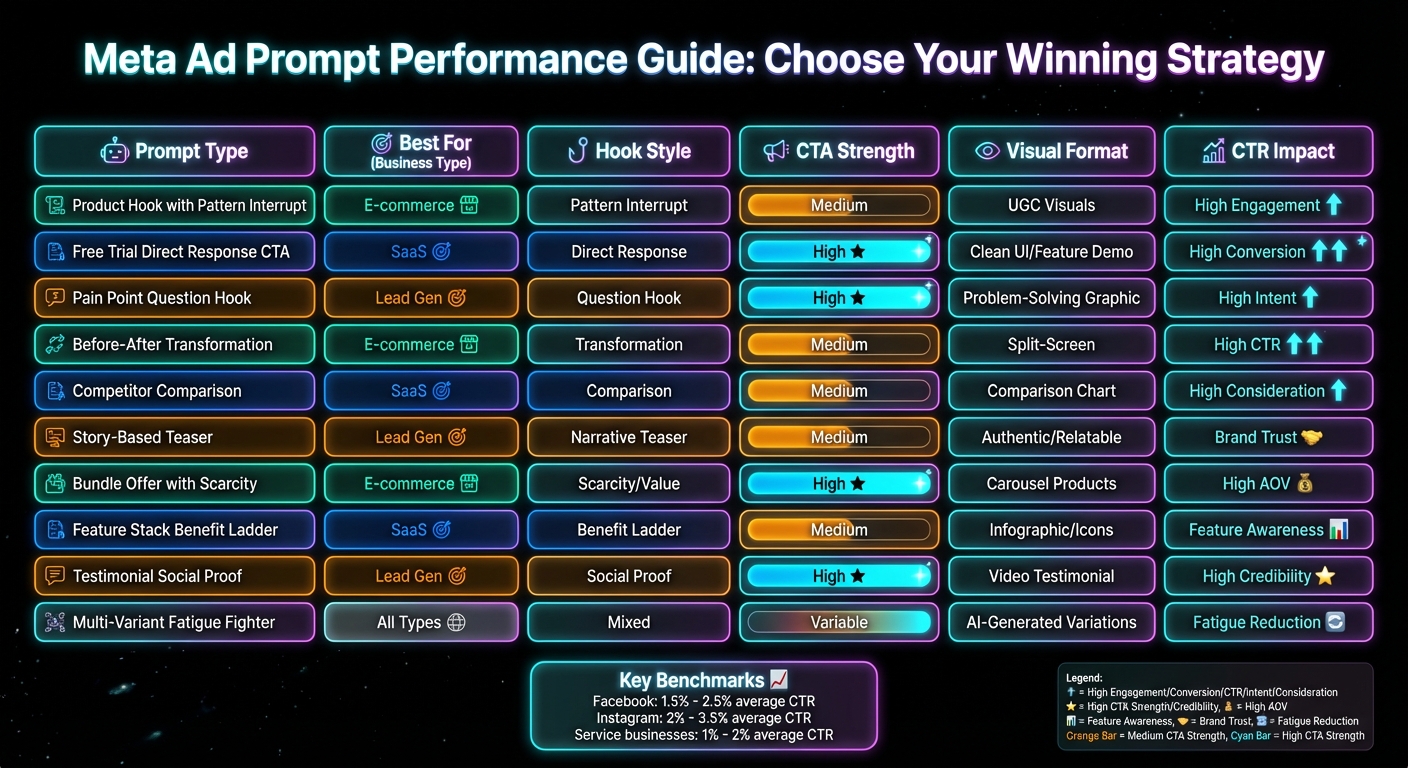
Meta Ad Prompt Performance Comparison: CTR, Conversion & Use Cases by Campaign Type
The table below highlights how different prompts perform across various metrics, offering a practical way to align your creative strategies with your business type and campaign goals.
Prompt performance isn't one-size-fits-all. For example, e-commerce brands often thrive with pattern interrupts that boost engagement, while SaaS companies see better results using benefit ladders or competitor comparisons to drive conversions. Similarly, lead generation campaigns benefit from pain point hooks and social proof, which quickly establish trust.
| Prompt Type | Ideal For | Hook Type | CTA Strength | Visual Style | CTR Impact |
|---|---|---|---|---|---|
| Product Hook with Pattern Interrupt | E-commerce | Pattern Interrupt | Medium ("Shop Now") | UGC Visuals | High Engagement |
| Free Trial Direct Response CTA | SaaS | Direct Response | High ("Start Free Trial") | Clean UI / Feature Demo | High Conversion |
| Pain Point Question Hook | Lead Gen | Question Hook | High ("Get Quote") | Problem-Solving Graphic | High Intent |
| Before-After Transformation Visual | E-commerce | Transformation | Medium ("See More") | Split-Screen Visual | High CTR |
| Competitor Comparison Statement | SaaS | Comparison | Medium ("Learn More") | Comparison Chart | High Consideration |
| Story-Based Teaser | Lead Gen | Narrative Teaser | Medium ("Read More") | Authentic/Relatable Image | Brand Trust |
| Bundle Offer with Scarcity | E-commerce | Scarcity/Value | High ("Get Bundle") | Carousel of Products | High AOV |
| Feature Stack Benefit Ladder | SaaS | Benefit Ladder | Medium ("Explore") | Infographic/Icon List | Feature Awareness |
| Testimonial Social Proof | Lead Gen | Social Proof | High ("Join Now") | Video Testimonial | High Credibility |
| Multi-Variant Creative Fatigue Fighter | All | Mixed | Variable | AI-Generated Variations | Fatigue Reduction |
CTR Benchmarks
Click-through rates (CTR) vary depending on platform and industry. For instance:
- Facebook: Average CTR ranges between 1.5% and 2.5%.
- Instagram: Typically sees CTRs between 2% and 3.5%.
- Service-based businesses: Expect CTRs around 1% to 2%.
ADEN's LAB Pricing Plans
Choose a plan that matches your creative needs and ad budget:
- Lift Off: $59/month for 30 ads - ideal for testing 2–3 prompts.
- Hyperstream: $89/month for 50 ads - suitable for rotating 4–5 prompts to combat creative fatigue.
- Apex Mode: $179/month for 200 ads - perfect for budgets over $1,000/day, enabling full-scale testing of all 10 prompts with multiple variations.
Conclusion
Meta advertising in 2026 will require constant updates to creative strategies. With acquisition costs climbing and algorithms shifting, AI-generated ad prompts provide a game-changing solution. These tools can cut ad production time by as much as 80% and increase click-through rates (CTR) by 15–25%.
The 10 prompts shared here are tailored to address challenges in e-commerce, SaaS, and lead generation. They’re crafted to drive conversions and lower costs, ensuring your campaigns remain competitive in Meta’s ever-changing landscape.
To take this a step further, ADEN's LAB offers a streamlined way to create ads at scale. For as little as $59 per month, you can generate 30, 50, or even 200+ static Meta ads - bringing the cost per ad down to just $0.90 compared to the typical $30–$50 designer fees. The platform handles creative refreshes, A/B testing, and real-time analytics, giving you the tools to stay ahead of algorithm changes without needing an expansive design team.
Want to stay ahead? Simply copy a prompt, create five variations, and test them in Meta Ads Manager for a week. Use ADEN's LAB dashboard to monitor your CTR and ROAS. By 2026, 70% of top Meta advertisers will rely on AI for their creative needs - these prompts could be the competitive boost your campaigns are looking for.
FAQs
How do I choose the best prompt for my campaign goal?
Start by identifying your campaign's main goal - whether that's increasing leads, boosting e-commerce sales, or driving SaaS sign-ups. Once you're clear on the objective, create prompts that are specific and measurable, ensuring they align with what you're trying to achieve. Your inputs should highlight clear benefits for your audience.
Avoid using vague or misleading language. Not only can this confuse your audience, but it could also violate platform policies, which require ads to be truthful. Instead, focus on crafting clear, well-defined messages that operate within set constraints while prioritizing performance. This approach will help you stay on track and meet your campaign goals effectively.
What should I track to spot a winning Meta ad fast?
To spot a successful Meta ad, keep an eye on essential performance metrics such as engagement, click-through rate (CTR), and conversion rate. These numbers reveal how effectively your ad connects with your audience and encourages them to take action.
How often should I rotate creatives to avoid ad fatigue?
To keep your campaigns running smoothly and your audience interested, it's a good idea to switch up your creatives every 2-4 weeks. Regularly refreshing your ads helps avoid ad fatigue and ensures your results stay on track.
Your next ad batch starts here
Finish with a ready-to-test ad batch
Paste your website to generate static creatives. Drop the link → get ads in about 90 seconds → upload them to Meta → scale.
Free to try No prompt writing