How to Test Meta Ad Creatives Faster Without Wasting Budget
Turn the strategy into creatives
Create Meta ads for your product
Paste your product page. ADEN'S LAB turns the offer, audience, and positioning into complete ready-to-use Meta static ads.
Free to try No prompt writing

Want to improve your Meta ad performance without overspending? Focus on structured testing. Many advertisers waste money by testing too many variables at once or making decisions too soon. Here’s a simple framework to test ads effectively:
- Creative Matters Most: It drives 56% of your campaign’s ROI - more than targeting or bidding. Dedicate 15–20% of your budget to testing.
- Speed Up Production: Use tools like ADEN's LAB to create ad variations in under 90 seconds, cutting costs by up to 85%.
- Test One Element at a Time: Change only one variable (e.g., headline or image) to identify what works best.
- Budget and Metrics: Allocate 10–20% of your ad spend for testing, monitor key metrics like CTR and CPA, and avoid acting on early results.
- Scale Smartly: Gradually increase budgets for winning ads and refresh assets every 2–4 weeks to prevent fatigue.
This method ensures you spend smarter, identify what works, and scale results efficiently.
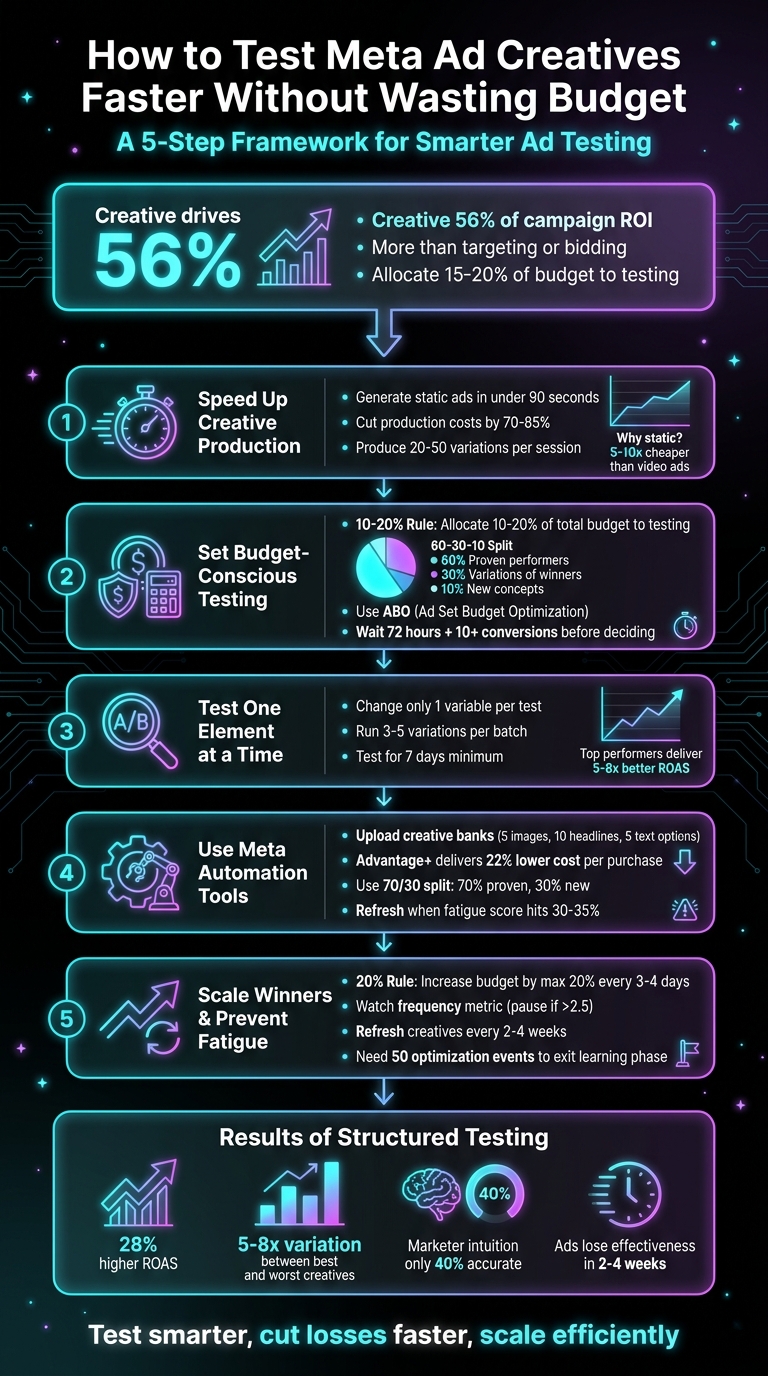
5-Step Framework for Testing Meta Ad Creatives Without Wasting Budget
The New Meta Ads Creative Testing Framework for 2026
Put the playbook to work
Apply this playbook to your page
Paste your website and the Lab will turn the strategy you are reading into a ready-to-test ads.
Free to try No prompt writing
Step 1: Speed Up Creative Production with ADEN's LAB
One of the biggest hurdles in creative testing is the slow pace of production. Many advertisers deal with long delays when waiting for creative variations, which can stall campaigns and limit testing opportunities. ADEN's LAB solves this problem by generating static Meta ads in less than 90 seconds, slashing production time by 95% compared to traditional methods. With creatives ready almost instantly, you can focus your testing budget where it matters most.
Why Static Meta Ads Are Ideal for Testing
Static ads are a great choice for testing because they simplify the entire creative process. Producing video ads, for instance, can cost 5–10 times more and requires longer production timelines. Carousel ads, while visually engaging, introduce multiple variables that make it harder to track performance accurately. On the other hand, static ads are more cost-effective and provide clearer performance metrics. This makes it easier to identify which elements - like headlines, colors, or calls-to-action (CTAs) - are driving results.
How AI Delivers Test-Ready Creatives
ADEN's LAB takes the benefits of static ads a step further by using AI to produce optimized visuals in record time. All you need to do is upload a product image and type a prompt like: "E-commerce shoe ad, bold red background, '50% Off'". In under 90 seconds, the AI generates five Meta-ready variations formatted at 1080x1080px, ready for direct upload to Ads Manager.
This process eliminates the need for tools like Photoshop, costly designer fees, and lengthy revision cycles. Users have reported cutting costs by 70–85% while producing 20–50 variations per session at almost no additional expense. This efficiency enables systematic batch testing, where you can run 3–6 variations for each element with small budgets of $10–20 per test. This approach ensures statistically significant results without overspending. Faster production means quicker testing and smarter budget use, which are essential for avoiding performance dips. By making creative production faster and more affordable, ADEN's LAB sets the stage for effective testing and campaign scaling.
Step 2: Set Up Budget-Conscious Testing Campaigns
Once your creatives are ready to test, the next move is to build a testing framework that delivers clear results without overspending. The secret lies in sticking to controlled budgets and keeping your campaign structure focused. This approach ensures that every variation is tested fairly before you decide to scale.
How to Allocate Testing Budgets
A good rule of thumb for your testing budget is the 10–20% rule: set aside 10% to 20% of your total paid social budget for testing new creative variations. For instance, if you're spending $1,000 daily on Meta ads, allocate $100–$200 specifically for testing.
To break it down further, use a 60-30-10 split:
- 60% goes to proven performers that are already driving results.
- 30% is for variations of those winners, like tweaks to hooks or visuals.
- 10% is reserved for entirely new concepts.
When setting up ad sets, allocate 2–3 times your target Cost Per Acquisition (CPA) per day. This gives Meta’s algorithm enough data to work with for optimization.
For testing, stick with Ad Set Budget Optimization (ABO) instead of Campaign Budget Optimization (CBO). ABO ensures that each creative variation gets equal budget distribution, avoiding the risk of Meta favoring one ad too early based on initial engagement.
Select Testing Goals and Metrics
Once your budget is sorted, focus on tracking the right performance metrics. In the first 24–48 hours, monitor key indicators like Click-Through Rate (CTR) and Hook Rate. A hook rate above 20% means your ad is grabbing attention, while a CTR that’s 25–35% higher than your account baseline shows strong engagement.
However, don’t rush to conclusions based on early metrics. Wait at least 72 hours and aim for 10+ conversions before making decisions. Evaluate performance by analyzing CPA and ROAS. Keep in mind that Meta’s algorithm often needs around 50 optimization events within a 7-day period to stabilize and exit the learning phase. Acting too soon - especially with fewer than 10 conversions - can lead to inaccurate conclusions, as early results can vary by up to 32%.
To safeguard your budget, use automated rules. For example, pause any ad set that spends more than 2x your target CPA without producing a conversion. Typically, spending $200–$500 per variation over 5–7 days should give you enough data to make informed decisions.
Step 3: Test One Element at a Time
Now that your budget is under control, it’s time to focus on testing, but with one key rule: A/B test Meta ads by testing one element at a time. This method ensures that every dollar you spend gives you clear insights into what’s driving your ad’s performance.
Why is this important? If you change multiple elements - like the headline and the visual - at the same time, you’re left guessing which adjustment made the difference. Testing one variable at a time eliminates this confusion. It lets you pinpoint exactly what works so you can replicate those strategies in future campaigns.
Start by testing the elements with the biggest impact. For example, focus on the hook first. The hook, whether it’s the first 2–3 seconds of a video or the main image in a static ad, plays a huge role in grabbing attention. A strong hook can boost your hook rate by 15–20 percentage points, and since creative quality accounts for 47% of ad performance variability, it’s a great place to start. Once you’ve nailed the hook, move on to other elements like messaging angles, ad formats, and finally, lower-priority tweaks like the call-to-action (CTA).
Run Batch Tests with 3–5 Variations
When running tests, stick to 3–5 variations per batch. Testing fewer than three limits your options, while testing more than five can spread your budget too thin to get meaningful results. For example, when testing hooks, keep everything else - visuals, copy, and CTA - exactly the same. Only change the opening line or the first three seconds of the video.
To ensure fair testing, use ad set budget optimization (ABO). This approach distributes your budget evenly across all variations, preventing Meta’s algorithm from favoring one ad too early based on initial engagement signals that might not lead to conversions. Let the test run for at least seven days to account for weekly traffic patterns, like differences between weekday and weekend behavior.
Analyze Results to Find Winners
Once your test is complete, analyze the data to identify the winning variation. Wait until each variation has at least 10–30 conversions before making a decision. While monitoring early indicators is helpful, your final judgment should be based on metrics like cost per acquisition (CPA) and return on ad spend (ROAS).
The top-performing creative in a test often delivers 5–8 times better ROAS than the weakest one, so the standout should be clear once you have enough data. Define your success criteria before you start - such as aiming for a 15–20% improvement over your control ad - to avoid shifting your goals mid-test. If a variation spends 2–3 times your target CPA without generating conversions, pause it immediately. Once you’ve identified your winners, move them into high-spend campaigns, but only after confirming their performance with statistical confidence. These winning creatives will then become the foundation for scaling your campaigns effectively.
Step 4: Use Meta Tools to Test and Scale Faster
After pinpointing your best-performing creatives through structured testing, it’s time to let Meta’s automation tools take over. With ADEN's LAB handling production - delivering ready-to-test static ads in under 90 seconds - and Meta's Advantage+ tools managing distribution, you can seamlessly transition from creation to scaling. These tools work together to test combinations and scale winning creatives automatically, ensuring efficient and cost-effective results.
This streamlined process removes the delays that come from waiting on designers to create variations. By uploading a batch of ADEN's LAB-generated creatives, the system can identify the top-performing combinations using AI tools for Meta ads without the need for manual duplication of campaigns.
Automate with Advantage+ Campaigns
Building on your initial creative tests, Advantage+ enhances your reach by automatically finding the best combinations of assets. For example, you can upload a creative bank - such as 5 images from ADEN's LAB, 10 headlines, and 5 primary text options. Meta’s AI then generates hundreds of possible combinations and tests them to uncover the pairings that deliver the lowest cost per acquisition.
Accounts leveraging Advantage+ Creative with a structured input system saw approximately 22% lower cost per purchase over 90 days compared to manual setups. However, this system works best when you provide assets with clear differences rather than subtle tweaks. For instance, instead of uploading five nearly identical images, offer a variety - like a product shot, a lifestyle image, and a customer-focused photo. This diversity gives the algorithm stronger signals to work with.
"Treat Meta's AI as your distribution and testing co-pilot, not your creative director. Its role is to optimize distribution based on your pre-built creative assets."
To balance stability with innovation, start with a 70/30 split: 70% proven winners and 30% new concepts. This approach helps maintain consistent performance while still testing fresh ideas. Additionally, use the "Exclude Combinations" feature to ensure the AI doesn’t pair images and text in ways that clash with your brand guidelines. Keep an eye on your Creative Fatigue Score, refreshing or rotating assets once it surpasses 30–35%.
With distribution automated, you can focus on refining your messaging by testing various headlines and text combinations.
Test Multiple Headlines and Copy Variations
Meta’s tools allow you to test up to 10 different headlines and primary text options within a single ad. The system automatically shuffles these elements to identify the best-performing combinations for specific audience segments. This eliminates the need to create separate campaigns for every variation of your messaging.
However, be cautious with AI-driven features like "Text Improvements." While these can optimize for engagement, they might reorder your copy or swap headlines and primary text. Chris Pollard, Founder of Ads Uploader, highlights this risk:
"Every time Meta rearranges your copy, you lose the ability to understand what's actually driving performance."
- Chris Pollard, Founder of Ads Uploader
Always preview any modifications Meta plans to make before launching. Use the "Edit" button in Ads Manager to review these changes and ensure they align with your goals.
For minimal-risk adjustments, enable features like Visual Touch-ups and Relevant Comments. These tools tweak aspects like brightness, contrast, and cropping without altering your core message, helping you maintain control over your brand voice. By following these steps, you can move from rapid creative production to dynamic, algorithm-driven distribution with confidence.
Step 5: Scale Winners and Prevent Ad Fatigue
Once you've identified your top-performing ads, the next step is scaling them up without compromising their effectiveness. This requires careful planning - both in how you increase budgets and how you keep your creatives engaging as they reach a larger audience.
Move Winners to High-Spend Campaigns
To scale efficiently, use a two-campaign structure: keep your Testing Campaign running with a modest budget to validate new ideas, while moving proven winners into a separate Scaling Campaign. The Scaling Campaign will receive higher budgets and broader reach, ensuring your successful ads aren't disrupted by ongoing tests. This approach protects your revenue-generating ads while maintaining a steady flow of new insights.
When increasing budgets, stick to the "20% Rule" to avoid resetting Meta's learning phase. Gradually raise your budget by no more than 20% every 3–4 days. For instance, if you're spending $100 daily on a winning ad set, increase it to $120, wait three days, and then move to $144. This slow, steady increase helps maintain algorithm stability while scaling delivery.
Meta's system requires around 50 optimization events (like purchases) within your conversion window to exit the learning phase and stabilize performance. Keep an eye on your frequency metric as you scale. If your frequency exceeds 2.5, performance often begins to dip. Rising CPMs and declining click-through rates are further signs that ad fatigue is setting in, signaling the need for fresh creatives.
As Assem Gamal, Growth Marketer at Softailed, explains:
"Mastering ad scaling is one of the defining skills separating elite media buyers from the rest."
- Assem Gamal, Growth Marketer, Softailed
To maintain control over your CPA during scaling, consider switching from automatic to manual bidding with cost caps.
Create Fresh Variations with ADEN's LAB
Scaling success relies on keeping your creative assets fresh. Instead of waiting for performance to drop, schedule proactive refresh cycles every 2–4 weeks. This ensures your campaigns stay ahead of saturation, with new assets ready to roll out.
ADEN's LAB Apex Mode offers a simple solution for creative refreshes, allowing you to generate 200 ads monthly for $179 - less than $0.90 per ad. This gives you the ability to run 3–5 variations of each winning creative simultaneously. Each variation uses the same proven concept but tweaks the details, extending the life of your successful approach.
For example, if a "time-saving" hook is performing well, ADEN's LAB can help you create multiple interpretations of that idea. One ad might feature a clock, another a before-and-after timeline, and a third a customer testimonial about saved time. These variations reinforce the same message while offering fresh visuals for the algorithm to distribute.
Top advertisers typically allocate 20–30% of their total budget to continuous testing. This ensures a steady stream of new winners is ready to replace fatigued ads. With ADEN's LAB generating test-ready creatives in under 90 seconds, you can maintain this pace without relying on external designers or agencies.
Finally, create a pattern library to track what works - specific hooks, visuals, and calls-to-action that consistently drive results. Use these proven elements as templates for your next creative batch, building on past successes instead of starting from scratch.
Conclusion
Testing Meta ad creatives doesn't have to be a drawn-out process. By following a clear framework - speeding up production with AI, setting smart budgets, isolating variables, using Meta's tools, and scaling successful ads - you can uncover high-performing creatives much more quickly.
As we look toward 2026, the focus on creative quality is undeniable. With Meta's Andromeda algorithm automating targeting and bidding, the creative itself becomes your most powerful tool for impact. This structured testing approach not only simplifies the process but also delivers better results. In fact, advertisers using structured methods see a 28% higher ROAS compared to those relying on random testing. And the difference between the best and worst-performing creatives? A staggering 5–8x variation in ROAS. These aren't small margins - they can determine whether your campaign thrives or drains your budget.
Relying on data, not guesswork, is key. Marketer intuition proves accurate only 40% of the time, making random decisions an expensive gamble. Instead, let the numbers guide you. Use strict kill criteria: pause underperforming ads within 48–72 hours or after spending $50–$100 per campaign. This ensures your budget is spent efficiently, focusing on what works.
Testing doesn't stop after one success. Even top-performing ads lose their effectiveness within 2–4 weeks, so a steady flow of new creatives is essential to stay ahead. Tools like ADEN's LAB can produce test-ready static ads in under 90 seconds, removing the common bottleneck of creative production.
Success on Meta in 2026 won't just belong to brands with the deepest pockets. By adopting this framework, you can test smarter, cut losses faster, and scale your winning ads efficiently.
FAQs
How long should I run a creative test before deciding?
Experts suggest running a Meta creative test for 3 to 7 days. This timeframe gives the algorithm enough room to collect data and evaluate how well your creative performs. Cutting tests short could result in unreliable conclusions, while extending them unnecessarily might drain your budget if the creative isn’t delivering results. Keep in mind, Meta resets the learning phase whenever you swap out a creative, so it’s important to allow adequate time for the data to provide actionable insights.
What budget do I need per ad variation to get reliable results?
To get dependable results, set your daily testing budget to 1–2 times your target cost per acquisition (CPA). For instance, if your target CPA is $40, aim for a daily budget of $40–$80 per variation. Keep creative testing to 20% of your total budget to ensure it doesn’t interfere with overall performance. Testing 3–5 ad variations at a time provides enough variety while still gathering meaningful data.
How do I refresh creatives without losing performance?
Refreshing creatives can feel like a balancing act, but using a structured approach makes it much easier. Start by isolating variables - test one element at a time, like headlines, visuals, or CTAs, to pinpoint what drives performance. Keep a close eye on metrics to see how each change impacts results.
Budgeting is another critical piece. Try following the 60-30-10 rule: allocate 60% of your budget to proven high-performing creatives, 30% to testing new ones, and 10% to experimenting with bold, untested ideas. This way, you minimize risks while still leaving room for innovation.
When introducing new creatives, do it gradually. Sudden changes can disrupt algorithms and confuse your audience. Tools powered by AI can be incredibly helpful here - they can analyze competitive trends and help you make smarter, data-driven decisions.
By taking these steps, you not only maintain performance but may even see improvements in key metrics like ROAS or impressions, all while avoiding the dreaded sudden drop-offs.
Your next ad batch starts here
Finish with a ready-to-test ad batch
Paste your website to generate static creatives. Drop the link → get ads in about 90 seconds → upload them to Meta → scale.
Free to try No prompt writing