How to Scale Creative Output Without Hiring Designers or an Agency
Try the workflow instead of comparing it
See what an AI ad generator makes from your product
Paste your product page and get a complete Meta ad batch—creative concepts, images, headlines, and copy—without another tool stack.
Free to try No prompt writing

When your Meta ads start failing, it’s rarely about targeting or budget - it’s because your ads are outdated. Ads often lose effectiveness in 3–7 days due to fatigue, leading to wasted budget and rising costs. The problem? Traditional workflows can’t keep up with the demand for new ads. Waiting on designers or agencies is slow, expensive, and limits your ability to test and scale.
The solution is automation. Tools like Aden's Lab let you generate dozens of ad variations in seconds - no designers, no delays. By automating ad production, testing multiple angles at high volume, and using performance data to guide decisions, you can reduce costs, improve results, and scale your campaigns effectively.
Key takeaways:
- Ads fatigue quickly; rotate new ones every 3–7 days.
- Automated tools like Aden's Lab produce ads instantly, saving time and money.
- High-volume testing identifies winners faster and keeps performance steady.
- Match ad production to spending: for every $10,000/month, aim for 30–50 new ads weekly.
Scaling Meta campaigns isn’t about hiring more designers - it’s about streamlining production and focusing on what works.
How I Create Meta Static Ads at Scale Using AI (Full Workflow)
Put the playbook to work
Apply this playbook to your page
Paste your website and the Lab will turn the strategy you are reading into a ready-to-test ads.
Free to try No prompt writing
Why Traditional Creative Workflows Don't Scale
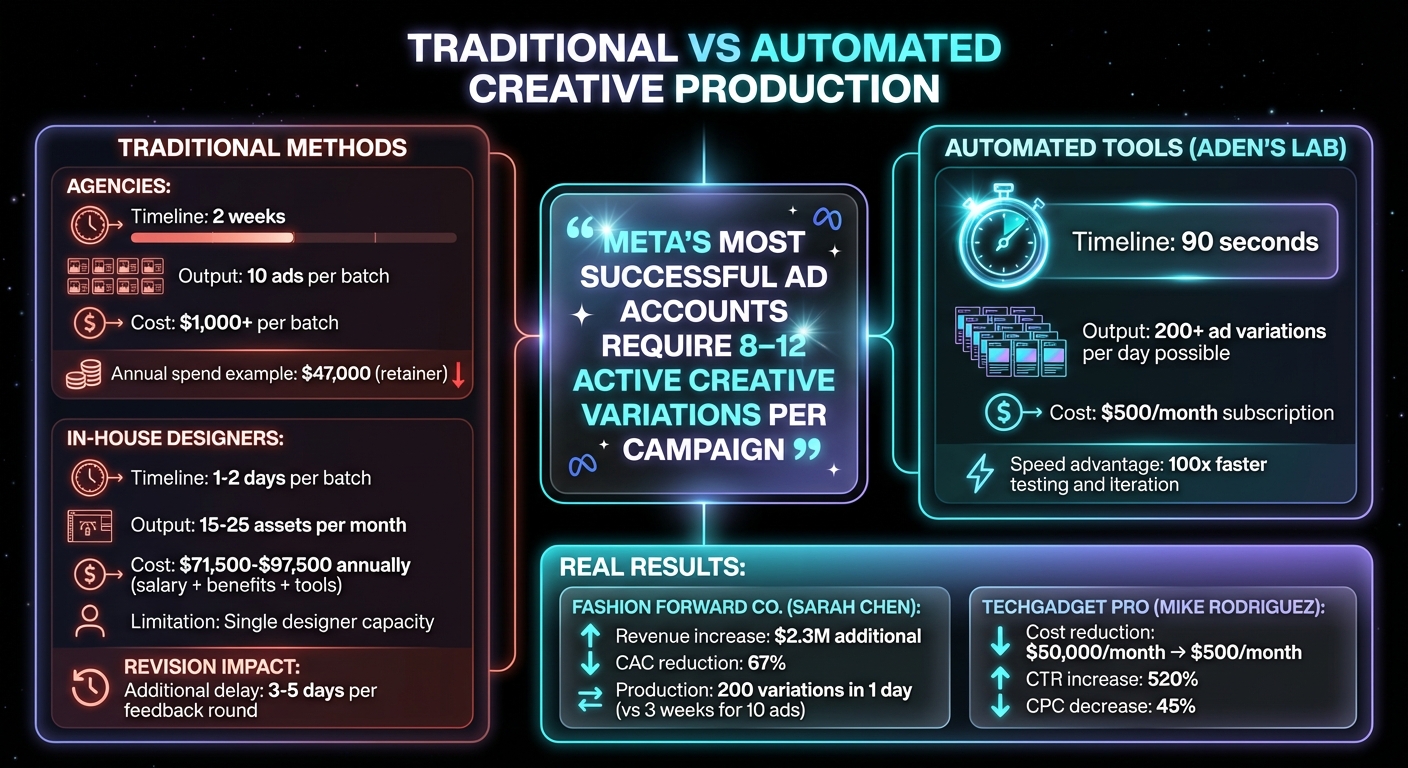
Traditional vs Automated Ad Creative Production: Cost and Speed Comparison
Traditional creative workflows just can't keep up with the fast-paced demands of Meta's advertising ecosystem. Whether you rely on agencies, hire in-house designers, or use DIY tools, the production speed falls short. Ads burn out quickly, campaigns need constant refreshing, and the slow turnaround of traditional methods creates bottlenecks. This not only limits the volume of creatives but also accelerates ad fatigue.
For example, agencies typically take two weeks to deliver just 10 ads, costing over $1,000 per batch. By the time those ads are ready, market conditions have likely shifted, competitors are running new campaigns, and your creative concept may already feel outdated. In-house designers are faster, often delivering assets in 1–2 days, but they hit capacity quickly. A single designer can realistically produce 15–25 assets per month before burnout becomes a concern. And with annual costs ranging from $71,500 to $97,500 (including salary, benefits, and tools), this approach isn't cheap.
Meta's most successful ad accounts typically require 8–12 active creative variations per campaign. To keep the algorithm engaged and maintain stable CPAs, you need a constant flow of fresh creatives - a demand that traditional workflows simply can't meet.
Creative Fatigue: Why Your Ads Die After 3–7 Days
Meta's algorithm operates at a relentless pace. Ads often lose their effectiveness after just 3–7 days, and in most cases, the culprit is creative fatigue - not issues with budget or targeting. Once an ad's frequency hits 4.0 or its CTR drops by more than 20% over two weeks, the algorithm penalizes the ad, driving costs up. Traditional workflows can't match this rapid cycle, leaving you stuck with underperforming ads while costs climb.
The Real Cost of Waiting on Designers
Delays in creative production aren't just frustrating - they're expensive. Waiting on designers means missed opportunities to launch high-performing campaigns, often resulting in skyrocketing CPAs. For instance, James Williams, a marketing operations professional, spent $187,000 over 14 months on a mix of agency retainers ($47,000) and in-house designers ($140,000) for a mid-sized e-commerce brand. Despite this investment, slow creative turnaround doubled the brand's CPAs.
Each round of feedback can add 3–5 days to the process. By the time revisions are done, competitors have already tested and optimized dozens of new creative variations. Automated systems, by comparison, can scale ad testing and iterate up to 100 times faster. Without a faster way to generate fresh creatives, scaling your campaigns isn't just difficult - it’s impossible.
Step 1: Automate Creative Production
Relying on manual workflows simply can't keep up with the pace needed to scale on Meta. To stay ahead, you need a system that can churn out dozens of fresh static ads almost instantly. Automating Meta ad production eliminates the delays that often cause winning ads to lose their edge.
Here’s how Aden's Lab changes the game.
How Aden's Lab Works: Drop a Link, Get Ads
Aden's Lab operates on a simple yet powerful concept: paste your URL, and in under 90 seconds, you'll have Meta ads ready to launch. The platform automatically pulls images and key details from your page to create multiple static ad variations. These aren't just random designs - they’re crafted using proven strategies based on buyer psychology and conversion principles, leaving subjective design choices out of the equation.
For instance, Sarah Chen, the CMO of Fashion Forward Co., leveraged Aden's Lab to produce over 200 ad variations in a single day. Previously, her agency took three weeks to deliver just 10 ads. The AI-generated creatives not only saved time but also outperformed the agency’s work by 340%, driving $2.3 million in additional revenue and slashing her CAC by 67%.
Similarly, Mike Rodriguez, Growth Director at TechGadget Pro, cut his creative spend from $50,000 per month on agency retainers to just $500. At the same time, his CTR jumped by 520%, and his CPC dropped by 45%.
With Aden's Lab, you can quickly produce new ad variations and let Meta's algorithm identify the top performers.
Why Static Ads Work Best for Meta Scaling
Speed isn’t the only reason static ads dominate when scaling on Meta - they come with other key advantages.
Static image ads are one of the most scalable formats on Meta. They’re quick to create, easy to deploy, and compatible with every placement. Unlike video ads, which often require considerations like sound design and longer load times, static ads can be tested in high volumes without added complexity. They seamlessly integrate across Facebook and Instagram feeds, stories, and side placements, giving Meta’s algorithm more opportunities to find cost-effective impressions.
Another major benefit? Static ads tend to last longer before they fatigue, especially when refreshed regularly with new hooks, layouts, and angles. Meta’s delivery system rewards accounts that maintain creative diversity. By offering a variety of assets, you’ll improve your Opportunity Scores and lower your CPAs, as the platform can better match ads to different audience segments. Static ads make achieving this diversity faster and more affordable, making them a cornerstone for scaling high-budget campaigns on Meta.
Step 2: Test Creatives at High Volume to Beat Fatigue
Once you've automated creative production, the next challenge is tackling ad fatigue. To stay ahead, consistently refresh your creatives. The brands that grow profitably on Meta aren't just running a handful of ads - they're testing dozens or even hundreds every month. This high-volume approach allows Meta's algorithm to identify winning ads before your top performers lose their edge.
Ad fatigue typically sets in within 3–7 days. To combat this, rotate your creatives proactively. If an ad's frequency climbs above 4.0 or its click-through rate (CTR) drops by more than 20% over two weeks, it's a red flag that your budget is being wasted. The solution isn't to tweak targeting or increase spend - it’s to introduce fresh creatives before performance declines. By clearly separating creative angles, you can gain sharper insights into what works.
How to Structure High-Volume Testing
Because ad fatigue happens fast, structured testing is key to finding new winners before your current ads lose momentum. Start with a dedicated testing campaign using Ad Set Budget Optimization (ABO), which lets you allocate a specific budget to each ad set. Here's how to set it up:
- Create one ad set for each creative angle, such as a pain-point hook, a benefit-driven message, or social proof.
- Load 3–4 distinct creatives into each ad set.
This setup ensures clean, actionable data by isolating each angle. Within 24–48 hours, you'll see which creatives deliver strong click-through rates and return on ad spend (ROAS). Once a creative performs well, move it into a Campaign Budget Optimization (CBO) or Advantage+ Shopping campaign, where Meta can efficiently allocate your budget.
Avoid grouping all creatives into a single ad set. Doing so muddles the data, making it hard to identify which angle is driving results. By isolating creative angles, you allow Meta's algorithm to better match ads to user segments, improving its "Opportunity Score" and helping to lower your cost per acquisition (CPA).
Don't Run Fatigued Ads
Running ads that have overstayed their welcome is a surefire way to drive up your CPA. When the same message is shown too often, your audience starts ignoring it, and the algorithm struggles to maintain performance - resulting in higher costs. For example, if you're spending $10,000 daily and a fatigued creative raises your CPA by 15%, you're burning $1,500 every single day.
High-volume testing keeps your campaigns fresh by ensuring a steady flow of new creatives. Instead of waiting for performance to nosedive, replace ads on a set schedule. Weekly checks on metrics like frequency and CTR can guide these decisions. This method removes guesswork and keeps your campaigns running efficiently, even as you scale aggressively.
Step 3: Use Data to Refresh Creatives, Not Designers
Once you’ve automated production and embraced high-volume testing, the next step is letting performance data guide your creative updates. Scaling Meta ads effectively means ditching manual design delays and relying on data to drive decisions. When you’re spending thousands of dollars daily, every hour spent waiting for a designer costs you money. Successful brands treat data as their creative director, using it to make precise, timely adjustments to ad rotations.
Kill Underperformers, Scale Winners
Pay close attention to key performance metrics like CTR above 1–2%, ROAS at least 2–3x your target margin, and frequency under 4.0. If a creative’s CTR drops more than 20% over two weeks or its frequency exceeds 4.0, it’s time to pause that ad. These changes indicate the algorithm is struggling to find new users, meaning you’re wasting money on fatigued impressions.
With these metrics, your workflow becomes straightforward. Start by filtering ad sets with a ROAS above 2.5x and a frequency below 3.0. Pause the bottom 20% of performers. Then, duplicate your top three ads into new campaigns, increasing budgets by 50–100%. Over the next three days, monitor their performance - if the metrics stay strong, you’ve got a winning ad to scale. If performance drops, pull back and test a different angle. This approach eliminates guesswork and keeps your campaigns running efficiently, even with high spending.
Iterate Creatives in Real-Time
Traditional creative workflows can slow down scaling efforts. By the time new designs are ready, your campaign may have already lost its momentum. That’s where systems like Aden’s Lab come in. When you notice signs of fatigue, you can instantly generate 10–15 fresh static ads - no briefs, no revisions, no delays. This automated process completely replaces the back-and-forth of manual creative production.
Speed is crucial because creative fatigue doesn’t wait for your schedule. Keep a reserve of 5–10 ready-to-launch assets to ensure you can rotate fresh content weekly. This consistent flow of new creatives signals to Meta’s algorithm that your account offers diverse inventory, boosting your Opportunity Score and lowering your cost per acquisition. Brands that maintain this rhythm often see a 20–30% lift in ROAS compared to those that produce creatives sporadically. It’s not about the quality of a single ad - it’s about how quickly and consistently you can adapt.
Step 4: Match Creative Volume to Your Ad Spend
One common mistake advertisers make is increasing their budgets without boosting their creative output. If you keep running the same few ads as your spending grows, your audience will see the same content over and over. This repetition leads to audience fatigue and forces Meta to rely on underperforming ads. To prevent this, your creative output needs to grow in step with your ad spend.
Balancing Ad Volume with Spending
Here’s a rule of thumb: for every $10,000 increase in daily spending, aim to produce 30–50 new static creatives each week. Structure your campaigns carefully - limit each creative angle to 3–4 distinct ads to avoid overlapping signals. Monitor your metrics closely. A drop in engagement or conversion rates is often a red flag that your creative assets are becoming stale.
Take this example: one account scaled from $300/month to $300,000/month by increasing their creative output from 2–4 ads per set to over 10. They ran parallel campaigns with fresh creative assets at every spending milestone. This approach helped them avoid delivery issues caused by duplicated or fatigued ads. If your budget exceeds $50,000 per month, expect to increase your creative output by tenfold to maintain strong performance.
The Importance of Commercial Rights
Quantity isn’t the only factor - legal flexibility is just as critical. Stock photo licenses, freelance agreements, and agency contracts can limit how you use creative assets or impose extra fees for each launch. This can slow you down when scaling. With Aden's Lab, every ad comes with full commercial rights. This means you can test and launch ads across multiple ad sets without worrying about renegotiation or additional fees. Aden's Lab ensures you can scale both creatively and legally without unnecessary hurdles.
Conclusion
Scaling Meta campaigns hinges on tackling one major challenge: creative bottlenecks. Without a steady flow of fresh ads to match your ad spend, you'll hit a wall. When that happens, your ad frequency rises, click-through rates (CTR) plummet, and cost per acquisition (CPA) skyrockets - even with excellent targeting. The brands that succeed are those that test relentlessly, cut underperformers quickly, and refine their approach using real data rather than waiting on lengthy design processes.
The traditional approach - briefing agencies, waiting weeks for revisions, and spending over $1,000 for a handful of creatives - just can’t keep up with the pace of modern campaigns. When you need 30–50 new ads every week, you need a system that works as quickly as you do. That’s where AI automation tools transform the game. Instead of juggling timelines and endless feedback cycles, you can simply upload a link and have ads ready to launch in 90 seconds. No prompts, no setup, no back-and-forth.
Aden's Lab removes the roadblocks that prevent advertisers from scaling. It delivers the volume to test multiple angles simultaneously, the speed to refresh creatives before performance declines, and the legal rights to launch without delays. For example, when TechGadget Pro switched from a $50,000/month agency to a $500/month subscription, they didn’t just save money - they increased their CTR by 520% and generated an additional $1.8 million in revenue. This was all because they could finally test at the speed their campaigns required.
If you're spending over $10,000 per month on Meta ads but still recycling the same few creatives, you're missing out. The answer isn’t hiring more designers or pushing agencies for faster turnarounds. It’s automating the creative process entirely so you can focus on what truly drives results: testing, iterating, and scaling based on data.
FAQs
How do I know if an ad is fatigued?
You can identify ad fatigue by keeping an eye on a few key metrics. Watch for a cost-per-result that doubles, lower click-through rates (CTR), higher cost-per-click (CPC), or reduced reach - these are clear signs your audience might be overexposed to the same ad. Additionally, a decline in positive feedback or an increase in negative reactions can be strong indicators. Spotting these patterns early allows you to tweak your creative or refine your targeting, helping you avoid wasting your ad budget.
How much creative do I need for my monthly spend?
The amount of creative content you need hinges on two key factors: your budget and your testing approach. Many advertisers dedicate 20-30% of their budget specifically to testing new creatives. The goal? To maintain a balance between quality and variety, ensuring your audience doesn’t experience ad fatigue. When it’s time to scale, you’ll likely need even more creative assets. However, overloading your account with excessive testing can backfire. That’s where Aden’s Lab steps in - delivering high-performing creatives quickly, so you can scale efficiently without the hassle of hiring designers or agencies.
What’s the simplest way to test new angles fast?
The quickest way to try out new ad angles is by leveraging AI tools that can produce multiple ad variations in no time. Take ADEN'S LAB as an example - it lets you input a product link and generates ready-to-use ads in roughly 90 seconds. This means you can test different messaging, visuals, and hooks simultaneously, all without needing a designer. It’s a great way to figure out what resonates most and scale your efforts efficiently.
Your next ad batch starts here
Finish with a ready-to-test ad batch
Paste your website to generate static creatives. Drop the link → get ads in about 90 seconds → upload them to Meta → scale.
Free to try No prompt writing