Creative Fatigue in Meta Ads: Early Warning Signs and the Recovery Playbook
Turn the idea into a testing batch
Generate new hooks and angles from your product page
Paste your URL to create multiple ready-to-test concepts instead of adapting generic examples by hand.
Free to try No prompt writing

Tired ads cost money. When people see the same ad repeatedly, they stop engaging. This leads to higher costs and lower performance on Meta platforms. The trick is spotting the warning signs early and taking action before your campaign tanks.
Here’s what to watch for:
- CTR Drops: A 10–15% decline in click-through rates (CTR) over a week signals trouble.
- High Frequency: If people see your ad too often (e.g., 3+ times for prospecting audiences), performance dips.
- Rising Costs: A 20%+ jump in CPM (cost per thousand impressions) can mean fatigue.
- Lagging Metrics: Metrics like ROAS (return on ad spend) and CPA (cost per acquisition) confirm issues but show up too late.
To fix this, prioritize underperforming ads, tweak elements like headlines or visuals, and rotate interest-based audiences. AI tools like ADEN's LAB can help produce new ad variations quickly, keeping campaigns fresh and effective.
Solving creative fatigue with strategies to refresh your ads
Put the playbook to work
Apply this playbook to your page
Paste your website and the Lab will turn the strategy you are reading into a ready-to-test ads.
Free to try No prompt writing
Early Warning Signs of Creative Fatigue
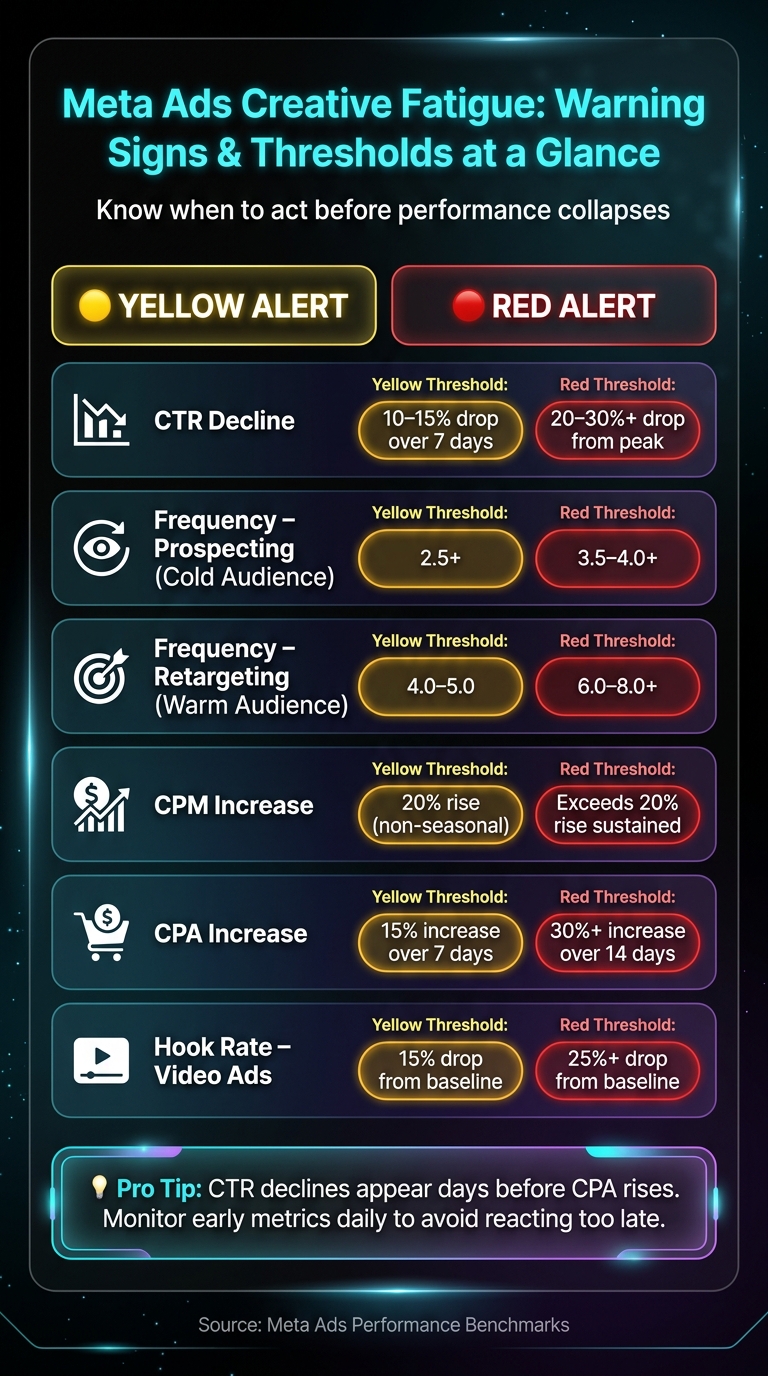
Meta Ads Creative Fatigue: Warning Signs & Thresholds at a Glance
Creative fatigue doesn’t just appear out of nowhere - it sends subtle signals before fully impacting performance. Metrics like CTR often shift days before ROAS and CPA catch up, making early detection crucial. Let’s break down the key indicators that help spot fatigue before it derails your campaigns.
CTR Decline
CTR (click-through rate) is your first red flag. A week-over-week drop of 10–15% should grab your attention. If it falls 20–30% from its peak, consider that a critical warning. Establish a baseline by tracking CTR during the first 3–5 days of an ad’s run. Account-wide averages can obscure these trends, so always monitor on a rolling 3-day basis. A consistent decline over three days is often a clear sign of fatigue setting in.
"The key insight here is that fatigue starts showing in CTR days before it shows in CPA. If you only monitor CPA, you're always reacting too late." - Losid Berberi, CMO, TheOptimizer
While CTR is the earliest indicator, other metrics like audience exposure can also provide valuable clues.
Frequency and First-Time Impression Rate
Frequency reveals how often the average person sees your ad. For cold (prospecting) audiences, performance typically dips once frequency exceeds 2.5–3.0. For warm (retargeting) audiences, the threshold is higher - around 4.0–6.0.
Another critical metric is the first-time impression rate, which tracks how many new people are seeing your ad versus repeat viewers. If this rate drops below 50%, it’s a sign your budget is being spent on re-showing the same creative to the same audience. Always analyze frequency at the individual ad level. An ad set might seem fine on average while a single ad within it has already hit a high frequency, such as 4.0+. Spotting these trends early can help you avoid costly mistakes and prepare to scale winning creatives once performance stabilizes.
Rising CPM, CPC, and CAC
When engagement drops, Meta starts penalizing your ad by raising costs. A 20%+ increase in CPM without a clear seasonal or competitive reason is a strong indicator of creative fatigue. CPC and customer acquisition costs (CAC) often rise shortly after, reinforcing the need to act quickly.
Here’s a quick reference for key thresholds across these metrics:
| Metric | Yellow Alert | Red Alert |
|---|---|---|
| CTR Decline | 10–15% drop over 7 days | 20–30%+ drop from peak |
| Frequency (Prospecting) | 2.5+ | 3.5–4.0+ |
| Frequency (Retargeting) | 4.0–5.0 | 6.0–8.0+ |
| CPM Increase | 20% rise (non-seasonal) | Exceeds 20% rise |
| CPA Increase | 15% increase over 7 days | 30%+ increase over 14 days |
| Hook Rate (Video) | 15% drop from baseline | 25%+ drop from baseline |
ROAS and CPA as Lagging Indicators
ROAS and CPA don’t predict fatigue - they confirm it. By the time CPA climbs 15–30% above baseline, the creative has likely been underperforming for 3–7 days. A good rule of thumb: if an ad’s 7-day CPA exceeds 1.3x its 30-day average, it’s time to take action.
Relevance Scores and Delivery Drops
Meta’s diagnostic tools, like Quality Ranking and Engagement Rate Ranking, can signal issues before cost metrics shift. A decline in these scores often occurs 7–10 days before CPA starts climbing. Similarly, if an ad’s share of ad set spend drops by 15 percentage points or more over three days, it’s a sign Meta’s algorithm is detecting lower engagement - even if it’s not yet obvious on your dashboard. Paying attention to these early cues can help you pivot before the situation worsens.
Diagnosing the Root Cause of Creative Fatigue
Before jumping to conclusions and pausing an ad or completely revamping your creative, it’s essential to confirm that creative fatigue is the real issue. Sometimes, the problem lies elsewhere - like audience saturation, a weak offer, or even targeting errors. Each of these requires its own unique solution.
Creative Fatigue vs. Targeting or Offer Problems
Once you’ve spotted signs of fatigue through key metrics, the next step is figuring out whether the creative itself is the problem or if external factors are to blame. A simple way to test this is by introducing a fresh creative into the same ad set. If the new ad performs well right away, the original creative likely became stale. To combat this, some advertisers produce ads on autopilot to maintain a fresh creative pipeline. But if the new ad struggles from the start, the issue might be audience saturation or an unappealing offer.
Here’s a comparison of common signals to help diagnose the root cause:
| Signal | Creative Fatigue | Audience Saturation | Poor Offer/Targeting |
|---|---|---|---|
| CTR Pattern | Declines on specific ads | Drops across the entire set | Low from the beginning |
| Frequency | High on certain ad IDs | High across the ad set | Generally low |
| Reach Trend | Keeps growing | Levels off | Increases but with little engagement |
Another clue: If your CTR and CPM remain steady but conversions drop, the problem is likely with your landing page or offer - not the creative.
"Fatigue is expensive because it rarely looks dramatic at first. It looks like a winner becoming average, then average becoming unscalable." - Manson Chen, Founder, Sovran
How Audience Type and Budget Affect Fatigue Speed
Audience type and budget play a huge role in how quickly fatigue sets in. Warm retargeting audiences, for example, often exhaust creatives within 5–7 days because of their limited size. Cold audiences, on the other hand, can sustain creatives for 2–4 weeks. Similarly, higher daily budgets speed up fatigue. Campaigns spending over $1,000 a day may see performance drop in as little as 7–14 days, while lower-budget campaigns ($100–$200 daily) might perform well for 2–3 weeks. For instance, a $5,000/month budget targeting a 200,000-person audience will burn out creatives much faster than the same budget spread over a 2 million-person audience.
"Creative fatigue is predictable. When frequency hits 3 on your warm audiences and CTR is dropping, you already know what's coming. Refresh before ROAS collapses - not after." - Ahmed Ashraf, Founder, Traffiy
| Audience Type | Typical Fatigue Timeline | Frequency Threshold |
|---|---|---|
| Retargeting (Warm) | 5–7 days | 3.0+ |
| Prospecting (Cold) | 2–4 weeks | 2.5–3.0 |
| High Budget ($1k+/day) | 7–14 days | Rapid accumulation |
Understanding these timelines can help you anticipate fatigue and act before performance drops.
How Ad Format and Placement Affect Fatigue Rates
The format of your ad also influences how quickly fatigue sets in. Video ads often fatigue at the hook level - viewers stop watching within the first 3 seconds if the content doesn’t grab their attention. Static ads, meanwhile, can suffer from "pattern blindness", where users scroll past familiar visuals in their feeds.
Placement adds another layer to the equation. An ad might underperform on Instagram Stories but still deliver strong results in the Facebook Feed. To address this, analyze placement-level data in Meta Ads Manager. This allows you to pinpoint underperforming placements without discarding a creative that might still work elsewhere.
The Recovery Playbook: How to Fix Fatigued Ads
Once you’ve identified creative fatigue as the issue, the next step is to tackle it with a clear plan.
Which Creatives to Fix First
When fatigue is confirmed, prioritize the ads that are dragging down your performance the most. Start with ads where CPA has increased by 30–50% above target or ROAS has dropped significantly - these should be your top concerns.
If multiple ads are showing similar declines, focus on the one with the highest frequency and the sharpest CTR drop. For video ads, check the hook rate (calculated as 3-second views ÷ impressions). If the hook rate has dropped by 20% or more from its baseline, it’s a sign that your creative isn’t grabbing attention early enough.
Another red flag is a steep decline in spend share. For example, if an ad’s share of ad set spend falls from 60% to 35% over three days, it’s a clear sign the ad needs immediate attention.
| Metric | Investigate | Fix First |
|---|---|---|
| CTR Decline | 10–15% drop vs. 7-day baseline | 20–30%+ drop vs. baseline |
| CPA Increase | 15% above target | 30–50%+ above target |
| Hook Rate (Video) | 15% drop from baseline | 25%+ drop from baseline |
| Spend Share Drop | 10% in 3 days | 15–20%+ in 3 days |
How to Refresh Ad Content
Refreshing doesn’t always mean starting from scratch. Think of it as having three levels of effort:
- Level 1: Update the hook or headline. This simple tweak can restore performance about 50–60% of the time.
- Level 2: Change the ad format. For instance, switch from a video to a static image or try a carousel. A new format can catch the attention of users who’ve grown used to the original.
- Level 3: Revamp the entire creative concept. If the fatigue is severe, rebuild the ad around a completely new angle, such as shifting from focusing on pain points to highlighting social proof.
A structured refresh process can yield impressive results. Take the example of a DTC golf brand in April 2026. Working with Nishant Kapoor at EntireCommerce AI, they saw their CTR drop from 1.2% to 0.7% over eight weeks, while CPA climbed 40% above target. By creating 50 ad variations across six creative angles and testing them systematically, they turned things around. CPA dropped by 38%, CTR rose to 2.1%, and ROAS improved from 2.1x to 4.3x.
Here’s a tip: archive your winning creatives instead of deleting them. Ads that fatigue in one quarter can often perform well again after a 6–8 week break.
Once you’ve refreshed your creatives, don’t forget to adjust your audience targeting and budget to maximize the renewed performance.
Audience Rotation and Budget Adjustments
Sometimes the creative isn’t the problem - it’s the audience. If an ad has been overused in a small retargeting pool, move it to a cold prospecting audience where the frequency is still low. The same ad can perform differently depending on who’s seeing it and how often.
For small retargeting audiences, you might even pause the campaign for 2–3 weeks. This gives the audience time to reset before you re-engage them.
On the budget side, keep an eye on CBO campaigns. Meta’s algorithm often favors older ads, even when their performance is slipping. If a legacy ad is soaking up impressions while its metrics decline, manually cap its spend and redirect the budget to fresher creatives in separate ad sets.
"The fix is not slower delivery of the same ad. It is faster delivery of the next one." - Murat Bock, Founder, Adlibrary
Keep in mind that budget changes over 20% can reset an ad set’s learning phase, temporarily increasing CPA for 3–5 days. When possible, make adjustments gradually.
A/B Testing and Creative Rotation Systems
To prevent fatigue, always have 8–12 active ads per campaign. This gives Meta’s algorithm fresh options to deliver, rather than burning out a single asset.
Set baselines for each new ad during its first 3–5 days. Use this early performance as the benchmark rather than relying on account-level averages. If an ad’s 3-day CTR drops 20–30% below its baseline, it’s time for a refresh. For your top-spending ads (the top 20% by spend), plan a refresh every 21–28 days. Medium performers can last 35–45 days, while low performers should be cut entirely.
A “pulse” rotation strategy - introducing a new batch of creatives every 14 days - can also help. This gives older ads time to fade from memory, making them more effective if reintroduced later. The goal isn’t to constantly churn out new ideas, but to keep enough variety in rotation so no single ad overstays its welcome.
Using AI Tools to Prevent and Manage Creative Fatigue
While manual strategies for overcoming creative fatigue exist, AI tools are changing the game by addressing the problem before it even begins.
Why High Creative Volume Matters
For the recovery playbook to work, a steady flow of new creative assets is essential. A solid 3-2-1 pipeline (3 active, 2 in testing, 1 ready for production) demands a level of output that traditional design workflows struggle to deliver.
In competitive U.S. markets with high CPMs, refreshing creative assets regularly is a must. Data shows that high-performing creative can lose up to 40% of its effectiveness in just 7–10 days in fast-paced auction environments. For campaigns with significant budgets, this means rolling out 2–3 new variations every week to remain competitive.
"The brands that win on Meta in 2026 aren't the ones with the best single ad. They're the ones with the deepest creative library and the fastest refresh cycle." - Top Growth Marketing
This demand for rapid creative turnover highlights the value of AI tools that can speed up and scale the production process.
Why Static Ads Work Well on Meta
Static ads stand out because they’re quicker to produce and easier to update, making them perfect for scaling campaigns. Formats like testimonials, for instance, tend to last longer before becoming stale compared to more resource-intensive video ads. Their modular design is a big advantage - elements like headlines, product images, backgrounds, and text overlays can be swapped out individually. Each tweak helps refresh an ad’s relevance signals.
For instance, Meta Feed ads generally stay effective for 14–28 days before performance drops, while Meta Reels often hit fatigue much sooner, in just 7–14 days. This flexibility makes static ads a reliable choice for maintaining engagement.
To keep up with these demands, platforms like ADEN's LAB use AI to streamline the production of fresh creative assets.
Building a Fatigue-Resistant Workflow with ADEN's LAB
The real challenge for advertisers isn’t crafting a strategy - it’s producing enough content quickly. That’s where ADEN's LAB comes in. This AI-powered platform focuses on creating static ads for Facebook and Instagram, generating eye-catching creatives in less than 90 seconds from a product or landing page URL.
ADEN's LAB allows for batch production, eliminating the stress of last-minute content creation. It can churn out dozens of ad variations across different angles - like problem-solution, social proof, or direct offers - in a single session. For example, one campaign used the platform to create 50 ad variations in one go, cutting CPA by 38% and doubling ROAS.
By combining smart creative strategies with AI-driven production, marketers can combat fatigue and keep their audiences engaged.
Pricing for ADEN's LAB starts at $59/month for 30 ads and goes up to $179/month for 200 ads. This brings the cost per ad down to as little as $0.90, a huge savings compared to the $30–$50 typically spent on traditional design workflows. For advertisers managing high-budget campaigns that require weekly creative updates, this cost efficiency can make a big difference in overall performance and ROI.
Conclusion: Staying Ahead of Creative Fatigue
As outlined earlier, spotting creative fatigue early and rotating ad creatives strategically are essential for success on Meta. Fatigue is a consistent and predictable challenge. Key warning signs include a 10% drop in CTR over a week or when prospecting audience frequency hits 2.5–3.0. Addressing these signals promptly can help you avoid costly declines in performance. Proactive monitoring is essential to staying ahead.
Before diving into a creative refresh, it’s important to identify the root issue. Refreshing without tackling problems like audience saturation or weak offers wastes time and resources. A structured approach, such as a refresh ladder, can make all the difference. Start by tweaking the hook, then adjust visuals, and only change the entire concept if absolutely necessary. In many cases, simply updating the hook can recover 50–60% of the original performance by applying proven Meta ad copy frameworks. This method not only conserves resources but also builds a more adaptable creative strategy.
Keeping pace with creative fatigue requires both strategic planning and efficient production. As Manson Chen aptly puts it:
"If a team can only refresh by producing from scratch, it will always refresh too slowly."
To maintain a competitive edge, it’s crucial to have a sustainable creative pipeline. This means consistently rotating assets, running continuous tests, and ensuring rapid production. ADEN's LAB is a prime example of how AI platforms for ad asset creation can meet the high-speed demands of Meta campaigns, ensuring a steady and effective workflow.
FAQs
How do I tell creative fatigue from a bad offer or landing page?
Creative fatigue becomes evident when there's a gradual decline in key metrics like CTR, engagement, or CPA over time, often due to the audience seeing the same ad too often. On the other hand, if performance is consistently poor from the start - regardless of how many times the ad is shown - the problem likely lies with the offer or landing page. Here's a simple way to tell: if new creatives boost engagement, it's probably fatigue. If they don't, the offer or landing page is likely the culprit.
How often should I refresh creatives for prospecting vs. retargeting?
When running prospecting campaigns, it's a good idea to update your creatives once the frequency goes beyond 3 - usually every 1–2 weeks. For retargeting campaigns, aim to refresh your creatives after users see them more than 10 times, which typically happens every 2–3 weeks.
Keep a close eye on metrics like CTR (Click-Through Rate), CPC (Cost Per Click), and frequency. These will help you catch signs of creative fatigue early and ensure your campaigns keep performing well. For high-budget campaigns, consider introducing 2–3 new creative variations each week to keep things fresh.
What’s the fastest creative refresh that can recover performance?
The fastest way to boost ad performance is by tweaking the hook within the first 3 seconds. If that doesn’t do the trick, consider switching up the format or experimenting with a fresh angle. Small, ongoing adjustments - like modifying hooks, colors, or text overlays - can help keep your creative relevant for longer. Timing is key, though. Aim to update these elements within 7 days to keep your audience interested and engaged.
Your next ad batch starts here
Finish with a ready-to-test ad batch
Paste your website to generate static creatives. Drop the link → get ads in about 90 seconds → upload them to Meta → scale.
Free to try No prompt writing