3-3-3 Framework for Meta Ad Testing
Turn the strategy into creatives
Create Meta ads for your product
Paste your product page. ADEN'S LAB turns the offer, audience, and positioning into complete ready-to-use Meta static ads.
Free to try No prompt writing

The 3-3-3 framework is a structured approach to testing Meta ads, designed to help you identify high-performing combinations quickly and efficiently. It focuses on testing:
- 3 Messaging Concepts: Different psychological angles (e.g., problem-aware, product-focused, social proof).
- 3 Creative Formats: Static images, short videos, and carousels.
- 3 Variations: Different hooks or visuals for each concept.
This method generates 27 ad combinations per cycle, enabling faster insights and better scaling opportunities. Once you find a winner, you can scale winning creatives to maximize your return. With Meta’s algorithm prioritizing ad content over manual targeting, this framework ensures your campaigns align with current trends.
Key takeaways:
- Static ads are ideal for testing due to their simplicity and quick production time.
- Focus on metrics like CTR, CPA, and ROAS to measure success.
- Use tools like ADEN'S LAB to streamline ad creation and maintain a steady flow of new content.
The advertisers who consistently test, learn, and refine their ads will see the best results in 2026.
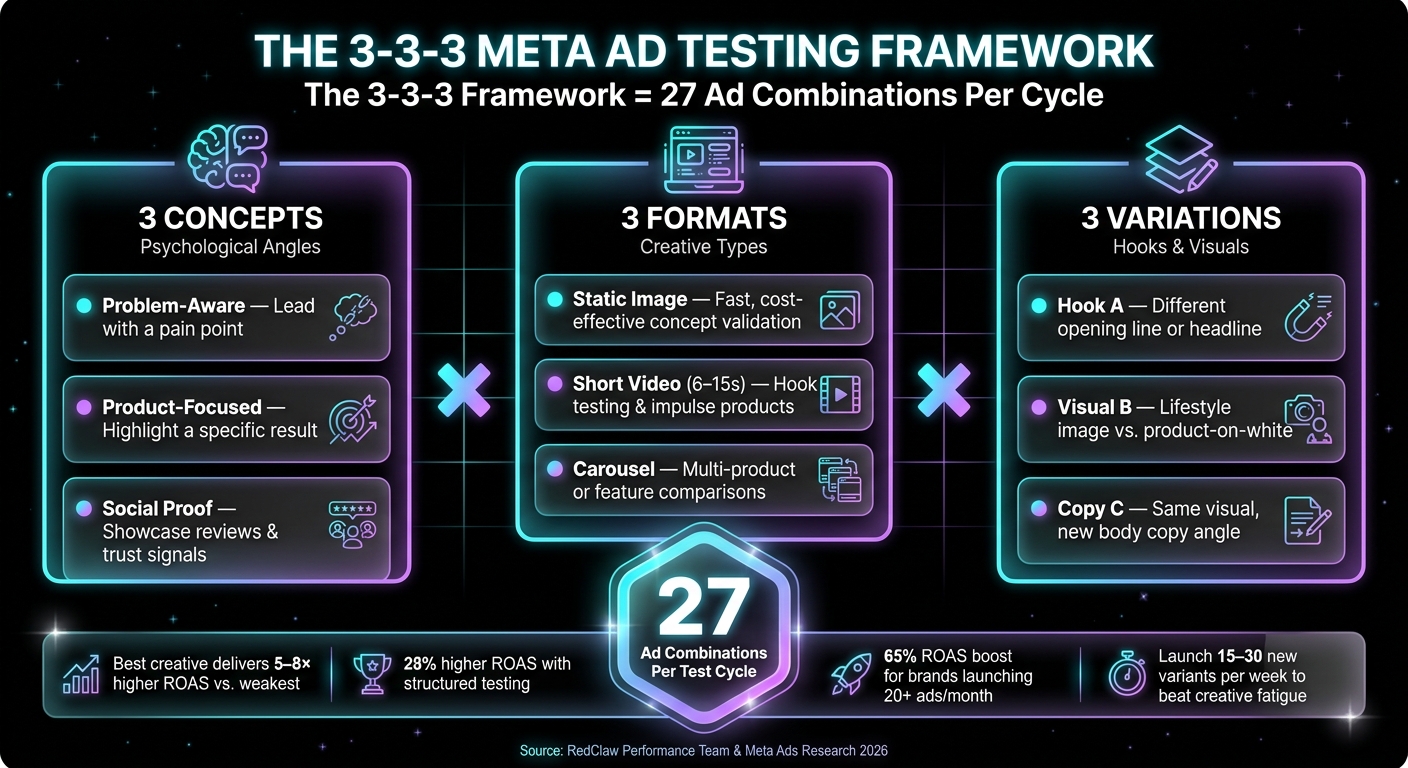
The 3-3-3 Meta Ad Testing Framework: 27 Combinations to Find Your Winner
Breaking Down the 3-3-3 Framework
The 3 Concepts: Messaging Angles
A concept is essentially a unique psychological angle - a completely different reason for someone to care about your product. The 3-3-3 framework begins by testing three of these angles at the same time.
The most effective angles on Meta platforms are typically problem-aware, product-focused, and social proof. Here’s how they work:
- Problem-aware: This type of ad starts with a pain point, like "Tired of wasting money on ads that don't convert?"
- Product-focused: These ads emphasize a specific result, such as "Generate 30 static ads in under 10 minutes using AI platforms for Meta ads."
- Social proof: These ads build trust by showcasing customer reviews, star ratings, or user numbers.
The key is to ensure these angles are genuinely distinct, not just slight variations of the same idea. This allows you to test which psychological trigger resonates most with your audience before diving into more resource-intensive creative production. As the RedClaw Performance Team notes:
"The algorithm handles targeting, placements, and bidding automatically. What it cannot do is create better ads. That is your job."
Focus on testing these broader concepts first, rather than smaller details like button colors or fonts. Big-picture elements should come before fine-tuning.
Once you’ve identified the strongest concepts, apply them across multiple creative formats to maximize their potential.
The 3 Formats: Static, Video, and Carousel
After choosing your three angles, the next step is to test each one across three formats: static images, short videos, and carousels. Each format serves a distinct purpose and targets different types of users.
- Static images: These are cost-effective and ideal for quickly validating concepts.
- Short videos (6–15 seconds): Great for testing hooks and grabbing attention, especially for impulse-driven products.
- Carousels: Perfect for showcasing multiple products or providing detailed comparisons of features.
Using a variety of formats sends different signals to Meta’s algorithm. Meta’s Andromeda model analyzes creative elements - like visuals, tone, and copy - to decide who sees your ad. If you run visually similar ads within the same format, the algorithm might group them together, which can limit your reach. Testing across formats avoids this problem.
| Format | Avg. CTR Benchmark | Best Use Case |
|---|---|---|
| Static Image (1:1) | 0.9%–1.4% | Quick concept validation |
| Static Image (9:16) | 1.1%–1.8% | Capturing cold audiences |
| Short Video (6–15s) | 1.5%–2.6% | Hook testing |
| Carousel | 1.0%–1.6% | Multi-product or feature showcases |
Source: [1]
For most advertisers, static ads should form the foundation of your testing cycle. They’re efficient for validating concepts before committing to video production.
Once you’ve nailed the concepts and formats, it’s time to refine the execution by experimenting with hooks and visuals.
The 3 Variations: Hooks and Visuals
With your concept locked in and the format decided, the final layer focuses on creating three variations of the same message, each with a different hook or visual style.
The hook is the most critical part - it’s what grabs attention in the first 1.5 to 3 seconds of a video or serves as the standout headline and image in a static ad. If the Hook Rate falls below 25%, it means the ad isn’t capturing attention fast enough. For static ads, this translates to having a compelling visual and headline right off the bat.
To create variations, adjust one element at a time. For example, change the hook but keep the body copy the same, or test a lifestyle image against a product-on-white background while leaving the headline unchanged. This approach isolates the performance impact of each change. Minor tweaks, like adjusting font size or button color, rarely make a noticeable difference.
"Meta ads creative is the single biggest lever controlling your cost per acquisition on Facebook and Instagram." - Tal Yeger
Put the playbook to work
Apply this playbook to your page
Paste your website and the Lab will turn the strategy you are reading into a ready-to-test ads.
Free to try No prompt writing
How to Set Up a 3-3-3 Testing Cycle
Setting Campaign Goals and Testing Thresholds
Before you launch your ads, it’s essential to define what success looks like. Establish clear KPIs, such as your target CPA, minimum ROAS, and CTR benchmarks. Also, set kill rules upfront to remove emotion from decision-making.
Here’s a quick guide to when to pause or scale your ads:
- Pause ads with a CTR below 0.5% after 3 days or a CPA exceeding 2× your target after 7 days.
- Ads with a CTR above 1.5% and a ROAS above 3× are strong candidates for scaling.
The table below breaks down these thresholds:
| Metric | Kill Threshold | Winner Signal |
|---|---|---|
| CTR | Below 0.5% after 3 days | Above 1.5% |
| CPA | 2× target after 7 days | Below target |
| ROAS | Below 1.5× after 7 days | Above 3× |
| Hook Rate | Below 20% | Above 30% |
| Hold Rate | Below 25% | Above 40% |
(Source:)
For daily budgets, allocate $20–$30 per ad set. Let each creative spend $30–$50 before making any judgments. Ending tests too early can lead to higher costs in the long run, so patience is key.
Once your goals are set, organize your campaigns to A/B test Meta ads and messaging angles effectively.
Organizing Campaigns and Ad Sets
To ensure fair testing, use ABO (Ad Set Budget Optimization) rather than CBO (Campaign Budget Optimization). ABO guarantees equal spend across all concepts, preventing any from being overlooked. Once you identify winning ads, move them to a CBO scaling campaign, using their Post IDs to retain social proof.
Here’s how to structure your campaign:
- Create one ad set per concept, focusing on each of your three messaging angles.
- Each ad set should include three variations (different hooks or visuals testing the same angle). Ensure that creative similarity stays below 40% to avoid Meta’s algorithm grouping ads together and limiting distribution.
"Post-Andromeda testing rewards consolidation, not fragmentation." - Antonio Ventre, Founder, Skaleit Agency
To keep things organized, use a consistent naming convention for your ads. For example:
[BRAND]_[ANGLE]_[FORMAT]_[DATE]_[VARIANT#]. This approach makes it easier to filter and analyze results in Ads Manager as your testing volume grows.
Once your ad sets are ready, launch them and keep a close eye on performance.
Launching and Monitoring Your Tests
After launching, resist the urge to make changes for at least 7 days. This waiting period allows enough data to accumulate for a proper evaluation.
During this phase, focus on key metrics like Hook Rate (3-second views divided by impressions) and Hold Rate (ThruPlays divided by 3-second views). These metrics provide valuable insights:
- Hook Rate: Measures how well the opening frame grabs attention. Aim for a rate above 30%.
- Hold Rate: Indicates whether the middle section of your ad keeps viewers engaged. A rate above 40% is ideal.
If your Hook Rate consistently falls below 20%, the creative isn’t compelling enough to stop the scroll - no budget increase will fix that.
"Creative testing is the single most important ongoing activity for Meta Ads performance in 2026." - RedClaw Performance Team
Analyzing Results and Scaling with the 3-3-3 Framework
How to Read Test Results and Optimize Your Concepts
After running your campaign for 7 days, it’s time to dig into the data, starting from the top of the funnel. If your Hook Rate falls below 25%, it’s a sign that your opening frame isn’t grabbing attention. The solution? Test a new hook rather than scrapping the entire concept. On the other hand, a Hold Rate under 40% suggests your creative is losing viewers midway. This points to a messaging issue, not just a visual tweak.
Here’s the thing: small adjustments won’t save a flawed concept.
Another critical metric is the Engagement Rate Ranking in Ads Manager. Even if your ad is converting, a "Below Average" ranking could mean higher CPM costs. Antonio Ventre, Founder of Skaleit Agency, puts it plainly:
"If an ad is converting well but has below‑average engagement ranking, you are paying a CPM penalty that no amount of bid optimization will fix."
Also, when refining your creative, make sure the new version is conceptually distinct. Meta’s Andromeda algorithm clusters visually similar ads, which can lead to suppression. A simple color change won’t cut it.
Understanding these signals lays the groundwork for optimizing Meta ad campaigns and developing a consistent testing routine.
Building a Recurring Testing Schedule
Creative fatigue is inevitable, typically hitting within 2 to 4 weeks of launching a campaign. That’s why a one-and-done test cycle won’t work - you need a regular testing schedule baked into your process.
Here’s a smart budget breakdown: dedicate 70–80% of your spend to iterating on proven winners and 20–30% to testing entirely new messaging angles. Top-performing teams in 2026 are launching 15 to 30 new ad variants every week to keep fatigue at bay. If your ad frequency with cold audiences creeps above 3.5, consider it an early warning sign that fatigue is setting in.
"The advertisers who win in 2026 are not the ones with the biggest budgets. They are the ones who test the most, learn the fastest, and scale their winners most effectively." - RedClaw Performance Team
Scaling Static Ads with ADEN'S LAB
To sustain a fast-paced testing cycle, you need to scale creative production without delays. The real challenge for most brands using the 3-3-3 framework isn’t the strategy - it’s producing enough creative. Manually generating 15–30 static ad variants weekly can overwhelm even the most efficient design teams.
That’s where ADEN'S LAB comes in. This AI-driven platform simplifies the process by creating scroll-stopping Facebook and Instagram ads in minutes. All you need to do is upload your product URL or landing page, and the platform generates direct-response static ads based on proven conversion strategies. Pricing starts at $0.90 per ad on the Apex Mode plan, which costs $179/month for up to 200 ads.
For brands running the 3-3-3 framework at scale, this tool ensures you always have fresh creatives ready to go. Instead of waiting for design revisions, you can launch new variants immediately, let the data guide your decisions, and keep the algorithm engaged. This is crucial for maintaining consistent ROAS as we move into 2026.
The NEW WAY To Test Facebook Ads (Post Andromeda)
Conclusion and Key Takeaways
The 3-3-3 framework takes the guesswork out of Meta ad testing by prioritizing messaging angles, followed by hooks, and then formats. This order is crucial - research shows that the best-performing creative in a test can deliver 5–8x higher ROAS compared to the weakest one. The difference? It’s all about the core concepts, not minor aesthetic adjustments.
Advertisers who use a structured testing approach see 28% higher ROAS, while brands that launch 20+ new ads each month experience a 65% boost in ROAS. These numbers highlight just how important a solid creative strategy is.
"Creative is your most important optimization lever. The algorithm handles targeting, placements, and bidding automatically. Understanding Meta ads automation is key to leveraging these features. What it cannot do is create better ads." - RedClaw Performance Team
Consistency is key - launching 15–30 new ad variants each week is essential for staying competitive. Tools like ADEN'S LAB make this process effortless, generating static Meta ads in minutes from a single product URL. With prices starting at just $0.90 per ad, you can fully implement the 3-3-3 framework without the need for costly design teams. This speed and efficiency allow you to test, learn, and refine your strategy continuously.
FAQs
How do I pick the best 3 messaging concepts?
To pinpoint the most effective messaging concepts, start by testing a variety of creative approaches that resonate with your audience's key motivations - whether that's addressing their pain points, aligning with their aspirations, or leveraging social proof. Here's how you can do it:
- Begin with 5-6 distinct themes that reflect different angles or ideas.
- For each theme, create 2-3 variations to see which execution works best.
- Run systematic tests and closely track performance metrics like Click-Through Rate (CTR), Cost Per Acquisition (CPA), and Return on Ad Spend (ROAS).
As results come in, pause any underperforming concepts. Focus your energy on the ones that consistently perform well. Once you've identified the top 3, refine them further and scale their reach to maximize their effectiveness.
How long should I let each 3-3-3 test run before deciding?
Each 3-3-3 test should run for at least 7 days to collect enough data for analysis. However, running the test for 10–14 days is even better, as it provides more stable and reliable results. This timeframe ensures you have sufficient information to evaluate your ad performance and make well-informed decisions.
When should I scale a winner versus create a new variation?
When a creative has been running for at least 7 days, gathered 30+ conversions, and consistently hits your CPA and ROAS targets without showing major dips, it’s a good time to scale it. Stability is key - watch for steady performance with no significant fluctuations.
However, if you notice performance slipping - like CPA jumping by more than 30% over two weeks or frequency climbing above 3.0 - it’s time to pause or reevaluate. For creatives still in the testing phase or delivering inconsistent results, prioritize creating new variations to keep things fresh and engaging.
Your next ad batch starts here
Finish with a ready-to-test ad batch
Paste your website to generate static creatives. Drop the link → get ads in about 90 seconds → upload them to Meta → scale.
Free to try No prompt writing