How to Find Winning Meta Ads Faster With a Better Testing Framework
Turn the strategy into creatives
Create Meta ads for your product
Paste your product page. ADEN'S LAB turns the offer, audience, and positioning into complete ready-to-use Meta static ads.
Free to try No prompt writing

Want better results from your Meta ads? Here’s the key: a structured testing framework.
Most marketers waste money on inefficient ad testing - overlapping campaigns, tweaking too much at once, or stopping ads too early. This leads to higher costs, poor data, and declining performance. To fix this, follow these steps:
- Test smarter with A/B testing Meta ads via an ABO campaign: Focus on isolating variables (like hooks or visuals) to find what works.
- Allocate your budget wisely: Spend 60% on proven ads, 30% on variations, and 10% on new ideas.
- Use efficient tools like ADEN's LAB: Quickly generate ready-to-test static ads for $0.90 each.
- Follow the 3:2:2 method: Test 3 visuals, 2 texts, and 2 headlines to create 12 ad variations.
- Focus on big changes, not minor tweaks: Test different angles to reach new audiences and avoid penalties.
- Analyze the right metrics: Prioritize CPA and ROAS after 10–15 conversions to scale winners effectively.
Step 1: Generate Static Creatives at Scale
Why Static Ads Work Best on Meta
Static ads are a go-to format on Meta because they’re easy to produce, test, and iterate. They’re quicker to create than videos and offer clean, high-volume signals that Meta can use to identify what works.
"Static images still train the algorithm on thumbnail-level engagement - how quickly users stop scrolling or hover. They provide high-volume, low-noise signals that help Meta identify strong hooks before scaling."
- Mike Lim, Performance Marketer
These ads are perfect for single-variable testing since they let you isolate elements like images or headlines without distractions like music or pacing. To keep campaigns performing at their best, it’s crucial to regularly introduce fresh static creatives. Leading performance marketers push 20–30 new concepts into testing every month to avoid creative fatigue. This approach ensures a steady stream of high-performing ads, and ADEN's LAB makes this process even faster.
How to Use ADEN's LAB for Fast Creative Production
ADEN's LAB takes the guesswork (and time) out of creative testing. Just input your product or landing page link, and The AI evaluates your brand and offer. It identifies winning patterns based on historical performance, such as hooks, visuals, and calls-to-action.
Within minutes, the platform churns out dozens - or even hundreds - of ready-to-test creatives. Compare that to manual production, which can cost $30–$50 per ad and take days. Using ADEN's LAB, marketing teams can launch campaigns up to 10x faster. Plus, the bulk processing feature integrates directly with Meta Ads Manager via API, cutting down hours of manual setup.
For the best results, stick to the 1080×1350 vertical format (4:5), which takes up more mobile screen space and boosts click-through rates. Square images (1:1) are also highly effective, working well across 80% of Meta placements. To ensure crisp visuals even after Meta’s compression, use a resolution of 1440×1440 or higher.
Put the playbook to work
Apply this playbook to your page
Paste your website and the Lab will turn the strategy you are reading into a ready-to-test ads.
Free to try No prompt writing
Step 2: Structure Tests Using the 3:2:2 Dynamic Creative Method
How the 3:2:2 Testing Structure Works
Once you've streamlined your creative generation process, the next step is organizing these assets for testing. That’s where the 3:2:2 framework comes into play. This method structures your Meta ad tests using 3 unique creatives (visuals), 2 primary texts, and 2 headlines. Meta’s algorithm then combines these elements to create 12 unique ad variations (3 × 2 × 2), which are shown to different users in real time.
This setup consolidates all the data under a single dynamic ad unit. Why is that important? It prevents splitting your budget across multiple campaigns and helps Meta’s algorithm learn more effectively.
"A Dynamic Creative Ad is a flexible container for multiple creative elements."
- Rokas Steponavičius, CEO, TryCrush.ai
The framework also aligns with the 48-hour rule for testing creatives. With a modest budget of $50–$100, you can determine the best-performing combination in just two days.
Here’s the trick: don’t test minor tweaks. Instead, focus on big-picture concepts. For example, test a "Health Angle" against a "Financial Angle" rather than making small changes like adjusting colors or fonts. This approach helps you understand which messaging resonates most with your audience.
Applying ADEN's LAB Creatives to the 3:2:2 Framework
ADEN’s LAB makes it easy to implement the 3:2:2 structure. The platform analyzes your product or landing page and generates dozens of ready-to-test creatives based on proven templates. From there, you just need to pick 3 distinct visuals, 2 primary texts, and 2 headlines for your dynamic creative unit in Meta Ads Manager.
Once your ads are live, Meta Ads Manager’s "Breakdown" feature becomes your best friend. Use it to identify the top-performing creative elements. Navigate to the ad level, click "Breakdown", and choose "By Dynamic Element" to see which combinations are driving results. Pay attention to metrics like CPA (Cost Per Action) or ROAS (Return on Ad Spend) instead of simply looking at how the budget is distributed.
When you find a winning ad combination, extract its Post ID and move it to a separate scaling campaign. This allows you to keep any social proof (likes, comments, shares) intact while increasing the budget for better reach. ADEN’s LAB also integrates directly with Meta Ads Manager via API, letting you process and launch new 3:2:2 tests quickly. This not only saves time but also sets you up for efficient scaling and optimization in future testing stages.
Here's EXACTLY How To Test Facebook Ads In 2026
Step 3: Test Different Creative Angles
Building on the 3:2:2 structure, it's crucial to experiment with entirely different creative angles to keep your ads fresh and avoid penalties from the algorithm.
Why Big Changes Outperform Small Adjustments
Meta’s algorithm penalizes ads that appear too similar - especially within the first three seconds of a video or ad creative. If you only make minor changes, like tweaking a few words or adjusting colors, the platform groups these ads together and limits their delivery. This "similarity penalty" can slow down your testing process significantly.
While small adjustments might improve click-through rates (CTR), they rarely lead to better conversions. Meta's algorithm often prioritizes these minor variations over proven performers simply because of the similarity issue. As Soarwithus points out:
"Changing only the words while keeping the same shot no longer counts as a test".
To truly test effectively, focus on completely different creative angles that target distinct motivators. For instance, promoting a health supplement by addressing "brain fog" instead of "joint pain" appeals to different buyer personas and can help uncover new audience segments. Meta’s "soulmate theory" reinforces this idea: diverse creative assets are essential to connect with the right audience.
When evaluating your tests, look at metrics like CPA and ROAS after achieving 10–15 conversions. Early engagement signals, such as CTR, don’t give the full picture. The key to success is isolating variables and identifying what truly drives performance—often by cutting Meta CPA through AI-driven optimization - this is where ADEN's LAB shines.
How ADEN's LAB Helps Create Unique Angles
ADEN's LAB uses the P.D.A. Framework (Persona, Desire, Awareness) to generate multiple creative concepts. From a single product or landing page link, it can produce 8–12 distinct ad ideas, each targeting a different psychological trigger or buyer motivation.
The platform categorizes these variations into proven formats, such as:
- Problem-solution ads
- Social proof
- Product demos
- Psychological hooks (like FOMO or aspiration)
- Narrative-driven stories (e.g., founder journeys or customer transformations)
Since creative angles are responsible for 70–80% of performance differences in Meta ads, having this variety is key to identifying campaigns that truly stand out.
Once ADEN's LAB generates these unique angles, you can incorporate them into your 3:2:2 structure. For example, you might select three visually distinct creatives - like a customer testimonial, a product demo, and a bold text overlay - and pair them with two primary texts and two headlines. This approach ensures that Meta’s algorithm treats them as unique, helping you exit the learning phase faster and scale your campaigns more effectively.
Step 4: Analyze Metrics and Scale Winners
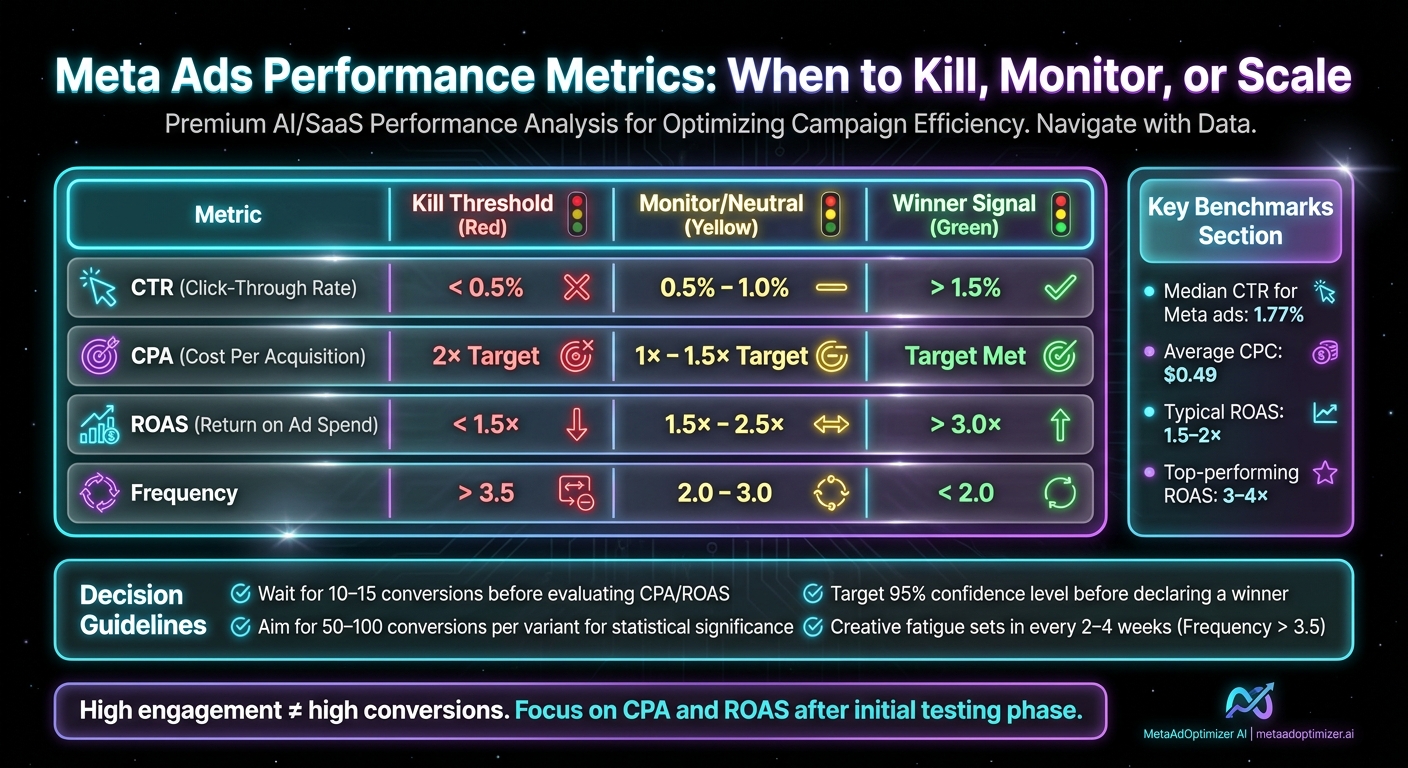
Meta Ads Testing Framework Metrics Decision Guide
After setting up a structured testing framework, the next step is diving into the numbers. This analysis helps pinpoint which ads are worth scaling and which ones need to be paused.
Which Metrics Matter for Ad Testing
Some metrics stand out as early indicators of ad performance. Click-Through Rate (CTR) and Hook Rate are key during the first 24–48 hours. These show whether your ad grabs attention and stops the scroll. For context, the median CTR for Meta ads is around 1.77%, while the average Cost Per Click (CPC) is $0.49.
However, engagement alone doesn’t guarantee sales:
"High engagement ≠ high conversions. Meta can't distinguish 'this ad gets clicks' from 'this ad gets profitable sales'" - Vibemyad
That’s why Cost Per Acquisition (CPA) and Return on Ad Spend (ROAS) are the metrics to focus on once your campaign gathers traction. After about 10–15 conversions, these metrics offer a clearer picture of profitability. A ROAS between 1.5–2× is typical, but top-performing campaigns can hit 3–4×. Avoid making decisions based on gut instinct; aim for at least 50–100 conversions per variant or a 95% confidence level before declaring a winner.
Another important metric is Frequency, which measures how often users see your ad. A frequency higher than 3.0–3.5, paired with a declining CTR, signals creative fatigue and audience saturation. When this happens, it’s time to update your creatives or expand your audience.
Here’s a quick reference guide for decision-making:
| Metric | Kill Threshold | Monitor/Neutral | Winner Signal |
|---|---|---|---|
| CTR | < 0.5% | 0.5% – 1.0% | > 1.5% |
| CPA | 2× Target | 1× – 1.5× Target | Target Met |
| ROAS | < 1.5× | 1.5× – 2.5× | > 3.0× |
| Frequency | > 3.5 | 2.0 – 3.0 | < 2.0 |
To streamline this process, set up automated rules. For instance, pause any ad that exceeds 2–3 times your target CPA without generating a conversion.
With these metrics in mind, the focus shifts to scaling the winners effectively.
How to Scale Winners with ADEN's LAB
Once you’ve identified your top-performing ads, the challenge becomes scaling them while keeping performance steady. A major roadblock for many brands is creative fatigue, which typically sets in every 2–4 weeks. The key to overcoming this is maintaining a steady flow of fresh creatives.
Enter ADEN's LAB and its Apex Mode plan. This service produces 200+ optimized static ads per month at just $0.90 per ad. With this volume, you can continuously test new angles, refresh underperforming ads, and stay ahead of creative fatigue. To scale effectively, increase your budget by 20% every 24–48 hours using AI-driven budget allocation, ensuring you don’t disrupt Meta’s learning phase.
ADEN's LAB also allows you to repurpose successful messaging across formats. For example, if a particular hook works well in one design, you can quickly generate variations in different styles. This approach keeps your campaigns dynamic without requiring a complete overhaul.
Traditional Designer Workflows vs. ADEN's LAB
To understand the advantage of ADEN's LAB, compare it with traditional creative production methods. Here’s how they stack up:
| Feature | Traditional Designer Workflow | ADEN's LAB (Apex Mode) |
|---|---|---|
| Volume | 5–10 ads per month | 200+ ads per month |
| Turnaround Time | Days or weeks per iteration | Near-instant/Automated |
| Cost | $2,000–$8,000/mo | $179/mo ($0.90 per ad) |
| Testing Capability | Limited to a few "best guesses" | Rapid testing of multiple angles/hooks |
| Scaling Support | Slow to react to ad fatigue | Proactive generation to maintain scale |
Traditional workflows often involve lengthy back-and-forths, creative briefs, and manual revisions. ADEN's LAB eliminates these delays, enabling you to produce ads faster and rely on data - not guesswork - to determine winners. This speed advantage is critical, especially in an environment where creative quality influences 47% of ad performance variability.
Brands that follow structured testing processes see a 28% higher ROAS compared to those that test randomly. With ADEN's LAB, you’re not just producing ads - you’re building a system that consistently drives performance and sets the stage for long-term campaign growth.
Conclusion
Main Takeaways
A well-structured testing framework is your secret weapon to streamline ad performance. By isolating variables, spotting patterns, and building a library of proven creatives, you can eliminate inefficiencies and speed up results. The four steps we covered - producing static creatives at scale, using the 3:2:2 testing method, exploring different creative angles, and analyzing Meta ad metrics to scale winners - work together to simplify the process and boost outcomes.
ADEN's LAB makes this entire approach quicker and more cost-effective. With the Apex Mode plan, you can generate 200+ optimized static ads per month for just $0.90 per ad. This lets you consistently test new creative ideas and avoid the frustration of waiting on designers or agencies. Automated production means you can replace weeks of manual work with fast, data-driven insights.
The key to success lies in separating testing campaigns from scaling campaigns. Dedicate 20–30% of your ad budget to testing new ideas, while focusing the rest on scaling proven winners. Allow 3 to 5 days before making optimization decisions, aiming for a 95% confidence level or 50 conversions per variant before declaring a winner. This disciplined approach ensures your budget is used wisely and your data remains reliable, setting the stage for ongoing campaign success.
What to Do Next
Now that you have a clear framework, it’s time to put it into action. Start by using ADEN's LAB to quickly generate static creatives - just input your product or landing page URL, and you’ll have engaging ads ready in minutes. Use the 3:2:2 framework to structure your tests, and during the first 24–48 hours, focus on leading indicators like CTR and thumb-stop rate. As more conversion data comes in, shift your attention to CPA and ROAS to identify the top-performing creatives.
Document your findings by building a pattern library of winning hooks, visuals, and CTAs - this becomes your go-to playbook for future campaigns. Once you’ve identified the best-performing creatives, move them into scaling campaigns with larger budgets and broader audiences. By sticking to this framework, you’ll not only overcome creative fatigue but also leverage precise data analysis to fuel continuous growth. With ADEN's LAB handling the heavy lifting of creative production, you can focus on making smarter, strategic decisions that drive long-term success.
FAQs
How much budget do I need to test ads?
For a practical starting point, aim to allocate $20 to $50 per ad set per day when testing Meta ads. While Meta technically allows you to run ads for as little as $1 per day, that amount usually isn’t enough to gather meaningful data or identify which creatives perform best.
By sticking to the $20–$50 range, you can ensure your ads reach enough people to produce statistically reliable results and help you figure out what works faster. This approach gives your campaigns the delivery and data they need to perform effectively.
When should I stop or scale a test?
Once you've collected enough reliable data to spot clear performance trends or identify a winning creative, it's time to stop or scale a test. The key is to focus on consistent patterns across your tests, recognize when further variations yield diminishing returns, and pinpoint the elements driving results. Instead of waiting endlessly for statistical significance, prioritize actionable insights. This approach helps you learn faster and scale successful ads more effectively.
How do I avoid creative fatigue on Meta?
To keep your Meta ads engaging and avoid creative fatigue, it's crucial to use a structured testing framework. Regularly refresh and fine-tune your ad creatives by testing one variable at a time. For reliable results, wait until you reach statistical significance - typically around 50-100 conversions per variant. Always ensure at least one creative test is running. This method not only helps you spot top-performing ads but also keeps your campaigns dynamic and appealing over time.
Your next ad batch starts here
Finish with a ready-to-test ad batch
Paste your website to generate static creatives. Drop the link → get ads in about 90 seconds → upload them to Meta → scale.
Free to try No prompt writing