How to Turn One Winning Meta Ad Into 15 New Variations Without Guessing
Turn the strategy into creatives
Create Meta ads for your product
Paste your product page. ADEN'S LAB turns the offer, audience, and positioning into complete ready-to-use Meta static ads.
Free to try No prompt writing

If you’ve got a Meta ad that’s performing well, don’t stop there. Instead of starting from scratch, use that winning ad as a foundation to create 15 new variations. By tweaking key elements like the hook, visuals, and call-to-action, you can systematically test what works - without wasting ad spend on random changes.
Here’s the process in a nutshell:
- Analyze your winning ad: Break it down into key components (hook, visuals, headline, body copy, CTA) and identify what’s driving success using proven Meta ad copy frameworks.
- Set up a framework: Separate what works (fixed elements) from what you’ll test (variables).
- Leverage AI tools: Use platforms like ADEN's LAB to quickly generate variations based on your framework.
- Test systematically: Run tests with clear benchmarks (e.g., CPA, CTR) and isolate variables for reliable results.
- Refine and repeat: Use insights from each test cycle to improve future campaigns and avoid creative fatigue.
This approach ensures you maximize the potential of your best-performing ads while maintaining a structured, data-driven testing process.
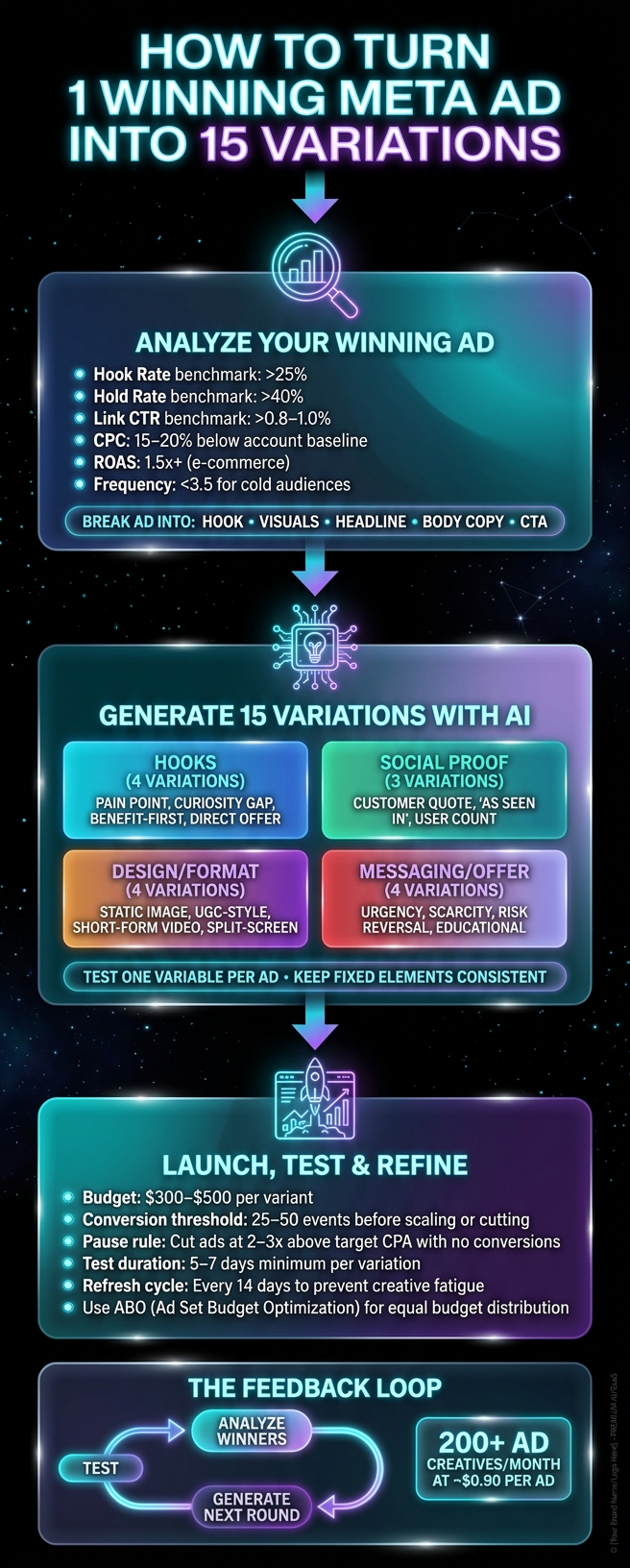
How to Turn 1 Winning Meta Ad Into 15 Variations: A 3-Step System
How To Run A/B Tests on Meta Ads (Step-by-Step for Beginners)
Put the playbook to work
Apply this playbook to your page
Paste your website and the Lab will turn the strategy you are reading into a ready-to-test ads.
Free to try No prompt writing
Step 1: Analyze Your Winning Meta Ad
Before diving into creating 15 variations, take a step back and figure out why your ad is performing well. One of the biggest mistakes advertisers make is skipping this step. They copy the outward appearance of a successful ad without truly understanding what’s driving its results.
Identify Key Performance Metrics
Metrics tell a story - but only if you know how to read them in the right order. Think of it as a hierarchy: Hook Rate shows if the ad grabs attention, CTR (Click-Through Rate) reveals if it inspires clicks, and CPA/ROAS indicates whether it leads to profitable outcomes.
Here’s a quick way to confirm you’ve got a winning ad: look for a CTR that’s 25–35% above your account baseline and a CPC that’s 15–20% lower. When evaluating CPA, wait until the ad gathers at least 10–15 conversions over 48–72 hours.
Two creative-level metrics you’ll want to monitor closely are Hook Rate (3-second video views ÷ impressions) and Hold Rate (ThruPlays ÷ 3-second views). If the Hook Rate is under 25% or the Hold Rate is below 40%, it’s a sign that your ad is losing viewers before the message even lands.
| Metric | What It Measures | Benchmark |
|---|---|---|
| Hook Rate | Ability to grab attention (first 3 seconds) | >25% |
| Hold Rate | Viewer retention beyond the opening | >40% |
| Link CTR | Interest in clicking | >0.8–1.0% |
| CPC | Cost of traffic vs. account baseline | 15–20% below baseline |
| ROAS | Profitability | 1.5x+ (e-commerce) |
| Frequency | Audience saturation | <3.5 for cold audiences |
Once you’ve nailed down these metrics, it’s time to dissect your ad and figure out what’s making it tick.
Break Down the Winning Ad Into Its Parts
Take your successful ad and break it into its core components: the opening hook, visuals, headline, primary text (body copy), and CTA. This will help you identify which piece is driving performance.
For example, TripleDart analyzed a B2B SaaS ad in April 2026 and found that pain-point messaging like “Stop wasting budget...” generated registrations at a $48 CPA, while feature-demo messaging like “See how our AI platform works...” resulted in a much higher $112 CPA. The key difference? The copy angle. Everything else - visuals, format, and CTA - remained the same, but the pain-point approach outperformed by 2.4x.
So, what’s driving your ad’s success? A high Hook Rate but weak CPA might mean your ad grabs attention but fails to convert, suggesting the body copy or offer could be the issue. On the other hand, a strong CPA paired with a low Hook Rate indicates your ad resonates well with a narrow audience but struggles to attract attention.
"The hook is the gating element... Ads with hook rates below 20% rarely accumulate enough downstream data to optimize against." - Rule1
Build a Variation Framework
Now that you’ve analyzed your metrics and broken down the ad components, organize your findings into a clear framework. The goal is to separate fixed elements (the parts that are working) from variables (the parts you’ll test). This keeps your 15 variations from turning into random experiments.
| Ad Component | Fixed (Keep) | Variable (Test) | Goal |
|---|---|---|---|
| Hook | Problem-aware text | 3 new visual pattern interrupts | Increase Hook Rate |
| Visual | Lifestyle imagery | Product-focused vs. UGC-style | Test audience resonance |
| Headline | Benefit-led claim | Question-based vs. social proof | Improve CTR |
| CTA | "Shop Now" | "Learn More" vs. "Get the Deal" | Lower CPA |
The key here is testing one element at a time. By isolating variables, you can pinpoint exactly what’s driving the change. If you adjust multiple elements at once, you’re back to guessing. This structured approach sets the stage for the AI-driven generation process in the next step. You can also use these AI tools to streamline the creative process.
Step 2: Use AI to Generate Ad Variations
Now that you’ve built your variation framework, it’s time to transform that structure into actual ads - quickly and efficiently. This is where ADEN's LAB steps in to simplify the process. Instead of manually writing 15 different ad angles or briefing a designer, you can input your data into the platform and let it systematically create variations tailored to your testing goals.
Gather Inputs Before You Begin
Before diving in, make sure you’ve collected these four key inputs:
- Product URL: Use this to extract essential visuals and product details.
- Winning Ad Assets: These serve as your creative foundation, providing a proven baseline for new variations.
- Performance Benchmarks: Define targets like CPA, ROAS, or CTR to guide your testing.
- Psychological Messaging Angles: Focus each variation on a single driver, such as pain points, curiosity, social proof, urgency, or benefits.
To enhance your strategy, study competitor ads in the Meta Ad Library. Look for campaigns that have been running for several weeks. This can offer insights into effective hooks, visuals, and call-to-action phrases that resonate with audiences.
Map Out Your 15 Variation Categories
With your inputs ready, assign each variation to a specific testing category. This ensures clarity and avoids overlap, allowing each ad to focus on testing a distinct element. Here’s a breakdown:
| Variation Category | # | Variation Type | Variable Being Tested |
|---|---|---|---|
| Hooks | 1 | Pain Point | Specific customer frustration |
| 2 | Curiosity Gap | Question or intriguing opener | |
| 3 | Benefit-First | Lead with the primary outcome | |
| 4 | Direct Offer | Open with the discount or deal | |
| Social Proof | 5 | Customer Quote | Verified testimonial as primary copy |
| 6 | "As Seen In" | Media mentions or press logos | |
| 7 | User Count | "Join 10,000+ happy customers" | |
| Design/Format | 8 | Static Image | High-quality product photography |
| 9 | UGC-Style | Authentic, lo-fi visual or avatar | |
| 10 | Short-Form Video | Motion-based demo or storytelling | |
| 11 | Split-Screen | "Problem vs. Solution" comparison | |
| Messaging/Offer | 12 | Urgency | Limited-time availability |
| 13 | Scarcity | Low stock or exclusive access | |
| 14 | Risk Reversal | Money-back guarantee or free shipping | |
| 15 | Educational | "How it works" in 3 steps |
This structure ties directly to your framework, ensuring a clear focus for each ad variation.
Generate Copy and Creatives With AI
Once your categories are mapped, ADEN's LAB gets to work. It generates headlines, copy, and creatives for all 15 variations, focusing on one variable per ad. By building on the success of your winning ad, the platform fine-tunes its outputs instead of starting from scratch.
For copy, the AI creates alternative hooks, headlines, and body text while keeping your core message consistent. On the creative side, it delivers options in three formats - static images, short-form videos, and UGC-style ads - catering to different user preferences. If you’re on the Apex Mode plan ($179/month), you can produce up to 200 static ad creatives monthly, which breaks down to just $0.90 per ad. This makes it a budget-friendly alternative to traditional design workflows.
Once your first round of ads runs, performance data flows into the Winners Hub, refining your approach for the next set of variations. With your ads ready to go, you’re all set to move on to Step 3 and start testing.
Step 3: Launch and Test Your 15 Variations
Now that your 15 ads are ready, it’s time to upload them into Meta Ads Manager to gather actionable data. A well-structured setup ensures you get clear insights.
Group Variations by Testing Theme
Organize your 15 ads based on the variable you’re testing, such as hooks, offer messaging, or creative formats. Keep the audience and budget consistent across all groups to ensure that performance differences are due to the ad variations themselves - not targeting factors.
For the most accurate results, use Ad Set Budget Optimization (ABO) instead of campaign-level budget control. ABO ensures that each ad variation gets an equal share of the budget, making the test results more reliable. A good starting point is $300–$500 per variant, or enough to generate 25–50 conversion events before deciding which ads to keep or cut.
Make sure to run these tests in a dedicated testing campaign, separate from any ongoing scaling campaigns. If you mix new ads with proven ones, Meta’s algorithm will favor the established creatives, making it harder for the new ads to gain traction.
Once your ad sets are organized, it’s time to define clear performance metrics.
Set Clear Metrics for Success
Before launching, establish specific benchmarks like CPA and ROAS optimization. Use diagnostic metrics like CTR (click-through rate) and frequency to understand what’s working. For instance:
- A CTR below 0.8% on cold traffic could indicate issues with your hook or visuals.
- A frequency above 3.0 suggests your audience is starting to ignore the ad.
"Success with Meta Ads is no longer about finding one 'perfect' ad. It's about building a system for relentless creative testing and iteration." - Genyad
Stick to this key rule: pause any variation that’s 2–3x above your target CPA without conversions. Don’t wait for it to improve - redirect that budget to ads showing promise. Keep in mind that ad performance often spikes during the first 48–72 hours, so let each variation run for at least 5–7 days before making final decisions.
Use Data to Refine the Next Round
Once you’ve identified your winning ads, analyze the results to refine your future campaigns. Look for patterns: Did problem-aware hooks outperform benefit-focused ones? Did static images get better results than UGC-style formats? These insights are far more valuable than finding a single successful ad.
Feed your findings into ADEN's LAB through the Winners Hub to guide your next round of ads. This creates a feedback loop where each testing cycle builds on the last. To avoid creative fatigue, plan for a 14-day refresh cycle, swapping out variations before performance starts to decline.
Conclusion: A Repeatable Process for Scaling Meta Ads
Scaling Meta ads isn’t a matter of chance - it’s about having a structured system in place. By breaking down a winning ad into its essential parts - hook, headline, body copy, visual, and call-to-action - you create a foundation that’s easy to replicate. From there, AI can take over, generating 15 well-structured variations in just minutes. Add disciplined testing with clear criteria for scaling or cutting ads, and you’ve got a recipe for consistent success.
The real magic lies in the knowledge you gain from every test. Each cycle strengthens your data foundation, making future campaigns even sharper and more effective. This approach not only boosts performance but also tackles one of the biggest challenges in Meta advertising: creative fatigue. As AdGPT insightfully puts it:
"Creative fatigue is not a brand problem. It is a systems problem." – AdGPT
By consistently producing data-driven variations, you can avoid issues like rising CPMs and falling CTRs - two major roadblocks when scaling campaigns.
Tools like ADEN'S LAB are designed to support this kind of system. Sarah Chen, CMO of Fashion Forward Co., shared her experience: "ADEN'S LAB created 200+ ad variations in one day. Our previous agency took 3 weeks for 10 ads. The AI-created ads outperformed our human-created ones by 340%." This example highlights how transforming a single winning ad into a scalable process can supercharge your growth. The framework outlined here ensures you can replicate these results, building success one winning ad at a time.
FAQs
How do I know my Meta ad is really a winner?
A successful Meta ad isn't about short-lived surges in performance; it’s about delivering steady results over a period of 7–14 days. To truly measure its effectiveness, the ad should align with clear objectives, such as hitting a defined ROAS or CPA target. Additionally, it needs to reach a statistically significant spend - typically between $500 and $1,000 - to ensure the data is reliable. Always consider the ad's performance in relation to your audience, budget, and placements to determine if its success can be consistently replicated.
What should I keep fixed vs. test in my 15 variations?
Think of ads as a collection of interchangeable pieces - hooks, visuals, copy, and CTAs - rather than static, unchangeable blocks. This modular approach allows you to experiment and refine individual elements without overhauling the entire ad.
What stays consistent? Your brand guidelines, offer details, and any compliance language. These are your non-negotiables and ensure your messaging remains aligned with your identity and legal requirements.
When testing, focus on one variable at a time. For example, tweak the headline, adjust the hook, reframe the benefits, or try a different CTA. This controlled approach ensures that any performance shifts can be directly linked to the specific change you made. The result? Clear, actionable insights that can guide your future campaigns.
How much budget and time do I need to test each variation?
When determining a winning ad, it's a good idea to test at least six different creative variations. Allocate a budget of $50 per day per ad set - this usually provides enough data within 48 to 72 hours to draw meaningful conclusions.
For more in-depth testing, aim for enough impressions to move beyond the learning phase. This often means spending about $500 per combination. And to keep your ads fresh and engaging, make sure to refresh your tests every 14 days to avoid ad fatigue.
Your next ad batch starts here
Finish with a ready-to-test ad batch
Paste your website to generate static creatives. Drop the link → get ads in about 90 seconds → upload them to Meta → scale.
Free to try No prompt writing