Competitor-Angle Prompts for Meta Ads Without Copying Competitor Ads
Use the prompts on your real offer
Generate these ad angles for your product
Skip the blank prompt box. Paste your product page and ADEN'S LAB applies the angles to your offer, images, headlines, and copy.
Free to try No prompt writing

In Meta advertising, the secret to success lies in understanding why competitor ads work without directly copying them. By analyzing their psychological hooks, emotional triggers, and Meta ad copy frameworks, you can create original, high-performing campaigns that reflect your brand's voice. Here's how:
- Validate angles: Look for ads running over 14-60 days to identify effective strategies. Use AI tools to analyze emotional triggers like fear or aspiration. You can also leverage AI tools for Meta ads to speed up this analysis.
- Reframe strategies: Swap mechanisms and fill gaps competitors miss (e.g., transparency, trust). Use a Brand Voice Document to stay consistent.
- Test systematically: Use a Factorial Variant Matrix to combine hooks, visuals, and CTAs, generating multiple ad variations for testing.
- Stay ethical: Borrow structures, not content. Focus on triggers and concepts, not direct replication.
- Localize for impact: Address regional gaps (e.g., shipping delays) to tailor ads and boost engagement.
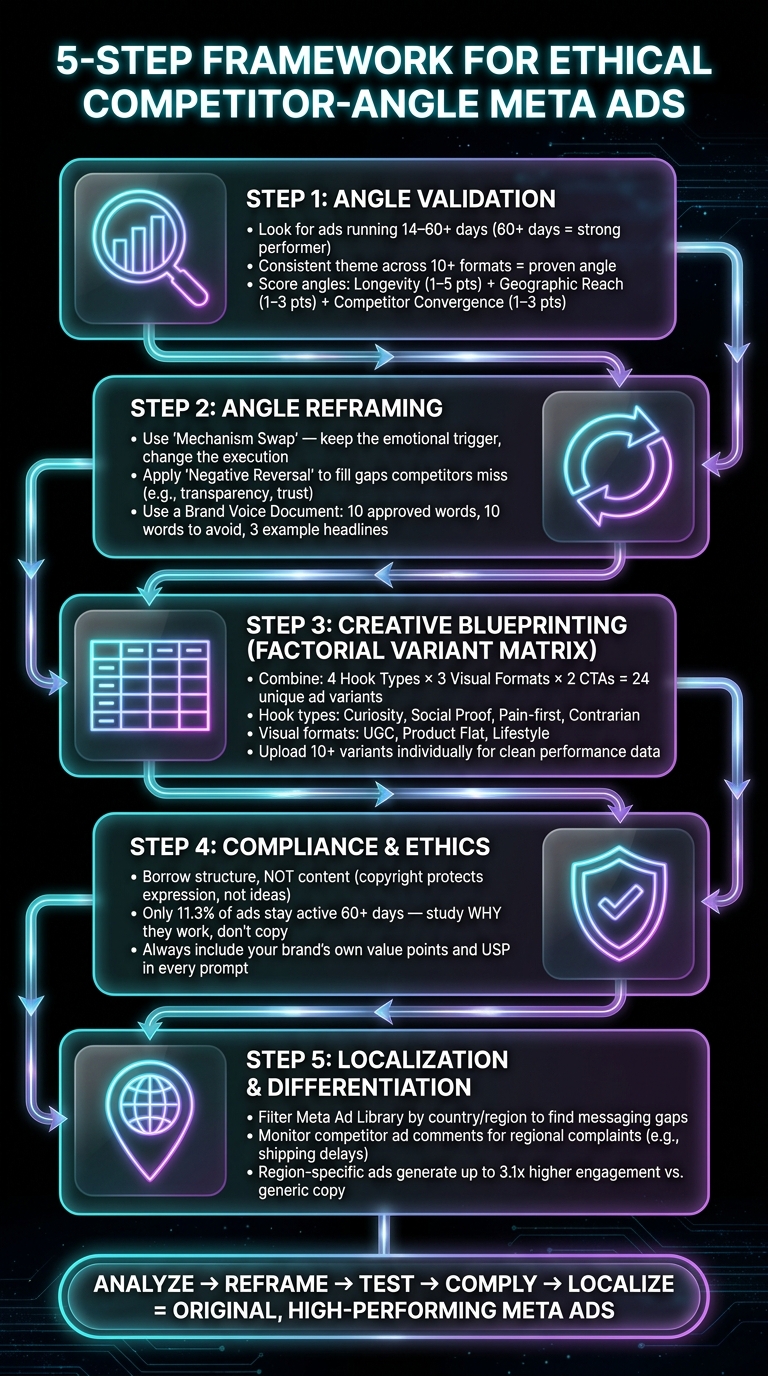
5-Step Framework for Ethical Competitor-Angle Meta Ads
This AI System Analyzes Your Competitor's Meta Ads (n8n Tutorial)
Put the playbook to work
Apply this playbook to your page
Paste your website and the Lab will turn the strategy you are reading into a ready-to-test ads.
Free to try No prompt writing
1. Angle Validation
To begin, it’s essential to confirm whether a particular advertising angle resonates in the market - not just for competitors, but broadly. One quick way to assess this is by looking at the lifespan of competitor ads. Ads running for at least 14 days typically meet a basic profitability standard. If an ad has been live for over 60 days, that’s a strong sign of its effectiveness, as Meta’s algorithm tends to suppress ads that underperform. This step lays the groundwork for adapting strategies ethically while also sparking creative concepts.
A consistent message across multiple formats is another strong indicator of success. For example, if a competitor uses the same theme across 10 or more formats - like videos, carousels, or static images - it’s a clear sign that the angle is driving results.
"Every ad that runs for more than 60 days is telling you something. Every carousel that gets repeated across platforms is a signal." - Dennis Francis
Once you’ve identified these performance cues, take it a step further with technology. AI tools can help you dissect the emotional core of a competitor’s ad - whether it’s tapping into fear, aspiration, or identity - without directly copying the content. This approach helps you understand why an angle works, not just that it works.
To prioritize which angles to adapt, score them using a simple system: longevity (1–5 points), geographic reach (1–3 points), and competitor convergence (1–3 points). This scoring method helps you focus on the angles with the most potential.
2. Angle Reframing
Once you've identified effective angles from competitors, the next step is to rework them so they align with your brand's unique identity. This means taking the emotional triggers behind their success and reshaping them with your distinct value in mind.
The Mechanism Swap
Great ads tap into core emotional triggers like fear, curiosity, social proof, or aspiration. The trick here is to focus on the trigger itself, not the exact phrasing. Use a method called the "Mechanism Swap." With this approach, you can prompt an AI to identify the emotional trigger in a competitor's ad and rewrite it while keeping your unique selling proposition (USP) front and center.
"Don't Copy Iterate: Copying a competitor puts you one step behind. Instead, take their winning concept and add a 'Unique Selling Proposition' (USP) that they lack." - Denote
To go a step further, you can explore gaps left by competitors. This is where the "Negative Reversal" approach comes into play. For instance, if your competitor emphasizes speed or performance but glosses over transparency, you can highlight that gap. A hook like "No hidden fees. Ever." taps into trust, a powerful emotional trigger, and fills a gap they’ve overlooked.
To maintain brand consistency, equip your AI with a Brand Voice Document. This document should include 10 approved words, 10 words to avoid, and three example headlines. By doing this, you ensure that your messaging stays true to your brand and doesn't veer into sounding like a generic spin on competitor content.
3. Creative Blueprinting
The Factorial Variant Matrix
Once you've ethically reimagined competitor insights, the next step is turning that fresh perspective into a comprehensive testing framework. This is where the Factorial Variant Matrix comes into play. By combining different hook types with various visual formats, you can create a wide range of ad variants from a single insight.
Here’s how it works: take one validated idea and cross it with multiple hooks and visuals. For instance, a good starting point for a direct-to-consumer launch could be 4 hooks × 3 visuals × 2 CTAs. This setup generates 24 unique ad combinations - plenty to test and refine.
Here’s an example structure:
- Hook types: Curiosity, Social Proof, Pain-first, Contrarian
- Visual formats: UGC (User-Generated Content), Product Flat, Lifestyle
By pairing these hooks and visuals, you build a framework for consistent and structured testing.
When testing more than 10 variants, upload each ad individually. Why? It keeps performance data clean and makes it easier to pinpoint which element - whether it's the hook, visual, or CTA - is driving results.
"The marketer who runs AI-assisted Meta ads well in 2026 isn't the one who uses the most tools - it's the one who writes better briefs than the people who don't." - Murat Bock, Founder, adlibrary.com
Meta's algorithm thrives on creative variety. A well-designed matrix not only sharpens your brand message but also gives you an edge by delivering unique, high-performing ads in real time. This approach ensures you have the diversity and volume needed to identify winning creatives quickly.
4. Compliance and Ethics
Borrow the Structure, Not the Content
Once you've sketched out your creative approach, it's essential to ensure every detail stands on its own ethically. Here's the golden rule of ethical competitor research: take inspiration from the structure, not the content. Copyright law shields specific elements like text, images, and videos in an ad, but it doesn't extend to the underlying concept or format. For example, using a "testimonial-style" format or a "pain-point-first" hook is acceptable, but directly copying text or visuals is plagiarism - and it erodes your brand's integrity.
"Copyright protects expression, not ideas or strategies." - Coinis Editorial Team
The trick is to analyze the psychological triggers behind successful ads - like curiosity, fear of missing out, or social proof - and then apply those triggers to highlight your product's unique benefits. This method ensures your ad stays original while leveraging proven strategies to connect with your audience.
Here’s a telling statistic: only 11.3% of ads remain in active rotation for more than 60 days. Ads with this kind of staying power deserve extra attention - not to copy, but to understand why they worked. What emotional appeal made them resonate? What structural choices kept them effective? These are the questions to guide your research.
"Extract the formula, not the content." - Adligator Team
Tools like the Meta Ad Library are public and legal resources for ad research, making them safe for compliance. However, directly replicating a competitor’s headline, visuals, or unique selling proposition (USP) crosses an ethical line. Your prompts should always include your brand’s own value points, voice, and distinguishing features to ensure the final product is unmistakably yours. If you need a starting point, you can use an ad copy idea generator to brainstorm unique angles that align with your brand identity.
5. Localization and Differentiation
Turn Local Competitor Gaps Into Your Hook
Once you've set up your creative strategy, tapping into regional specifics can give you an edge that sets your ads apart.
Too often, brands treat localization as nothing more than translation. But it can be so much more - a way to outmaneuver competitors. By using tools like the Meta Ad Library to filter by country and media type, you can uncover regional messaging gaps. This helps you see how competitors tailor their ads for different U.S. regions - or what they fail to address. With insights from your creative framework, you can use these missed opportunities to refine your Meta ad optimization strategy and stand out.
Think of it as counter-positioning your local messaging. For instance, check out the comments on competitor ads for regional complaints, like shipping delays or limited product availability. These gaps are golden opportunities to craft your hooks. If a competitor is being criticized for slow shipping in a certain area, your ad could confidently state: "2-day delivery to your door - guaranteed." This isn’t imitation; it’s smart listening.
"The creative is the only lever left to pull." - Denote
Localized messaging isn’t just a nice touch - it works. Ads with region-specific content can see up to 3.1x higher engagement rates compared to generic copy. And Meta’s Andromeda system rewards ads that are not only high-quality but also outperform competitors in the same auction. So, when your creative speaks directly to local audiences, it’s not just connecting with users - it’s also earning algorithmic favor.
Here’s the idea: use AI to analyze competitor audience signals from specific U.S. regions. This approach is a key part of how AI reduces Meta CPA by identifying high-intent segments more efficiently. Then, turn those insights into persona hypotheses and create ad hooks that fill the gaps competitors overlook. You’re not copying their approach - you’re addressing what they’ve missed. This method highlights how ethical competitor research can inspire highly effective Meta ads tailored to local audiences.
Conclusion
The main takeaway here is straightforward: you don’t have to mimic your competitors to gain insights from them. Instead, analyze what’s effective in your industry, break it down to its core elements, and rebuild it in a way that reflects your brand’s voice, offerings, and unique strengths.
What makes this approach dependable is treating AI as an analyst rather than a researcher. When you feed AI real-world data - like ad copy, landing page content, or customer feedback - it produces practical, actionable insights. On the flip side, asking AI to generate completely original ideas often results in inaccuracies or "hallucinations." The strategies outlined here rely on combining human-gathered insights with AI's processing power, setting the stage for faster and more precise execution.
As mentioned earlier, the short lifespan of most Meta ads highlights why it’s crucial to base your creative efforts on proven signals. By rooting your campaigns in competitor hooks that have already shown effectiveness, you can minimize risks before committing resources.
The final step? Turning insights into actionable creative briefs. Lokeshwaran Magesh from Hawky.ai sums it up perfectly:
"Research without action is trivia. The final step converts everything you have gathered into creative briefs your team can execute."
Leverage these frameworks to move seamlessly from observation to execution - efficiently, ethically, and at scale.
FAQs
How do I find Meta ads that are actually working?
To spot effective Meta ads, focus on those that have been running for 14 days or more - a clear sign they’re likely performing well. Ads with several variations often indicate ongoing testing to refine what works best. Tools like the Meta Ads Library can help you dive into these campaigns. Pay close attention to the headlines, visuals, and landing pages to identify elements that connect with audiences. This approach allows you to learn from successful strategies without duplicating them outright.
How can I use competitor angles without copying their ads?
To ethically draw inspiration from competitor strategies, start by studying their ads to uncover what resonates - whether it's their hooks, visuals, or audience-focused insights. Dive into the psychology behind their messaging to understand why it works. From there, break down elements like headlines and calls-to-action, then craft your own distinct versions that align with your brand’s identity and audience preferences. Steer clear of copying their exact wording or imagery to maintain originality and stay within ethical and legal boundaries.
What’s the simplest way to test lots of ad variations fast?
The quickest way to test multiple ad variations is by leveraging AI-generated prompts to craft controlled ad copies. By isolating specific variables - like headlines, calls-to-action (CTAs), or offers - you can streamline your A/B testing process. This method allows you to reach statistically meaningful results faster, boosting your return on ad spend (ROAS) while cutting down customer acquisition costs (CAC). Take a look at competitor ads for inspiration, then adapt their winning strategies into fresh, original versions for rapid experimentation.
Your next ad batch starts here
Finish with a ready-to-test ad batch
Paste your website to generate static creatives. Drop the link → get ads in about 90 seconds → upload them to Meta → scale.
Free to try No prompt writing