Why 90% of Affiliate Ads Lose Money (And the Creative Shift That Fixes It)
Turn the strategy into creatives
Create Meta ads for your product
Paste your product page. ADEN'S LAB turns the offer, audience, and positioning into complete ready-to-use Meta static ads.
Free to try No prompt writing

Most affiliate ads fail because of poor ad design, not targeting or budget issues. Meta’s algorithm prioritizes ad quality over audience tweaks, making the visual and message content of your ad the most important factor for success. Here's the core problem and solution:
- Main Issue: Ads quickly lose effectiveness due to "creative fatigue", where repeated exposure lowers engagement and increases costs. Most user-generated content (UGC) ads only perform well for 14–18 days.
- Why It Matters: Meta’s AI evaluates your ad’s appeal within seconds. If it doesn’t grab attention, it won’t be shown to high-intent users, no matter how much you spend or adjust targeting.
- Solution: Focus on producing a high volume of engaging ads quickly and affordably. Automation tools like ADEN's LAB can generate hundreds of ad variations in minutes, keeping campaigns fresh and reducing Meta CPA with AI-driven creation.
Instead of relying on outdated methods like manual ad creation or excessive targeting tweaks, affiliates should prioritize producing varied, effective ads at scale to stay competitive.
How To Make Meta Ads Creatives That CRUSH (Even as a Beginner)
Put the playbook to work
Apply this playbook to your page
Paste your website and the Lab will turn the strategy you are reading into a ready-to-test ads.
Free to try No prompt writing
Why Most Affiliate Ads Lose Money
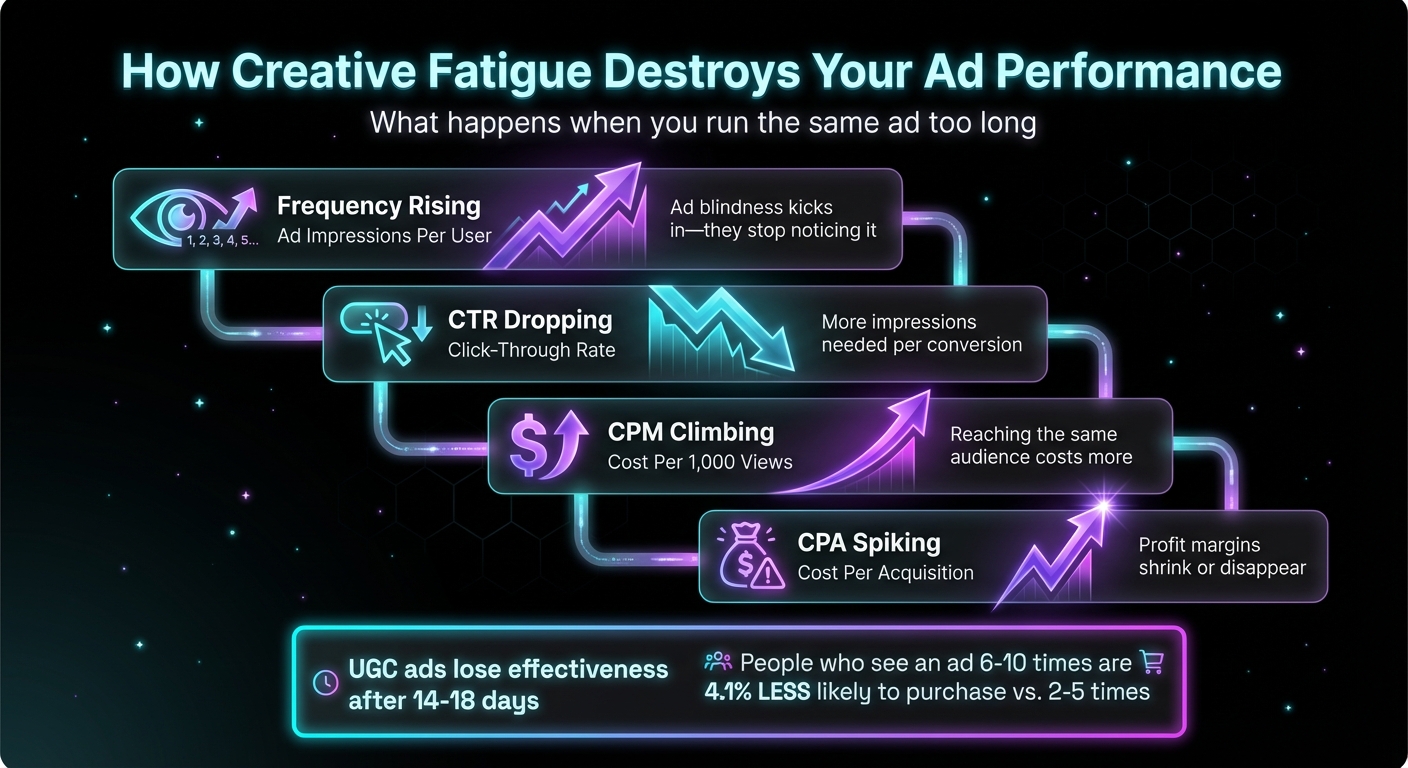
Creative Fatigue Impact on Meta Ad Performance Metrics
Generic Creatives Don't Get Clicks
If your ad looks like everything else in someone's feed, Meta's algorithm picks up on it fast. Here's how it works: Meta tests your ad with a small portion of your audience. If people scroll right past it without interacting - no likes, comments, shares, or clicks - the algorithm pulls back. That means fewer people see your ad, and your costs go up.
This isn't about targeting. It's a creative signal issue. Meta prioritizes ads that spark engagement. If your ad doesn't perform in those critical first few hours, the platform assumes it's not worth pushing to a larger audience.
Overly polished creatives often scream "ad" to users, making them easy to ignore. People are trained to scroll past anything that looks too perfect. On the flip side, raw, unpolished content - think user-generated content (UGC) that feels like it came straight from a friend's phone - grabs attention. In fact, UGC-style ads deliver 4x higher engagement compared to polished brand content.
"Targeting cannot save a broken creative. Budgets cannot save broken creative. Optimization cannot save a broken creative." - Ivan Teh, Founder, Advisible
Many affiliates waste time tweaking small elements like button colors or headlines. But if your hook - the first three seconds - doesn't grab attention, nothing else matters. The rest of your message won't even get seen. A weak creative not only limits ad distribution but also risks overexposure, which can quickly lead to audience burnout.
Creative Fatigue Kills Your CPA
Running the same ad for too long can tank your performance. It's called creative fatigue, and it hits you in two ways.
First, there's the direct impact: as people see your ad repeatedly, they stop engaging. This lowers your click-through rate (CTR), meaning you need more impressions to get the same number of clicks. Naturally, this drives up your cost per acquisition (CPA).
Then there's the hidden cost: when engagement drops, Meta's Estimated Action Rate takes a hit. This can push your ad into less competitive auctions, where you're shown to lower-intent users, or it can increase your CPM (cost per thousand impressions).
UGC ads, while effective, typically lose their edge after 14-18 days. After that, your frequency climbs, CTR drops, and CPM spikes. Essentially, you're paying more to show an ad that fewer people care about.
| Metric | What It Means | Impact on Your Wallet |
|---|---|---|
| Frequency Rising | Same audience sees the ad too often | Ad blindness kicks in - they stop noticing it |
| CTR Dropping | Fewer people clicking | More impressions needed per conversion |
| CPM Climbing | Higher cost per 1,000 views | Reaching the same audience costs more |
| CPA Spiking | Acquisition costs increase | Profit margins shrink or disappear |
I've seen campaigns go from profitable to losing money in under a week due to fatigue. Meta's algorithm doesn't care how well your ad performed last month - it only evaluates how it's doing right now.
Better Targeting Won't Fix Bad Creatives
One of the biggest misconceptions in affiliate marketing is this: "If I just find the right audience, my ad will work."
The truth? No amount of targeting tweaks or budget adjustments can save a weak creative.
Meta's algorithm has shifted the game. With tools like Advantage+ campaigns and AI-driven optimization, the platform handles targeting for you. Your job is to deliver compelling creatives. When an ad underperforms, many affiliates immediately adjust the audience or budget. But if the creative is generic or stale, those changes won't help. The algorithm has already decided your ad isn't worth showing to high-intent users. Lowering your budget means fewer impressions, while raising it only speeds up fatigue.
The numbers don't lie. People who see an ad 6-10 times are 4.1% less likely to make a purchase compared to those who see it 2-5 times. You can't out-target or out-spend that reality. The only fix is using AI tools for Meta ads to create fresh, engaging content.
"Your creative matters more than how much you spend or who you target." - Paul Grisel, Founder, VIDEOAI.ME
The bottom line? Weak creatives are a money pit, and focusing on targeting alone won't turn things around. Instead, the focus needs to shift toward creating ads that grab attention and keep engagement high.
Why Traditional Ad Production Can't Keep Up
Designers Are Expensive and Slow
Creating ads manually is a frustratingly slow and expensive process. It involves multiple steps - briefing, waiting, revising, and finally launching. This approach might work for a few ads, but it completely falls apart when you need dozens of fresh creatives every week.
At $30–$50 per ad, the costs add up quickly. Worse, with a low first pass approval rate (FPAR), 83% of ads need revisions before they can even go live. One team reported an FPAR as low as 17%, meaning they were stuck reworking the vast majority of their ads.
"When your FPAR is low, you're burning resources on rework instead of volume." - Adacted
Meta’s platform demands new creative every 2–4 weeks. But manual workflows can take days - or sometimes weeks - just to deliver a single batch. By the time those ads are ready, they’re already outdated. This lag directly impacts affiliates who depend on speed and scale to stay competitive.
Affiliates Need Volume, Not Just Quality
As mentioned earlier, battling creative fatigue requires more than just good design. Affiliates need to churn out ads at a high volume - and fast. Top Meta advertisers are testing over 100 ads each month just to maintain performance. Some teams take it even further, producing up to 500 new creatives daily - around 15,000 ads every month. Traditional production methods simply can’t keep up with this level of demand.
Even with a large team - say, 40 creators and 10 editors - producing hundreds of ads each week, the cost per ad still hovers around $320. That might be manageable for big brands, but it’s completely out of reach for most affiliates.
Speed is another major issue. Meta’s Advantage+ Shopping Campaigns often allocate budgets to top-performing ads early on, reducing spend on newer creatives. If your team takes two weeks to deliver fresh ads, you’re stuck running fatigued creatives while waiting for replacements.
And it’s not just about pumping out more ads; you need variety, too. Meta doesn’t reward slight tweaks or recycled formats. Instead, it favors genuinely different ad styles - like unboxing videos, testimonials, comment responses, or day-in-the-life clips. For manual production teams, each format becomes its own time-consuming project, further driving up costs and delays.
For most affiliates, this creates an impossible situation. They know they need more ads to scale, but hiring a full creative team is financially out of the question, and freelancers can’t deliver the speed or volume required. This production bottleneck ultimately limits how far they can grow.
The Creative Shift That Fixes It
Why Static Ads Work Best on Meta
If you're stuck in the slow, expensive grind of manual ad creation, switching to static ads can be a game-changer. Static ads are quicker, cheaper, and easier to scale, solving production delays almost instantly. Unlike video ads - which require scripting, filming, editing, and endless revisions - a static ad can be created and tested in just a few hours.
Static ads also excel at grabbing attention fast. In a feed where users scroll in mere seconds, a sharp product image paired with bold, clear text gets your message across immediately. This is even more critical when you consider that 85% of Meta users watch videos with the sound off.
"Static ads aren't outdated or overshadowed by dynamic formats. They're a different tool for a different job. Dynamic ads are powerful because they personalize. But static ads are powerful because they persuade." - Dan Pantelo, Marpipe
Meta's Andromeda AI engine has also shifted the game. It now determines your audience largely based on the creative itself. A well-crafted static ad with a compelling hook, striking visuals, and a clear value proposition signals to the algorithm exactly who should see it. While video still has its place, its longer production process and higher testing costs make it less practical for affiliates needing to test multiple ideas quickly.
How Automation Removes the Creative Bottleneck
When manual creation slows you down, automation steps in to deliver results in minutes. Instead of waiting days for a designer to produce one ad, automated tools can generate hundreds of ads instantly. Think of this as moving from a one-off approach to a streamlined production system. You're not crafting individual masterpieces - you’re creating a steady flow of inventory, where speed and consistency matter more than perfection.
AI-powered platforms can analyze your product page, pull out key selling points, and generate multiple ad variations with different hooks, layouts, and calls to action. Tasks that used to take a design team an entire week can now be completed in under two minutes. Using AI to produce static ads has been shown to reduce testing costs by 60%. This isn’t about sacrificing quality for quantity - it’s about generating enough quality ads to find the ones that perform best. Automation allows you to test multiple ideas in the time it once took to test just one, keeping your campaigns fresh and competitive.
What $100M in Meta Spend Taught Me About Static Ads
After managing over $100 million in Meta ad spend, one lesson stands out: the most effective ads aren’t always the most polished. Some of the top-performing static ads look intentionally "rough", featuring handwritten notes, post-it-style designs, or screenshots with arrows. Why? Because they blend into the feed and feel more authentic - exactly what users are drawn to.
Another key takeaway is that volume beats perfection. In my experience, brands that churned out hundreds of ads weekly consistently outperformed those that spent weeks fine-tuning a single campaign. High-performing creative teams are now producing hundreds of ads for as little as $320 per ad, many of which are static. This steady stream of fresh, raw creatives keeps campaigns from becoming stale and ensures they stay ahead of ad fatigue.
Finally, the creative itself is everything. No amount of targeting or budget can save a poorly designed ad. Meta’s algorithm now relies heavily on the creative asset to match your ad with the right audience. If your ad is generic, outdated, or unclear, no optimization strategy will save it. But with a consistent flow of fresh, engaging static ads, you can keep costs low and performance high.
"You can't media buy yourself out of a bad creative situation." - Connor Lane, HexClad
This is the creative shift: it’s no longer about crafting one "perfect" ad. It’s about building a system that consistently produces winning ads at scale - without blowing your budget.
How ADEN's LAB Solves the Affiliate Creative Problem
Drop a Link, Get Ads in Minutes
ADEN's LAB takes the hassle out of ad creation. All you need to do is paste your landing page URL, and within 90 seconds, the platform generates dozens of Meta ads that are ready to launch. No need to coordinate with designers, go through endless revisions, or spend time learning complicated tools.
The system works by analyzing your landing page, pulling out key selling points, and building multiple ad variations automatically. What used to take weeks for a design team can now be done in mere minutes. And don’t worry - this isn’t about sacrificing quality for speed. Instead, it’s about creating a dependable system that delivers consistent results.
For affiliates managing multiple offers, this means skipping the delays and jumping straight into testing. With ads produced instantly, you can respond to performance data without losing momentum, ensuring your campaigns stay fresh and competitive.
Built to Fight Creative Fatigue
Let’s face it - creative fatigue is unavoidable. UGC ads, for example, tend to lose their effectiveness in just 14–18 days, and Meta’s algorithm won’t warn you when performance starts to dip. ADEN's LAB addresses this challenge head-on by generating multiple ad variations from a single URL, giving you the tools to stay ahead of fatigue without starting from scratch every time.
The platform creates variations with different hooks, layouts, and calls to action, each tailored to test unique angles or messages. This matters because the performance difference between hooks can be massive - up to 300%. By having a variety of creatives ready to go, you can maintain steady campaign performance and avoid the steep drop-offs that come from relying on just a handful of ads. Instead of adding new ads to a tired campaign (which Meta often deprioritizes), you can refresh your strategy with entirely new batches of creatives.
Produce Hundreds of Ads for Under $1 Each
Keeping your ads fresh is only half the battle - cost efficiency is just as important. ADEN's LAB makes high-volume testing affordable, with plans starting at $59 per month for 30 ads. For those scaling up, the Apex Mode plan offers 200 ads per month for $179, breaking down to just $0.90 per ad. Compare that to traditional costs of $30–$50 per ad - or even $320 for in-house production - and the savings are clear.
| Plan | Ads Per Month | Monthly Cost | Cost Per Ad |
|---|---|---|---|
| Lift Off | 30 | $59 | $1.97 |
| Hyperstream | 50 | $89 | $1.78 |
| Apex Mode | 200 | $179 | $0.90 |
This pricing structure allows you to test aggressively without worrying about overspending. Even if some ads don’t perform well, the low cost makes it easy to find and scale the winners.
"Creative is the only sustainable advantage you have on Meta. Everyone has access to the same targeting." - Adacted
With ADEN's LAB, producing ads isn’t just affordable - it’s designed to make high-volume testing a standard practice for success.
What Affiliate Marketers Should Do Differently
Prioritize Creative Quality Over Targeting
Gone are the days of obsessing over audience segments and fine-tuning bidding strategies. On Meta, creative quality accounts for 70–80% of ad performance, far outweighing the impact of budget or targeting adjustments. With Meta's AI now handling much of the targeting, your focus should shift to delivering high-quality creative assets.
Instead of spending hours refining audience lookalikes, invest in crafting strong, compelling ideas. The right hook can outperform a weaker one by over 300%. Experiment with different pain points, value propositions, and psychological triggers to connect better with your audience. Remember, the message itself is more critical than the format - an engaging concept shot on an iPhone can easily outshine a lackluster idea filmed with high-end equipment.
For those running Advantage+ Shopping Campaigns (ASC), launching fresh batches in duplicated ASCs ensures your ads get a fair chance to perform. While quality remains key, the sheer volume of creative output also plays a significant role, which leads us to the importance of automation.
Use Automation to Compete on Volume
Winning affiliates don’t just create better ads - they create more ads. High-performing teams test at least 15–20 variations per cycle, all without overloading their design budgets or waiting weeks for revisions. This is where automation becomes a game-changer.
Think of your creative process as a production line: consistent output, strict quality checks, and fast turnarounds. Tools like ADEN's LAB allow you to generate dozens of ads in just 90 seconds by simply dropping a link. At $0.90 per ad on the Apex Mode plan, you can test hooks, messages, and formats at a scale that’s tough to compete with. The goal is to produce numerous strategic variations and quickly eliminate underperforming ads. Once your production process is running smoothly, the next step is to refine and scale your winning ideas.
Test More, Iterate Faster, Scale Smarter
With high-quality creatives and rapid production in place, it’s time to adopt a disciplined testing schedule to identify top performers. Successful affiliates follow a simple weekly rhythm: review results on Monday, launch new tests by Friday. The process is straightforward - test, cut underperformers fast, and double down on what works. Here’s a framework to guide your testing:
- 40% of your budget: Focus on hook testing with 5–7 variations over 48–72 hours. If the hook rate falls below 30%, drop it.
- 35% of your budget: Pair winning hooks with different value propositions and test these combinations over 5–7 days.
- 25% of your budget: Experiment with format variations of proven winners. Try different presenters, layouts, or calls to action to keep your creatives fresh and avoid fatigue.
To measure efficiency, calculate your Cost-per-Winner (CPW): divide your total testing spend and production costs by the number of winning creatives. And always keep this in mind: explore more, expand less. Many affiliates make the mistake of over-iterating on old winners instead of seeking out fresh ideas that resonate with new audiences.
"The goal of creative testing is to find new winners. It's not about hitting an arbitrary number of creatives tested." - Nathan Hudson, Perceptycs
FAQs
How do automation tools help prevent creative fatigue in affiliate ads?
Automation tools play a key role in combating creative fatigue in affiliate ads, streamlining the process of producing fresh, high-quality ad creatives. Creative fatigue occurs when audiences are repeatedly exposed to the same ads, leading to a noticeable drop in engagement. Automation simplifies this challenge by quickly generating ready-to-use creatives, replacing the time-consuming manual design process and ensuring a constant supply of new content.
By allowing frequent updates and testing of new ad variations, automation helps keep campaigns engaging and relevant. This approach not only sustains audience interest but also avoids the performance declines that come with outdated creatives. With automation in place, advertisers can confidently scale their campaigns, knowing their ads remain effective and engaging.
Why does creative quality matter more than targeting for Meta ads?
When it comes to Meta ads, creative quality is king. The platform's algorithm prioritizes ads that grab attention and drive engagement. So, even if your targeting is spot-on, outdated or lackluster creatives can tank your campaign's performance. To stay competitive and see consistent results, you need to focus on delivering fresh, high-quality ads.
Meta has moved toward broad targeting, putting more responsibility on its algorithm to identify the right audience. This shift means your creative is the star player - it determines how well your ad connects with viewers and how much the algorithm amplifies it. Simply put: Without engaging creatives, no amount of precise targeting can rescue your campaign.
Why might static ads work better than video ads on Meta?
Static ads have a lot going for them. They load quickly, catch attention right away, and communicate a clear message without any extra distractions. Plus, they’re easier and faster to create, which makes them a smart option when time and simplicity are key.
While video ads can draw people in, static ads shine in situations where users are scrolling fast and need to grasp your message instantly. Their no-frills approach ensures your point gets across without being buried in complicated visuals or drawn-out content.
Your next ad batch starts here
Finish with a ready-to-test ad batch
Paste your website to generate static creatives. Drop the link → get ads in about 90 seconds → upload them to Meta → scale.
Free to try No prompt writing