Turn Your Product Page Hero Section Into 10 Meta Ads
Turn the strategy into creatives
Create ready-to-test Meta ads for your product
Paste your product page. ADEN'S LAB turns the offer, audience, and positioning into complete ad concepts with images, headlines, and copy.
No design brief or prompt writing required.

You do not need to start Meta ads from scratch. I can turn one product page hero section into 10 ad angles by pulling six items that are already on the page: the headline, subheadline, CTA, main image, offer, and proof.
Here’s the short version:
- The hero section is the best starting point because it already explains the product in a few seconds.
- I can sort its message into four buckets: message, visual, offer, and proof.
- Then I can turn those into 10 ads for prospecting, retargeting, or both.
- To test them well, I keep the audience, placement, and budget setup the same and compare angle vs. angle.
- I judge winners by the right metric:
- Benefit ads: CTR
- Proof ads: conversion rate
- Offer ads: ROAS
- Objection ads: conversion rate
- A simple starting budget is $50/day per group for e-commerce, and $50 to $100/day per group for SaaS or lead gen.
- If frequency passes 2.5 to 3.0 or CTR drops 20% to 30% in 7 to 14 days, I refresh the ad instead of rebuilding the whole thing.
What I like about this approach is that it cuts wasted time. Instead of asking, “What should this ad say?”, I start with what the page already says and turn it into testable ad formats.
Here’s the full set of ad angles covered in the article:
- Benefit-first static
- Pain-point static
- Social-proof static
- Offer-first static
- Objection-handling static
- Feature-explainer static
- Lifestyle outcome static
- Short-form video hook
- Guarantee or risk-reversal
- Launch or limited-time bundle
How to Structure a Meta Ads Campaign for One Product (Full Walkthrough)
sbb-itb-628c49f
Quick Comparison
| Ad Angle | Best Use | Main Goal | Pull From Hero |
|---|---|---|---|
| Benefit-first static | Cold traffic | CTR, ROAS | Headline + main visual |
| Pain-point static | Cold traffic | CTR | Subheadline + problem visual |
| Social-proof static | Warm traffic | Conversion rate | Ratings, reviews, testimonial |
| Offer-first static | Warm traffic | CVR, CPA | Price, discount, free trial |
| Objection-handling static | Warm traffic | Conversion rate | Guarantee, returns, cancel anytime |
| Feature-explainer static | Both | CTR, engagement | Feature bullets + screenshot |
| Lifestyle outcome static | Cold traffic | CTR, ROAS | Lifestyle image + outcome copy |
| Short-form video hook | Cold traffic | 3-second views, CTR | Headline + moving product shots |
| Guarantee / risk-reversal | Warm traffic | Conversion rate | Money-back or free-trial language |
| Limited-time bundle | Both | ROAS, CVR | Bundle, deadline, discount |
Bottom line: if the hero section can sell the page visit, it can also power the ad click. I just need to pull the right parts, match them to one angle per ad, and use AI tools to test them in a clean way.
2. How to Extract the Right Inputs From Your Hero Section
Pull the message, offer, proof, and visual angle
Read the hero section like you're seeing the page for the first time. Your job is to pull out four inputs: message, offer, proof, and visual angle.
The message is the main promise. It's the outcome the product gives the customer. The offer is the thing pushing the click or purchase, like a "$29 starter kit", "Save $20", "Free 14-day trial," or "Ships free in the U.S." The proof is any trust signal, such as a 4.8-star average, "10,000+ customers," or a quote like "Saved 4 hours/week." The visual angle is the style of the image: lifestyle photography, a clean product shot, a before/after, or a demo screenshot.
It helps to sort these by campaign stage. For prospecting, lean on the broad promise and the pain point. For retargeting, lean on the discount, guarantee, and proof. Once you've pulled those inputs, drop them into a matrix and start building angles.
Organize hero assets into a simple ad matrix
Put those four inputs into a simple four-column matrix.
| Column | What to Put Here | Ad Use |
|---|---|---|
| Message | Core promise, pain point, key benefit | Headline and primary-text hook |
| Visual | Hero image style, product angle, lifestyle shot | Creative asset direction |
| Offer | "$29 starter kit", "Save $20", "Free 14-day trial", or "Ships free in the U.S." | Urgency line or CTA overlay |
| Proof | Star rating, review count, customer milestone | Credibility overlay or support line |
Why does this work so well? Because it turns one hero section into a bunch of ad angles. You mix and match inputs you already have instead of asking the design team for net-new assets. One hero can fill every cell in the matrix. Then that matrix becomes the source for the 10 ad concepts in the next section.
Use ADEN's LAB to speed up extraction and output
You can build the matrix by hand, or you can paste the page URL into ADEN's LAB and let it pull brand-aligned inputs and generate static Meta ads in under 90 seconds. That kind of speed helps when you need a lot of variations fast. From there, you can use the output to build the 10 concepts that come next.
3. Turn One Hero Section Into 10 Meta Ad Concepts
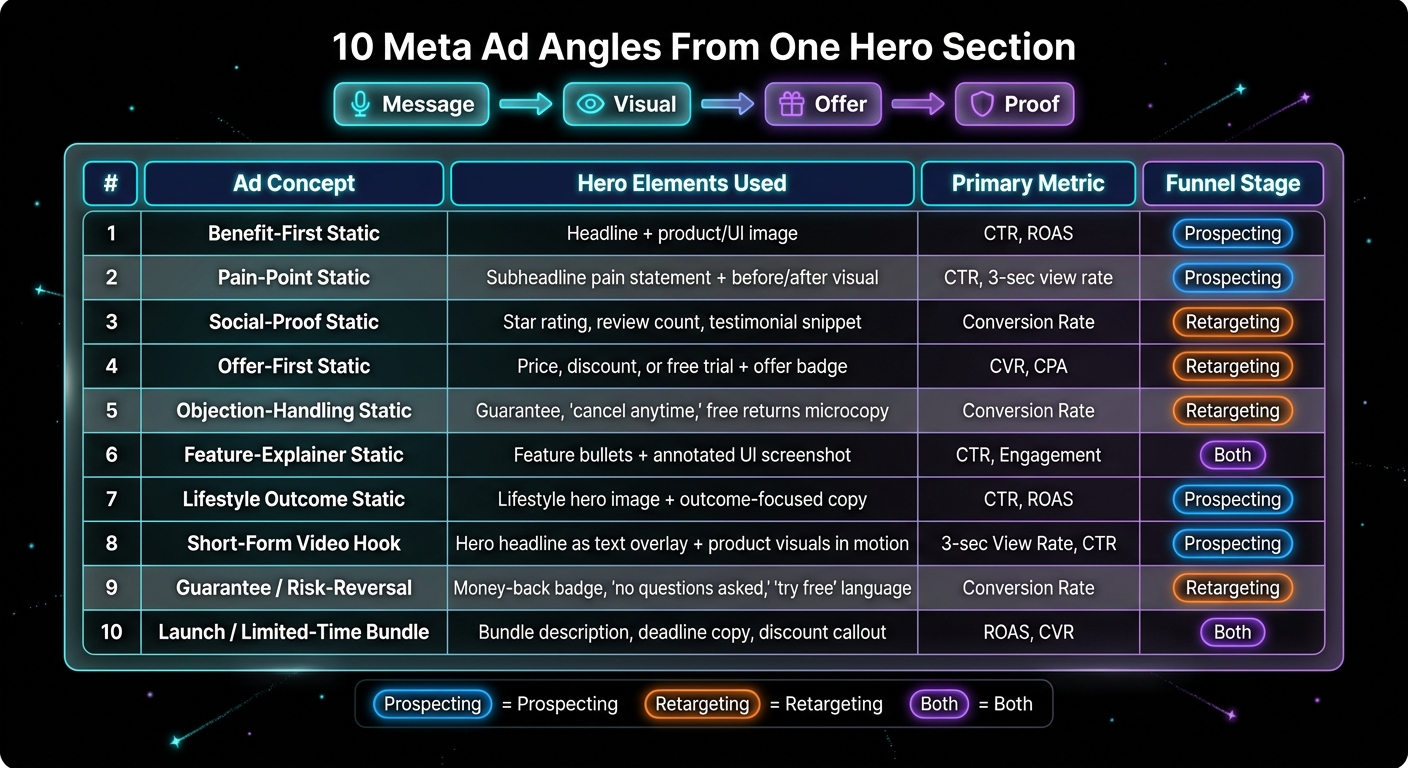
10 Meta Ad Angles From One Hero Section: Funnel Stage, Goal & Key Metrics
10 ad concepts to build from one hero
Once you have the matrix, you can take one hero and spin it into 10 different Meta ads. The base stays the same - message, visual, offer, and proof. What changes is the angle.
That matters because the same hero can do different jobs. One version can pull in cold traffic. Another can help close people who already know you. Same ingredients, different pitch.
| # | Ad Concept | Hero Elements Used | Primary Metric | Funnel Stage |
|---|---|---|---|---|
| 1 | Benefit-first static | Main headline + product/UI image | CTR, ROAS | Prospecting |
| 2 | Pain-point static | Sub-headline pain statement + before/after visual | CTR, 3-second view rate | Prospecting |
| 3 | Social-proof static | Star rating, review count, testimonial snippet | Conversion rate | Retargeting |
| 4 | Offer-first static | Price, discount, or free trial callout + offer badge | CVR, CPA | Retargeting |
| 5 | Objection-handling static | Guarantee, "cancel anytime", free returns microcopy | Conversion rate | Retargeting |
| 6 | Feature-explainer static | Feature bullets + annotated UI screenshot | CTR, engagement | Both |
| 7 | Lifestyle outcome static | Lifestyle hero image + outcome-focused copy | CTR, ROAS | Prospecting |
| 8 | Short-form video hook | Hero headline as text overlay + product visuals in motion | 3-second view rate, CTR | Prospecting |
| 9 | Guarantee or risk-reversal | Money-back badge, "no questions asked", "try free" language | Conversion rate | Retargeting |
| 10 | Launch or limited-time bundle | Bundle description, deadline copy, discount callout | ROAS, CVR | Both |
Use the table to match the angle to the job you need done: prospecting, retargeting, or both.
How to format each concept for Meta
Each concept should stick to one clear angle across the primary text, headline, CTA, and visual. If you try to cram in too much, the ad gets muddy fast.
Here’s how the strongest concepts map from hero section to Meta ad:
Benefit-first static - Primary text: one sentence that expands the main outcome. Headline: outcome only, like "Cut Reporting Time in Half". Visual: a clean product shot or UI screenshot. CTA: Learn More for SaaS or Shop Now for e-commerce.
Pain-point static - Primary text: lead with the frustration as a question, like "Still stitching spreadsheets together every Monday?", then show the fix. Headline: name the problem, like "Stop Manual Reporting". Visual: a messy before-state next to a clean after-state. CTA: Learn More or Sign Up.
Social-proof static - Primary text: lead with customer count or rating, like "Trusted by 5,000+ teams across the U.S.". Headline: a short quote or rating, like "4.8★ Rated by Hot Sleepers". Visual: a star-rating badge or testimonial overlay on the product image. CTA: Shop Now or Learn More.
Offer-first static - Primary text: state the deal plainly, like "Get full access from just $59/month - cancel anytime". Headline: anchor the price, like "Plans from $59/mo". Visual: an offer sticker or badge on the hero image. CTA: Sign Up or Get Offer.
Launch or limited-time bundle - Primary text: add urgency with a deadline, like "New: Starter Bundle - save $40 when you join this week". Headline: reinforce the time window, like "Launch Week: Save $40". Description: hard cutoff, like "Offer ends Sunday at 11:59 PM PT". Visual: bundle layout with a limited-time sticker. CTA: Shop Now or Get Offer.
Keep text overlays light. One strong line is enough. Let the primary text and headline fields do most of the work.
How ADEN's LAB helps produce variations at scale
After you lock in the angles, the next problem is simple: production takes time.
ADEN's LAB generates static Meta ad variations for each concept using psychology-based hooks and brand-matched styling. That means you can test more angles without doing all the design work by hand. Plans start at $59/month for 30 ads, which gives you enough room to test several concepts early on.
4. How to Test These 10 Ads Without Wasting Budget
Set hypotheses and test by angle group
You’ve got 10 concepts. Now slow down for a second and group them by angle before you spend a dollar.
Since all 10 ads came from the same hero section, the point of the test is to isolate the angle. Not the audience. Not the placement. Keep those fixed. Run each angle group - benefit, proof, offer, and objection - in its own ad set with the same audience, optimization event, placements, and daily budget.
Before the campaign goes live, write down what you expect each group to do. That sounds simple, but it changes how you read the results. For example, you might expect proof-based ads to drive a lower CPA than benefit-based ads because they reduce trust friction for cold audiences. That kind of hypothesis gives you a clear yardstick before the numbers start coming in. Otherwise, it’s too easy to look back and invent a story after the fact.
A practical starting point:
- E-commerce: start at $50/day per group
- SaaS or lead gen: start at $50–$100/day per group
- Test length for e-commerce: 5–7 days
- Test length for SaaS or lead gen: 10–14 days
Once the test is live, judge each group by the metric that fits its place in the funnel.
Track the metrics that decide winners
Not every ad should win the same way.
Use CTR and CPC to judge the hook. Use conversion rate to judge message match. Use CPA and ROAS to judge whether the ad makes money. The big idea here is simple: you’re checking whether the promise in the hero section still holds up once it becomes an ad.
Use this table to match each angle group to the main metric that matters most:
| Angle Group | Primary Success Metric |
|---|---|
| Benefit | CTR |
| Proof | Conversion rate |
| Offer | ROAS |
| Objection | Conversion rate |
Don’t stack a top-of-funnel prospecting ad next to a retargeting ad and judge them on the same number. That’s apples to oranges. Judge each concept by the metric tied to its angle group, and compare only ads at the same funnel level.
Refresh winners before fatigue hits
Even a strong ad wears out.
On cold audiences, keep an eye on frequency. If it climbs above 2.5–3.0, or if CTR drops 20–30% over 7–14 days, it’s time to refresh the ad. But don’t rebuild the whole thing. Change just one surface-level element:
- hook
- crop
- badge placement
- CTA
- offer wording
The core hero message should stay the same. You’re not replacing the winning angle. You’re just giving it a new coat of paint.
Use ADEN's LAB to spin up new variants from the winning angle without starting from scratch. That lets you keep the angle that’s working while feeding new versions into the test.
5. Conclusion: Build a Repeatable Hero-to-Ad System
Once you've gone through extraction, concepting, and testing a few times, this stops feeling like a one-off task and starts working like a system.
Your product page hero section already gives you the raw material. The headline is your main promise. The subheadline adds the supporting benefit. The CTA shows the offer. Star ratings and testimonials give you proof. The product image sets the visual direction. You don't need to invent any of this. You just need to pull it out and reshape it into ad-ready formats.
One hero section can produce 10 testable Meta ads.
The steps to repeat on every page
Run the same sequence on every product page. Stick with the same five-step workflow every time: extract, group, map, test, and refresh.
Put those five steps into an SOP, and any team member can use the process on any product page. As you keep doing that, you build a library of proven angles you can use for new products fast, which cuts creative production time from weeks to days.
Use ADEN's LAB to move through steps one through three faster. Paste in your product page URL, and the platform generates static Meta ad creatives in under 90 seconds, based on the same hero elements you'd pull by hand.
Build the system once, then use it again on every product page.
FAQs
What if my hero section is weak?
If your hero section isn’t doing much heavy lifting, that doesn’t mean your ads have to fall flat too. ADEN'S LAB helps you work around the limits of your current page by pulling key messaging from your product link and turning it into Meta ad creatives.
In about 90 seconds, you can put together polished ad variations without rewriting copy by hand, making new visuals from scratch, or waiting on a designer.
Which ad angles should I test first?
Start with ad angles taken straight from your product page hero section: the main value prop, top customer benefits, and the offer people see right away.
Then turn those into formats like static images and short-form videos so you have a repeatable testing setup. That makes it easier to spot which message gets the best response, fast.
How many hero elements should an ad use?
Use one hero element or angle per ad. Stick to a single headline, one proof point, or one pain-point fix so the message stays clear and doesn't feel stuffed.
That also makes testing much easier. You can swap different hero-section elements across ad variations and keep each one centered on conversions.
Create Ads That Print Money
Your competitors aren't waiting — why should you? Drop your product link → get scroll-stopping ads in 90 seconds.