Turn Five-Star Reviews Into Scroll-Stopping Meta Ad Creatives
Turn the strategy into creatives
Create ready-to-test Meta ads for your product
Paste your product page. ADEN'S LAB turns the offer, audience, and positioning into complete ad concepts with images, headlines, and copy.
No design brief or prompt writing required.

Your best Meta ads may already be sitting in your reviews.
If I want better Facebook and Instagram ads, I don’t need to guess what to say. I can pull lines from five-star reviews, sort them by pain point, outcome, objection, and proof, then turn them into quote ads, screenshot ads, carousel ads, and UGC-style statics. That matters because review-led ads have shown 12% higher CTR, 18% higher conversion rates, and 35% better ROAS than standard Meta ads.
Here’s the whole process in plain English:
- I collect reviews from places like Google, Facebook, Trustpilot, Yotpo, support tickets, and post-purchase emails.
- I group each review by what it helps with: pain, desired result, objection, trust signal, or success story.
- I pull short, exact customer phrases like “saved me 4 hours a week” or “I thought this was a scam, but…”
- I match those phrases to ad types:
- Single image quote ads for one sharp message
- Screenshot testimonial ads for social proof
- Carousel ads for multiple angles
- UGC-style statics for in-feed, peer-style messaging
- I test them against my current ads using the same audience, budget, and placements.
- I watch CTR, CPA, ROAS, engagement rate, and frequency, then swap weak ads before fatigue hits.
A few numbers make the case even clearer:
- Review-led ads: 4.2 ROAS
- Standard Facebook ads: 3.1 ROAS
- Unedited user content: 19% higher engagement
- Ad fatigue can show up in 3–7 days
- If frequency goes above 3, it’s often time to rotate new review copy
When I need more output, I can use ADEN'S LAB to turn a landing page URL and review angles into static Meta ad drafts in under 90 seconds. That helps me test more messages without waiting on a full manual workflow.
This article is about building a simple system: collect review language, turn it into ads, test what wins, and keep the rotation moving.
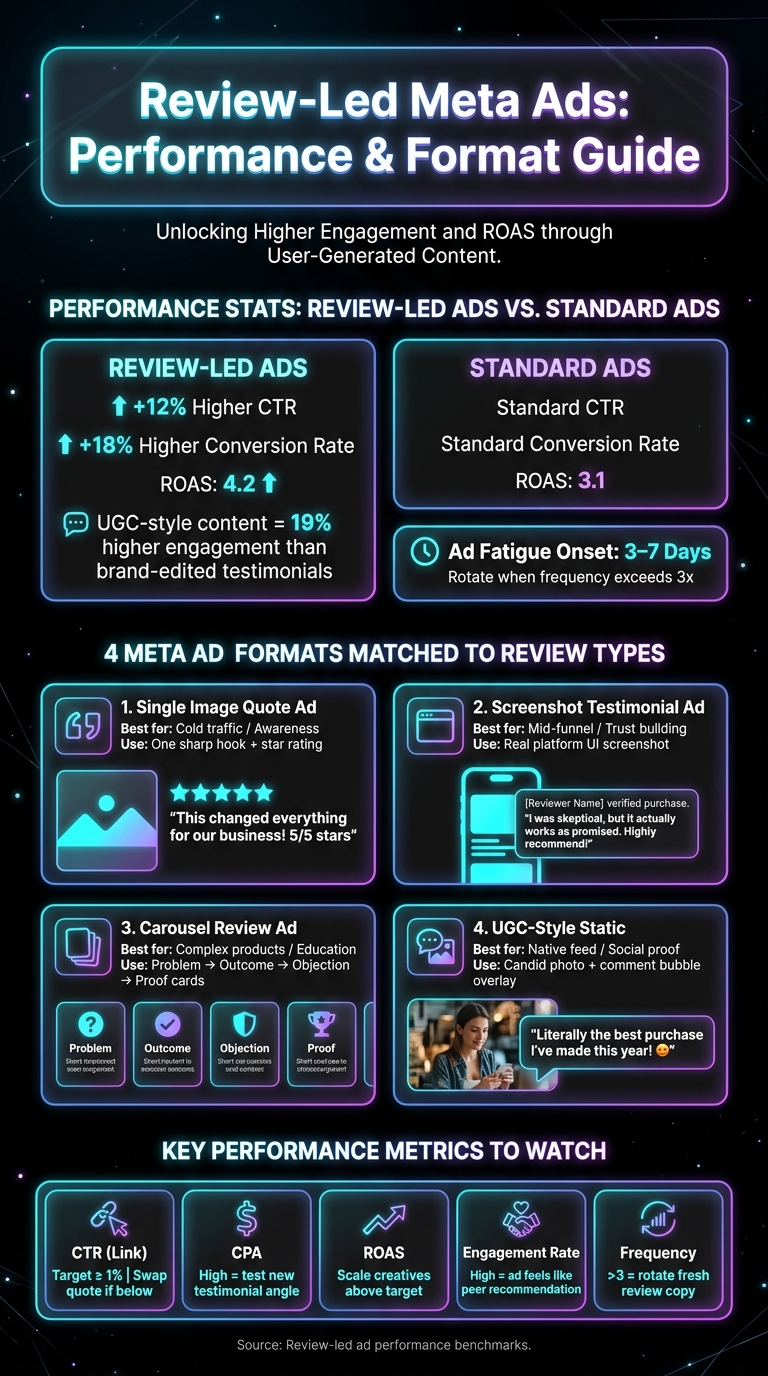
Review-Led Meta Ads vs. Standard Ads: Performance Stats & Format Guide
1. Mine Reviews for Hooks, Benefits, Objections, and Proof
Collect and Centralize Customer Reviews
Before you write a single ad, build a quote bank first, perhaps using AI tools for Meta ads to speed up the process. Pull reviews from Google Business Profile, Facebook, Yelp, Trustpilot, Reviews.io, and Yotpo. Then add support tickets, interviews, NPS responses, post-purchase emails, and social comments.
Put everything into one spreadsheet. That makes it much easier to tag patterns fast and build a quote bank you can use across ads.
Tag Reviews by Funnel Stage and Message Type
Once everything is in one place, sort reviews by how they help sell. Not every review belongs in the same ad.
Label each review by function:
- pain point
- desired outcome
- objection
- trust signal
- success story
Then match those labels to the right funnel stage:
| Funnel Stage | Review Type to Use | Copy Strategy |
|---|---|---|
| TOFU (Cold) | Pain point, relatable struggle | Hook → relevance → light offer |
| MOFU (Warm) | Objection reversal, specific benefit | Proof → benefit → offer |
| BOFU (Hot) | Results, trust signal, success story | Urgency → reminder → risk reduction |
This gives you a simple way to pair each review with the ad format where it has the best shot. Instead of treating reviews like random praise, you turn them into a reusable library for ad creative. This systematic approach is how teams produce Meta ads on autopilot to maintain high output without sacrificing quality.
Pull Out Scroll-Stopping Phrases Word for Word
Use the customer's exact words whenever you can. Plain, specific language often hits harder than polished brand copy.
Customer language is usually the most authentic version of your message.
Pull lines that can work as hooks, headlines, or testimonial overlays. Look for phrases with sensory detail, measurable outcomes, or emotional reactions. "Saved me 4 hours a week", "faded in 14 days", or "I thought this was another scam, but..." are the kind of lines that make someone pause. If a review speaks straight to a pain point or desire, use it as a headline.
Verbatim customer reviews often outperform polished testimonials.
Those quotes, objections, and proof points become raw material for static ads, carousels, and UGC-style creatives. Those exact phrases are what you'll turn into Meta hooks, headlines, and testimonial creatives in the next section.
sbb-itb-628c49f
7 Static Ads That Convert (Like Crazy) on Meta
2. Turn Review Insights Into Specific Meta Ad Formats
Turn those quotes into ads people can understand at a glance. In most cases, four Meta ad formats do the job, and each one lines up with the review language you already have.
Single Image Quote Ads and Screenshot Testimonial Ads
A single image quote ad is the easiest format to make. Start with a 5-star rating, a short pull quote, reviewer attribution, and a simple product image. For example, BOOM! used "My husband of 40 years was like, Woah!" as the headline. Use this when you need one strong hook and instant proof.
Screenshot testimonial ads work a bit differently. Instead of building a polished quote graphic, you use a screenshot of the review exactly as it appears on Google, the App Store, or Amazon. That familiar interface - star rating, reviewer name, platform badge - helps people recognize it right away. The goal isn't to make it fancy. The goal is to make it feel familiar. Always get explicit permission before using a customer's words in paid ads, and keep attribution clear with their name, company, or location.
Carousel Review Ads for Multiple Angles
Carousel ads let you show several proof points in one unit without cramming everything into a single image. Give each card a clear role:
- problem
- outcome
- objection
- proof
This setup works well for complex products because you can show different review angles in one swipeable ad.
If one quote feels too limited, break that same review into a swipeable proof sequence.
UGC-Style Static Creatives Built From Real Review Language
UGC-style statics look more like something a customer posted than something a brand made. Most use a candid photo with a short review snippet layered in as a comment bubble or caption. L'Oréal ran this format on Facebook using overlays like "It's been only one week and I'm glowing," pulled directly from real user comments. That overlay made the praise easy to see while people scroll, without breaking the in-feed feel.
Keep the overlay short, mobile-friendly, and easy to skim. Unedited, user-submitted content gets 19% higher engagement than brand-edited testimonials, so keep edits light. That's a big part of why it feels native and trustworthy.
Use this matrix to match the review type to the format:
| Ad Format | Best Use Case | Key Strengths |
|---|---|---|
| Single Image Quote | Cold traffic / Awareness | Communicates core value fast; clean and readable |
| Screenshot Testimonial | Middle-of-funnel / Trust building | High authenticity; familiar platform UI builds credibility |
| Carousel Review | Education / Complex products | Tests multiple proof points and segments in one ad |
| UGC-Style Static | Native feed / Social proof | Feels like a peer recommendation; high relatability |
3. Use AI to Scale Review-Based Creatives With ADEN'S LAB
Once you've mined and tagged your reviews, the next problem is speed.
Manual ad production slows your refresh cycle. And on a platform where creatives can fatigue within 3–7 days, that delay can hurt performance fast.
From Review Notes and URLs to Ad-Ready Static Creatives
Start by making sure your landing page reflects the review themes that hit hardest. Then paste the URL into ADEN'S LAB to generate static Meta ad drafts in under 90 seconds.
ADEN'S LAB reads the page and pulls in brand language, visuals, and copy cues. That helps the ad drafts stay close to the source material instead of drifting into generic ad copy. In plain English: your landing page and your ads stay on the same page before you spin up more versions.
Generate Copy Variations From Real Customer Language
Once the source page is lined up, you can turn each winning quote into several hooks to test.
ADEN'S LAB takes one source quote and spins it into multiple primary text options, including:
- Rating-based headlines
- Time-saving claims
- Objection-handling copy
One review should lead to multiple test angles, not just one ad.
That matters because review-based ads can lift CTR, cut CPC, and improve conversion rate. AI gives you the output volume needed to test enough angles to keep finding winners.
Match Test Volume to Your Plan Tier
Lift Off ($59/month, 30 ads) works for early-stage testing. It's enough to check a few review angles without going too far too fast.
Hyperstream ($89/month, 50 ads) makes sense for brands that need a steady refresh cycle to stay ahead of fatigue.
Apex Mode ($179/month, 200 ads) is built for aggressive scaling, with per-ad cost dropping to about $0.90.
| Feature | Manual Workflow | ADEN'S LAB |
|---|---|---|
| Time to Launch | Much slower | Under 90 seconds |
| Ad Volume | Low (limited by designer bandwidth) | 30–200 ads/month |
| Cost per Creative | $50–$150+ USD | ~$0.90 USD |
Next, track which review angles win on CTR, CPA, and ROAS, then refresh the losers before fatigue sets in.
4. Measure Performance and Keep Review Creatives Fresh
Watch CTR, CPA, ROAS, and Engagement Rate
Once your review creatives are live, the next job is simple: keep what works and cut what doesn't.
Each metric tells you something different about how the creative is doing. CTR (link click-through rate) shows whether the review hook stops the scroll - aim for 1% or higher. CPA tells you whether the testimonial helps clear buyer doubt. ROAS tells you whether that angle is worth spending more on. Engagement rate matters too, especially for testimonial-led ads. When engagement is high, it often means the ad feels like a real recommendation.
Watch frequency closely as well. If the same audience sees an ad 3+ times, it's usually time to rotate in new review copy.
| Metric | What It Reveals | Optimization Response |
|---|---|---|
| CTR (Link) | Hook strength; how well the review hook stops the scroll | If <1%, test a new headline or swap the review quote |
| CPA | Conversion efficiency; how well the testimonial proof handles objections | If high, try a different testimonial angle or check landing page alignment |
| ROAS | Revenue performance; financial impact of the review angle | Scale creatives that beat target ROAS |
| Engagement Rate | Trust and relevance; signals the ad feels like a real recommendation | High engagement suggests the content feels like a real recommendation and connects with the audience |
| Frequency | Ad fatigue; whether the audience is tired of the same review | If >3, rotate in fresh customer language or new testimonials |
A/B Test Review-Based Creatives Against Existing Ads
Run controlled A/B tests so you can see which review angle is doing the work.
Compare review ads against your current ads using the same budget, audience, and placements. When creative is the only thing that changes, it's much easier to tell whether social proof is behind the lift.
Keep the test clean by changing one variable at a time:
- hook
- proof type
- CTA
For CTAs, skip generic copy when you can. It's often smarter to match the promise in the review with the action in the ad. For example, test lines like "Get the kit" or "See how it works".
Conclusion: Build a Repeatable Review-to-Ad System
Collect reviews, tag the strongest angles, turn them into Meta creatives, test them under controlled conditions, and swap in new versions before fatigue sets in.
FAQs
How many reviews do I need to start?
You don’t need a huge pile of reviews before you can use them in your Meta ad creatives. If your business is already up and running, start with what you already have. Check your existing Google or Facebook reviews and see what stands out.
Need more to work with? Reach out to your best clients by email, ask for feedback on social media, or offer small incentives.
For ads, the goal isn’t to hit some magic number. It’s to use genuine, varied reviews that point to clear product benefits.
Which review format works best for cold audiences?
For cold audiences, raw, unedited testimonials tend to work best, especially when they show a clear before-and-after shift or speak to one specific pain point.
Video testimonials often work best here because they build trust fast. A real person talking about a real result can do a lot of heavy lifting.
If you don’t have video, image ads can still do the job. Use a customer photo and a short review snippet that gets to the main benefit right away.
How do I use reviews in ads legally?
Use only real, verified customer reviews in Meta ads. Get clear consent before using a customer’s name, image, or testimonial.
Check where the review came from, and don’t script it or heavily rewrite the customer’s original words. That helps keep the message honest and can help you avoid policy issues or ad rejection.
Create Ads That Print Money
Your competitors aren't waiting — why should you? Drop your product link → get scroll-stopping ads in 90 seconds.