If You’re Testing Ads Weekly, Hiring a Designer Might Be Your Worst Move
Try the workflow instead of comparing it
See what an AI ad generator makes from your product
Paste your product page and get a complete Meta ad batch—creative concepts, images, headlines, and copy—without another tool stack.
Free to try No prompt writing

If you’re running weekly ad tests on Meta, relying on designers could be slowing you down and costing you more than you realize. Here’s why:
- Creative fatigue happens fast: Click-through rates can drop 15–20% in just 2–3 weeks, and after 7–8 exposures, they can fall by 40%.
- You need volume and speed: To maintain performance, 4–6 new ad variants per ad set are required weekly. For five ad sets, that’s 20–30 ads per week. Most designers can only produce 5–10 ads in that time.
- Costs add up quickly: Freelance designers charge $35–$100/hour, with batches costing $500–$1,500. In-house designers’ salaries and overhead also inflate costs, making each ad expensive.
The result? Designers often become a bottleneck, leading to recycled concepts, slower testing, and missed opportunities to scale campaigns.
Solution: Automated ad generation tools like Aden’s Lab can create Meta-ready ads in minutes, bypassing the delays and high costs of manual design. For $179/month, you can generate up to 200 ads - less than $1 per ad - while avoiding revision cycles and production limits.
If you’re serious about scaling your Meta campaigns, ditch the traditional design workflows and embrace faster, more efficient systems.
What It Actually Costs to Use Designers for Weekly Ad Testing
Designers Can't Move Fast Enough
Most freelance designers take around 5–7 days to deliver a batch of ads. By the time you’ve gone through briefing, feedback, and revisions, your testing window might already be closed. Animation Director Harry Butt puts it plainly:
Often the 'quick' jobs do end up becoming longer projects and I would try to gauge how much time I should make for multiple rounds of revisions.
This slow turnaround is a major issue, especially considering how quickly creative fatigue sets in. In the fast-paced world of Meta advertising, advertisers need to get ads live in minutes—not days—by learning how to generate Facebook ads that convert in seconds. Delays not only slow down your ability to test effectively but also increase costs, as detailed below.
What You're Really Paying Per Ad
The slow pace of production doesn’t just hurt your testing speed; it also inflates the cost of each ad. Let’s break it down. An in-house graphic designer earning $50,000 to $85,000 annually produces about 10 ads per week. That means each ad costs between $96 and $163 in salary alone. Freelance designers, on the other hand, typically charge $35–$100 per hour, with batches of ads costing anywhere from $500 to $1,500.
But that’s not the full picture. You also need to account for additional costs - about $4,700 - for things like recruitment, payroll taxes, software licenses, equipment, and management time. As Samuel Edney, Managing Director at CETA Software, points out:
Even small scheduling delays can cause overtime premiums or non-productive days for staff. These costs, if not correctly forecasted, may accumulate and push a project off track.
If your creative needs go beyond what a single designer can handle - typically 5 to 10 ads per week - these added expenses can quickly snowball, eating into your budget.
The Production Ceiling That Stops You From Scaling
The rising costs highlight an even bigger issue: a production ceiling that limits your ability to scale campaigns. For advertisers spending over $50,000 per month on Meta, maintaining performance often requires 6–20 fresh creative concepts weekly. Yet a single designer can only produce 5–10 ads in that same timeframe.
This shortfall creates what Nathan Hudson calls a "creativity bottleneck." Designers often resort to minor tweaks just to hit quotas, rather than crafting truly distinct concepts. Adding more designers to the team might seem like a solution, but it only increases overhead and compounds the problem. The result? Limited ability to test new ideas and scale your campaigns effectively.
Put the playbook to work
Apply this playbook to your page
Paste your website and the Lab will turn the strategy you are reading into a ready-to-test ads.
Free to try No prompt writing
Why Testing Ads Every Week Requires Speed and Volume
Creative Fatigue Kills Performance Fast on Meta
Meta’s advertising system is all about recent performance. When you keep showing the same ad over and over, your audience quickly loses interest. Studies show that after just a few weeks, click-through rates can drop by 15–20%, and after 7–8 views, they can plummet by 40%. Since creative quality accounts for 56% of campaign performance on Meta, letting your ads grow stale is a recipe for failure. Even the best targeting or budget tweaks won’t save a campaign weighed down by fatigued creatives.
This is why keeping an eye on ad frequency is so important. If your frequency creeps past 3.0 to 4.0, you’re essentially throwing money away. At that point, the platform keeps pushing the same tired ad instead of delivering a fresh, engaging message.
What Happens When You Can't Produce Ads Fast Enough
Falling behind on ad production doesn’t just mean missed chances - it actively drains your budget. Take, for example, a supplement brand spending $13,000 a month. Within four weeks, their return on ad spend (ROAS) dropped from 1.35 to 0.75, and their cost per acquisition (CPA) shot up from $48 to $87. The problem? They launched six new ads at once, and Meta’s algorithm favored a fresh creative with a 44% hook rate. Unfortunately, that ad came with a much higher CPA of $68, compared to the $43 CPA of their proven ad. This mistake ended up costing them $18,000 before they could fix it. When your ad production can’t keep up with the testing demands, you end up wasting money on either overused content or poorly performing new ads.
This is what’s known as the “high-engagement trap.” Meta often prioritizes fresh, attention-grabbing ads, even if they fall short on conversions. Without a steady flow of new creatives, you’re left with two bad options: running fatigued ads or gambling on untested ones. Both scenarios stall your campaign’s growth.
Here’s the reality: only about 10% of new ad concepts turn into winners. For advertisers spending over $50,000 a month, that means testing 6–20 new concepts every month - roughly 2–4 per week - to maintain strong performance. If your design team can only produce 5–10 ads in that same time frame, you’re already behind. The bottom line? To keep campaigns fresh and effective, you need a system that supports fast, high-volume ad production through automation.
How to Scale Meta Ads Beyond $10K Day Without Creative Fatigue
Designer Workflows vs. Automated Ad Generation
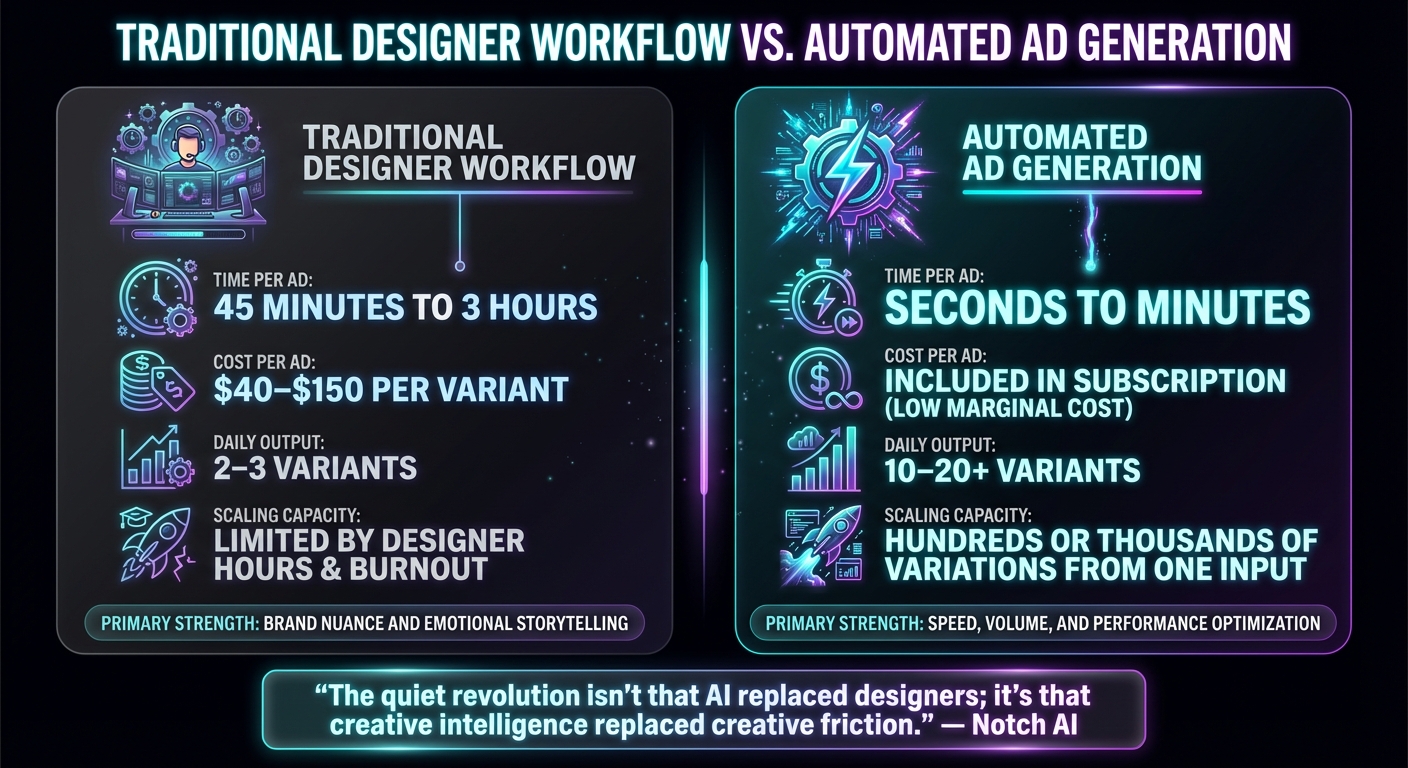
Designer Workflows vs Automated Ad Generation: Cost and Speed Comparison
When it comes to weekly ad testing, there's a clear gap between what manual design can deliver and what Meta's platform demands. Crafting a single ad manually takes anywhere from 45 minutes to 3 hours. If you’re paying $50 per hour, that’s $40 to $150 per ad variant. Now, multiply that by the 6–20 concepts typically needed each month, and the costs quickly add up.
Automated ad generation completely changes the game. AI tools for Meta ads can produce ad variations in seconds to minutes - and there are no extra charges for revisions. Instead of paying hourly rates, you’re looking at a flat monthly subscription. Once you’re set up, the marginal cost for each additional ad is practically zero.
The capacity difference is striking. A designer might manage to create 2–3 variants a day, but automated systems can churn out 10–20+ variants in the same time frame. Some advertisers are even running hundreds of ads weekly without increasing staff. This level of output allows businesses to keep up with the fast-paced demands of Meta’s platform.
"The quiet revolution isn't that AI replaced designers; it's that creative intelligence replaced creative friction." - Notch AI
Here’s a side-by-side look at how traditional workflows stack up against automated ad generation:
| Feature | Traditional Designer Workflow | Automated Ad Generation |
|---|---|---|
| Time per Ad | 45 minutes to 3 hours | Seconds to minutes |
| Cost per Ad | $40–$150 per variant | Included in subscription (low marginal cost) |
| Daily Output | 2–3 variants | 10–20+ variants |
| Scaling Capacity | Limited by designer hours and burnout | Hundreds or thousands of variations from one input |
| Primary Strength | Brand nuance and emotional storytelling | Speed, volume, and performance optimization |
This comparison highlights why automated ad generation is essential for scaling efficiently. The issue isn’t about designers lacking skills - it’s that the nature of the job has evolved. Meta campaigns now require a sheer volume of creative assets that manual workflows simply can’t keep up with.
With 73% of U.S. marketers already leveraging AI for content creation and companies reporting over $1.4 million in savings by switching to automated creative solutions, the benefits are becoming impossible to overlook.
How Aden's Lab Solves the Production Problem
Aden's Lab tackles the challenges of ad production with a streamlined, automated approach. By moving away from manual design processes, it offers a faster, more efficient way to create high-performing ads.
Drop a Link, Get Ads in Minutes
Forget the delays of manual ad creation. With Aden's Lab, all you need to do is paste your URL, and within 90 seconds, the platform pulls essential details to generate Meta-ready ads. This process eliminates the need for time-consuming revisions. When your click-through rate (CTR) starts to dip - often by 15–20% after two to three weeks - you can quickly rotate in fresh ads the same day. This rapid turnaround keeps your campaigns dynamic and effective, making it easier to test and scale without the usual bottlenecks.
Produce Hundreds of Ads Without Hiring Anyone
Aden's Lab makes high-volume ad production both affordable and efficient. For example, the Apex Mode plan lets you create 200 ads per month for just $179, which breaks down to $0.90 per ad. Compared to traditional design costs, this pricing structure is a game-changer. Without being limited by designer availability or lengthy revision cycles, you can test 4–6 ad variations weekly across multiple campaigns. This ensures you’re always uncovering new, high-performing creatives. This continuous Meta ad optimization prevents performance plateaus.
Ads Built to Perform on Meta
The platform doesn’t just churn out ads - it creates ones designed to excel on Meta. By optimizing elements like brightness, contrast, and visual hierarchy, Aden's Lab ensures your products stand out on screen. These tweaks have been shown to increase CTR by 18–35% within Meta Advantage+ suite. Each ad is crafted using direct-response principles and aligned with Meta’s algorithm, ensuring they meet the platform’s standards for creative quality and conversion potential.
Given that creative elements account for 56% of campaign performance, starting with ads tailored for success can significantly impact your results. Plus, Aden's Lab ads are fully compatible with Meta’s automatic cropping, text variations, and placement optimization features, ensuring your campaigns are not only quick to launch but also built to perform from day one.
Conclusion
The reality is, if you're testing ads weekly on Meta, traditional designer workflows are holding you back. They’re slow, costly, and limit your ability to scale. While creative quality accounts for 56% of campaign performance, it only matters if you can generate enough content to uncover those rare winning ads. With a hit rate of just 6–7%, you need to test dozens - if not hundreds - of ads to find a scalable winner without overspending. And let’s face it, traditional production methods simply can’t keep up.
This bottleneck demands a complete shift in how creative assets are produced. The top-performing brands on Meta by 2026 won’t necessarily have the best designers - they’ll be the ones who can rotate fresh ads every 7–10 days, test aggressively, and avoid production delays. That’s where Aden’s Lab comes in. With this tool, you can skip the usual hurdles: no briefs, no revisions, no waiting. Just drop a link, and in 90 seconds, you’ll have Meta-ready ads with hundreds of variations - no extra hires required.
Scaling is what separates thriving advertisers from those that plateau. When CTR drops 15–20% after just two to three weeks and purchase intent declines by 16% after six exposures, you need a system that can keep up with Meta’s fast-paced environment. Aden’s Lab eliminates production limits entirely, allowing you to test faster, launch smarter, and identify winning ads before your competition has even finished their first round of edits.
If you’re still depending on designers for weekly ad testing, you’re not just slowing yourself down - you’re capping your growth. It’s time to rethink how you approach ad production.
FAQs
How do I know when an ad is fatigued on Meta?
When an ad's performance takes a noticeable dip, it might be a sign of fatigue. Key indicators include a declining click-through rate (CTR), lower conversion rates, or increasing costs per result. These shifts often mean your audience has grown too familiar with the ad and is no longer responding to it.
How many new ads should I launch per week for my budget?
For most campaigns, rolling out 3-5 new ads per week strikes a good balance. This approach offers enough variety to identify ads that perform well, without stretching your budget too thin. If you’re managing a larger budget, you can increase the number of ads you test, ensuring the quality of each ad remains a priority.
When should I still use a designer instead of Aden’s Lab?
If your brand doesn't have a consistent visual identity, your website or marketing materials feel scattered, or your campaigns need a polished and unified appearance that automation alone can't deliver, working with a designer is still an excellent option.
Your next ad batch starts here
Finish with a ready-to-test ad batch
Paste your website to generate static creatives. Drop the link → get ads in about 90 seconds → upload them to Meta → scale.
Free to try No prompt writing