Testimonial Meta Ad Prompts for Higher-Trust Facebook and Instagram Ads
Use the prompts on your real offer
Generate these ad angles for your product
Skip the blank prompt box. Paste your product page and ADEN'S LAB applies the angles to your offer, images, headlines, and copy.
Free to try No prompt writing

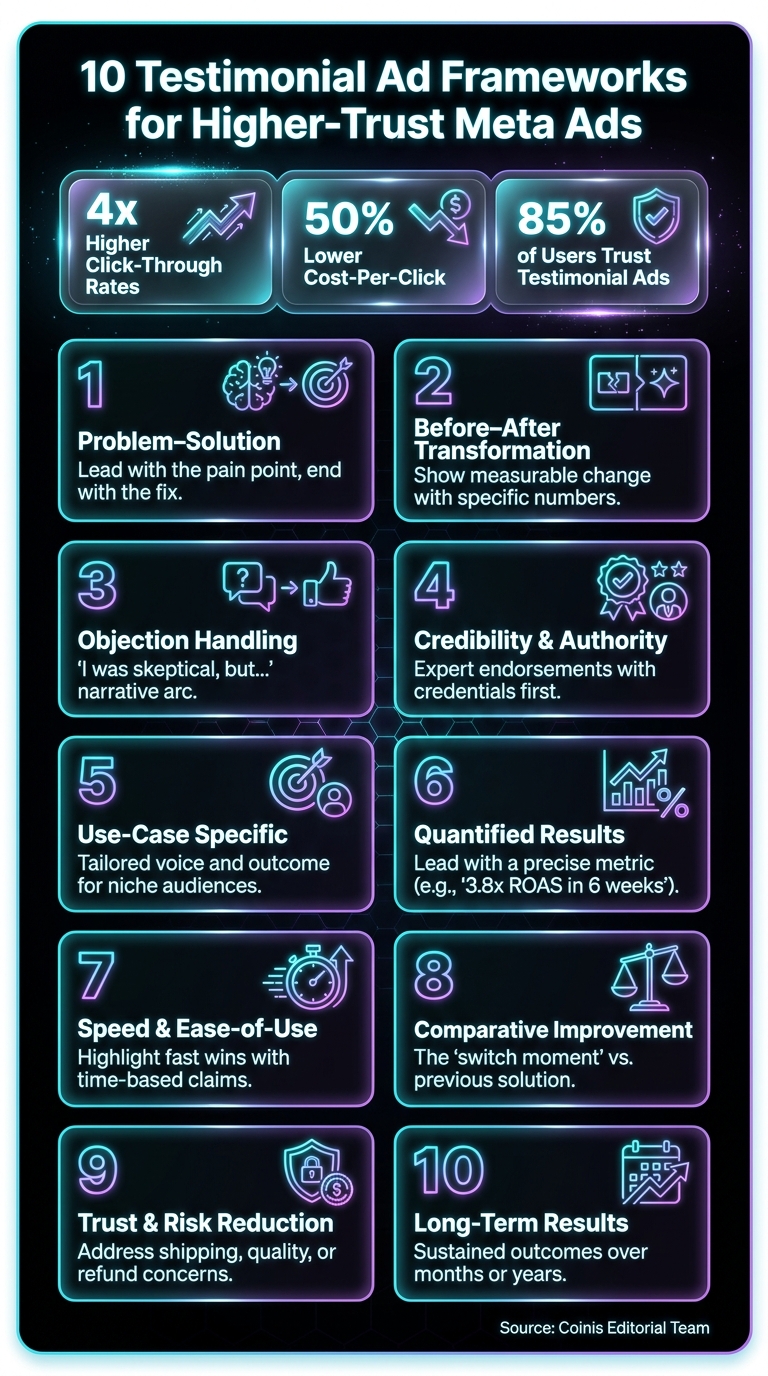
Testimonial ads on Facebook and Instagram work because they feel relatable and build trust. These ads, featuring real customer stories or AI-generated testimonials, deliver 4x higher click-through rates, reduce cost-per-click by 50%, and are trusted by 85% of users compared to traditional brand messaging.
The challenge? Crafting genuine testimonials takes time. AI-generated prompts can simplify the process, helping you create effective, natural-sounding copy in minutes. This article outlines 10 testimonial ad styles - from problem-solving stories to long-term results - designed to engage your audience and drive conversions. Before scaling, ensure your campaigns are ready with a pre-launch ad checklist.
Key Takeaways:
- Problem–Solution Testimonials: Address a pain point and show how your product resolves it.
- Before–After Transformations: Highlight measurable improvements with clear "before" and "after" states.
- Objection Handling: Counter doubts by showing how concerns were resolved.
- Credibility & Authority: Leverage expert endorsements to establish trust.
- Use-Case Specific Testimonials: Tailor testimonials to niche audiences with specific outcomes.
- Quantified Results: Use numbers to showcase measurable success.
- Speed & Ease-of-Use: Emphasize quick and simple results.
- Comparative Improvement: Show how your product outperforms alternatives.
- Trust & Risk Reduction: Reassure hesitant buyers with specific claims and proof.
- Long-Term Results: Highlight sustained customer success over time.
Use these frameworks to create ads that feel personal, build trust, and convert effectively.
10 Testimonial Ad Frameworks for Facebook & Instagram
1. Problem–Solution Testimonials
A problem–solution testimonial highlights a customer's challenge and how it was resolved, making the ad feel like a personal recommendation. This approach resonates with readers because it mirrors their own struggles, creating an immediate sense of connection and credibility - far more impactful than a standard brand message.
The key here is the PAS framework: start with the pain point, emphasize its impact, and then show how the product or service provided the solution. For example, “Never ran out of stock again” is much more engaging than a generic statement like “improved inventory management.” This clear and relatable structure makes your ad copy feel genuine and approachable.
"Lead with the result, not the feature. 'Shipped same day' beats 'fast fulfillment.'" - Coinis Editorial Team
Prompt:
"Write a Facebook ad testimonial in the first person for [product/service]. The customer was struggling with [specific problem]. Use the PAS framework: open with the pain point, briefly agitate it, then show how [product] solved it. Lead with the result. Keep the primary text under 150 characters and the headline under 27 characters. Use casual, conversational language that sounds like a real customer, not a brand."
When crafting these ads, use actual customer feedback from reviews or support tickets. Mimicking real buyer language makes the testimonial feel more authentic, which is critical - user-generated content is seen as 2.4x more trustworthy than polished brand messages. This trust factor is what makes problem–solution testimonials so effective.
From here, you can also explore testimonials that focus on transformative “before and after” stories.
Put the playbook to work
Apply this playbook to your page
Paste your website and the Lab will turn the strategy you are reading into a ready-to-test ads.
Free to try No prompt writing
2. Before–After Transformations
Before–after testimonials are powerful because they highlight a clear change - from a frustrating problem to a tangible result. Instead of vague product claims, these stories allow potential customers to see themselves in the "before" and envision their own success in the "after."
Start by focusing on the "before" state to grab attention. As Jay Kim puts it:
"The before side is actually where the click decision is made. Viewers do not click on before‐after thumbnails because the after looks good. They click because the before resonates with their current situation."
A compelling "before" ensures the transformation feels relatable. Combine this with a specific, measurable "after" (like "lost 22 lbs in 90 days" instead of "felt better") to build trust. For instance, skincare ads featuring before–after visuals have been found to boost conversion rates by 35%.
Prompt: "Create a testimonial ad for [product/service] starting with a clear 'before' state - describe the customer's frustration or struggle in simple terms. Follow with the 'after' state, using specific numbers, timeframes, or measurable outcomes. Keep the main text under 150 characters and the headline under 27 characters. Use a casual, relatable tone. End with a direct CTA like 'Try it free' or 'See how it works.'"
Always pair this text with visuals that maintain consistent lighting, angles, and backgrounds in both frames. This ensures the transformation feels authentic rather than staged. For mobile feeds, stack the "before" and "after" images vertically (with "before" on top) to maximize visibility.
3. Objection Handling
Turn Skepticism Into a Selling Point
When people see ads, they often bring a healthy dose of doubt. Maybe they've been let down before, aren't convinced it’s the right fit, or feel the price might not justify the risk. That’s where objection-handling testimonials come in - allowing real customers to voice their initial concerns and how they overcame them.
These testimonials work like a conversation. They follow a pattern: "I was worried about [concern], but [result]." This format connects with potential customers because it mirrors their own hesitations. As Wade Cline, General Manager at RaveCapture, explains:
"I was skeptical but... these create a narrative arc in a single sentence."
That single sentence does a lot of heavy lifting. It acknowledges the doubt, offers a resolution, and builds trust - all without needing a long-winded pitch.
Objection-handling testimonials are especially effective for middle-of-funnel (MOFU) audiences. These are the people who already know about your business - they’ve visited your site or interacted with your content - but haven’t taken the leap yet. They’re interested but need a little nudge to feel confident. Pairing these testimonials with transformation or problem-solution ones ensures you address lingering doubts while reinforcing the value of what you offer.
Pro Tip: To craft these ads, dig into your review database. Look for phrases like "I was skeptical", "I worried", or "I didn’t think it would work." These naturally address objections and are far more relatable than overly polished claims.
4. Credibility and Authority
Let Someone Else Vouch for You
When you're addressing cold audiences, merely handling objections isn't enough. You need something stronger - something that instantly establishes trust. This is where credibility and authority testimonials come into play. These testimonials go beyond the basics by relying on the expertise of well-known professionals to create a powerful trust signal.
Borrow Trust from Recognized Voices
We naturally trust experts. When a certified professional - like a coach, dermatologist, or financial advisor - endorses a product, their credibility rubs off on the brand. This phenomenon is known as authority bias.
"Authority bias is a documented cognitive heuristic... In advertising contexts, authority signals reduce the cognitive effort required to evaluate a claim - the reader trusts the messenger, which transfers partially to the message." - Murat Bock, Founder, adlibrary
Prompt Idea: Lead with the Credential, Then the Claim
Start with the expert's full credentials (e.g., "Dr. Aliza, Board-Certified Dermatologist") before presenting their testimonial. Pair this with measurable or verifiable results. Research shows that ads structured this way outperform those focusing solely on benefits by 21% on aided recall.
This approach is particularly effective in areas like healthcare, finance, and legal services - industries where skepticism can run high. In these contexts, a simple peer testimonial often isn't enough to establish trust.
Next, you'll see how use-case-specific testimonials can further strengthen your brand's credibility.
5. Use-Case and Niche-Specific Testimonials
Speak Directly to One Person's Problem
When it comes to testimonials, specificity is key. Instead of relying on generic praise, focus on crafting testimonials that address your audience's particular challenges. The most compelling testimonials feel like they were written with the reader in mind - speaking directly to their industry, their struggles, and even using their own terminology.
Tailor Both Voice and Format to Your Niche
To make testimonials resonate, match the tone and language to your audience. A B2B finance manager, for instance, might emphasize efficiency, saying something like, "Cut our reporting time in half." On the other hand, a fitness enthusiast might highlight personal achievements, such as, "Finally hit my goal weight before summer." The secret is to center the testimonial around a specific, measurable outcome instead of vague compliments.
"Match the voice to the persona. A fitness buyer speaks differently than a B2B finance lead." - Coinis Editorial Team
The format matters just as much as the voice, and AI tools for ad assets can help you generate these variations quickly. For example, a casual chat-screenshot style might appeal to consumer audiences on Instagram, while a clean and professional quote card could be more fitting for a B2B audience on LinkedIn or Facebook. By aligning both the tone and format with the expectations of your niche, you not only enhance authenticity but also build trust.
6. Quantified Results
Let the Numbers Do the Talking
When it comes to creating impactful ads, quantified results speak louder than vague statements. Including precise metrics in your copy can make your message stand out in a crowded space.
Take this example: "We went from 2.1x to 3.8x ROAS in six weeks." That’s a lot more compelling than a generic claim like "We improved our ROAS."
"The key word is specific. 'We improved our ROAS' is ignored. 'We went from 2.1x to 3.8x ROAS in six weeks' earns a pause." - Wissam Hallak, Co-Founder, AdAdvisor
Start your ad with a strong number - whether it’s a percentage saved, revenue gained, or time reduced. Then, briefly explain the result and finish with a clear call to action (CTA). It’s a simple formula, but it works.
Numbers-First Testimonial Prompt
Here’s a proven way to create a testimonial ad that highlights measurable success:
"Write a Facebook ad testimonial from a [customer type] who achieved [specific measurable result - e.g., '40% lower cost per lead'] within [timeframe - e.g., 'three weeks'] using [product/service]. Lead with the number. Keep the primary text under 150 characters. End with a direct CTA."
This approach ensures your testimonial focuses on concrete results, which consistently outperform vague endorsements in Meta ad environments. You can further optimize these results by leveraging Meta ads automation to scale high-performing copy. For even more impact, pair the copy with a before-and-after visual. This combination makes the numbers feel even more credible.
7. Speed and Ease-of-Use
The "Fast Win" Testimonial Prompt
When it comes to easing concerns about complexity, focusing on speed and simplicity can work wonders. A testimonial that highlights how quickly a product or service delivers results can immediately address doubts. For example, phrases like "set up in 5 minutes" or "delivered the same day" can be incredibly effective in countering hesitation.
Here’s a tailored prompt designed to emphasize this point:
"Act as a senior performance copywriter. Write a Facebook ad testimonial using proven Meta ad copy frameworks from a [customer type - e.g., 'busy e-commerce founder'] who was surprised by how fast or easy [product/service] was to use. Include a specific time metric (e.g., 'set up in under 10 minutes' or 'first results in 48 hours'). Primary text: 50–125 characters. Headline: under 27 characters. Use casual, authentic language. No buzzwords like 'game-changer' or 'seamless.' End with a direct CTA."
This prompt ensures your ad stays concise and focused while addressing potential objections with clear, measurable outcomes. By banning overused buzzwords, the testimonial feels more genuine and relatable, offering skeptics solid proof instead of empty claims.
Using specific, time-based claims not only builds trust but also drives better results. Ads like these tend to see higher click-through rates and lower cost-per-click, making them a smart addition to your campaign strategy.
8. Comparative Improvement
The "Switch Moment" Testimonial Prompt
When it comes to persuasive testimonials, the most impactful ones highlight the exact moment a customer realizes they’ve found something better. This "switch moment" - when they notice a clear, measurable improvement - can make a testimonial stand out, especially in Meta ads.
For example, claims like "doubled open rates in two weeks" pack far more punch than vague statements like "great service". By focusing on specific results and ease of use, comparative improvement testimonials showcase how a product outshines previous solutions. They’re not just about what’s good - they’re about what’s better.
Here’s a helpful AI prompt for Meta ads to craft this kind of testimonial:
"Act as a conversion copywriter. Write a Facebook or Instagram testimonial ad for [Product] using this customer quote: '[Insert Quote]'. Structure the copy using the FAB framework: Feature, Advantage over previous solutions, and Benefit (the improved outcome). Emphasize the exact moment the customer recognized the improvement. Primary text: 50–150 characters. Headline: under 27 characters. Use natural, unscripted language. Avoid words like 'game-changer' or 'unleash.' End with a clear CTA."
This framework ensures the focus stays on measurable results, making the message feel grounded and relatable rather than overly generic. To find which testimonial variation resonates best, consider A/B testing Meta ads to compare different 'switch moments.'
Here’s a tip: before diving into writing, ask your customers questions like, “What challenges were you facing before using our product?” and “How has our product helped you overcome them?” Their answers provide authentic, raw insights that can make your copy feel more natural and human.
9. Trust and Risk Reduction
The "Safety Net" Testimonial Prompt
When buyers are on the verge of making a decision, hesitation often creeps in. This is where a well-placed, targeted testimonial can work wonders, easing doubts and pushing them toward action.
The stats speak for themselves: 93% of consumers rely on online reviews to make purchase decisions. Even better, ads that include testimonials can boost click-through rates by 4x and increase purchase intent by 30%.
But not all testimonials are created equal. Specific, concrete claims - like “shipped the same day” or “refund processed in 48 hours” - carry far more weight than generic praise. Pairing these specifics with natural, unpolished language makes them even more effective. In fact, consumers perceive user-generated content as 2.4x more trustworthy than brand-generated material. This kind of reassurance lays the groundwork for a compelling call to action.
To address buyer hesitation at the critical moment, here’s a ready-to-use prompt:
"Write like a direct-response copywriter. Create a Facebook or Instagram testimonial ad for [Product] that directly tackles a specific buyer hesitation - such as concerns over shipping, product quality, or refunds. Use natural, conversational language and start with a reassuring outcome. Keep the primary text between 50–150 characters and the headline under 27 characters. Avoid vague superlatives and end with a low-friction call to action."
For an even stronger impact, layer in proof signals. Combine the testimonial with trust-building elements like star ratings or order stats (e.g., “8,214+ orders shipped”) to amplify credibility.
10. Long-Term Results
The "Still Using It" Testimonial Prompt
Short-term wins can be misleading, but long-term results are where the real value of Meta ads shines through.
Here’s something to consider: 72% of customers say positive reviews and testimonials directly influence how much they trust a company. Now, imagine the impact of testimonials that highlight success over months or even years. A customer who’s been with you for two years isn’t just satisfied - they’re proof your product delivers consistent, lasting results.
The most effective long-term testimonials follow the Problem-Solution-Result (PSR) framework over a clear timeline. For example: "I struggled with X, started using your product, and after 18 months, I’ve saved 200 hours and reduced costs by 40%." These specifics - real numbers paired with a real timeframe - transform generic quotes into powerful trust-builders.
A standout example of this is the "Customer Success Story" format. It shows measurable ROI, like a +250% increase in six months, and walks prospects through the journey from initial challenges to sustained growth. This approach turns one customer’s experience into a persuasive trust signal.
To create testimonials with this kind of credibility for your Meta ads, try this prompt: (or use our ad copy idea generator for more inspiration)
"Write like a direct-response copywriter. Create a Facebook or Instagram testimonial ad for [Product] that highlights a long-term customer result. Use the Problem-Solution-Result framework and include a specific timeframe (e.g., 'after 12 months' or '2 years later'). Lead with the sustained outcome, use natural conversational language, include a concrete metric, keep primary text between 50–150 characters and the headline under 27 characters, and end with a low-friction call to action."
This structure ensures your testimonial focuses on long-term success, which resonates deeply with potential customers.
As Damon Chen, Founder of Testimonial, explains:
"A truly effective testimonial resonates with potential customers by addressing their concerns, demonstrating real results, and building trust."
When crafting your ads, always lead with the long-term outcome, not just the features. For instance, "Reduced churn by 40% over two years" is far more compelling than "great customer support." Time-based, specific results are key to winning over skeptical buyers.
Conclusion
Testimonial-based Meta ads aren’t just a nice addition - they’re one of the most dependable ways to lower your cost per click and win over uncertain buyers. The stats speak for themselves: ads with testimonials deliver 4x higher click-through rates and slash cost-per-click by 50% compared to typical branded creatives. That’s not just a small improvement - it’s a game-changer for making the most of your ad budget.
The 10 prompt frameworks covered in this article - from problem–solution narratives to showcasing long-term results - are designed to tackle specific psychological hurdles your audience might have. By testing different approaches, identifying what clicks with your audience, and scaling those winning messages, you can fine-tune your campaigns for maximum impact.
AI tools make this process even faster. By 2026, 71% of organizations are expected to use generative AI for content creation, saving 2 to 3 hours per piece on average. Tools like ADEN's LAB can create static Meta ad creatives in under 90 seconds, starting at just $59/month. This brings production costs down to as little as $0.90 per ad, allowing you to generate hundreds of testimonial variations without needing a designer or agency.
The key takeaway? Don’t treat testimonials as an afterthought - put your customers’ voices front and center. Use these prompt frameworks as a creative starting point, apply your brand’s unique context in an AI tool, and let the data guide you to the most effective messaging. Begin with one prompt category, craft at least three variations, and test them against your current top-performing ad. Time and again, results-driven copy outshines overly polished brand messaging.
"Consumers find UGC 2.4x more authentic than brand-created content. A testimonial ad borrows that credibility and applies it directly to your offer." - Coinis Editorial Team
The difference in performance will make a strong case for incorporating these testimonial strategies into all your campaigns. Put them to use and see how they can boost trust and drive conversions like never before.
FAQs
How do I make AI testimonials sound real?
To make AI-generated testimonials feel genuine, focus on creating a natural and relatable tone. Include specific details that reflect real customer experiences. Avoid language that feels overly polished or rehearsed - genuine feedback often includes casual phrasing or a conversational style. Incorporating elements like user stories or direct quotes can make these testimonials more believable. By crafting testimonials that resemble user-generated content (UGC), you can effectively build trust and leverage social proof in a way that resonates with your audience.
Which testimonial style should I test first?
Testimonial-style ads are a great starting point because they often deliver better results than standard branded creatives. These ads resonate with audiences by building trust and encouraging higher engagement, making them a smart choice for boosting the performance of your campaigns.
What proof can I add to avoid getting flagged?
Including social proof - such as genuine customer testimonials or reviews - can significantly boost trust in your ad. Why? People are more likely to engage with content that feels relatable and authentic.
Testimonial-based ads have a natural edge because they mirror real-life recommendations. They not only resonate better with audiences but also tend to perform well in terms of engagement. Plus, they’re less likely to be flagged since they come across as credible and grounded in real experiences.
For example, a satisfied customer saying, "This product completely changed how I manage my day - simple, effective, and worth every penny!" can make a world of difference in how your ad is perceived. It feels personal and trustworthy, creating a stronger connection with potential customers.
In short, weaving genuine testimonials into your ads can make them feel less like marketing and more like a friendly suggestion from someone who’s been there.
Your next ad batch starts here
Finish with a ready-to-test ad batch
Paste your website to generate static creatives. Drop the link → get ads in about 90 seconds → upload them to Meta → scale.
Free to try No prompt writing