31 Scroll-Stopping Meta Ad Hooks You Can Copy + Paste
Turn the idea into a testing batch
Generate new hooks and angles from your product page
Paste your URL to create multiple ready-to-test concepts instead of adapting generic examples by hand.
Free to try No prompt writing
Want your Meta ads to stand out in 2026? You’ve got just 1.5 seconds to grab attention. If your hook fails, your ad gets skipped. But the right hook can slash your costs, boost engagement, and drive conversions. For example, Oral-B’s March 2026 campaign used a simple “Problem-Agitation” hook to reach 800 million people with 23 million views for just $207,400.
Here’s what you’ll learn:
- Hooks that work: From bold claims to curiosity gaps, these strategies are backed by data.
- Proven results: Hooks like “Stop wasting money on ads that don’t convert” can increase click-through rates by up to 37%.
- How to win on Meta: Test 3–5 hooks per campaign, refresh every 2–4 weeks, and focus on what resonates.
Key takeaway: Your ad’s opening seconds are critical. Use these 31 hooks to stop the scroll, lower costs, and improve results. Ready to level up your Meta ads? Let’s dive in.
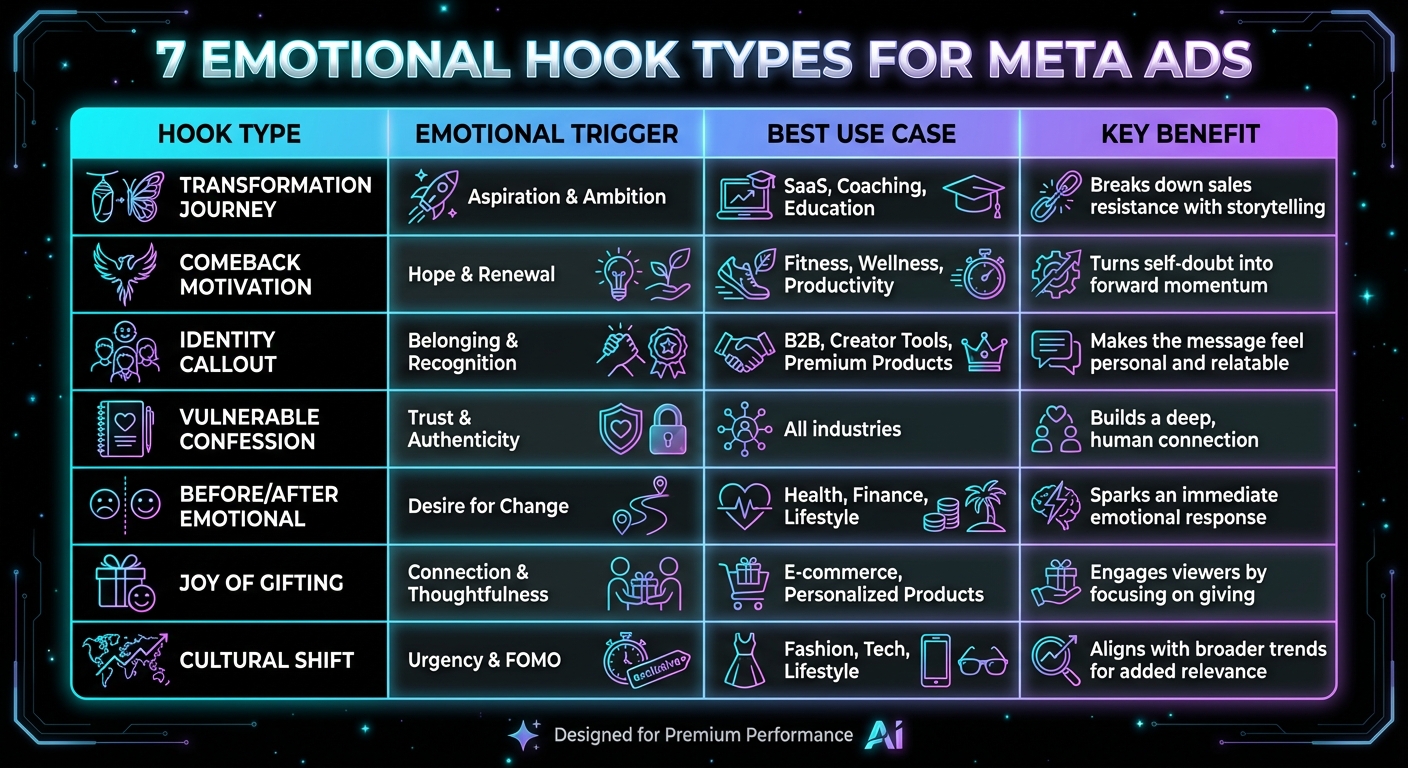
7 Emotional Hook Types for Meta Ads: Triggers, Use Cases & Benefits
The Best Hooks for Meta Ads 2026
Put the playbook to work
Apply this playbook to your page
Paste your website and the Lab will turn the strategy you are reading into a ready-to-test ads.
Free to try No prompt writing
1. Attention-Grabbing Openers
The first few seconds of your ad are everything. These openers are designed to stop the endless scroll in its tracks, boasting raw hook rates of 38%–52%. The secret? A mix of visual motion, audio triggers, text overlays, and a seamless platform-native feel that doesn’t scream “ad”.
1. The Direct Challenge Hook
Call out your audience’s biggest mistake right away. For example: "Stop wasting money on ads that don't convert." This works because it taps into loss aversion - people are more motivated to avoid mistakes than to chase gains. Keep it short - 12 words or fewer - for instant impact.
2. The Curiosity Gap Opener
Leave your audience hanging with an open-ended teaser. Try: "The #1 reason your ads stopped working..." and pause before delivering the answer. This curiosity-driven approach can increase click-through rates by up to 37% compared to generic openings. The brain loves closure, and viewers will stick around to get it.
3. The Bold Claim Hook
Start with a bold, measurable result that grabs attention. Example: "We reduced CPA by 62% in 14 days." using AI-driven optimization This type of hook challenges viewers to examine your offer, making it particularly effective for audiences who are already weighing their options.
4. The Question Hook
Ask a question that directly addresses your audience’s pain point. Example: "Why do 73% of DTC brands lose money?" Questions like this create an information gap that viewers feel compelled to close. On platforms like Meta, question hooks typically see hook rates between 30% and 38%.
5. The Pattern Interrupt Visual
Use unexpected visuals to disrupt the scroll - think rapid scene changes, bold colors, or unusual camera angles. These visuals activate the brain’s novelty response. Combine this with a compelling text overlay for maximum effect.
6. The Social Proof Lead
Start with an impressive stat or an authority marker. Example: "Why 10,000+ creators switched to this..." Social proof can significantly increase trust, boosting purchase likelihood by as much as 270%. This is especially effective for cold audiences who need validation before engaging.
7. The Direct Address Hook
Speak directly to your audience to make them feel seen. Example: "Coaches, freelancers, and creators..." This taps into the "cocktail party effect", where people instinctively pay attention when addressed personally. It’s a great way to filter for your ideal customer.
8. The Warning Hook
Frame your message with urgency by highlighting a common mistake. Example: "Stop doing [Common Habit] immediately." Negative framing works because people are driven to avoid losses, often more than they are to achieve gains. Use this to disrupt conventional thinking or expose widespread errors.
With these openers, your ad is primed to grab attention. Next, it’s time to focus on hooks that address your audience's pain points and guide them toward your solution.
2. Problem-Solution Hooks
Once you've grabbed attention, problem-solution hooks are a powerful way to connect with viewers who share the challenges you're addressing. These hooks not only engage the right audience but also signal to Meta's algorithm who might benefit most from your message.
When crafting these hooks, focus on outcomes rather than features. For example, instead of promoting a "cloud-based API", highlight how it saves 10 hours of manual work per week. By asking yourself, "So what?" for every feature, you uncover the real benefits that resonate with your audience. Statistics back this up - problem-based hooks on Meta often achieve hook rates of 26–34%, while visual transformations (like before-and-after scenes) can reach 30–40%. Let’s dive into some specific types of hooks that deliver results, using proven Meta ad copy frameworks.
9. The Relatable Question Hook
Start with a direct question that addresses a common pain point. For instance, in March 2026, Oral-B ran a Meta campaign with the hook: "Sensitive gums? Switch to Oral-B-I-O. For healthier gums in one week." This campaign reached over 800 million people, earned 23 million views, and spent $207,400. The inclusion of a specific timeframe - "in one week" - helped reduce skepticism and boost trust. This type of hook is great for engaging high-intent viewers and driving conversions.
10. The "Stop Wasting" Command Hook
This approach uses a direct command to highlight a loss while offering an immediate solution. For example: "Stop wasting money on ads that don't convert. Try this instead." By tapping into the audience's fear of loss and creating urgency, this hook works especially well for cold audiences who are still exploring their options. It’s a simple yet effective way to drive engagement and conversions.
11. The Specific Time-Drain Hook
Quantify wasted time or effort to make the problem feel personal. For example: "Tired of spending 4 hours a week pulling reports from 5 different ad platforms?" This specificity grabs attention by making the issue relatable, a phenomenon known as the "cocktail party effect". A B2B ad using this exact hook in March 2026 successfully attracted highly qualified leads experiencing this problem.
12. The Outcome-First Hook
Lead with the benefit, not the feature. Instead of saying, "Our new mattress has memory foam," try "Wake up feeling refreshed every morning." This approach answers the "So what?" question immediately, showing why the feature matters. Ads that focus on benefits outperform those centered on features by 83%.
13. The Visual Transformation Hook
Show a quick before-and-after comparison to instantly demonstrate the problem and its solution. For example, a 3-second split-screen visual can communicate the message effectively, even without sound. Using rapid scene changes or time-lapses in the first few seconds maximizes impact. This format consistently achieves hook rates of 30–40% on Meta.
14. The Seasonal Comeback Hook
Acknowledge setbacks without judgment and offer a way forward. Samsung nailed this with their March 2026 campaign: "Time for a comeback? Reignite your resolution!" Promoting the Galaxy Watch8 and S25 Ultra, the campaign generated 5.9 million views with just $52,000 in ad spend by targeting users who had missed their New Year’s goals. This empathetic approach positions your product as the solution to a common struggle.
15. The "Switch To" Command Hook
Pair a direct command with a clear timeframe to create urgency. For example: "Switch to [Product] for [Benefit] in [Timeframe]." This structure works because it promises a specific, believable outcome, which reduces skepticism. Oral-B used this framework effectively to achieve massive reach and engagement.
16. The Unverbalized Frustration Hook
Call out a frustration your audience might not openly express. For instance: "You're doing [task] the hard way. Here's the shortcut." By describing their pain point in exact terms, you show that you understand their struggle, making them eager to hear your solution.
These hooks guide viewers from simply recognizing their problem to actively seeking a solution. Next, we’ll explore how social proof and authority can help build trust and credibility with your audience.
3. Social Proof & Authority
After addressing your audience's pain points, social proof becomes the key to building trust and turning casual scrollers into loyal buyers. Why does this work so well? Because 93% of consumers rely on online reviews to guide their purchasing decisions. Ads featuring customer reviews, in fact, achieve 4x higher click-through rates compared to those without this element of trust. The secret lies in showcasing real people, genuine results, and authentic credibility - not just polished marketing language.
Social proof thrives when it combines specific data with heartfelt testimonials. For example, instead of generic phrases like "thousands of happy customers", highlight precise figures like "8,214 orders" or "12,847 brands switched." Interestingly, ratings between 4.2 and 4.5 stars are more effective in driving purchases than a perfect 5.0, which can sometimes seem untrustworthy. On Meta, Social Proof Lead hooks typically achieve hook rates of 24% to 32%, while UGC Confession hooks - where real customers candidly share their experiences - can reach 28% to 36%. Once you've earned trust with these strategies, you can move on to deepening the connection through emotional and aspirational storytelling.
17. The Customer Count Hook
Numbers can be powerful. Start with how many people have already chosen your product: "12,847 brands switched to [Product] this month." This approach taps into conformity bias, making your product seem like the obvious choice. The specificity adds credibility, while the large number creates a sense of urgency and trust.
18. The Influencer Discovery Hook
Influencers can feel like trusted friends when done right. For instance, in March 2026, Fiido collaborated with influencer Kerllenrego, who shared her excitement about discovering their electric bike. The campaign reached 2.1 million people with just $18,000 in ad spend. The key is to make the endorsement feel genuine, not forced.
19. The Expert Authority Hook
Having an industry leader or respected figure endorse your product can be a game-changer. Take Notion's campaign from March 2026, where Cursor's CEO emphasized the importance of using advanced AI tools:
"Using the best AI-native tools is an important competitive advantage."
This type of validation resonates especially well with SaaS and B2B audiences focused on staying ahead.
20. The Specific Outcome Testimonial Hook
Vague praise like "I love this product" doesn’t carry much weight. Instead, go for testimonials with measurable results, such as "I lost 8kg in 12 weeks" or "Saved 10 hours of manual work per week." Including details like the customer's name, photo, and location adds a layer of authenticity that can significantly boost conversions.
21. The Star Rating Overlay Hook
Sometimes, a simple star rating can do wonders. Displaying a rating between 4.2 and 4.5 stars directly on your ad creative can instantly establish trust. For example, Leroy Merlin Poland used dynamic catalog ads with live ratings in 2026, achieving a 353% increase in conversion rate and a 79% improvement in ROAS. It’s a quick way to validate your product before potential customers even dive into the details.
22. The Volume + Scarcity Stack Hook
Pairing large sales numbers with limited availability can create a powerful sense of urgency. For example: "12,000 sold this month, only 43 left" or "14 people viewing this right now." This combination can increase conversions by up to 98%.
23. The UGC Confession Hook
There’s something compelling about unscripted, raw video testimonials. When a real customer shares their honest experience, it feels authentic and relatable. As digital marketing expert Ansherina Opena puts it:
"The messiness is the message. It bypasses the viewer's built-in ad detector because it looks and feels like content, not advertising."
This approach often outperforms polished, studio-quality ads because it feels more genuine.
24. The Review Carousel Hook
A carousel of reviews can address multiple customer concerns in one swipe. For instance, each card could tackle a specific worry - price, quality, delivery, or results. Including five or more reviews in this format can boost conversions by up to 270%. Placing these reviews near your call-to-action ensures they’re seen at the most critical moment.
Next, we’ll dive into how emotional and aspirational messaging can create lasting connections with your audience, driving long-term loyalty.
4. Emotional & Aspirational Appeals
Once trust is established through social proof, the next step is to connect on a deeper, emotional level. Emotional hooks are powerful because they bypass logical resistance and speak directly to the heart. As Angad Singh from Segwise puts it:
"Emotion first, logic second - emotion gets the click; logic justifies the purchase."
The focus should be on the experience a product creates, not just the product itself. Emotional hooks tap into universal human desires: the need for growth, the fear of missing out (FOMO), and the drive to improve. Storytelling plays a key role here, emphasizing the journey over the features. A great example is Shopify’s 2026 "Founder Journey" campaign, which followed a creator’s one-year struggle to bring an idea to life. This narrative made Shopify feel like more than a tool - it became a partner in achieving dreams. Similarly, Funko Europe’s "Pop Yourself!" campaign encouraged fans to design custom figures for loved ones, focusing on the joy of giving. The result? 34.1 million views and 50 scaled versions of the campaign. To manage such high-volume creative testing, many brands leverage Meta ads automation to optimize performance.
Here are some tried-and-true emotional hooks to shift basic interest into genuine engagement.
25. The Transformation Journey Hook
This hook highlights the emotional arc from struggle to success. For example: "From idea to finished product in one year - here's how we did it." Stories like this captivate the brain’s emotional centers and keep attention locked beyond the critical three-second window. The key is authenticity - audiences can spot a made-up story a mile away.
26. The Comeback Motivation Hook
This approach acknowledges past failures while offering a fresh start. It connects with viewers who may feel stuck or disappointed by unmet goals and encourages them to take positive action without judgment.
27. The Identity Callout Hook
Speak directly to the aspirations of your audience. Phrases like "For the creator who's ready to go full-time" or "Built for the entrepreneur who refuses to settle" resonate deeply. This strategy uses the "cocktail party effect", making the message feel personal and relevant.
28. The Vulnerable Confession Hook
Radical honesty grabs attention. Statements such as "Why we almost quit" or "I was wrong about this" build trust by showcasing vulnerability. This honesty cuts through the polished façade of traditional marketing.
29. The Before/After Emotional Hook
Rather than focusing solely on physical transformations, this hook emphasizes emotional shifts. For instance: "From overwhelmed to in control in 30 days." It appeals to the audience's desire for a better emotional state.
30. The Joy of Gifting Hook
This strategy turns passive viewers into active participants by focusing on the act of giving. Funko Europe’s campaign, which encouraged fans to create personalized figures for loved ones, is a prime example. By centering the message on connection and thoughtfulness, the campaign achieved 34.1 million views.
31. The Cultural Shift Hook
This hook ties your product to larger societal trends or movements. For example: "Say goodbye to hustle culture - here's the smarter way to work." Positioning your product within a broader conversation creates a sense of urgency and relevance.
| Hook Type | Emotional Trigger | Best Use Case | Key Benefit |
|---|---|---|---|
| Transformation Journey | Aspiration & Ambition | SaaS, Coaching, Education | Breaks down sales resistance with storytelling |
| Comeback Motivation | Hope & Renewal | Fitness, Wellness, Productivity | Turns self-doubt into forward momentum |
| Identity Callout | Belonging & Recognition | B2B, Creator Tools, Premium Products | Makes the message feel personal and relatable |
| Vulnerable Confession | Trust & Authenticity | All industries | Builds a deep, human connection |
| Before/After Emotional | Desire for Change | Health, Finance, Lifestyle | Sparks an immediate emotional response |
| Joy of Gifting | Connection & Thoughtfulness | E-commerce, Personalized Products | Engages viewers by focusing on giving |
| Cultural Shift | Urgency & FOMO | Fashion, Tech, Lifestyle | Aligns with broader trends for added relevance |
These hooks are designed to resonate emotionally, helping brands move beyond surface-level interest to create meaningful engagement. By tapping into universal human experiences, they leave a lasting impression.
Conclusion
The difference between a Meta ad that gets ignored and one that grabs attention boils down to just 0.4 seconds. That tiny fraction of time is all it takes for your hook to activate the brain's orienting response - or disappear into the endless scroll. The 31 hooks outlined here aren’t just creative suggestions - they’re psychological triggers that directly influence your Click-Through Rate (CTR) and Return on Ad Spend (ROAS). They’re not just ideas; they’re tools to elevate your Meta ad performance.
Creative content now drives 56% of outcomes in Meta auctions. This means your hook isn’t just an opening line - it’s the driving force behind your campaign’s success. Winning on Meta in 2026 won’t be about who spends the most; it’ll be about who can consistently produce and scale high-performing creatives fast enough to combat audience fatigue and keep engagement high.
To maximize the impact of these hooks, adopt a systematic approach: test 3–5 hook variants per campaign, refreshing them every 2–4 weeks - or sooner if performance drops by more than 15% from its peak. High-performing accounts that run 5+ creative variants per ad set often achieve 20–30% lower Cost Per Acquisition (CPA) compared to those using only 1–2 variants. This approach ensures you identify the hooks that truly drive engagement and conversions.
Streamlining your creative process is key, and ADEN's LAB addresses this challenge directly. Instead of waiting days for designers to produce a handful of ads at $30–$50 each, you can generate dozens - or even hundreds - of Meta-optimized static ads per month starting at just $59. With options as low as $0.90 per ad, you can test multiple variations of these 31 hooks, keep your ads fresh, and scale your campaigns without delays. Designed specifically for the Meta algorithm, the platform focuses on creating ads that deliver results - not just aesthetically pleasing designs.
Take action today: pick three hooks, use ADEN's LAB to create variations, and launch them this week. Track metrics like 3-second video view rates and thumb-stop ratios to identify what resonates. Brands that implement these hooks and test them systematically will outperform their competitors and secure their market position. Your next winning hook could be live in just 90 seconds.
FAQs
Which hook types work best for cold audiences on Meta?
Hooks that pique curiosity, pose intriguing questions, or challenge widely held beliefs tend to perform exceptionally well for cold audiences on Meta. These tactics grab attention fast and make users pause their scrolling, which is key to boosting engagement.
How do I test hooks without burning budget?
Testing ad hooks doesn’t have to drain your budget. A smarter approach is to use data-driven strategies instead of blindly experimenting. Here’s how:
- Start with 3-5 reliable hook types that align with your audience and platform. Examples include engaging questions, attention-grabbing pattern interrupts, or compelling social proof.
- Implement small-budget A/B testing to compare performance. This allows you to see what works without overspending.
- Rotate your hooks every 2-4 weeks to keep your audience engaged and prevent ad fatigue.
To streamline the process, take advantage of AI tools and user-generated content (UGC). These resources can help you quickly create multiple hook variations, making it easier to identify what resonates most - all while keeping costs in check.
What metrics should I track to judge a hook fast?
To assess the effectiveness of a hook, focus on these key metrics:
- Viewer drop-off in the first 3 seconds: This shows how quickly you're grabbing attention.
- Engagement rates: Look at actions like clicks or views that go beyond the initial 3 seconds.
- Click-through rate (CTR): This measures how well your content encourages interaction.
These metrics provide a clear picture of whether your hook is pulling viewers in and keeping them engaged.
Your next ad batch starts here
Finish with a ready-to-test ad batch
Paste your website to generate static creatives. Drop the link → get ads in about 90 seconds → upload them to Meta → scale.
Free to try No prompt writing