Multi-Touch Attribution for Meta Ads: Guide 2026
Turn the strategy into creatives
Create Meta ads for your product
Paste your product page. ADEN'S LAB turns the offer, audience, and positioning into complete ready-to-use Meta static ads.
Free to try No prompt writing

Multi-Touch Attribution (MTA) helps advertisers understand the full customer journey by assigning credit to all ad interactions, not just the last click. This method is crucial in 2026 due to privacy changes like Apple's ATT and the phase-out of cookies, which have reduced attribution accuracy by 40–60%. Meta's tools, such as the Conversions API (CAPI) and Event Match Quality (EMQ) scores, help close these gaps, ensuring better tracking and data reliability.
Key takeaways:
- Why MTA matters: Traditional last-click attribution misses 30–40% of conversions. MTA provides a clearer picture of ad performance, especially with Meta's AI-driven models.
- Privacy challenges: ATT opt-in rates are just 15–25%, and iOS updates have made tracking harder. Server-side tools like CAPI are essential for accurate data.
- Best MTA models: Time-decay attribution works well for most Meta advertisers, giving more credit to recent interactions.
- Creative testing: Testing at least 20 ad concepts monthly boosts ROAS by 65%. Meta's Andromeda algorithm emphasizes variety and quality in ad creatives.
- Tools for scaling: Platforms like ADEN'S LAB make it easy to generate high-volume, effective ads quickly, starting at $59/month.
How Meta Attribution Works in 2026

Meta's Native Attribution Model Explained
Meta's default attribution model operates on a 7-day click/1-day view window. This means if someone clicks an ad within seven days or views it within one day before converting, the ad gets credit. As of January 12, 2026, Meta officially retired the 28-day click, 28-day view, and 7-day view attribution windows. This change hit brands selling higher-consideration products particularly hard, with some reporting a 15–30% drop in reported conversions overnight.
To help advertisers adapt, Meta introduced a feature called "Breakdown by Attribution Setting" in early 2026. This tool allows advertisers to compare performance across various attribution windows within a single report. It’s particularly helpful for understanding how much conversion volume relies on longer decision-making cycles. However, these native tools are increasingly strained as evolving privacy regulations and technological shifts disrupt data collection.
How Privacy Changes and Signal Loss Affect Attribution
In 2026, privacy updates and signal loss have made attribution more complex. Apple’s App Tracking Transparency (ATT) opt-in rates have plateaued globally at just 15–25% as of Q1 2026. Meanwhile, Google Chrome’s phase-out of third-party cookies is 80% complete. To complicate matters further, iOS 17 and 18 now remove the fbclid parameter from Safari URLs, making it difficult for the Meta Pixel to connect clicks to conversions without server-side support.
These privacy-driven changes have significantly impacted Meta’s ad attribution. Between 2024 and 2026, attribution accuracy dropped by 40–60%. When reliable data signals are unavailable, Meta’s algorithm shifts to on-platform proxy signals and automated ad tools, which can extend the learning phase and create inconsistent cost-per-result metrics.
"The iOS 14 privacy changes in 2021 fragmented the signal layer permanently. CAPI exists specifically to rebuild the closed loop that ATT broke." - Murat Bock, Founder, AdLibrary
How to Set Up Reliable Tracking
To navigate these challenges, a dual-channel tracking setup is essential. In 2026, the most effective approach is using both the Meta Pixel and CAPI (Conversions API) together. The Pixel captures client-side actions, such as page views, while CAPI sends server-side data, like purchases or sign-ups, directly to Meta.
For this setup to work seamlessly, ensure every event has a unique event_id to avoid duplication. Regularly check your Event Match Quality (EMQ) in Meta’s Events Manager. Scores below 7.0 can hurt your campaign performance. Here’s a breakdown of EMQ scores and recommended actions:
| EMQ Score | Match Rate | What to Do |
|---|---|---|
| Great | 90%+ | Keep your current setup as is |
| Good | 70–89% | Enhance first-party identifiers |
| Fair | 50–69% | Add more detailed CAPI data |
| Poor | Below 50% | Fix any misconfigurations immediately |
To improve your EMQ, prioritize collecting and passing hashed emails and phone numbers server-side. Early collection of first-party data - through lead magnets or gated content - helps Meta better match users. Additionally, configuring Aggregated Event Measurement (AEM) is critical for compensating for signal loss from iOS users. Without AEM, iOS conversions are often underreported, leading to inaccurate attribution and poor budget allocation.
Put the playbook to work
Apply this playbook to your page
Paste your website and the Lab will turn the strategy you are reading into a ready-to-test ads.
Free to try No prompt writing
Meta’s New Attribution Model Will Blow Up Your Ad Strategy - Here’s Why
Multi-Touch Attribution Models for Meta Ads
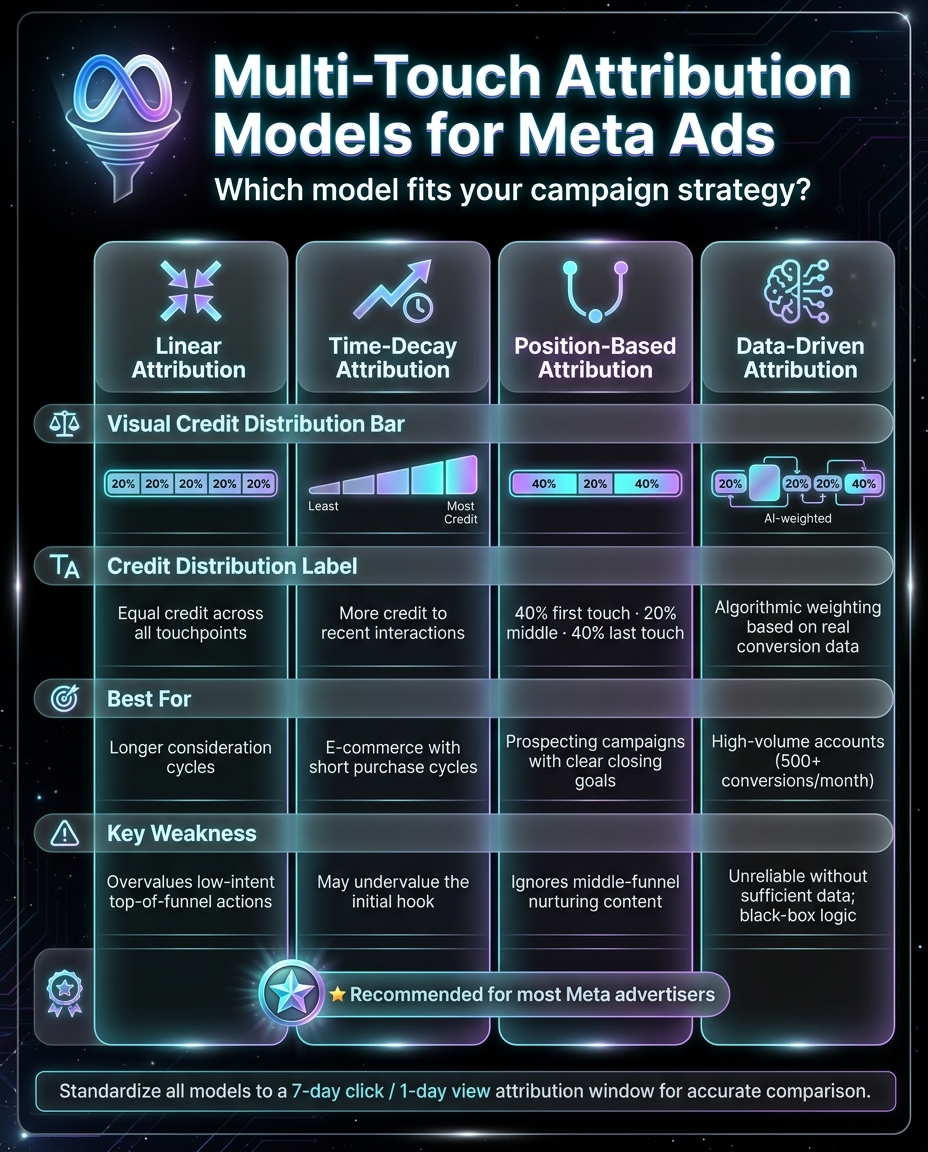
Multi-Touch Attribution Models for Meta Ads: Side-by-Side Comparison
MTA Models: An Overview
Once you have reliable tracking in place, the next step is figuring out how to divide conversion credit among the various touchpoints in a customer’s journey. Here are four main approaches, each with its own logic:
- Linear attribution: This model splits credit equally across every touchpoint. While straightforward, it doesn’t account for the varying importance of different interactions - like a casual ad view versus a decisive click.
- Position-based attribution: This method gives 40% of the credit to the first touch, 40% to the last, and spreads the remaining 20% across the middle interactions. It’s useful for balancing early prospecting efforts with the final push to conversion.
- Time-decay attribution: This model places more weight on touchpoints closer to the conversion. It aligns well with Meta’s ad fatigue cycle, which typically resets every 2–4 weeks, ensuring recent interactions get more credit.
- Data-driven attribution: This approach uses algorithms to assign credit based on actual conversion data. However, it requires a high volume of events - usually 500 or more conversions per month - to deliver reliable insights.
Each model offers a different perspective on how to allocate your budget with AI and evaluate ad performance.
Which MTA Model Works Best for Meta Advertisers
For most Meta advertisers, particularly those running e-commerce or direct-response campaigns, time-decay attribution is often the go-to choice. It prioritizes recent interactions, giving more credit to the ads that directly influence conversions.
While linear attribution might seem fair, it can overemphasize low-intent actions at the top of the funnel. On the other hand, data-driven attribution can be extremely effective but only if backed by a strong CAPI signal. Without that, the algorithm may rely on incomplete data, leading to less reliable results.
MTA Model Comparison Table
| Model | Credit Distribution | Best For | Key Weakness |
|---|---|---|---|
| Linear | Equal credit across all touches | Longer consideration cycles | Overvalues low-intent top-of-funnel interactions |
| Time-Decay | More credit to recent touches | E-commerce with short purchase cycles | May undervalue the initial hook |
| Position-Based | 40% first, 40% last, 20% middle | Prospecting-focused campaigns with closing goals | Ignores middle-funnel nurturing content |
| Data-Driven | Algorithmic weighting | High-volume accounts (500+ conversions/month) | "Black box" logic; unreliable without sufficient data |
To get accurate comparisons across these models, make sure your attribution window is standardized - set it to a 7-day click and 1-day view for all campaigns. Without this consistency, your analysis won’t hold up.
Next, we’ll dive into how to implement these models effectively.
How to Implement Multi-Touch Attribution for Meta Ads
Building Your Attribution Dataset
To implement a Multi-Touch Attribution (MTA) model, the first step is building a clean and complete dataset. Start by activating CAPI (Conversions API), which helps bypass browser limitations that can miss up to 40% of conversions. CAPI captures more conversion events by overcoming the challenges of browser-based tracking.
Once CAPI is up and running, check your Event Match Quality (EMQ) score in Meta's Events Manager. Aim for a score of 7.0 or higher. To achieve this, ensure you're passing hashed identifiers (like email addresses and phone numbers) and purchase values in the correct currency. As Murat Bock, Founder & Fullstack Developer, puts it:
"Cleaner signal = faster exit from learning = tighter cost control. Most advertisers who struggle with auto Facebook ads have a signal problem, not a campaign structure problem."
With CAPI in place, gather detailed performance data through Meta's Marketing API. This includes metrics at the campaign, ad set, and ad levels. Combine this data with insights from GA4 and your e-commerce platform using server-side event deduplication. This process creates a clean, closed-loop dataset that is ready for modeling. Once your dataset is consolidated, you can move on to configuring your MTA model.
How to Configure and Calculate MTA Models
After preparing your dataset, it's time to configure your MTA model. One popular approach for Meta advertisers is time-decay attribution, which gives greater credit to touchpoints closer to the conversion event. For example, you could apply an exponential decay factor (commonly 0.5 per day), meaning a touchpoint 7 days before conversion would receive half the weight of one 6 days prior. Another approach to consider is linear attribution, which evenly distributes credit across all touchpoints.
To ensure accuracy, use a consistent 7-day click and 1-day view window across all campaigns. This consistency is crucial to avoid discrepancies in model output caused by mismatched settings rather than actual performance differences.
How to Validate and Maintain Your Attribution Model
Once your model is configured, regular validation is key. A reliable method is running incrementality tests. Pause ads for a holdout group and compare their conversion rates to those of an active group. If your model heavily credits an ad but the holdout group shows no significant drop in conversions, the model may need adjustment.
Keep an eye on key performance signals, such as:
- CPA increasing by 30% within two weeks
- Frequency exceeding 3.0
- CTR dropping by 40%
Also, monitor creative similarity scores. Meta's Andromeda engine, which rolled out fully in October 2025, treats visually similar ads as a single unit. This can consolidate attribution data and make it harder to pinpoint which creative is driving conversions. If multiple ads look nearly identical, Andromeda may group them under the same retrieval node, potentially skewing your results.
Finally, maintain a testing log to track hypotheses, variables, and outcomes. Advertisers who follow a structured testing approach see about 28% higher return on ad spend compared to those who test randomly. Regular validation ensures your MTA model stays aligned with evolving ad performance, helping you make smarter campaign decisions.
Using Attribution Insights to Improve Meta Ad Performance
These strategies tie together the process of turning attribution insights into actionable steps for better Meta ad performance. The focus is on three key areas: budget optimization, creative measurement, and creative scaling. Together, they create a system for maximizing results.
Budget and Bid Strategy Based on MTA Data
Once you’ve established a reliable MTA (multi-touch attribution) model, you can use its insights to refine your budget and bidding strategies. MTA data allows you to allocate spending more effectively, moving away from last-click credit and toward touchpoints that genuinely drive conversions.
For instance, in Advantage+ Shopping Campaigns (ASC), set a budget cap of 10–20% for existing customers. This encourages the algorithm to prioritize acquiring new customers rather than over-focusing on warm audiences that would likely convert anyway.
If you notice CPA (cost per acquisition) rising while EMQ (Estimated Marketing Quality) stays stable, it could signal creative fatigue. In such cases, shifting the budget toward fresh creative ideas is more effective than tweaking bid caps. It’s also important to avoid mixing bidding strategies within the same campaign structure. As Murat Bock, Founder & Fullstack Developer, explains:
"Automation amplifies whatever signal you give it. If your ad creative carries a weak angle... automation will spend money faster on that weak signal." - Murat Bock
For scaling, increase your budget by 20% when CPA is below 0.8x your target and your campaign has spent over $200 in the last three days. This keeps scaling decisions grounded in data rather than instinct.
Measuring Creative Performance with MTA
MTA data helps identify which creatives contribute to conversions earlier in the funnel - often assets that might otherwise be paused too soon under last-click attribution models. Considering that creative quality accounts for 47% of Meta ad performance, accurate measurement is essential. MTA can track which creative concepts are driving results and identify signs of fatigue before performance dips significantly, giving you the chance to refresh content proactively.
Brands that test 20 or more conceptually different ads each month see 65% higher ROAS (return on ad spend) compared to those testing fewer than 10. The key here is testing fundamentally different approaches, such as a pain-point focus versus a social-proof angle, rather than making small visual tweaks. Meta’s Andromeda engine treats visually similar ads as one unit, so minor variations won’t provide the diversity needed for meaningful insights.
By leveraging these creative insights, you can ensure your ad production remains efficient and aligned with performance goals.
Scaling Creative Output with ADEN'S LAB

Once you’ve identified winning creative concepts, scaling quickly becomes essential. Limited creative volume can restrict the effectiveness of MTA-driven optimization. For MTA models to deliver reliable attribution data, they need a variety of touchpoints across distinct ad concepts. Running only a handful of ads at a time won’t provide the diverse signals required.
This is where ADEN'S LAB steps in. The platform allows you to generate high-performing static Meta ads in minutes using just a product or landing page link. It’s designed to support the high creative volume necessary for MTA optimization. For accounts spending over $50,000 monthly, the goal should be to produce 25–40 or more conceptually distinct creatives per month.
"Creative output is often the biggest limiting factor for scaling campaigns, and ADEN'S LAB solves that problem by transforming ad production into a fast, automated, and scalable process." - ADEN'S LAB
With pricing starting at $59 per month and an Apex Mode plan that can produce 200 ads monthly at just $0.90 per ad, high-volume testing becomes accessible for advertisers at any budget. Once MTA data highlights a high-performing concept, ADEN'S LAB can rapidly generate variations of that angle. These top-performing variations can then be consolidated into scaling campaigns using Post IDs to retain social proof. The process becomes cyclical: MTA identifies winners → ADEN'S LAB scales production → better data informs attribution → repeat.
Conclusion: Getting More from Meta Ads with Multi-Touch Attribution
Last-click attribution was never the complete story - it was just the easiest option. Fast forward to 2026, and browser-based tracking only captures about 60–70% of actual conversions. Add Meta's recent updates, like Andromeda, which influence ad delivery, and it’s clear that relying solely on platform-reported data can leave you with gaps when making decisions about budgets and creatives.
That’s where multi-touch attribution (MTA) comes in. By spreading credit across all meaningful touchpoints, MTA helps you see the full picture: which creatives bring people into the funnel, which ones close the deal, and which might need some work. Combine this with a strong Conversions API (CAPI) setup - aiming for an Event Match Quality (EMQ) score of 7.0 or higher - and you’ll have the kind of reliable data automated bidding thrives on.
The specific MTA model you choose - whether it’s linear, time-decay, or data-driven - is less important than using it consistently. The main goal is to base your spending decisions on the entire customer journey, not just the last ad click.
However, MTA is only as useful as your creative output. Attribution data can tell you which creative angle is working, but only if you’re testing enough concepts to get meaningful insights. As the RedClaw Performance Team wisely put it:
"The advertisers who win in 2026 are not the ones with the biggest budgets. They are the ones who test the most, learn the fastest, and scale their winners most effectively."
This is where ADEN'S LAB steps in. Once MTA pinpoints a winning concept, speed is critical - you need to create variations, test them, and scale before creative fatigue kicks in. With plans starting at just $59/month and the ability to produce up to 200 ads per month at $0.90 per ad, ADEN'S LAB turns attribution insights into actionable creative without the usual production bottlenecks. This creates a powerful feedback loop: better attribution data fuels faster creative testing, which drives better performance and sharper insights.
FAQs
Do I really need both Meta Pixel and CAPI?
Absolutely. Using both Meta Pixel and CAPI (Conversions API) is a smart move. Here's why: CAPI helps regain some of the conversion data that may be lost due to privacy updates like iOS 14. When paired with the Pixel, you get a more complete and precise picture of your event data. This combination leads to better ad targeting, improved performance, and more reliable measurement of results.
How do I improve my Event Match Quality (EMQ) score?
To boost your Event Match Quality (EMQ) score, make sure your Conversions API (CAPI) is properly set up with server-side event tracking. Always send precise purchase values along with the correct currency. Aim for an EMQ score of at least 6.0, though scores above 7.0 are even better. Achieving this helps minimize noise in your learning signals and improves your ad performance.
When should I use time-decay vs data-driven attribution?
Time-decay attribution emphasizes recent interactions, making it perfect for campaigns where the most recent engagements are critical in driving conversions. This approach works well for fast-moving campaigns where timing plays a key role in influencing decisions.
Data-Driven Attribution
Data-driven attribution takes a more comprehensive approach by analyzing the entire conversion path. Using Meta's machine learning, it assigns credit based on actual data, offering a clear and unbiased perspective. This method is ideal for campaigns with plenty of data and more complex customer journeys, helping marketers understand both immediate performance and long-term effectiveness.
Your next ad batch starts here
Finish with a ready-to-test ad batch
Paste your website to generate static creatives. Drop the link → get ads in about 90 seconds → upload them to Meta → scale.
Free to try No prompt writing