How to Lower CAC on Meta Ads Without Killing Scale
Turn the strategy into creatives
Create Meta ads for your product
Paste your product page. ADEN'S LAB turns the offer, audience, and positioning into complete ready-to-use Meta static ads.
Free to try No prompt writing

Lowering Customer Acquisition Cost (CAC) on Meta ads while scaling your campaigns is possible with the right approach. Here's the quick breakdown:
- Creative Fatigue: Avoid relying too much on a single ad. Regularly test and refresh ad variations to maintain engagement.
- Key Metrics: Track CPM (Cost Per Mille), CTR (Click-Through Rate), CPA (Cost Per Acquisition), and ROAS (Return on Ad Spend) to identify inefficiencies.
- AI Tools: Use tools like ADEN's LAB to quickly generate ad variations at low costs, enabling high-volume testing.
- Testing Strategy: Launch 50–70 ad variations weekly, identify top performers, refine them, and scale effectively.
- Targeting & Bidding: Leverage broad targeting, Lookalike Audiences, Meta's Conversions API (CAPI), and strategies like Cost Cap or ROAS Target bidding for better results.
Here's How To Lower Your Facebook Ads CAC By 50%
Put the playbook to work
Apply this playbook to your page
Paste your website and the Lab will turn the strategy you are reading into a ready-to-test ads.
Free to try No prompt writing
What CAC Is and Why It Matters for Meta Ads

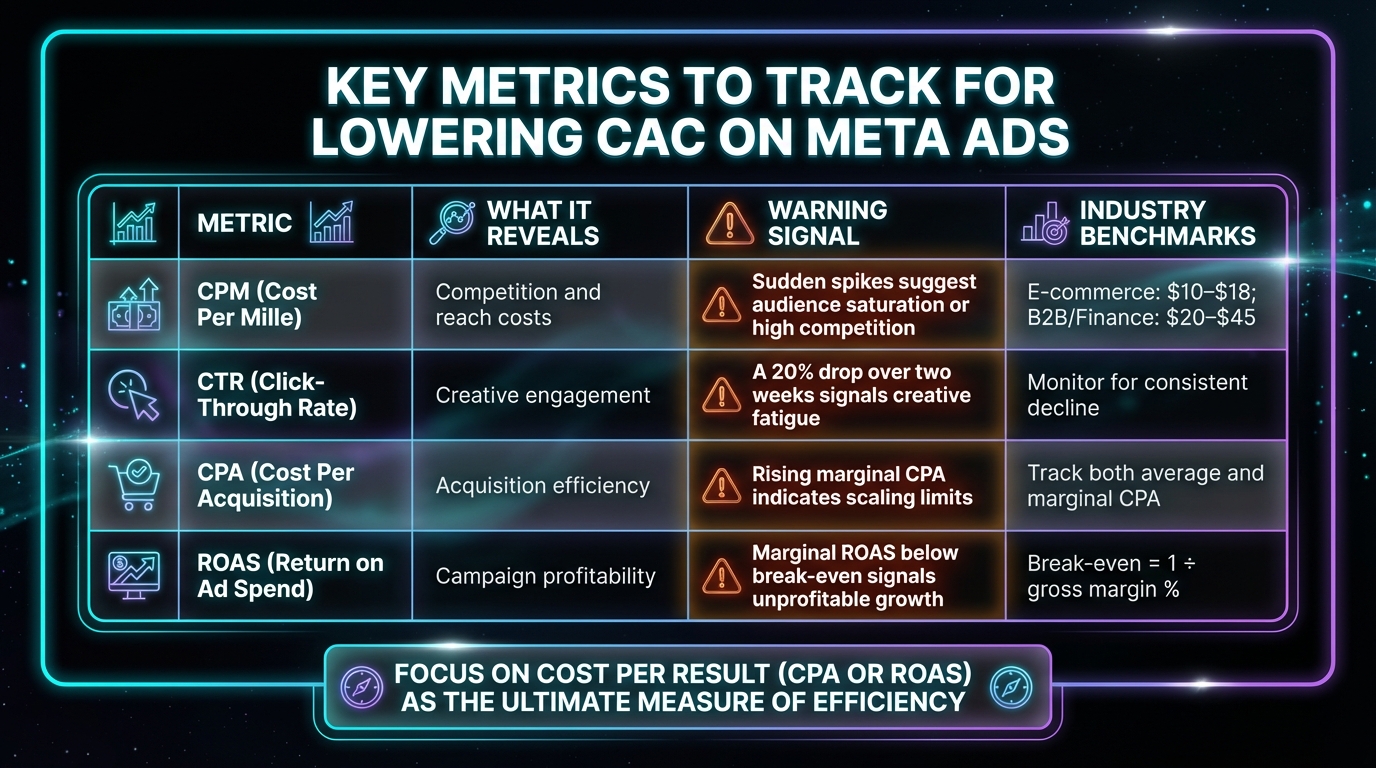
Meta Ads Key Metrics Tracking Guide: CPM, CTR, CPA, and ROAS Warning Signals
CAC, or Customer Acquisition Cost, is calculated by dividing your total Meta ad spend by the number of new customers acquired (e.g., $10,000/200 = $50). It’s a key metric for assessing the profitability of your campaigns. However, focusing solely on CAC can be shortsighted. Successful brands often emphasize Customer Lifetime Value (LTV) over simply keeping CAC low. As Adacted explains:
"LTV is your secret weapon. The brands that win on Meta long-term aren't the ones with the best first-order ROAS. They're the ones with the best customer lifetime value."
Why does LTV matter? A higher LTV means you can afford to spend more on acquiring customers, which gives you an edge in Meta's competitive auction environment.
Why CAC Goes Up When You Scale
Scaling your Meta ad campaigns isn’t as simple as increasing your budget and expecting proportional results. Three main factors contribute to rising CAC as you scale: audience saturation, creative fatigue, and auction competition.
- Audience Saturation: Initially, Meta targets your ads to high-intent users - those most likely to convert. But as you scale, this audience gets exhausted, and your ads are shown to less qualified users. This leads to higher costs for fewer conversions.
- Creative Fatigue: As users see your ads repeatedly, engagement drops. A frequency above 3.0 for prospecting campaigns often signals fatigue, prompting Meta’s algorithm to increase costs.
- Auction Competition: Meta’s ad system operates like an auction. Scaling means bidding more aggressively for the same high-value users, especially during peak times like Black Friday, when costs can jump by 50–150%.
Metrics to Track for Lowering CAC
Keeping CAC in check requires monitoring the right metrics. The four most important ones are CPM, CTR, CPA, and ROAS. Each offers clues about potential issues and areas for improvement.
- CPM (Cost Per Mille): This is the cost for 1,000 impressions. CPM varies by industry (e.g., $10–$18 for e-commerce, $20–$45 for B2B/finance). Sudden spikes might indicate audience saturation or increased competition.
- CTR (Click-Through Rate): This shows how well your ads resonate with your audience. A 20% drop in CTR over two weeks often signals creative fatigue. Lower CTR makes your ads appear less relevant to Meta’s algorithm, driving up costs.
- CPA (Cost Per Acquisition): This reflects the direct cost of acquiring a customer. Monitoring marginal CPA - the cost of acquiring each additional customer as you increase your budget - can help identify when scaling starts delivering diminishing returns.
- ROAS (Return on Ad Spend): This metric measures how much revenue you generate for every dollar spent. Like CPA, you should track both average and marginal ROAS. If marginal ROAS falls below break-even (calculated as 1 divided by your gross margin percentage), it signals unprofitable spending.
As Benly.ai puts it:
"Rather than chasing the lowest CPM, focus on your cost per result (CPA or ROAS) as the ultimate measure of efficiency."
| Metric | What It Reveals | Warning Signal |
|---|---|---|
| CPM | Competition and reach costs | Sudden spikes suggest audience saturation or high competition |
| CTR | Creative engagement | A 20% drop over two weeks signals creative fatigue |
| CPA | Acquisition efficiency | Rising marginal CPA indicates scaling limits |
| ROAS | Campaign profitability | Marginal ROAS below break-even signals unprofitable growth |
Understanding these metrics allows you to pinpoint inefficiencies and adjust your ad creatives and campaign strategies to maintain profitability as you scale.
Using ADEN's LAB to Generate Ads That Lower CAC
In scalable Meta ad campaigns, keeping CAC (Customer Acquisition Cost) low hinges on quickly producing a variety of ad creatives. The biggest obstacle? Slow creative production. Many brands struggle to churn out enough ad variations to test and find winners efficiently. That’s where ADEN's LAB steps in, using AI to generate optimized Meta ads in minutes - saving both time and money compared to traditional design methods.
How ADEN's LAB Reduces CAC Through AI Ad Creation
ADEN's LAB is an AI-driven tool designed to create static ads tailored for Meta's algorithm. All it needs is your product URL, and in just minutes, it generates ready-to-use Facebook and Instagram ads optimized for conversions. The real game-changer is the speed and scale it offers: instead of waiting 4–48 hours for a designer, ADEN's LAB can produce dozens of ad variations in mere minutes.
This speed translates directly into lower CAC. For example, the Apex Mode plan costs just $0.90 per ad, allowing you to generate 200 ads per month for $179. Compare that to freelance designers who typically charge $50 to $500 per ad [8,12]. In one standout case study, an e-commerce brand created 200 static ad variants in just one hour for $180. Testing revealed five winning ads, which led to a 35% drop in CAC (from $18 to $12) and doubled ROAS (Return on Ad Spend). With these results, the brand was able to scale its daily ad spend from $10,000 to $50,000 without compromising performance [8,9].
ADEN's LAB’s AI is trained to align with Meta's algorithm, incorporating features like high-contrast visuals, concise text overlays, and audience-specific imagery. These elements are designed to improve engagement metrics like click-through rates and relevance scores. Case studies suggest that this approach can cut CAC by 20–40% by enabling high-volume testing and faster iteration cycles [8,11]. This efficiency helps brands scale their budgets without losing control over CAC.
Static Ads vs. Designer-Made Creatives: A Comparison
When it comes to scalability and cost-effectiveness, AI-generated ads from ADEN's LAB have a clear edge over traditional designer-made creatives. While custom designs may offer artistic flair, they come with higher costs and slower turnaround times. Here’s a side-by-side comparison:
| Metric | ADEN's LAB AI Ads | Designer-Made Creatives |
|---|---|---|
| Cost per Ad | $0.90 | $50–$500 |
| Production Time | 1–5 minutes | 4–48 hours |
| Scalability | Unlimited batches; 100+ variants per day | Limited by designer capacity |
| Optimization | Trained on Meta's algorithm | Manual, subjective adjustments |
| CAC Impact | 20–40% reduction via high-volume testing | Variable, slower iteration |
The numbers speak for themselves. With ADEN's LAB, you can produce 10 times more ad variations for 80–90% less than hiring traditional designers [8,12]. This means more opportunities to test and identify high-performing ads before your budget is exhausted. The ability to launch new creatives quickly also minimizes delays and ensures you’re not stuck spending on underperforming ads.
This combination of speed, cost savings, and scalability doesn’t just lower CAC - it builds the foundation for high-volume testing strategies, which we’ll dive into next. By streamlining creative production, ADEN's LAB gives brands the tools to stay competitive in an ever-changing ad landscape.
How to Test Hundreds of Creatives to Find Winners
Testing a large number of creatives is a critical strategy for keeping CAC low on Meta. To truly identify the ads that perform best, you might need to test as many as 300 creatives to uncover 100 that can handle significant ad spend efficiently. Most creatives won’t deliver the desired results, so the challenge is to quickly pinpoint the winning ones before your budget is drained by underperformers. Below is a step-by-step process to help you manage this high-volume testing effectively.
Many brands struggle to produce enough creatives for proper testing. Launching just 5–10 ads a month and waiting weeks for results is a slow process that often keeps CAC high. On the other hand, brands spending over $100,000 monthly are launching 25 or more new ads every week. This constant flow of fresh creatives ensures there’s always a pipeline of winners ready to replace ads that have run their course.
ADEN's LAB is a tool that simplifies this process by generating ads in minutes rather than days, with costs as low as $0.90 per ad through the Apex Mode plan. This allows for aggressive testing without overspending on production. The quicker you test, the faster you can find top-performing creatives and scale efficiently while maintaining low CAC.
Step-by-Step Guide to Testing Ads at Scale
Using ADEN's LAB, you can execute a streamlined and cost-effective testing process, which is the foundation of a responsive and agile ad strategy. For instance, a structured three-week testing cycle helped identify high-performing ads that significantly reduced CAC.
"The core hypothesis was simple: More ad creatives = more data = faster insights."
– Nathan Hudson, Growth Expert, Perceptycs
Here’s a breakdown of how to replicate this approach:
- Week 1: Launch 50–70 ad variations that explore different angles, value propositions, and visual styles. Experiment with headlines, product images, benefit highlights, and urgency triggers. Assign small budgets (around $2–$5 per ad) to gather initial data.
- Week 2: Identify the top 3–5 performers by analyzing key metrics like CAC and ROAS, then create 20–30 refined variations. For example, if an ad featuring "free shipping" resonates, test it with alternate product visuals or adjusted copy.
- Week 3: Scale up by launching 15–20 more ads that incorporate the elements from your winners. Increase budgets strategically to maximize performance.
Keep conversion thresholds in mind. Meta’s algorithm typically requires at least 50 conversions per week for an ad set to exit the learning phase and optimize properly. Focus your budget on variations showing early promise to hit this threshold faster.
Speed is key to maintaining a high testing velocity. The turnaround time from concept to live ad should be measured in days, not weeks. With ADEN's LAB, you can create and launch new ads within minutes, ensuring you stay agile and competitive.
Preventing Creative Fatigue with Regular Ad Refreshes
Testing alone isn’t enough - you need to refresh your creatives regularly to maintain strong performance. Even the best ads lose their effectiveness over time. As you scale spending, Meta will show your ads to broader audiences, which can lead to higher CAC. Most ads burn out within a few weeks, so having a system to replace them is crucial.
Monitor your ad frequency closely. If it climbs above 4, it’s a sign that your audience is seeing the same ad too often, which can cause click-through rates to drop and costs to rise. When this happens, refresh your creatives immediately.
To stay ahead of fatigue, use the "Ads Launched Per Mille" (ALM) metric. For every $1,000 spent on ads, aim to launch about 0.25 new creatives. For example, if your monthly spend is $20,000, you should be introducing around 5 new ads each week.
ADEN's LAB makes it easy to sustain this pace. Instead of waiting on designers or agencies, you can generate 10–20 new ad variations in under an hour whenever performance starts to dip. This helps you keep your campaigns fresh and prevents the performance declines that occur when ads run for too long.
"If you ramp spend faster than you can ramp creative volume, you'll blow up your CAC and have to pull back anyway."
– Tom, Author, Marketing is Hard!
Winning on Meta isn’t about having one standout ad - it’s about consistently producing a steady flow of high-performing creatives. ADEN's LAB gives you the ability to do just that, keeping your campaigns efficient and competitive.
Campaign Settings That Lower CAC While Scaling
Getting your campaign settings right is just as important as having great creatives. The way you approach targeting and bidding can make or break your ability to scale profitably without letting your customer acquisition cost (CAC) spiral out of control. While Meta's AI in 2026 does most of the heavy lifting, setting it up correctly is still on you.
Audience Targeting: Lookalikes, Broad Targeting, and CAPI
Broad targeting has become a go-to strategy because Meta’s algorithm uses your creative as its main signal. It analyzes who engages with your visuals and messaging and then finds similar people likely to convert. This approach works best for advertisers with a solid history of conversions.
For more precision, Lookalike Audiences are your best friend. Instead of uploading every customer, focus on your top 20% - the big spenders or repeat buyers. If you include a "value" column (like total spend), Meta can prioritize matching with high-value prospects. Start with a 1% Lookalike for tight targeting and low CAC. Only expand to 3–5% when your 1% audience is fully tapped out.
Bigger is better when it comes to ad sets. Advertisers who consolidated multiple small ad sets into fewer, larger ones saw a 32% drop in CAC. Each ad set needs enough budget to generate 50–100 conversions weekly, allowing Meta’s algorithm to exit the learning phase and stabilize costs. If you’re running too many ad sets, your budget gets stretched too thin, and the AI can’t gather enough data to optimize effectively.
Another must-have in 2026 is Meta’s Conversions API (CAPI). CAPI sends conversion data directly from your server to Meta, bypassing issues like ad blockers and iOS privacy restrictions that can cause browser-based tracking to miss over half of actual conversions. This ensures Meta’s AI gets clean, accurate data for optimization. Aim for an Event Match Quality score of 8.0 or higher by sending hashed email, phone number, and browser IDs with each conversion event. Once your targeting is dialed in, the next step is managing your spend with smart bidding strategies.
Bidding Strategies for Cost Control and Scale
Cost Cap bidding is a great way to control spending while scaling. It tells Meta to aim for an average cost per result. For example, if you set a $25 cost cap, the algorithm will allocate your budget only to opportunities that maintain that average. To give the algorithm some breathing room, start with a cost cap that’s 10–20% higher than your current average CPA.
If you’re running an e-commerce store with products at different price points, ROAS Target bidding might be a better fit. This approach focuses on return on ad spend (ROAS) instead of cost-per-conversion. It prioritizes showing ads to people likely to make higher-value purchases. For example, brands using Advantage+ Shopping Campaigns with ROAS targeting have reported a 12% lower CPA and a 15% higher ROAS compared to manual campaigns.
Automated rules can help you protect your budget and scale effectively. Use a layered approach:
- First, set budget protection rules (spend caps).
- Next, apply performance kill rules to pause ad sets if CPA exceeds twice your target for three straight days.
- Finally, add scaling rules to increase the budget by 15% when ROAS hits 3.0 and spend is above $100.
When you’re scaling vertically, raise budgets gradually - no more than 20% every 3–4 days - to avoid resetting Meta’s learning phase.
"AI handles 90% of the heavy lifting, but the remaining 10% of human intervention is what separates a profitable campaign from a wasted budget."
– Stormy AI
To keep CAC low while scaling, focus on giving Meta’s AI the right signals through CAPI, build quality Lookalike Audiences, and use bidding strategies that balance cost control with growth. Pair these settings with high-volume creative testing, and you’ll have a solid framework for scaling efficiently.
Conclusion
Reducing CAC on Meta ads boils down to three main strategies. First, focus on producing a steady stream of high-performing creatives by automating Meta ad production. Tools like ADEN's LAB can help you quickly identify winning ads by generating a large volume of options. Second, rely on data-driven campaign settings - use quality Lookalike Audiences based on your best customers, leverage Conversion API (CAPI) to feed clean data into Meta's algorithm, and apply smart bidding strategies to manage costs effectively. Third, adopt a consistent testing process to combat creative fatigue by refreshing ads regularly and keeping a close eye on performance.
These steps not only lower CAC but also set the stage for long-term campaign growth. Success on Meta depends on fresh creatives, precise audience segmentation, and strategic bidding - all working together to elevate results.
Keep an eye on metrics like CAC, ROAS, conversion rate, and CTR every month to understand what’s working and where improvements are needed. Set specific goals, such as cutting CAC by 15% within 90 days or increasing conversions by 20%, to track progress and ensure you're hitting your targets.
One of the biggest hurdles for advertisers is the creative bottleneck. ADEN's LAB offers a solution by producing up to 200 static Meta ads per month at just $0.90 per ad. This approach eliminates the delays and high costs of traditional design workflows, giving you the volume you need to stay ahead of creative fatigue and scale your campaigns profitably.
FAQs
What’s a good CAC target for my business on Meta?
A solid Customer Acquisition Cost (CAC) target on Meta usually ranges between $20.47 and $39.03, though this can shift depending on your industry. To make the most of your efforts, ensure your target aligns with your business objectives and the standard benchmarks for your sector.
How do I know when scaling is raising marginal CPA too much?
Tracking key metrics like ROAS (Return on Ad Spend) and CPA (Cost Per Acquisition) can reveal when scaling starts to hurt your profitability. If increasing your budget leads to a steep decline in ROAS and a noticeable spike in CPA, it’s a sign of diminishing returns. For instance, if tripling your ad spend results in your ROAS dropping by half and your CPA doubling, it might mean further scaling isn't worth the cost.
How many conversions do I need before judging a new creative?
When testing a new creative, it's best to evaluate its performance after it generates approximately 50 conversions per week. This threshold provides a sufficient amount of data to make a reliable assessment of how well the creative is performing and whether it resonates with your audience. By waiting for this sample size, you can avoid making decisions based on incomplete or misleading data.
Your next ad batch starts here
Finish with a ready-to-test ad batch
Paste your website to generate static creatives. Drop the link → get ads in about 90 seconds → upload them to Meta → scale.
Free to try No prompt writing