How to Build a High LTV Offer That Lets You Outbid Everyone on Meta
Turn the strategy into creatives
Create Meta ads for your product
Paste your product page. ADEN'S LAB turns the offer, audience, and positioning into complete ready-to-use Meta static ads.
Free to try No prompt writing

Meta ads are all about one thing: the highest bidder wins. To consistently outbid competitors, you need to focus on Lifetime Value (LTV) - the total profit a customer generates over their relationship with your business. Here’s the formula for success:
-
Understand Your LTV: Calculate it using this formula:
Average Order Value (AOV) × Purchase Frequency × Customer Lifespan.
For example, if your AOV is $50, customers buy 3 times a year, and they stay for 2 years, their LTV is $300. - Spend More to Acquire High-LTV Customers: If your competitors only focus on first-purchase revenue, they’ll limit their bids. But if you know your LTV, you can afford higher acquisition costs and win more auctions.
- Boost AOV Fast: Use product bundles or tiered offers to increase AOV without cutting margins. For example, a skincare brand offering a “Clear Skin Routine” bundle saw a 55% jump in AOV.
- Retention Equals Higher LTV: Use email/SMS campaigns and subscription models to drive repeat purchases. Retaining customers is far cheaper than acquiring new ones and ensures long-term profitability.
- Keep Ads Fresh: High-LTV strategies demand higher ad spend, which leads to ad fatigue. Regularly update your ad library to maintain performance. Tools like Aden’s Lab can generate ready-to-use ads in minutes, saving time and costs.
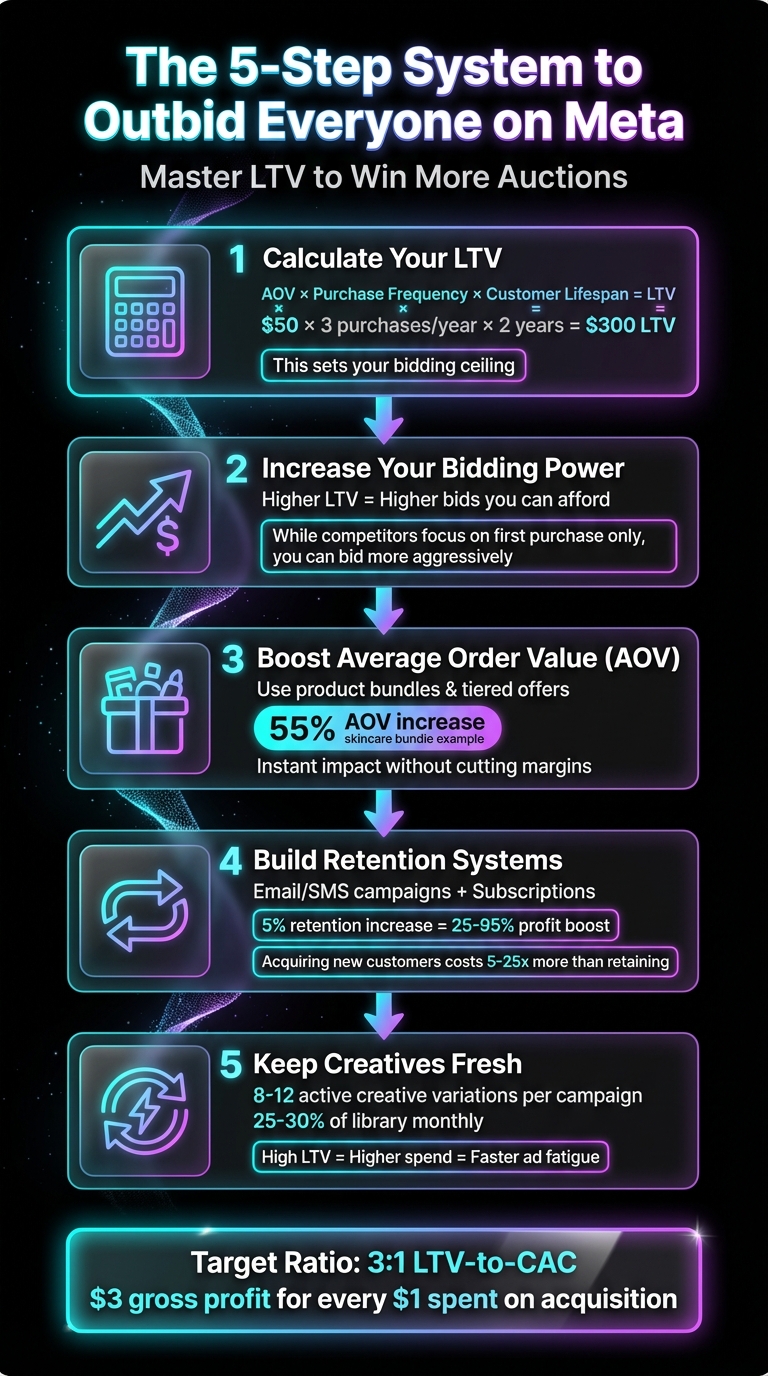
5-Step System to Build High LTV Offers and Outbid Competitors on Meta Ads
ULTIMATE GUIDE To Increase Your Lifetime Value Per Customer In 2025
Put the playbook to work
Apply this playbook to your page
Paste your website and the Lab will turn the strategy you are reading into a ready-to-test ads.
Free to try No prompt writing
What LTV Actually Means and Why It Controls Your Meta Spend
Let’s dig into what LTV (Lifetime Value) really means and how it directly impacts your Meta ad strategy.
LTV represents the total net profit you earn from a customer over the entire duration of their relationship with your business. It’s not just about that first purchase - it’s about every transaction they make with you. For example, a customer might start with a $40 purchase, but if they return multiple times, their LTV could grow to $200 (after factoring in costs).
This number is critical because it sets the upper limit on what you can afford to spend to acquire a customer. If your LTV is $200 and your profit margin is 50%, you’re left with $100 in net profit per customer. That $100 becomes your ceiling for acquisition costs, allowing you to bid strategically, even in competitive Meta ad auctions.
"Customer lifetime value is the single most important metric in e-commerce. It determines how much you can afford to spend on acquisition... and whether your business model is fundamentally sustainable." - andrebrov, Finsi.ai
Failing to understand LTV can lead to costly mistakes. For instance, you might see a $50 acquisition cost on a $40 first purchase and decide the campaign isn’t profitable, but you can analyze and optimize your CPA to see the full picture. But if that customer’s repeat purchases eventually bring their LTV to $150 or more, you’ve just shut down a campaign that could have been highly profitable. This is what I call margin misdiagnosis - a mistake that can kill long-term growth.
A higher LTV gives you the flexibility to bid more aggressively, leading to more auction wins. Since Meta’s algorithm rewards advertisers who can pay the most per result, not knowing your true LTV leaves you at a disadvantage.
How to Calculate Your Actual LTV for Meta Campaigns
The formula for LTV is straightforward:
Average Order Value (AOV) × Purchase Frequency × Customer Lifespan.
Let’s break it down with an example:
- If your AOV is $50,
- Customers buy three times a year,
- And they stay active for two years,
Your total revenue per customer is $300.
But here’s the catch - revenue isn’t profit. You need to subtract your costs to get to the net profit, which is the real LTV you should use to guide your bidding strategy.
Many advertisers make the mistake of ignoring repeat purchases, focusing only on the first order because it’s easy to track in short attribution windows. This leaves money on the table and skews your margins. Another common error is using gross revenue instead of net profit, which can inflate your LTV and lead to overbidding. To avoid these pitfalls, revisit your LTV calculations at least once per quarter. For Meta campaigns, segmenting your LTV into tiers - like high, medium, and low - can help you build value-based Lookalike Audiences that target potential high-value customers.
Once you’ve calculated an accurate LTV, you’ll see why ignoring it is risky.
What Happens When You Ignore LTV in Your Meta Campaigns
Scaling ad spend without factoring in LTV is like flying blind. Imagine you’re spending $10,000 a month with a cost per acquisition (CPA) of $30. As you scale, competition heats up, and your CPA jumps to $50. If you’re only looking at first-purchase revenue, you might panic and cut your spend. But what if your customers’ LTV is $180? Competitors who understand their LTV will keep scaling confidently while you miss out.
Ignoring LTV also means optimizing for the wrong audience. Meta’s algorithm learns from the data you feed it. If you focus only on low-cost acquisitions, the system will prioritize cheap, low-intent buyers who rarely return. On the other hand, incorporating predicted LTV into your strategy pushes Meta to find users with higher long-term value.
Take this example: In 2025, a skincare brand spent $100,000 monthly on Meta ads, with an average acquisition cost of $45. Their first-order value was $62, leaving an initial profit of just $17 per customer. However, an LTV analysis revealed that some customers had a three-year LTV exceeding $400, while others never reordered. By identifying high-LTV customers early - within 30 to 60 days - they adjusted their bids to focus on loyal, repeat buyers, cutting wasteful spend on one-time customers.
"The number one cause of failing or giving up on Facebook Ads is audience-related... Customer lifetime value literally guides every decision you make in business." - Neil Patel, Co-Founder, NP Digital
Ignoring LTV doesn’t just limit your ability to scale - it can make your business unsustainable. Between 2020 and 2024, Meta’s ad revenue doubled from $84 billion to $164 billion, even though its U.S. user base grew by just 6.4%. This drove up CPMs (cost per thousand impressions), forcing brands to rethink their ad economics. If you focus only on cheap clicks and ignore returning customers, you’ll end up paying what I call the "novice tax."
After managing over $100M in Meta ad spend, I’ve seen how recognizing LTV early can transform your bidding strategy. It’s the difference between constantly battling rising costs and scaling with confidence.
How Increasing Average Order Value Raises Your LTV Fast
Increasing your Average Order Value (AOV) can have an immediate and dramatic impact on your Lifetime Value (LTV), especially when running campaigns on Meta. While retention strategies take time to show results, boosting AOV delivers instant benefits - often within just a week.
Here’s why this matters: a higher AOV directly increases how much you can afford to spend on customer acquisition. For instance, if your AOV jumps from $50 to $75, you gain 50% more flexibility to bid aggressively in Meta's auction system. Considering that customer acquisition costs on digital platforms rose by 60% between 2023 and 2025, brands that didn’t adjust their AOV often found themselves unable to compete. On the other hand, brands that improved their AOV continued to scale successfully.
Higher AOV also reduces the percentage of your revenue consumed by fixed costs, like packaging, fulfillment, and transaction fees. For example, on a $50 sale, these costs might eat up 15%, but on a $75 sale, they could drop to just 10%. This difference adds up quickly, especially if you're spending thousands daily on Meta ads.
"AOV isn't just a metric - it's a revenue engine that drives sustainable, scalable ecommerce growth." - Kard
While retention strategies build long-term stability, increasing AOV enhances cash flow and bidding power right away - key factors for scaling quickly. One proven way to boost AOV without compromising margins is through strategic product bundling.
Using Product Bundles to Increase AOV Without Cutting Prices
Product bundling is a simple yet effective way to raise AOV while maintaining your margins. Instead of discounting individual products, you group complementary items together and present them as a comprehensive solution. This shifts the customer’s focus from the price of each item to the overall value of the bundle.
For example, a skincare brand could offer a "Clear Skin Routine" bundle that includes a cleanser, toner, and moisturizer. Customers perceive this as a complete solution, making the bundle an obvious choice. Research shows that bundling can increase AOV by 55% and revenue per user by 86%. Importantly, these gains don’t come from discounts - they come from reframing the offer.
In 2024, Greater Than, a hydration brand, introduced "mom hydration kits", which bundled electrolyte drinks with wellness guides for pregnant and postpartum women. This targeted approach, based on customer data, led to a 20% increase in AOV. The success came from addressing a specific need with a well-thought-out bundle.
Similarly, WHO IS ELIJAH, a fragrance brand, used tiered gift-with-purchase offers during Black Friday Cyber Monday 2024. Customers who spent beyond certain thresholds unlocked better rewards, resulting in a 46% boost in AOV. The strategy worked because the spend thresholds were set just above the typical AOV, encouraging shoppers to add more to their carts.
When creating bundles, name them based on the benefit they deliver, not the products they include. For instance, "Dullness & Dryness Solution" is more compelling than "Serum + Cream Bundle" because it highlights the outcome for the customer. On your landing pages, lead with the benefit, then showcase the products. And don’t hesitate to price bundles higher than the sum of their parts. For example, Soxy.com priced their bundles above the combined cost of individual items and still saw a 358% increase in AOV because customers valued the convenience.
Single Product vs. Bundle: Performance Metrics Compared
Bundling doesn’t just enhance perceived value - it also delivers measurable improvements across key performance indicators. Here’s how single-product sales compare to bundle-focused strategies:
| Metric | Single Product | Bundle Focus |
|---|---|---|
| Average Order Value | Lower (base price of 1 SKU) | 15% to 55% higher |
| CAC Tolerance | Low; limited by thin margins | High; allows for higher bids |
| ROAS Threshold | Requires high efficiency to stay profitable | More forgiving due to higher revenue per conversion |
| Scale Potential | Limited by rising ad costs | High; supports aggressive scaling |
| Fixed Cost Impact | High % of revenue per order | Lower % of revenue per order |
The most striking difference lies in CAC tolerance. Let’s say you’re selling a $40 product with a 50% margin, giving you $20 to work with. If your cost per acquisition (CPA) on Meta is $18, you’re barely breaking even. But if you bundle that $40 product with two others and sell it for $90, your margin jumps to $45. Now, you can afford a $35 CPA and still turn a profit. This extra flexibility allows you to win more auctions and scale faster than competitors selling single products.
Bundles also provide Meta’s algorithm with stronger signals. By optimizing for higher-value purchases using custom conversion events, you help the system identify users who are willing to spend more upfront. Over time, this improves the quality of your traffic, making it easier to scale profitably.
How Retention Extends LTV and Lets You Bid Higher
Retention doesn’t just improve lifetime value (LTV) - it gives you the freedom to bid more aggressively on platforms like Meta. While boosting average order value (AOV) offers immediate leverage, retention provides a long-term advantage. When you know customers will return, you can afford to spend more upfront, even if the first purchase barely breaks even.
Too often, advertisers focus only on the initial sale. They see slim margins and high acquisition costs and assume the campaign isn’t working. But those repeat purchases? They can turn a barely profitable first sale into a lasting, lucrative relationship. Without a retention strategy, you’re stuck in a cycle of constantly chasing new customers - at ever-increasing costs.
Here’s why retention matters: improving customer retention rates by just 5% can increase profits by 25% to 95%. On top of that, acquiring a new customer can cost 5 to 25 times more than retaining one. Every repeat purchase strengthens your bottom line.
When retention is built into your strategy, you gain clarity and confidence. You’re not guessing whether a customer will be profitable - you know their long-term value. This insight allows you to bid higher on Meta without stressing over short-term cost-per-acquisition fluctuations. For example, Boxycharm leveraged LTV predictions through Meta’s Conversion API and saw an 81% increase in predicted retention and a 30% higher return on ad spend over 12 months.
Shifting your focus from short-term wins to long-term value is the foundation of a strong retention strategy.
Email and SMS Campaigns That Drive Repeat Purchases
One of the quickest ways to improve retention is through automated email and SMS campaigns. These tools work behind the scenes to bring customers back, delivering a high return on investment. The secret? Use behavioral triggers that respond to customer actions - not generic messages.
- Replenishment reminders: For consumable products like skincare, supplements, or coffee, send an automated message when customers are likely running low. A well-timed email or SMS can significantly increase reorders.
- Browse abandonment sequences: If someone views a product but doesn’t add it to their cart, follow up within 24 hours with an email. Include social proof and highlight the product’s key benefits to gently guide them back - no discounts needed.
- Post-purchase education: After a customer makes a purchase, send helpful content like how-to videos, care tips, or setup instructions. This reduces returns and keeps your brand top of mind for future buys.
- Milestone celebrations: Recognize birthdays, anniversaries, or even a “1-year with us” moment. Pairing these messages with small perks, like free shipping, builds emotional connections without relying on constant discounts.
These automated campaigns are just the start. For even stronger retention, consider offering subscription options.
How Subscription Models Multiply LTV
Subscriptions are one of the most effective ways to boost LTV. Like email and SMS strategies, they reinforce retention and give you the confidence to spend more on acquiring new customers. Subscriptions create predictable, recurring revenue, making it easier to justify higher upfront costs. Over time, monthly fees add up, significantly increasing customer value.
Subscriptions work best for products with ongoing demand - think supplements, beauty items, pet food, or meal kits. The key is to position subscriptions as a convenient solution, not a rigid commitment.
To reduce churn, offer flexibility. Allow customers to skip, pause, or reschedule deliveries. This sense of control makes them more likely to stick around.
Another tactic? Introduce tiered rewards based on subscription longevity. For instance, after a few months, subscribers could unlock perks like free shipping or early access to new products. This sense of progression encourages loyalty and reduces cancellations.
Predictive churn scoring can also help. By analyzing engagement and delivery patterns, you can identify at-risk subscribers and intervene with personalized offers or reminders to adjust their plans before they cancel.
Why High-LTV Offers Need Fast Creative Production
Creating a high-LTV offer - whether it’s through bundles, subscriptions, or retention strategies - is just one part of the equation. The other, equally important part, is producing enough creatives to scale effectively on Meta. A strong LTV strategy might help you outbid competitors, but without a steady flow of fresh creatives, that edge can disappear quickly. Many advertisers do the hard work of boosting average order value and building retention systems, only to find their creative production can’t keep up with their spending potential. That’s why scaling creative output is just as important as crafting a high-LTV offer.
High-LTV offers allow for more aggressive bidding, which means higher daily ad spend. But with increased spending comes higher ad frequency, leading to creative fatigue. For example, if you’re spending $5,000 or $10,000 a day instead of $500, your ads will be shown to the same audience more often. As Admetrics explains, "The algorithm gets bored, and so do your audiences". What worked last week may stop working - not because your offer has changed, but because your audience has seen the same ad too many times.
By 2026, Admetrics predicts that "your creative is now your targeting". A limited set of creatives hampers the algorithm's ability to discover new high-value users, driving up CPMs. This is often referred to as the "monotony tax." High-performing accounts typically run at least 8–12 active creative variations per campaign and refresh about 25–30% of their creative library each month. Without a steady stream of fresh creatives, even the best high-LTV offers will hit a ceiling. Worse, ignoring creative scaling can cause your CPA to skyrocket by 200% in just weeks. Success on Meta doesn’t just come from having the best offers - it comes from producing and testing creatives faster than the competition.
How Creative Speed Gives You a Bidding Advantage
Fast creative production isn’t just about avoiding fatigue - it’s about keeping the algorithm confident, which helps maintain low costs and broad reach. Regularly feeding Meta’s algorithm with new creatives - featuring varied formats, messaging, and visuals - provides the diverse data it needs to target more high-value users effectively.
Different creative formats unlock different inventory pools. For example, a static image might perform well in the Feed, but without a Reels-optimized creative, you’ll miss out on that placement entirely. As Admetrics notes, "You can no longer win with the same three ads you used in 2024. The algorithm demands constant feeding". Covering all placements - Reels, Stories, Feed - and using a mix of formats like static images, videos, and carousels ensures you’re tapping into the full scope of Meta’s inventory.
Speed also allows you to address performance dips before they become major problems. For instance, when ad frequency hits 4.0 or click-through rates drop by more than 20% over two weeks, having fresh creatives ready to deploy can save your campaign. A reserve of proven creatives ensures you can replace underperforming ads immediately, keeping campaigns profitable without interruption.
Over time, faster creative testing compounds your success. The quicker you test and refine variations, the sooner you’ll discover winning concepts that let you outbid competitors. By consistently introducing fresh angles, you’ll keep the algorithm on your side. To achieve this, automating creative production is key.
How Aden's Lab Removes Creative Production Delays
While speed is critical, executing consistently can be a major challenge. That’s where Aden's Lab comes in. One of the biggest hurdles in scaling high-LTV offers on Meta isn’t budget or strategy - it’s the time it takes to produce new creatives. Traditional workflows - briefing designers, waiting for revisions, and managing feedback loops - are slow and expensive. With each ad costing $30–$50 and taking days or weeks to finalize, this process can’t keep up when you need dozens of creatives every month.
Aden's Lab eliminates this bottleneck by generating effective static Meta ads directly from a single landing page link. No prompts, no instructions, no back-and-forth. Just drop in your landing page link, and in 90 seconds, you’ll have optimized static ads ready to go. This tool is built for scale, delivering the creative output that high-LTV campaigns demand.
With the Apex Mode plan, brands can produce 200 ads per month for $179 - breaking down to just $0.90 per ad. That’s a fraction of traditional design costs, and the turnaround time is measured in minutes, not days. This speed lets you test aggressively, replace fatigued ads immediately, and maintain the creative variety needed to keep CPMs low and ROAS high.
For high-LTV campaigns - whether built on bundles, subscriptions, or retention-based strategies - this speed advantage is a game-changer. By continuously fueling the algorithm with fresh creatives, Aden’s Lab ensures you can scale effectively and stay ahead of the competition. It removes creative bottlenecks entirely, so you can focus on what drives results: testing, iterating, and scaling.
Conclusion: The 3-Part System for Outbidding Everyone on Meta
Winning Meta auctions isn’t about chance or having the deepest pockets - it’s about mastering your numbers and scaling strategically. This three-part system makes it simple: know your actual LTV, boost it with higher average order value and retention, and keep your creatives fresh to sustain algorithm performance. Here’s how it works:
Start by calculating your LTV and aiming for a 3:1 LTV-to-CAC ratio - $3 in gross profit for every $1 spent on acquiring customers. This ratio gives you a clear picture of what you can afford to bid, helping you confidently outbid competitors who may only focus on short-term returns.
Next, work on increasing your LTV. Raise your average order value with strategies like product bundles, and build retention systems such as email campaigns or subscription models. These efforts improve your margins, allowing you to bid more aggressively in auctions.
Finally, focus on keeping your creative assets fresh. Even with a strong LTV, outdated creatives can lead to fatigue and rising CPAs. Top advertisers refresh 25–30% of their creatives regularly and run 8–12 active variations per campaign. This constant refresh keeps the algorithm working to find high-value users at scale. Balancing creative speed with customer value is essential - neglecting one will limit your growth. Tools like Aden’s Lab can simplify this process, generating optimized static Meta ads from a single link in just 90 seconds. On their Apex Mode plan, with ads costing as little as $0.90 each, you can produce up to 200 ads monthly, testing faster than competitors tied to slower workflows.
FAQs
What’s the best way to estimate net LTV if my data is messy?
If your data feels chaotic, shift your focus to cohort analysis. This involves grouping customers based on shared behaviors or how they were acquired. By working with averages across these larger groups, you can even out inconsistencies and monitor aggregated revenue trends over time. Steer clear of depending on overly specific or unreliable data points. Instead, stick to simplified, big-picture metrics and conduct regular data reviews. This approach can help you estimate net LTV with greater confidence, even when data quality isn't perfect.
How do I set a max CPA using LTV without overbidding?
To determine a maximum CPA without overbidding, align your bidding strategy with your customer lifetime value (LTV) and your desired profit margin. Implement a bid cap or cost cap strategy that reflects your LTV and target CPA. Begin with a cautious approach, monitor results closely, and make gradual adjustments - such as increasing bids by 20-30% every few days. This method ensures you don’t overbid while still giving Meta the flexibility to optimize your campaigns effectively.
When should I refresh creatives to avoid Meta ad fatigue?
To keep your Meta ads performing well, it’s important to update your creatives every 2–4 weeks. The exact timing depends on factors like your audience size and ad spend. Keep an eye on key metrics such as click-through rate (CTR), engagement, and cost per click (CPC) - a drop in these numbers usually means it’s time for a change.
On platforms like TikTok, you might need to refresh even more often, sometimes weekly, since ad fatigue sets in faster there. Regular updates to your creatives can help you maintain strong performance and avoid wasting your budget.
Your next ad batch starts here
Finish with a ready-to-test ad batch
Paste your website to generate static creatives. Drop the link → get ads in about 90 seconds → upload them to Meta → scale.
Free to try No prompt writing