How 7-Figure Shopify Stores Lift AOV Without Discounting
Built for your product category
Turn your product page into category-specific Meta ads
Paste your URL and generate angles, visuals, headlines, and copy grounded in the offer customers will actually see.
Free to try No prompt writing

Discounting isn’t the only way to grow revenue. Successful Shopify stores focus on increasing Average Order Value (AOV) to boost profits without cutting into margins. Here’s how they do it:
- Product Bundling: Offer curated sets of complementary products to simplify decisions and increase cart size.
- Cross-Sells & Upsells: Suggest premium versions or complementary items at key moments, like product pages or checkout.
- Free Shipping Thresholds: Encourage higher spending by setting minimum order amounts for free shipping.
- Post-Purchase Upsells: Present relevant add-ons after checkout for extra revenue with minimal effort.
These strategies help stores maximize revenue per customer while preserving profitability. The key is testing each tactic individually and tracking metrics like AOV, conversion rate, and profit per visitor to ensure success.
Keep reading for actionable steps to implement these tactics effectively.
How To Increase AOV on your Shopify Ecommerce Store (4 Advanced Strategies)

Put the playbook to work
Apply this playbook to your page
Paste your website and the Lab will turn the strategy you are reading into a ready-to-test ads.
Free to try No prompt writing
Product Bundling: The Easiest AOV Lift
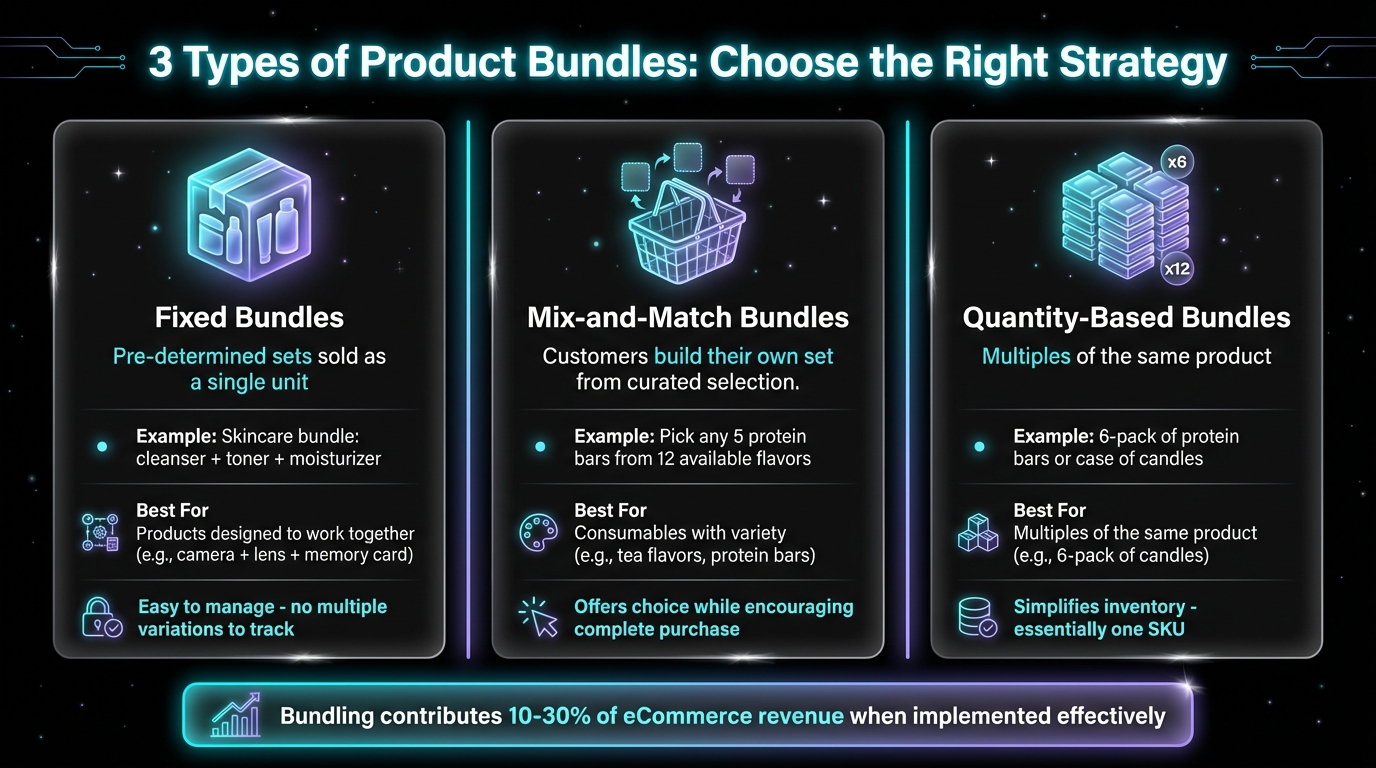
3 Types of Product Bundles for Shopify Stores Comparison Chart
Bundling takes the guesswork out of shopping by offering a pre-selected set of complementary products. Imagine a first-time yoga enthusiast buying a mat - they might hesitate over whether to add a strap, a block, or both. A bundle labeled "Everything You Need to Start" simplifies that decision by presenting a curated solution instead of a sea of choices.
Offering a 10%–20% discount on these curated bundles not only increases average order value (AOV) but also makes fulfillment more efficient. Processing one bundled order is far easier than handling several separate transactions. This strategy boosts revenue without significantly cutting into your margins. In fact, businesses that implement bundling effectively see it contribute 10% to 30% of their eCommerce revenue.
3 Types of Bundles and When to Use Each
Not all bundles are created equal. The type you choose should align with your product offerings and how your customers typically shop.
-
Fixed Bundles
These are pre-determined sets of items sold as a single unit. For example, a skincare bundle might include a cleanser, toner, and moisturizer. Fixed bundles work best when the products naturally complement each other, and they’re easy to manage because you don’t have to track multiple variations. -
Mix-and-Match Bundles
This approach gives customers the freedom to build their own set from a curated selection. For example, "Pick any 5 protein bars from 12 available flavors" offers choice while still encouraging a complete purchase. This works well for consumables like snacks, tea, or supplements where personal preference plays a big role. -
Quantity-Based Bundles
These bundles involve selling multiples of the same product, such as a 6-pack of protein bars or a case of candles. They’re ideal for high-usage items or wholesale buyers and simplify inventory management since you’re essentially dealing with one SKU.
Here’s a quick comparison:
| Bundle Type | Best For |
|---|---|
| Fixed Bundles | Products designed to work together (e.g., camera + lens + memory card) |
| Mix-and-Match | Consumables with variety (e.g., tea flavors, protein bars) |
| Quantity-Based | Multiples of the same product (e.g., 6-pack of candles) |
To create effective bundles, start by analyzing your order history. Look for patterns - if 40% of customers who buy a yoga mat also purchase a strap, that’s a strong indicator. Let data guide your bundling decisions instead of relying on guesswork.
Setting Up Bundles on Shopify
Once you’ve nailed down your bundling strategy, focus on a key technical detail: component-level inventory tracking. If one item in a bundle runs out of stock, the entire bundle should automatically become unavailable to prevent overselling.
To manage this, use composite variants that link the bundle SKU to the individual SKUs of its components. When someone buys the bundle, the system deducts stock from each component. If any item runs out, the bundle is marked as unavailable across all sales channels.
Here’s how to price your bundles effectively:
- Choose products that frequently sell together.
- Set a bundle price that offers a 10%–20% discount compared to buying the items separately. For instance, if a $30 product is bundled with two $15 items (totaling $60), a 10% discount would bring the price to $54. This not only increases AOV but also feels like a meaningful deal to the customer.
Before finalizing prices, calculate your price floor. Add up the cost of goods for all components, include any assembly or fulfillment costs, and divide by your minimum acceptable margin percentage. Most successful bundles maintain a margin that’s only 5 to 7 percentage points lower than your average product margin.
To maximize visibility, feature bundles prominently on product pages and in the shopping cart. To scale these promotions further, consider automating Meta ad production to showcase your top-performing bundles to new audiences. Add urgency with elements like "limited stock" banners or countdown timers to encourage quicker decisions.
Cross-Sells and Upsells: Getting Customers to Add More
Cross-sells and upsells are powerful tools for increasing order value by subtly steering customer choices. Upselling involves offering a premium version of the product a customer is considering, while cross-selling suggests complementary items that enhance the overall purchase. Upsells focus on raising the value of a single product, while cross-sells aim to increase the total number of items in the cart.
When executed well, cross-selling can boost sales by up to 20%. The secret lies in relevance. For example, a European bank that upsold mortgage customers to premium contracts saw their average margin rise by 10 basis points. Similarly, a health IT company introduced three pricing tiers and saw new customers spend 30% more on average. These results happen when the right offer is presented at the right time.
Shoppers already committed to buying are more likely to add complementary products if they enhance their original choice. One effective strategy is to anchor their decision by showing the premium option first, making mid-tier options appear more appealing. Interestingly, when presented with three choices, most people tend to pick the middle one.
Where to Show These Offers
Strategic placement of cross-sells and upsells can make or break their success.
- Product pages: Highlight premium versions or "Frequently Bought Together" bundles just below the "Add to Cart" button. This is a prime moment to suggest upgrades or add-ons.
- Cart drawers: Slide-out carts are perfect for cross-sells. For instance, suggest small add-ons like a phone case or screen protector. Including a free shipping progress bar here can also encourage additional purchases - many customers will add an item to reach the free shipping threshold.
- Checkout extensions: For Shopify Plus stores, checkout extensions allow you to display order bumps without disrupting the checkout flow. This keeps the process smooth and minimizes friction.
- Post-purchase upsells: These are offers shown immediately after checkout, before the "Thank You" page. With payment information already saved, customers can add to their order with a single click. Since the initial sale is secure, there’s no risk of cart abandonment.
A great example of timing comes from a store that reduced upsell touchpoints from five to two, which led to a 40% increase in acceptance rates. Fewer, well-placed offers tend to perform better than frequent interruptions.
Manual Curation vs. Automated Recommendations
While placement is crucial, tailoring the offers - whether manually or through automation - ensures they remain relevant.
If your catalog is small, with fewer than 50 products, manual curation works well. You can handpick logical pairings that make sense to your customers. However, for larger catalogs, like those in fashion or lifestyle brands with hundreds of SKUs, automated recommendations are indispensable. AI tools analyze browsing and purchase behavior to identify patterns that manual methods might miss. In fact, relevant suggestions convert 2.5 times better than random ones, making the investment in automation worthwhile.
"Upselling and cross-selling only work when they're rooted in timing and trust. Data and AI help reps know when the moment is right - but reps still need to earn the right to recommend." - Ryan Vaillancourt, VP of Sales, Revenue.io
One common mistake is using multiple apps for different touchpoints - one for the cart, another for post-purchase, and another for product pages. This fragmented approach can lead to "offer fatigue", where customers are bombarded with popups at every step. Instead, opt for a unified system that coordinates offers across all touchpoints and includes cooldown periods. This approach not only reduces friction but also aligns with the principles of bundling we’ve previously discussed.
Free Shipping Thresholds: The Quiet AOV Booster
Free shipping thresholds are an effective yet understated way to increase Average Order Value (AOV). They tap into a basic human preference: people would rather buy an extra $10 item than pay $7.99 for shipping. Why? Because the item feels like a gain, while the shipping fee feels like a loss. This simple psychology explains why customers often value a tangible product over paying for something intangible like shipping fees.
Consider this: 49.7% of online shoppers cite free shipping as their top reason for choosing where to shop. More than half will even add extra items to their cart just to qualify for it. On the flip side, 39% of cart abandonments happen because unexpected shipping costs appear during checkout. By setting a free shipping threshold, you not only encourage higher spending but also eliminate a major barrier to completing purchases.
There’s also a psychological factor at play called the goal gradient effect. When customers see something like "You're $12 away from free shipping", their brains kick into problem-solving mode. Closing that gap feels achievable, often requiring just one more item. The trick is to set a threshold that feels attainable without cutting too deeply into your margins.
Choosing the Right Minimum Order Amount
A good rule of thumb is the 30% rule: take your current AOV and set the free shipping threshold about 30% higher. For example, if your AOV is $65, aim for a threshold of $85. Using the median order value (instead of the average) can also help, as it avoids distortion caused by high-ticket items. This strategy typically creates a small gap that most customers can close with just one additional item.
Once you’ve calculated the threshold, round it to a clean number like $75, $85, or $100. Round numbers are easier for customers to remember and feel less arbitrary.
Here’s a quick guide:
| Current AOV | 30% Rule Threshold | Rounded Threshold | Expected AOV Lift |
|---|---|---|---|
| $45 | $58.50 | $60 | +15-25% |
| $65 | $84.50 | $85 | +15-25% |
| $85 | $110.50 | $110 | +10-20% |
| $120 | $156.00 | $150 | +10-15% |
To find the sweet spot, test different thresholds in small increments. For instance, if your current threshold is $75, try $85 for two weeks. Watch both AOV and conversion rates closely. If AOV rises but conversions drop too much, you’ve set the bar too high.
"The goal is to make free shipping feel attainable to the greatest number of customers, thereby increasing your overall revenues. Setting the threshold too high risks abandoned carts." - Aaron Zakowski, Digital Marketing Consultant
Brands like Allbirds ($75), Brooklinen ($100), and SKIMS ($75) showcase their thresholds prominently, using numbers tailored to their product margins and shipping costs. Your threshold should reflect your business’s unique economics.
Showing Progress Toward Free Shipping
Static messages like "Free shipping over $85" are helpful, but dynamic messaging is far more effective. For example, showing "You're $12 away from free shipping" makes the goal feel personal and achievable. This approach shifts the focus from "Do I want to spend more?" to "What can I add to get there?" It’s a natural fit with other AOV strategies, encouraging customers to finalize their purchase.
Adding a progress bar in the cart can make this even more engaging. As customers add items, the bar visually tracks how close they are to free shipping. It’s satisfying, clear, and aligns with the goal gradient effect. Since more than 80% of online shoppers are willing to meet a minimum threshold to avoid shipping costs, making their progress obvious can drive results.
"A customer with a $55 cart who sees 'Free shipping at $75' doesn't think 'that's $20 more.' They think 'I only need one more item.'" - Muhammed Tüfekyapan, Founder, Growth Suite
Some stores take it further with a triple stack: a free shipping threshold, a progress bar, and AI-powered product suggestions tailored to the exact amount needed to qualify. For example, if someone needs $18 more, show them products priced between $15 and $25. This eliminates guesswork and makes it easy for customers to close the gap.
One common mistake is hiding the free shipping message. Instead, make it highly visible - place it in the announcement bar, the cart drawer, and even on product pages. Kopari Beauty highlights a free gift at $60 in their cart messaging, using the same principle: clear, actionable incentives tied to specific spending goals. Visibility is key to making this strategy work effectively.
Post-Purchase Upsells: Revenue After Checkout
While most strategies focus on engaging customers during their shopping journey, post-purchase upsells tap into the potential revenue that remains after checkout.
Many stores stop interacting with customers the moment they complete their purchase. But here's the thing: the transaction doesn't have to be the end. Post-purchase upsells are offers presented immediately after a customer completes their order. At this point, the customer is still in a buying mindset, and their payment details are already saved - making it easy to accept an offer with just one click.
Research highlights that customers are up to 70% more likely to make another purchase right after completing one. They've already established trust with your brand, so a well-timed suggestion feels more like a helpful nudge than a pushy sales tactic.
Since you've already covered the customer acquisition cost, any revenue from these upsells goes straight to your bottom line with minimal extra expense. It’s a simple way to deepen the relationship while increasing profits.
What to Offer After Purchase
The best post-purchase upsells focus on items that are proven to sell well, have high margins, or consistently earn strong reviews. With 90% of consumers reading online reviews before buying, offering a highly-rated product is a safer bet than introducing something new or untested.
Relevance is crucial. If someone just bought a skincare cleanser, offering a complementary toner or moisturizer makes sense. Similarly, after a yoga mat purchase, suggesting resistance bands or a mat cleaner feels natural. Accessories with high margins work particularly well here because once the shipping costs for the initial order are covered, even small add-ons can significantly boost profits.
Tools That Simplify One-Click Upsells
Shopify and other platforms offer integrations that make post-purchase upsells seamless. These tools can display an upsell on the thank-you page or right after checkout, allowing customers to add items with a single click - no need to re-enter payment details or start a new transaction. Plus, they let you test different offers and tailor suggestions based on factors like cart value or purchase history, ensuring the upsells feel timely and relevant.
For example, in early 2026, Earth & Elements Jewellery, a sustainable lifestyle brand, teamed up with StoreLab to launch targeted Meta campaigns and growth strategies. These often include Meta ad exclusion strategies to ensure budget is spent on new prospects rather than existing customers who have already converted. Over just 90 days, their sales surged by 245%, their ROAS jumped from 3x to 7x, and total purchase value doubled to over £26,000. While this success wasn’t solely due to post-purchase upsells, it demonstrates how targeting customers already in a buying mindset can lead to impressive revenue growth.
Post-purchase upsells are a smart way to complement earlier strategies, helping to increase AOV without adding any extra customer acquisition costs.
Testing and Improving Your AOV Tactics
Every store operates differently - what works wonders for one might fall flat for another. To truly understand what drives your average order value (AOV), you need to test each tactic individually. While the strategies mentioned earlier can be effective, only through deliberate experimentation can you identify what resonates with your unique audience.
A common pitfall is trying to implement multiple tactics simultaneously without clear measurement. Instead, treat each change as a controlled experiment. Focus on one variable at a time, gather enough data to analyze the results, and then decide whether to stick with it, tweak it, or move on.
Before diving into these experiments, it’s crucial to know which metrics give you a clear picture of your store’s overall performance.
Numbers to Watch
While AOV is important, it’s not the only number that matters. The real game-changer is profit per visitor. For example, you might boost AOV with aggressive bundling or free shipping offers, but if those strategies eat into your margins, they could leave you losing money on every sale.
"AOV up doesn't mean profit up. You can increase your average order value and still lose money on the transaction." - Intelligems
Other key metrics to monitor include:
- Conversion rate: If upselling or bundling causes friction, you might see higher order values but fewer overall conversions.
- Revenue per visitor: This combines AOV and conversion rate, giving a clearer picture of how much value your traffic generates.
- Cart abandonment rate: For free shipping thresholds, a spike in cart abandonment could mean your minimum spend is set too high.
- Units per transaction: When testing bundles or cross-sells, this metric shows whether customers are actually adding more items to their carts.
Start Simple, Then Add Complexity
Once you’ve identified the metrics that matter and set up your experiments, it’s time to build momentum by starting with straightforward, high-impact tactics.
Begin with strategies like free shipping thresholds and product bundles. These are easy to implement and often deliver quick wins. Once you’ve gathered reliable data and stabilized these tactics, you can move on to more advanced options like post-purchase upsells or AI-powered product recommendations.
Take the example of Overtone. In April 2025, they partnered with ConversionWise to tackle stagnant growth and an AOV stuck at $50. By redesigning their Mega Menu with image-based navigation (proven more effective than text-only menus in A/B testing) and introducing a tiered rewards system, they achieved a 30% increase in revenue per session and projected an additional $135,000 in monthly revenue.
The key is to avoid making multiple changes at once, as this can make it nearly impossible to determine which adjustment drove the results. Isolate each tactic, test it thoroughly, and only move forward when the data clearly supports its effectiveness. This approach ensures every step you take is backed by measurable success.
Conclusion
From managing over $100M in Meta ad spend, one thing has become crystal clear: focused, incremental changes drive sustainable growth. Increasing your average order value (AOV) isn’t about slashing prices or relying on sales events. The most successful stores - those hitting seven figures - use strategies like bundling, cross-sells, free shipping thresholds, and post-purchase upsells to naturally encourage customers to spend more per transaction.
The biggest misstep many stores make? Trying to implement everything all at once. This scattershot approach leaves you with no clear data on what’s actually working. Instead, pick just one tactic - maybe a free shipping threshold or a bestseller bundle - and test it for two to three weeks. Pay attention to how it impacts not just AOV, but also your conversion rate and profit per visitor. If it works, keep it. If not, tweak or move on.
Once you’ve nailed down a winning tactic, build on that success. Add the next tactic, and then the next. This method mirrors how top brands scale their Meta ad campaigns: micro-scaling through small, controlled budget increases rather than risky, overnight leaps. The same principle applies to on-site strategies. Gradual, calculated changes add up over time without disrupting your funnel.
But remember, AOV only matters if it leads to profit. A $120 order that costs $115 to fulfill is far less valuable than an $80 order with solid margins. Focus on the metrics that truly drive profitability - like revenue per visitor, units per transaction, and overall profit - rather than simply chasing higher AOV numbers.
The stores that win are the ones that test systematically. They cut what doesn’t work and double down on what does. Start small, measure results honestly, and keep building from there.
FAQs
Which AOV tactic should I test first for my store?
To boost your store’s performance, start by fine-tuning your Meta ads to draw in high-AOV (Average Order Value) purchases. This involves crafting targeted campaigns and compelling ad creatives that resonate with shoppers who tend to spend more per order. By doing this, you can raise your average order value and grow your revenue - all without leaning on discounts. It’s a straightforward and effective strategy to get things moving in the right direction.
How do I raise AOV without hurting conversion rate?
To boost your Average Order Value (AOV) without compromising your conversion rate, the key is to focus on strategies that add value without disrupting the buying process. For instance, use upsells during checkout to suggest higher-value items or bundles that align with what the customer is already purchasing. The trick is to make these offers feel relevant and helpful, not overly aggressive.
Another approach is to fine-tune your ad creatives to spotlight premium products or bundle deals. This can naturally encourage shoppers to spend more while still feeling like they're getting great value. Lastly, experiment with different offers and messaging to find what works best, ensuring the entire experience remains smooth and customer-friendly.
How do I tell if AOV gains are actually profitable?
To determine if your Average Order Value (AOV) gains are actually profitable, you need to compare the extra revenue generated by the higher AOV against your ad spend and other related costs. The key is ensuring your profit margin remains positive after factoring in these expenses.
Keep a close eye on your Return on Ad Spend (ROAS) to measure how much revenue you're earning for every dollar spent on ads. If the additional revenue outweighs the costs, then your AOV gains are delivering real profitability.
Your next ad batch starts here
Finish with a ready-to-test ad batch
Paste your website to generate static creatives. Drop the link → get ads in about 90 seconds → upload them to Meta → scale.
Free to try No prompt writing