AI Facebook Ads for E-Commerce: The Complete Playbook for 3x ROAS
Built for your product category
Turn your product page into category-specific Meta ads
Paste your URL and generate angles, visuals, headlines, and copy grounded in the offer customers will actually see.
Free to try No prompt writing

Want to triple your ad returns? AI-powered Facebook ads are transforming e-commerce marketing. By leveraging AI, you can test hundreds of ad variations in minutes, optimize ad delivery, and scale campaigns with precision - all while boosting your return on ad spend (ROAS).
Here’s how AI changes the game:
- Faster Testing: Generate and test thousands of ads quickly.
- Smarter Targeting: Meta’s AI finds your ideal audience automatically.
- Higher ROAS: Achieve 3x revenue for every dollar spent on ads.
- Streamlined Ad Creation: Tools like ADEN'S LAB create 1,000+ ad variations daily.
To succeed:
- Use Advantage+ Shopping Campaigns to simplify targeting and placements.
- Install the Meta Pixel and Conversions API for accurate tracking.
- Focus budgets on high-performing ads while testing new ideas.
- Rotate ad creatives every 7–14 days to avoid fatigue.
Whether you're running a Shopify store, dropshipping, or scaling a DTC brand, AI tools make it easier to optimize campaigns, manage budgets, and grow profits. The key? Use AI to save time, reduce costs, and focus on scaling smarter.
Start now and let AI handle the heavy lifting.
The ULTIMATE Guide to using AI to make Facebook Ads (Full Step-by-Step Walkthrough)
Put the playbook to work
Apply this playbook to your page
Paste your website and the Lab will turn the strategy you are reading into a ready-to-test ads.
Free to try No prompt writing
Facebook Ad Basics for E-Commerce AI Campaigns
To get the most out of AI-driven ad campaigns, you need a solid foundation. Meta's advertising platform offers some powerful AI tools, but they only deliver results when your technical setup is strong, and your campaigns are structured effectively. A well-prepared setup and organized campaigns are the keys to achieving a 3x return on ad spend (ROAS).
Meta's AI Advertising Tools Explained
Meta has integrated several AI-driven features into its ad platform to simplify campaign optimization. Understanding these tools is critical for making informed decisions about your ad strategy.
Advantage+ Shopping campaigns automate many aspects of ad management, including audience targeting, placements, and creative combinations. You simply provide your products and creatives, and the system takes care of the rest. This feature is especially useful when testing multiple ad creatives - something that ADEN'S LAB excels at providing.
Broad targeting has become increasingly effective as Meta’s AI has improved. Instead of narrowing your audience with detailed interests or demographics, broad targeting allows the algorithm to find potential customers based on behavior patterns and conversion signals. The AI learns from actions like purchases, add-to-cart events, and page views, then identifies similar users. For e-commerce brands, this often outperforms manual audience selection by uncovering patterns that humans might overlook.
Dynamic creative optimization is another powerful tool. It tests various combinations of ad elements - like headlines, images, and descriptions - to identify what works best. You upload multiple versions of each element, and Meta’s system mixes and matches them to find the top-performing combinations for different audience segments. This approach becomes even more effective when you’re generating a large volume of ad variations using AI tools, as it can test far more combinations than manual methods.
Meta's AI thrives on variety and volume. The more creative options you provide, the faster the system can optimize. Traditional manual ad creation, where you might test only a handful of variations, limits your results. AI-generated ads, on the other hand, give Meta’s algorithm the data it needs to optimize aggressively.
While these tools are powerful, they require a strong technical foundation to unlock their full potential.
Technical Setup Requirements for AI Ads
To make the most of Meta's AI capabilities, you need to ensure your technical setup is complete and optimized.
- Meta Pixel: This tracking tool monitors user actions on your website, such as page views, add-to-cart events, and purchases. Without it, Meta can't measure ad performance or optimize for conversions. For Shopify users, installing the pixel is straightforward via the Facebook channel app. If you’re using platforms like WooCommerce or a custom site, you’ll need to manually add the pixel code to your site’s header.
- Conversions API (CAPI): CAPI works alongside the pixel to capture conversion data that browser-based tracking might miss due to privacy restrictions or ad blockers. It sends conversion data directly from your server to Meta, ensuring you don’t lose visibility into 20-30% of your conversions. Many e-commerce platforms offer easy CAPI integration through apps or plugins.
- Landing Page Quality: Fast load times and mobile-friendly designs are crucial. Meta’s algorithm considers landing page performance when calculating ad costs - better user experiences lead to lower CPMs (cost per thousand impressions).
-
Meta Ads Manager Metrics: Configure your Ads Manager to track key metrics like:
- ROAS (Return on Ad Spend): Revenue generated divided by ad spend - your main success indicator.
- CPA (Cost Per Acquisition): The cost of acquiring one customer, which must remain below your profit margin.
- AOV (Average Order Value): The average revenue per order. A higher AOV makes achieving profitable ROAS easier.
- CTR (Click-Through Rate): The percentage of people who click your ad, reflecting the quality of your creative.
- Conversion Rate: The percentage of clicks that result in purchases, showing how effective your landing page is.
- Account Health: New ad accounts face stricter spending limits and closer scrutiny. If you’re just starting, spend a few weeks building account history with smaller budgets before scaling up. Avoid policy violations, as rejected ads or disabled accounts can disrupt your progress.
With your technical setup ready, the next step is creating a campaign structure that works seamlessly with Meta's AI tools.
Campaign Structures That Work with AI
The way you organize your campaigns significantly impacts how effectively Meta’s AI can optimize them. A well-structured campaign allows the algorithm to perform at its best while giving you control over your budget and testing process.
Advantage+ Shopping campaigns are an excellent starting point for most e-commerce advertising. Create one campaign per product category or testing theme, and include multiple ad creatives. The AI will handle audience targeting, placement, and budget allocation. This setup works best when you have at least 10-15 ad creatives to test - something AI tools like ADEN'S LAB make easy.
For new campaigns, start with a daily budget of $50-$100. This provides the algorithm with enough data to learn without putting too much capital at risk. Once you achieve consistent results - usually after 50-100 conversions - you can gradually increase the budget by 20% every few days. Be cautious with aggressive scaling, as it can re-trigger the learning phase and temporarily impact performance.
Creative testing frameworks are essential for understanding what works and why. Instead of uploading random ads, test specific variables systematically. For example, start with different messaging angles - such as problem-focused, benefit-focused, or social proof. Once you identify the best-performing angle, test different visual styles within that framework. This method helps you pinpoint the elements driving success.
Create separate ad sets only when testing fundamentally different strategies, like targeting cold audiences versus retargeting or exploring different geographic markets. Within each ad set, let Meta’s AI handle optimization. Over-dividing your campaigns can limit the algorithm’s ability to identify patterns and scale effectively.
Budget allocation should focus on performance. Dedicate 70% of your budget to proven winners and 30% to testing new creatives. This ensures steady revenue while allowing room for experimentation. As new winners emerge, shift more budget to them and phase out underperforming ads.
Campaign naming conventions might seem minor, but they’re crucial when managing multiple campaigns. Use a consistent format, such as [Product]_[Objective]_[Date]_[TestVariable]. For example: WinterJacket_Conversions_Dec2025_ProblemFocused. This makes it easier to track performance across products and testing themes.
Building Ad Creatives That Convert
Once your technical setup and campaign structure are solid, the next step is crafting ad creatives that truly engage and convert. High-quality creatives are essential for Meta's AI to optimize effectively. The more creative options you provide, the faster the algorithm can pinpoint what resonates with your audience. Relying on AI-powered creative generation has become a game-changer, especially since manual production can be both time-consuming and expensive.
E-Commerce Niches and Messaging Angles
Different product categories call for tailored messaging strategies. Knowing what works best for your niche ensures your ads connect with your audience right away.
- Beauty and skincare: Ads focusing on transformations - like before-and-after visuals - are highly effective. Highlight key ingredients, professional endorsements, and customer testimonials. User-generated content (UGC) showing real people using the product can significantly boost trust and conversions.
- Fashion and apparel: Showcase style, fit, and versatility through lifestyle imagery in real-world settings. Themes like "outfit of the day" or seasonal trends resonate well. Video ads demonstrating how clothing moves or fits, paired with scarcity cues (like limited stock), create urgency.
- Electronics and gadgets: Use a problem-solution approach. Show off features like battery life, compatibility, or unique functions through video demonstrations. This helps potential buyers see the product’s value in action.
- Home and kitchen: Practical demonstrations work wonders here. Show how your product solves everyday problems, such as organizing clutter or saving time. Seasonal themes, like holiday decor in November or storage solutions in January, also perform well.
- Health and fitness: Combine motivational messaging with credibility. Authentic testimonials that highlight tangible benefits - like measurable results or time efficiency - tend to outperform generic endorsements.
- Pet products: Emotional messaging paired with engaging visuals is key. Ads featuring happy, healthy pets - especially UGC - strike a chord with pet owners. Address both practical needs and the emotional bond people have with their pets.
No matter the niche, certain messaging frameworks consistently deliver results:
- Problem-focused: Address a pain point and position your product as the solution.
- Benefit-focused: Highlight the positive outcomes your audience wants.
- Social proof: Use testimonials, reviews, or user numbers to build trust.
- Comparison: Subtly show why your product stands out from competitors.
Testing multiple creative angles is crucial. What works for one brand might not work for another, so experimenting with variations will help you pinpoint the most effective approach.
Generating Creatives with ADEN'S LAB
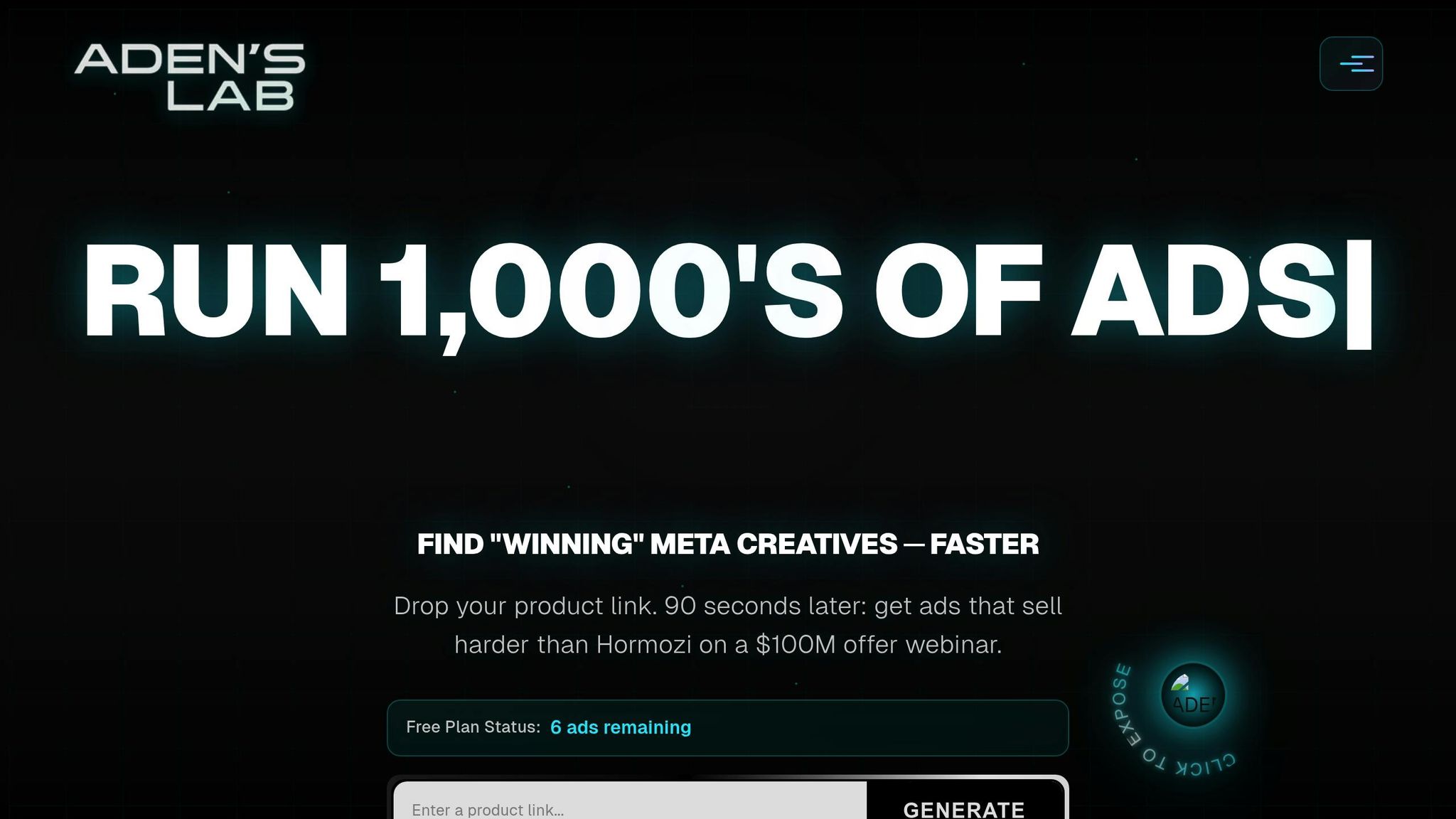
Once you’ve identified the right messaging strategies, ADEN'S LAB can help you produce creatives quickly and efficiently. Manually creating hundreds of ad variations isn’t practical, but ADEN'S LAB solves this by generating high-quality Meta ads in under 90 seconds. This allows you to test at scale without needing extensive design resources.
The process is simple: provide your product link, and ADEN'S LAB analyzes your product details, images, and target audience to craft attention-grabbing ads optimized for Meta's algorithm. The platform delivers complete ad kits - including visuals, hooks, and copy - designed to tap into buyer psychology and drive conversions.
With ADEN'S LAB, you can generate hundreds of ad variations, testing different messaging angles, visual styles, and hooks. This volume of creative data speeds up optimization, enabling Meta’s AI to quickly identify the best-performing combinations. The platform also ensures that ads align with your brand’s style while incorporating proven elements for conversions. Plus, commercial rights are included, so you can launch campaigns immediately.
For brands scaling aggressively, ADEN'S LAB can produce over 1,000 ads daily - something traditional methods simply can’t match. This rapid production helps combat creative fatigue by refreshing ad variations before performance dips. Once you identify winning angles, you can generate more variations within that framework to further refine and optimize your campaigns. This approach can lead to a significant boost in ROAS.
Best-Performing Ad Formats for 2025
Meta's algorithm favors specific ad formats, and understanding these preferences can help your ads achieve better reach and lower costs.
- Reels and vertical video: Expect these to dominate in 2025. Meta prioritizes video content, especially in a 9:16 aspect ratio suited for mobile viewing. Reels ads appear in Instagram Reels and Facebook video sections, grabbing attention during peak engagement. Keep videos short (15–30 seconds) and deliver your key message within the first few seconds. Use text overlays, as many users watch without sound. Quick tutorials, product demonstrations, and transformation sequences work particularly well.
- User-generated content (UGC): Ads that mimic authentic testimonials - shot on smartphones with natural lighting - often outperform polished brand content. UGC focusing on specific results or personal experiences builds trust and drives engagement.
- Carousel ads: These allow you to showcase multiple products or features in a single ad. Each card should have a clear message, whether it’s highlighting outfit combinations or different functionalities. This format gives Meta’s AI more elements to test across audiences.
- Static image ads: When done right, these remain effective. Use high-quality product photography with minimal text and bold, contrasting colors to stand out in busy feeds. While square (1:1) images are versatile, vertical formats (4:5) often perform better on mobile.
- Collection ads: These combine a cover image or video with a product catalog, letting users browse without leaving the platform. This seamless experience can boost average order values, especially for brands with large product ranges.
- Story ads: Full-screen ads that appear between organic Stories on Instagram and Facebook. These are immersive and capture attention quickly. Make sure key information is visible even if viewers scroll fast. Interactive elements like polls or swipe-up links (where available) can increase engagement.
Using these proven formats ensures your ad creatives perform well in Meta’s competitive ad landscape, helping you reach your audience effectively and drive results.
sbb-itb-628c49f
Setting Up and Optimizing AI Ad Campaigns
Once you've crafted high-converting creatives, the next step is launching and fine-tuning campaigns to achieve your target return on ad spend (ROAS). A strong setup ensures the algorithm performs effectively, while careful management helps you grow profitably. Starting with a solid foundation can save you from wasting both time and budget.
Campaign Setup Process
To begin, open Meta Ads Manager, select the Sales objective, and double-check your pixel setup to ensure the AI focuses on actual buyers instead of casual browsers.
For e-commerce brands, Advantage+ Shopping Campaigns are often a great choice. This type of campaign allows Meta's AI to handle placements, audience targeting, and creative delivery. By uploading your best-performing creatives, you let the algorithm analyze user behavior and identify the most likely buyers.
Set your budget at the campaign level instead of the ad set level. This gives Meta's AI the flexibility to allocate spending dynamically across audiences and placements. Start with a daily budget of at least $50.00 to provide the algorithm enough data for optimization. Lower budgets can lead to inconsistent delivery and a longer learning phase.
Within the campaign settings, enable Advantage Campaign Budget to let Meta allocate funds to the best-performing areas. Keep placements on Advantage+ Placements so the AI can test ads across multiple platforms like Facebook, Instagram, Messenger, and Audience Network for maximum reach.
When setting conversion goals, choose Purchase as the primary objective. Adjust your conversion window based on your sales cycle. For instance, a 7-day click or 1-day view window works well for many e-commerce brands. Products with longer decision-making periods may benefit from an extended window.
Before launching, simplify ad set targeting to allow AI more flexibility. Avoid overly narrow targeting - broad audiences give the algorithm room to find unexpected buyer segments.
At the ad level, upload your AI-generated creatives as separate ads for each variation. This setup provides clear data on which elements - like hooks, formats, or visuals - are driving results. If you're using dynamic ads or collection formats, include your product catalog so Meta can automatically show the most relevant items to interested users.
With your campaigns structured for efficiency, you're ready to monitor budgets and scale successful strategies.
Budget Allocation and Scaling Methods
Once your campaigns are live and generating data, managing your budget becomes critical for growth. The goal is to scale what works and cut what doesn't.
Allocate 70–80% of your ad spend to high-performing campaigns and use the remaining 20–30% to test new ideas. This approach allows you to explore fresh opportunities without risking your core revenue streams.
Let campaigns run for 3–5 days without making changes. Meta's AI requires around 50 conversions in a week to exit the learning phase. Frequent adjustments during this time can reset the process, so it's better to monitor performance before intervening.
For vertical scaling, increase your budget gradually - by 20–30% - once a campaign maintains your target ROAS for three consecutive days. For example, if you're spending $100.00 daily at a 3.5x ROAS, raise the budget to $120.00–$130.00 and monitor results over the next 48 hours. Avoid large increases, as they can disrupt performance and force the campaign back into the learning phase.
Horizontal scaling offers another way to grow by introducing new creative approaches. This strategy helps avoid audience fatigue when a campaign hits its spending limit. Launch new campaigns with varied creative angles, staggering them by 24–48 hours to give the algorithm time to adapt.
Track broader metrics like the Marketing Efficiency Ratio (MER), which divides total revenue by total ad spend. For example, even if a campaign's ROAS is only 2.5x, it might still be worth scaling if your overall MER is strong due to contributions from other sources like email marketing or organic traffic.
Also, consider your payback period for cash flow management. Evaluate how your average order value compares to your cost per acquisition, and factor in repeat purchases and customer lifetime value. Brands with strong customer retention might accept a lower initial ROAS if they can recover costs over time.
If a campaign exceeds 2–3x your target CPA without conversions, pause it immediately. This prevents unnecessary losses and protects your overall budget.
Using Campaign Budget Optimization (CBO) can also help. Meta automatically reallocates spending across ad sets based on performance, which is especially useful when testing different creative angles. The best-performing elements receive more budget in real time.
During high-demand shopping periods like Black Friday or the holidays, expect CPMs to rise by 30–50%. Plan ahead by gradually increasing your budget before these events to secure better ad delivery before competition peaks.
Testing and Updating Creatives
Even the best ads won't perform forever. Users are exposed to thousands of ads daily, and repeated exposure to the same creative can reduce engagement and conversions.
Signs of creative fatigue - like declining click-through rates, rising CPMs, or falling ROAS - often appear after 7–14 days, though this depends on audience size and budget. If ad frequency exceeds three impressions per user on average, it’s time to refresh your creatives.
To avoid fatigue, rotate creatives every 7–14 days. AI-powered tools can help you quickly generate new ad variations, so you always have fresh options. Aim to introduce 3–5 new ads per campaign each week. This gradual rotation ensures stability while keeping your content appealing.
When testing new creatives, take a structured approach. Start with your best-performing ad and tweak one element at a time - whether it’s the hook, visuals, or call-to-action. This method helps you pinpoint what drives improvements without disrupting the campaign.
This creative rotation works hand-in-hand with Advantage+ campaigns, keeping performance strong and your ads relevant. With consistent updates, your campaigns remain dynamic and effective, ready to meet your goals.
Advanced AI Ad Strategies for Growth
Once you've nailed down the basics of campaign setup and creative optimization, it's time to take things up a notch. These advanced strategies help you fine-tune your approach based on your business stage while focusing on long-term customer value.
Strategies by Business Stage
Your ad strategy should evolve with your business's growth, budget, and goals. A new Shopify store, for instance, has entirely different needs compared to a well-established DTC brand pulling in six figures monthly.
New Shopify Stores
If you're just starting out, chances are you're working with a tight budget - often under $1,000 per month. At this stage, the goal is simple: validate your product-market fit and find your first successful ads without draining your funds. To do this, run a single Advantage+ Shopping Campaign with a daily budget of $30–$50. Use AI to create 10–15 ad variations and stick to broad targeting. Keep a close eye on your break-even ROAS; for example, if your product costs $15 and sells for $45, aim for a minimum ROAS of 1.5x, with 2x being ideal. Avoid spreading your budget thin across multiple campaigns - focusing your spend helps the algorithm learn faster with limited data.
Growing DTC Brands
As your brand grows, you'll need to diversify and scale your creative testing. With enough campaign data to spot trends, start segmenting your strategies by funnel stage. This means running separate campaigns for cold traffic acquisition, retargeting warm audiences, and reactivating past customers. Allocate your budget strategically: 60% to proven winners, 25% to testing new creative approaches, and 15% to retargeting. Use AI to generate a wide range of creative formats - images, carousels, and videos - and experiment with messaging styles like social proof, problem-solving, lifestyle benefits, and urgency. Aim for a 3x–4x ROAS on cold traffic and 5x–8x on retargeting campaigns. Also, keep an eye on your Customer Acquisition Cost (CAC) versus Lifetime Value (LTV); a healthy ratio is typically 1:3 or better.
Dropshippers
Dropshipping comes with its own challenges, like longer shipping times and thinner margins. This makes quick testing and rapid adjustments crucial. Run 3–5 product campaigns at a daily budget of $20–$30 each. If a product doesn't generate sales after $100 in ad spend, drop it immediately. When you find a winning product, scale cautiously by increasing budgets 25% every two days while maintaining a minimum 2.5x ROAS. Since dropshipping products often have short lifecycles, refresh your creatives every 5–7 days to avoid ad fatigue. Use dynamic product ads linked to your catalog so Meta can automatically highlight trending items, and aim to test 15–20 products each month to keep profits steady.
Established Brands
Brands spending over $50,000 monthly should focus on integrating their ads across multiple channels and refining their attribution strategies. At this level, your Facebook ads should complement efforts like email marketing, influencer collaborations, and organic social media. Use AI to maintain creative momentum, generating 50+ ad variations each month, while your team zeroes in on strategy and analysis. Dive into cohort analysis to understand how different customer groups respond to your ads, and test premium formats like Instant Experiences and Collection Ads to showcase your full product range. Your target ROAS may drop slightly to 2.5x–3x as you invest in brand-building and long-term customer relationships.
Once you've optimized your acquisition strategies, the next step is to focus on driving repeat purchases and boosting customer value.
Retention and Upsell Campaigns
Getting new customers is expensive, but the real profit lies in turning them into repeat buyers. AI-generated ads can help you encourage repeat purchases, increase order values, and maximize lifetime value.
Start by segmenting past purchasers into custom audiences based on how recently they bought from you. For example:
- Customers who purchased in the last 30 days
- Those who bought 31–60 days ago
- Buyers from 61–90 days ago
- Customers inactive for over 90 days
Each group requires tailored messaging. Recent buyers respond well to cross-sell opportunities, like pairing running shoes with moisture-wicking socks or a fitness tracker. Use AI to create ads promoting these complementary items with hooks like "Complete Your Setup" or "Runners Also Love These."
For the 31–60 day group, focus on refills or upgrades. Skincare customers might need a serum restock, while coffee drinkers could be tempted by a new roast or a subscription option. AI-generated ads can highlight these products with messages like "Time for a Refill?" or "Ready to Restock?"
Reactivating customers in the 60–90 day range often requires a nudge. Offer exclusive discounts (10–15%) or showcase new arrivals they haven't seen yet. Use messaging that creates urgency, like "We Miss You" or "Something New Just Dropped." For those inactive for over 90 days, stronger incentives - like 20% off or free shipping - work best. AI can help you test various approaches to find what resonates.
Upsell campaigns are most effective immediately after a purchase. Target customers within 7 days of their transaction and showcase premium or complementary products. For instance, if someone buys a basic blender, show them a professional model with enhanced features. Frame the upsell as an upgrade with messages like "Love Your Purchase? Take It to the Next Level."
Post-purchase cross-sell ads should appear 14–21 days after the initial order. By this time, customers have experienced your product and are more likely to buy related items. Highlight these with social proof, such as "Customers Who Bought X Also Love Y", and include reviews or user-generated content to build trust.
Track key metrics like repeat purchase rate and average order value to measure success. A strong e-commerce brand typically sees 25–35% of customers make a second purchase within 90 days. If you're falling short, consider boosting your retention ad budget or testing more enticing offers.
You can also promote subscription or membership models through AI-generated ads. Recurring revenue not only stabilizes cash flow but also increases customer lifetime value. Highlight the convenience, savings, and perks of subscribing, and test different intervals - weekly, bi-weekly, or monthly - to see what works best for your audience.
Lastly, use lookalike audiences based on your highest-value customers (e.g., those who've made 3+ purchases or spent above a certain amount). These audiences often convert better than cold traffic, so tailor your acquisition ads to appeal to shoppers who prioritize quality and repeat purchases.
Compliance and Brand Consistency
As you scale up your ad volume, maintaining brand consistency and adhering to Meta's advertising policies becomes crucial. AI-generated ads can churn out content quickly, but they also carry risks like policy violations or brand dilution. A systematic review process and clear guidelines can help you avoid these pitfalls.
Create a checklist to ensure your ads comply with Meta's policies. Avoid making prohibited claims like "cure" or "guaranteed results", unless you have proper authorization. Ensure your images and messaging align with Meta's standards - no excessive skin, misleading health transformations, or shock tactics - and verify that your landing page matches the ad's claims for consistency.
Equally important is maintaining a cohesive brand identity. Even with AI handling ad creation, your ads should reflect your brand's tone, colors, fonts, and messaging style. For instance, a luxury skincare brand should stick to elegant, minimalist designs across all creatives. A detailed style guide can help ensure that even AI-generated ads stay true to your brand's essence.
Conclusion
Running successful Facebook ads for your e-commerce business doesn’t have to drain your resources or leave you stuck in a cycle of creative burnout. This guide has shown how AI can transform ad production into a streamlined process that drives measurable growth. Whether it’s setting up Advantage+ Shopping Campaigns, segmenting your retention audiences, or staying aligned with brand guidelines, these strategies offer a clear path to achieving 3x ROAS and beyond.
Here’s the bottom line: AI-powered ad creation eliminates the bottlenecks that hold back most scaling efforts. Traditional methods limit you to testing a few creatives each week, which often leads to ad fatigue and declining ROAS.
With ADEN'S LAB, this dynamic changes completely. By generating high-performing Meta ads in seconds from just a product link, you can test 10 times faster than your competitors while slashing production costs by 100 times compared to traditional agencies. This speed advantage is crucial when validating new products, scaling successful campaigns, or refreshing creatives every 5–7 days to maintain performance.
Whether you’re managing a $30 daily Shopify store or a brand pulling in $50,000+ a month, the same rules apply: prioritize your budget on proven winners, continually test fresh angles, and segment your audiences by purchase recency to boost retention revenue. Keep your creatives updated and compliant with Meta’s policies, and let AI handle repetitive tasks, freeing you up to focus on strategy and growth.
The ability to scale quickly and efficiently is your edge. By 2025, the most successful brands won’t necessarily be the ones with the largest budgets - they’ll be the ones generating and testing hundreds of ad variations each month without overspending. ADEN'S LAB offers the tools to make ad creation your competitive advantage, turning a costly bottleneck into a growth engine.
Start putting these strategies into action today. Track critical metrics like ROAS, CAC, LTV, and repeat purchase rates to ensure profitability. Test aggressively, scale wisely, and remember: every dollar saved on ad production is a dollar you can reinvest into testing and scaling what works.
Your journey to 3x ROAS begins with better creatives, faster testing, and smarter budget allocation. The playbook is in your hands - now it’s time to execute. Use AI-driven solutions to turn every ad dollar into meaningful growth.
FAQs
How does AI-driven ad creation help e-commerce brands achieve a 3x ROAS?
AI-powered ad creation enables e-commerce brands to achieve a 3x return on ad spend (ROAS) by using advanced algorithms to study shopper behavior, preferences, and engagement patterns. This results in highly targeted ads that connect with the right audience.
On top of that, AI enhances ad performance with intelligent bidding strategies, ensuring your budget is spent on the most lucrative opportunities. By constantly learning and fine-tuning campaigns, AI helps boost returns while cutting down on unnecessary spending.
What do I need to set up Meta’s AI tools for optimizing Facebook ad campaigns?
To make the most of Meta’s AI-driven advertising tools, you’ll need to have a few essentials in place:
- Meta Business Manager Account: This is your hub for managing ad campaigns and assets. If you haven’t set one up yet, it’s a must to get started.
- Meta Pixel or Conversions API: Install the Meta Pixel on your website or use the Conversions API (especially useful for platforms like Shopify). These tools help track user activity and fine-tune your ad targeting.
- Active Ad Account: Double-check that your ad account is active, linked to your Business Manager, and has up-to-date billing details. If you’re targeting U.S. audiences, ensure the currency is set to USD.
- Product Catalog: If you’re in e-commerce, upload a product catalog. This allows you to run dynamic ads that show users products tailored to their interests.
- Defined Goals and Data: Be clear on what you want to achieve - whether it’s conversions, website traffic, or something else. Also, having historical data is key for Meta’s AI tools to optimize your campaigns effectively.
With these steps covered, you’ll be set to tap into features like Advantage+ campaigns and automated targeting, helping you get more out of your Facebook ads.
How can I use AI to avoid ad fatigue and keep my Facebook ad campaigns engaging?
To keep your Facebook ad campaigns engaging and avoid ad fatigue, take advantage of Meta's AI-powered tools, such as Advantage+. These tools use performance data to fine-tune targeting, adjust creative elements, and allocate budgets effectively, helping your ads remain impactful and relevant.
Equally important is maintaining variety in your ad creatives. Switch up your formats, try out different hooks, and test new messaging approaches to keep your audience intrigued. By blending AI-driven optimization with consistently fresh and engaging content, you can stretch the lifespan of your campaigns and achieve better outcomes.
Your next ad batch starts here
Finish with a ready-to-test ad batch
Paste your website to generate static creatives. Drop the link → get ads in about 90 seconds → upload them to Meta → scale.
Free to try No prompt writing