Creative Testing Matrix for Meta Ads by Daily Budget, Offer, and Funnel Stage
Turn the strategy into creatives
Create Meta ads for your product
Paste your product page. ADEN'S LAB turns the offer, audience, and positioning into complete ready-to-use Meta static ads.
Free to try No prompt writing

The Creative Testing Matrix simplifies Meta ad testing by focusing on three factors: daily budgets, offer types, and funnel stages. This approach helps you identify which ad combinations perform best, avoid wasted spend, and improve results.
Key takeaways:
- Daily Budgets: Allocate enough budget per creative (e.g., $50–$100/day per ad set) to gather reliable data.
- Offer Types: Tailor creatives to match the offer (e.g., discounts vs. value-first offers) and audience expectations.
- Funnel Stages: Adjust messaging based on where the audience is in their buying journey (cold, warm, or hot traffic).
To succeed, test one variable at a time, use structured campaign setups (ABO for testing, CBO for scaling), and refresh creatives every 2–3 weeks to prevent ad fatigue. Tools like ADEN's LAB can streamline the process by producing ad variations quickly and affordably.
Bottom line: A structured testing matrix ensures every dollar spent generates actionable insights, leading to better ROAS and consistent ad performance.
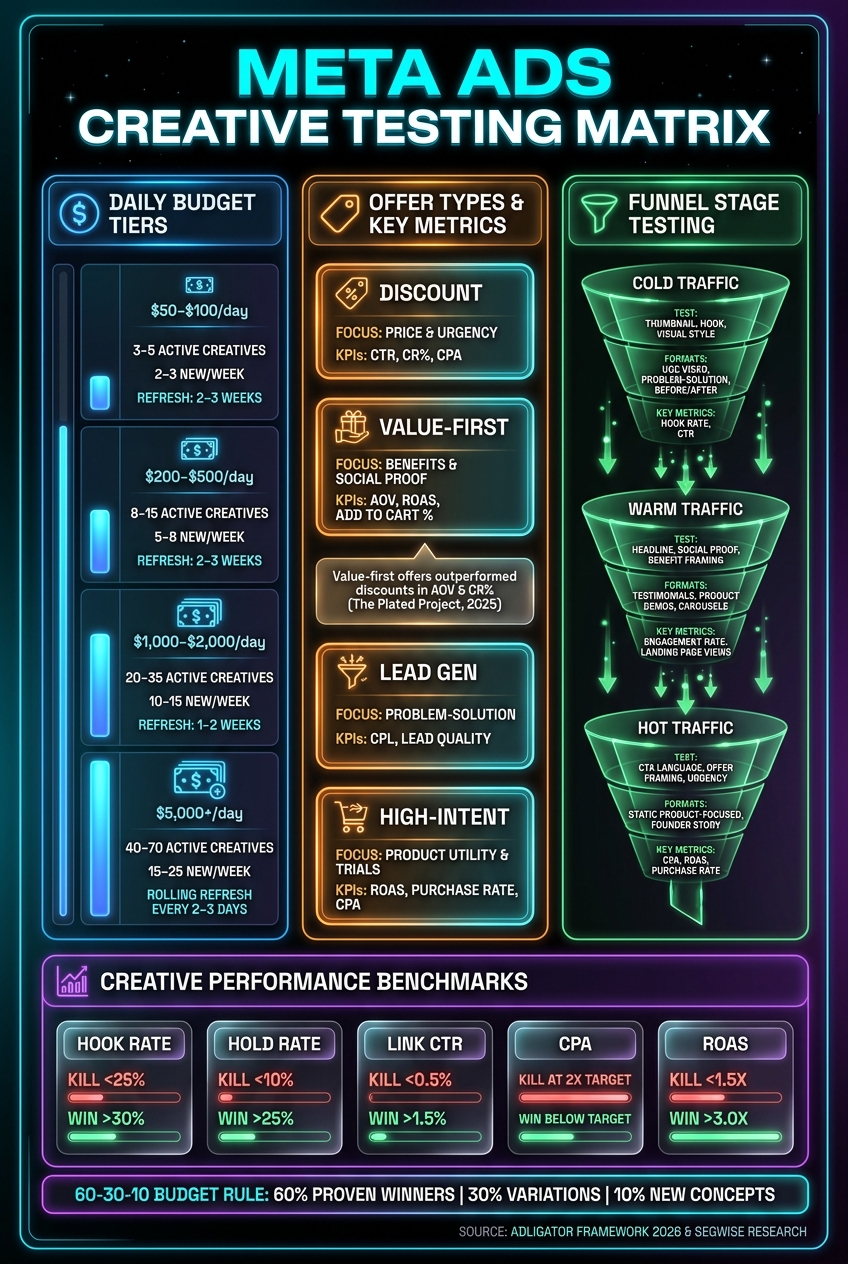
Meta Ads Creative Testing Matrix: Budget, Offer & Funnel Stage Guide
The New Meta Ads Creative Testing Framework for 2026
Put the playbook to work
Apply this playbook to your page
Paste your website and the Lab will turn the strategy you are reading into a ready-to-test ads.
Free to try No prompt writing
The Three Dimensions of the Creative Testing Matrix
The creative testing matrix is built around three essential factors that directly influence ad performance: daily spending, offer type, and the buyer’s decision stage. These variables help define the scope, timeline, and results of your tests.
Daily Budget Tiers
Your daily budget isn’t just about how many people you can reach - it also dictates how many creatives you can test effectively. Stretching a limited budget too far can lead to poor data quality. For example, splitting a $100/day budget across 20 creatives means each one gets only $5/day, which isn’t enough for Meta’s algorithm to optimize properly.
"Most Meta ad budgets do not get wasted on bad targeting. They get wasted on bad creative testing." - Angad Singh, Segwise
To gather meaningful insights, aim to set your daily budget for each ad set at 2×–3× your target CPA. This ensures enough conversion signals for Meta’s algorithm. Typically, Meta’s learning phase stabilizes after an ad set achieves about 50 optimization events within seven days. Anything below that threshold is more noise than useful data.
Here’s a breakdown of how daily budgets align with testing capacity:
| Daily Budget | Active Creatives | New Creatives/Week | Refresh Cycle |
|---|---|---|---|
| $50–$100 | 3–5 | 2–3 | 2–3 weeks |
| $200–$500 | 8–15 | 5–8 | 2–3 weeks |
| $1,000–$2,000 | 20–35 | 10–15 | 1–2 weeks |
| $5,000+ | 40–70 | 15–25 | Rolling (every 2–3 days) |
(Source: Adligator Framework 2026)
Larger budgets allow for faster learning, which can give you an edge. As the Adligator team explains:
"The account with 3 creatives is competing against an account with 30, and the one with 30 is learning faster."
Offer Types in Meta Ads
Just as budgets determine testing volume, the type of offer shapes your creative strategy and performance metrics. For instance, a discount ad and a lead generation ad demand different visuals, copy, and KPIs.
In 2025, The Plated Project tested a "Free Puzzle with Purchase" offer against a flat 20% discount. The value-first offer outperformed the discount in both Average Order Value (AOV) and Conversion Rate (CR%), proving that cutting prices isn’t always the best approach. Similarly, Bellavita ran two hooks for the same offer - "Smells like luxury" versus "Perfume that lasts 10 hours." The more specific hook delivered a 1.6× higher click-through rate (CTR).
Here’s how different offer types influence creative focus and key metrics:
| Offer Category | Creative Focus | Primary KPIs |
|---|---|---|
| Discount | Highlight price, urgency, and savings | CTR, Conversion Rate, CPA |
| Value-First | Showcase added benefits, social proof, and unboxing | AOV, ROAS, Add to Cart % |
| Lead Gen | Problem-solution messaging, clear explanations | CPL, Lead Quality, Landing Page View |
| High-Intent | Emphasize product utility, trials, or specific SKUs | ROAS, Purchase Rate, CPA |
To get reliable results, test offers with the same audience and format, ensuring only one variable changes.
Funnel Stages and Their Effect on Testing
The buyer’s stage in the funnel also impacts ad testing. Cold audiences need a strong hook to grab their attention, while warm audiences - already familiar with your brand - require a nudge to convert.
At the top of the funnel, focus on hooks and framing the problem. Metrics like Hook Rate and CTR are key indicators. Moving to the middle of the funnel, emphasize education and value-driven messaging. Finally, bottom-of-the-funnel ads should aim to drive conversions using testimonials, urgency, and targeted offers.
"The right angle with mediocre execution usually outperforms the wrong angle with excellent execution." - Angad Singh, Segwise
One common mistake is assuming strong engagement at the top of the funnel will automatically lead to conversions at the bottom. An ad with lots of likes and comments might not generate profitable sales if Meta’s algorithm doesn’t receive enough conversion data to optimize effectively.
How to Build and Run a Creative Testing Matrix
How to Structure the Matrix
Think of the matrix as a grid where each cell represents a unique combination of budget tier, offer type, and funnel stage. Each cell should have its own creatives, metrics, and timeline.
Start with the Angle Matrix. This involves mapping your offer against 4–6 angles, such as price, transformation, FOMO, social proof, curiosity, or authority. For each angle, create 2–3 creatives, resulting in a test batch of 12–18 pieces per cell. This amount is enough to gather meaningful insights without overspending.
Every creative should be tied to a clear hypothesis. As Structured Agency explains:
"Every ad set is a theory. You have to know why you are testing the ads within it."
Without this clarity, testing becomes guesswork. A structured matrix helps you test variables effectively while keeping campaigns organized.
Which Creative Variables to Test
Focus on creative elements in order of their impact to save both time and budget.
Start with the concept and angle, as these have the most influence. Next, test the hook - the first 1.5–3 seconds of a video or the main visual in a static ad. After that, move to format and style, and finally, test the CTA and offer framing. This sequence is critical because even the best CTA can’t fix a weak angle.
The variables to prioritize also depend on the audience’s stage in the funnel:
| Funnel Stage | Priority Variables to Test | Recommended Formats |
|---|---|---|
| Top (Cold Traffic) | Thumbnail, hook, visual style | UGC-style video, problem-solution, before/after |
| Middle (Warm Traffic) | headline, social proof, benefit framing | Testimonials, product demos, carousels |
| Bottom (Hot Traffic) | CTA language, offer framing, urgency | Static product-focused, founder story |
To get clear results, test one variable at a time. Tools like ADEN's LAB can help speed up this process by generating multiple hook and angle variations for static ads, allowing you to run isolated tests without waiting on design updates.
Campaign Structures for Clean Testing
Once your matrix is ready and variables are prioritized, structuring your campaigns correctly is key to preserving test accuracy.
One common mistake is mixing new creatives with proven winners. This confuses Meta’s algorithm, causing it to re-learn and destabilizing performance.
The solution? Use a two-campaign structure: one campaign for testing new ideas (using ABO - Ad Set Budget Optimization) and another for scaling winners (using CBO - Campaign Budget Optimization). ABO ensures equal spend across all variants, giving each creative a fair chance to perform. CBO, on the other hand, allows Meta to allocate more budget to early-performing creatives - ideal for scaling but not for testing.
Here’s an example: In March 2026, a DTC skincare brand tested hook types for their $48 vitamin C serum using an ABO setup. They allocated $300 to four ad sets over seven days. The problem-statement hook achieved a $29 CPA and 1.66x ROAS, while the product-demo hook only managed a $64 CPA and 0.75x ROAS. This showed that problem-aware hooks were twice as effective for cold audiences. Such clarity is only possible with isolated testing.
During testing, avoid using Advantage+ placements. Instead, separate ad sets by placement (e.g., Reels vs. Feed) to pinpoint where each creative performs best. Once a creative meets your target CPA over 5–7 days, it can move to the scaling campaign, where Advantage+ can help maximize reach efficiently.
Reading Results and Improving Creative Performance
By aligning with a A/B testing Meta ads with a structured matrix, you can effectively measure, analyze, and refine each ad variant to get the best results from your Meta ad campaigns.
Minimum Spend and Duration Rules for Testing
Each test should run for 7–14 days to give Meta's algorithm enough time to gather accurate data. The first 24–48 hours often produce unstable results, so patience is key. Aim to collect at least 10–30 conversions per variant - this reduces noise (inconsistencies in data) from 32% at 10 conversions to just 10% at 100 conversions. Additionally, ensure each variant reaches a minimum of 1,000 impressions before drawing any conclusions.
When it comes to budgeting, use your target CPA (cost per acquisition) to calculate the spend per variant. Multiply your CPA by 50 for the minimum spend or by 100 for more reliable results. For instance, if your target CPA is $40, you’d need to spend at least $2,000 per variant before making decisions. Use ABO (ad set budget optimization) setups with controlled daily budgets of $50–$100 per ad set for better control.
Once you've secured the necessary spend and duration, shift your focus to tracking performance metrics to refine your testing process.
Key Metrics to Track Creative Performance
Start by evaluating creatives with engagement metrics, and then confirm winners using conversion-based signals. Metrics like Hook Rate and CTR (click-through rate) help you determine if your creative grabs attention. Metrics like CPA and ROAS (return on ad spend) tell you if that attention translates into meaningful results.
| Metric | What It Signals | Kill Threshold | Winner Signal |
|---|---|---|---|
| Hook Rate (3s View Rate) | How well the opening frame grabs attention | Below 25% | Above 30% |
| Hold Rate (50% View Rate) | Ability to maintain interest after the hook | Below 10% | Above 25% |
| Link CTR | Relevance of the creative and offer appeal | Below 0.5% | Above 1.5% |
| CPA | Efficiency in driving conversions | 2x your target | Below target |
| ROAS | Overall ad profitability | Below 1.5x | Above 3.0x |
Keep an eye on how Meta allocates your budget. If the platform avoids spending on a particular creative, it’s often a sign that the algorithm sees it as underperforming - even before conversion data confirms it. Also, watch for CPM (cost per thousand impressions) trends. A lower-than-average CPM often indicates that Meta’s auction system finds your creative relevant and engaging.
"Confusing engagement with performance is the #1 mistake advertisers make... High engagement does not equal high conversions." - Vibemyad
How to Document and Iterate on Test Results
Once you've gathered performance data, document your findings to guide future creative development.
Maintain a Creative Testing Log to capture details like hypotheses, variables tested, dates, spend, results, and key takeaways. For example: "UGC hook with a pain-point opening outperformed product-feature opening for cold traffic, likely because the audience connects with the problem before seeing the solution." These insights help shape your next creative brief.
"If you can't state a mechanism, the win is a data point, not a learning." - Murat Bock, Founder, adlibrary.com
Use a consistent naming system for your creatives, such as ConceptID_Format_Angle_Date. This makes it easier to track patterns over time without digging through dashboards. Over time, this process builds a Creative Playbook - a go-to resource for understanding which hooks, formats, and angles resonate most with your audience. Tools like ADEN's LAB can simplify this by generating multiple ad variations from a single input, letting you test specific elements quickly without waiting for new designs.
How to Scale Winning Creatives and Keep Testing
Once you've identified your winning creatives, the next hurdle is scaling them effectively while keeping performance steady.
Moving Winning Creatives Across the Matrix
Using insights from your testing matrix, the goal is to scale efficiently. For example, a creative that performs well with cold traffic might need a more focused call-to-action (CTA) when used for retargeting. Likewise, a mid-budget winner tested at $50/day in an ABO setup should only move to a scaling campaign - such as Campaign Budget Optimization (CBO) or an Advantage+ campaign - after meeting specific benchmarks. These include achieving a 25–35% higher click-through rate (CTR), a 15–20% drop in cost-per-click (CPC), and at least 10–15 conversions with a positive ROAS trend over a 72-hour period.
Once these thresholds are met, scale the budget gradually - no more than 20% at a time - and only after confirming 3–5 proven winners. Scaling too fast can cause the algorithm to reset, leading to unstable performance.
As you scale, managing creative volume becomes essential to avoid fatigue and maintain results.
Maintaining Creative Volume to Fight Fatigue
Even the top-performing creatives have a shelf life. Research shows that purchase intent decreases by about 16% after six impressions. To counter ad fatigue, many leading brands refresh their creatives every 7–10 days on average.
One way to stay ahead is by maintaining a creative reserve - a stockpile of untested assets ready to roll out before performance begins to decline. Repurposing winning creatives can also extend their life. Adjust the aspect ratio, tweak the hook, or modify the headline to keep the content fresh without starting from scratch.
"Your competitive edge is now a creative production system, not a targeting spreadsheet." - Tal Yeger, AdGPT
Producing a steady stream of creatives can feel overwhelming, but tools like ADEN's LAB simplify the process. Their platform generates static Meta ad variations in under 90 seconds, allowing you to launch 15–30 new variants weekly without relying on designers or lengthy revisions. At just $0.90 per ad with the Apex Mode plan, it’s a cost-effective way to keep your creative pipeline running smoothly.
How to Split Budget Between Testing and Scaling
Once your testing spend is under control, use the 60-30-10 rule to balance your budget during scaling. Here’s how it works:
- 60% goes to proven winners.
- 30% is allocated to variations of those winners, like new hooks, different thumbnails, or adjusted copy.
- 10% is reserved for testing entirely new concepts.
"60% of the budget goes to winning ads, 30% goes to variations of the winning ads/different creative styles of the same angle or hook, and 10% to completely fresh ads. This structure maintained stable performance while testing." - Lead Gen Agency Owner
This method ensures stability while keeping your creative pipeline active. The table below outlines how this approach scales with different monthly ad budgets:
| Monthly Spend | Weekly Creative Volume | Recommended Structure |
|---|---|---|
| $10,000–$50,000 | 20–30 new creatives | 1 CBO Scaling / 1 ABO Testing |
| $50,000–$200,000 | 50–100 new creatives | 60-30-10 Budget Split |
| $200,000+ | 100–200+ new creatives | High-velocity AI-assisted pipeline |
When adding new concepts to a scaling campaign, limit it to one at a time. Adding multiple creatives simultaneously can confuse the algorithm, leading to wasted spend on ads that generate engagement but fail to convert. This can destabilize an otherwise strong campaign.
These steps complete the journey from testing to scaling, showing how a well-structured creative testing matrix can drive consistent performance across all stages of your campaigns.
Conclusion: Getting More from Meta Ads with a Creative Testing Matrix
This structured matrix ties together daily budgets, offer types, and funnel stages to fine-tune Meta ad performance. By eliminating guesswork, the creative testing matrix lets you focus on isolating variables, analyzing results, and applying proven strategies. Every dollar spent generates actionable insights.
As highlighted in this framework, syncing creative testing with budgeting, targeted offers, and funnel stages is crucial for long-term ad success. Data consistently shows better ROAS when structured testing is in place. And here's the key takeaway: creative quality is the ultimate game-changer. Leveraging AI tools for Meta ads can help streamline this production process. No level of audience targeting or budget management can bridge the gap between your top-performing and weakest creatives.
"The right angle with mediocre execution usually outperforms the wrong angle with excellent execution." - Angad Singh, Segwise
The formula for lasting success combines structure with speed. Testing the right ideas at the right funnel stages, allocating sufficient budgets, and refreshing creatives before they lose effectiveness creates a winning cycle. Maintaining a pipeline of 10 concepts in ideation, 5 in production, and 2 ready to launch ensures your testing remains consistent and delivers dependable results.
FAQs
How do I pick the right daily budget for each test?
Allocating 10–20% of your daily ad spend for testing fresh ideas can be a game-changer. To ensure accurate results, use Ad Set Budget Optimization (ABO). This approach prevents Meta from shifting funds prematurely, giving each ad set a fair chance to perform.
For reliable insights, set a daily budget of $30–$100 per ad set. This ensures you gather enough data - whether it's 100 conversion events or sufficient impressions - to make informed decisions.
When should I stop or scale a creative during testing?
Before launching your ads, it's important to define success benchmarks and conversion thresholds upfront. This means deciding what metrics will indicate a successful campaign, such as a target click-through rate (CTR) or cost per acquisition (CPA).
Let your tests run for 3–7 days or until you achieve at least 1,000 impressions and 10–30 conversions per variant. This gives your ads enough time and data to show meaningful results.
How to Handle Performance Data
- Scale up creatives that show strong and consistent performance over 7 or more days.
- Pause ads if the CTR falls below 0.5% after 3 days or if the CPA goes beyond your target.
Be patient with your tests. Cutting them off too early can interfere with the learning phase, which is crucial for optimizing your campaign.
How do I tailor creatives for cold vs. warm vs. hot audiences?
To make your creatives hit the mark, match your messaging to where your audience is in their journey. For cold audiences, use eye-catching hooks and engaging storytelling. Short-form videos or user-generated content can be particularly effective here. When targeting warm or hot audiences, focus on showcasing product benefits, sharing testimonials, and including strong calls to action. Carousel ads are a great option for displaying multiple products or emphasizing social proof. And don’t forget - your creative should always align with your landing page’s promise to keep conversion rates steady.
Your next ad batch starts here
Finish with a ready-to-test ad batch
Paste your website to generate static creatives. Drop the link → get ads in about 90 seconds → upload them to Meta → scale.
Free to try No prompt writing