Copy-Paste AI Prompts to Build a Weekly Meta Creative Testing System That Scales
Use the prompts on your real offer
Generate these ad angles for your product
Skip the blank prompt box. Paste your product page and ADEN'S LAB applies the angles to your offer, images, headlines, and copy.
Free to try No prompt writing

Want to improve your Meta ad performance without wasting time and money? Here’s the bottom line: 56% of your campaign’s success depends on the quality of your ads. If you’re not testing new ideas weekly, you’re risking higher costs and lower returns.
This guide breaks down a simple system to test 5–10 ad variations every week and scale what works. Here’s the process:
- Step 1: Use a testing matrix to isolate and test ad components like visuals, headlines, and CTAs.
- Step 2: Write scroll-stopping hooks, clear body copy, and action-oriented CTAs.
- Step 3: Set up campaigns in Meta Ads Manager to test one variable at a time for actionable insights by following a step-by-step A/B testing guide.
- Step 4: Automate ad production with tools like ADEN’s Lab to save time and scale faster.
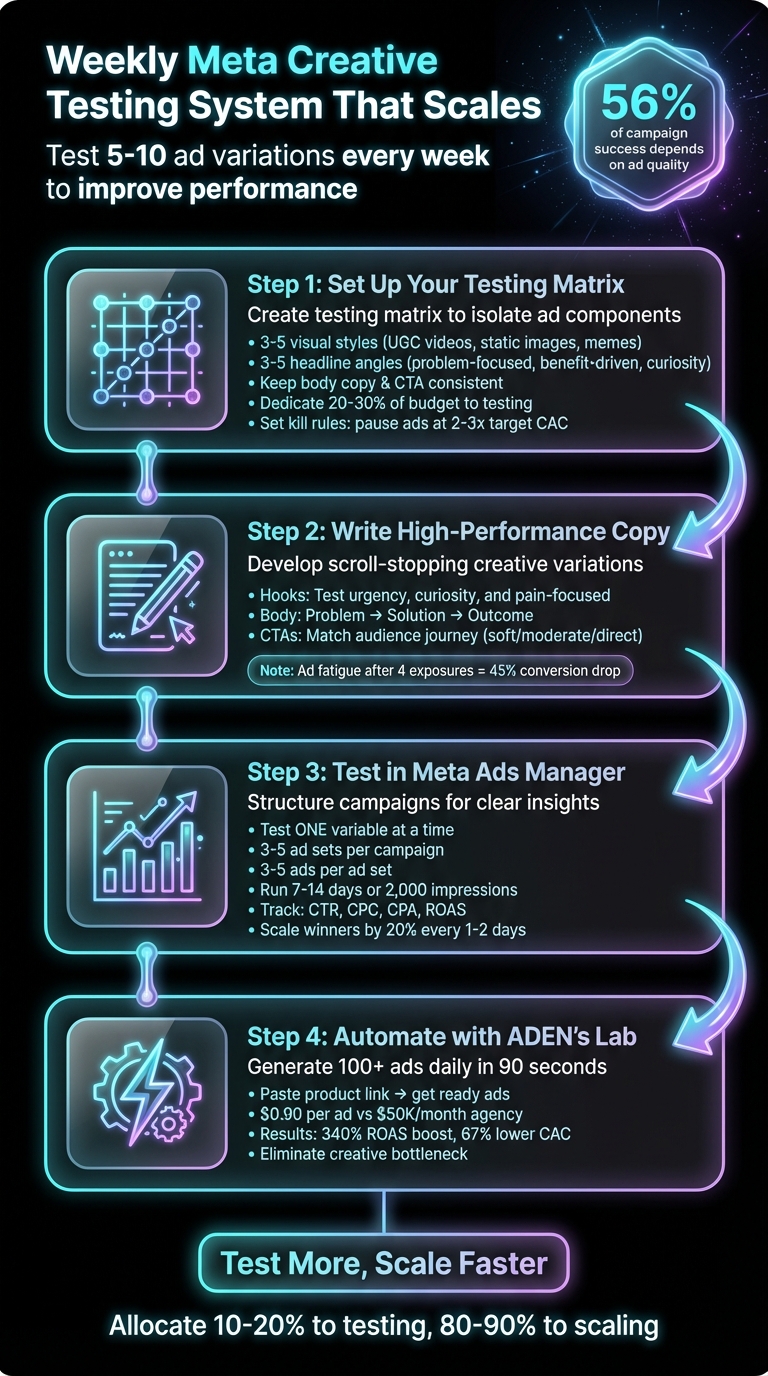
4-Step Weekly Meta Ad Creative Testing System
Step 1: Set Up Your Weekly Creative Testing Matrix
What a Creative Testing Matrix Actually Is
Once you've automated your creative production, the next logical step is organizing these elements in a systematic way. Enter the creative testing matrix - a structured framework that breaks your ad into modular components like visuals, hooks, value propositions, and CTAs. Instead of testing entire ads and guessing why one performed better, the matrix allows you to isolate specific elements to determine what truly drives results.
Here’s how it works: you create a master list of variables - think 5 hooks, 4 background styles, and 3 value propositions - and mix them into testable combinations. This approach shifts you from random experiments to identifying repeatable success patterns. For instance, if problem-focused hooks consistently outperform benefit-driven ones, you've uncovered a formula for success.
The matrix also helps tackle scaling challenges. Meta's algorithm, especially after the July 2025 Andromeda update, favors creative diversity. It learns faster when a consistent message is delivered across multiple formats like Reels, carousels, and static images. Without a matrix, you might be stuck testing just a handful of ads each week. With one, you can manage dozens - or even hundreds - of variations while maintaining control and clarity.
Understanding the matrix’s purpose is just the beginning. Structuring it effectively for weekly tests is where the real magic happens.
How to Structure Your Matrix for Weekly Tests
Start by identifying the key variables. Research shows that about 80% of ad performance often hinges on the visual hook and headline. Create 3–5 distinct visual styles (e.g., UGC videos, static images, or simple memes) and pair them with 3–5 headline angles, such as problem-focused, benefit-driven, or curiosity-based approaches. During this phase, keep the body copy and CTA consistent to ensure you're isolating and testing just one variable at a time.
Set clear "kill rules" before launching. For example, pause any ad that spends 2–3 times your target customer acquisition cost without generating a purchase. To gather meaningful insights, aim for each variation to achieve at least 1,000 impressions and 20–30 conversions. Dedicate 20–30% of your ad budget to testing, separate from your scaling budget, to minimize wasted spend on underperforming ads.
Use strict naming conventions to streamline analysis. Labels like TEST_Video_ProblemHook_PriceVP_Q1 can instantly tell you the ad’s key components. Always launch all variations in your matrix at the same time to avoid resetting Meta’s learning phase. Document every successful element in a centralized library. Over time, this library becomes a goldmine of proven creative elements that you can remix for future campaigns without starting from scratch.
Put the playbook to work
Apply this playbook to your page
Paste your website and the Lab will turn the strategy you are reading into a ready-to-test ads.
Free to try No prompt writing
How to Test Facebook Ads Creatives at Every Budget (2026)
Step 2: Write Creative Variations That Actually Perform
Once your matrix is ready, it’s time to fill it with high-impact copy. The difference between a $2 cost per acquisition and a $20 one often hinges on how well your words resonate with someone as they scroll. The combination of compelling text and visuals, paired with Meta ads automation, can significantly influence your results in Meta Ads Manager.
Hooks That Stop the Scroll
The first few seconds of a video - or the initial glance at a static image - are critical. This is when someone decides whether to keep scrolling or pause to engage. It’s not about being overly clever; it’s about being immediately relevant. Hooks that focus on a problem (like "Tired of wasting $500/week on ads that don’t convert?") often outperform generic benefit-driven statements (such as "Grow your business faster") because they address a real pain point.
Try testing three types of hooks in your initial round: urgency (e.g., "Only 12 hours left"), curiosity (e.g., "Discover the Meta setting that's draining your budget"), and direct pain (e.g., "Your ads are fatiguing after 4 exposures"). Short videos - under 15 seconds - tend to perform best with today’s fast-scrolling audience. For static images, use bold text overlays in large, readable fonts to highlight the core benefit before someone even reads your headline.
Also, keep in mind that over 50% of video watch time on Instagram Feed happens with sound on. So while captions are useful, don’t rely on them entirely. If you’re testing multiple hooks, pair them with identical body copy and CTAs to pinpoint which opening grabs the lowest cost per click.
Body Copy That Moves People to Act
Once the hook grabs attention, your body copy needs to deliver a clear and concise message. Direct, benefit-driven language often outperforms clever or abstract wordplay. Your audience should immediately understand what you’re offering without having to decode lengthy or complex sentences.
Structure your copy around three simple elements: acknowledge the problem, introduce your solution, and explain the outcome. For example, instead of saying, "Our platform uses advanced algorithms to optimize your campaigns", try, "Stop wasting ad spend on guesswork. Get recommendations that cut your cost per acquisition (CPA) in half." This approach makes the value crystal clear.
Experiment with different value propositions, like "save time", "save money", or "reduce stress", while keeping your hooks and CTAs consistent. Keep paragraphs short - just two to three sentences - and use line breaks to create breathing room. Dense text can discourage readers, especially on mobile screens.
CTAs That Drive Clicks
Your call-to-action (CTA) should match where the audience is in their buying journey. For cold audiences - those encountering your brand for the first time - lower-commitment CTAs like "Learn More" or "See How It Works" are often more effective. For warm audiences who already recognize your brand, stronger CTAs like "Shop Now" or "Start Free Trial" may drive better results.
Avoid a one-size-fits-all approach. Someone new to your brand likely isn’t ready for a "Buy Now" prompt, while someone who abandoned their cart might respond better to a direct nudge. Test three levels of CTAs - soft, moderate, and direct - and determine which delivers the best cost per conversion.
Steer clear of vague CTAs like "Click Here" or "Find Out More." Instead, be specific about the next step: "Get Your Free Audit", "Download the Template", or "Claim 20% Off." The more precise the action, the more likely people are to follow through. And remember - ad fatigue can set in after around four exposures, leading to a 45% drop in conversion rates. That’s why it’s essential to have fresh copy variations ready to roll out every week. With these strategies in place, you’re well-prepared to test and refine your performance in Meta Ads Manager.
Step 3: Test and Analyze Performance in Meta Ads Manager
After developing creative variations that you believe have potential, the next step is to set up campaigns that help you figure out what really works. This stage is where advertisers either see their budgets vanish or uncover opportunities for major growth: structuring campaigns to deliver clear insights.
How to Structure Campaigns for Clear Insights
One of the most common mistakes advertisers make is testing too many variables at once. When you change multiple elements simultaneously, it becomes nearly impossible to pinpoint what's driving performance. Meta's algorithm works best with clean, straightforward signals, so stick to testing one variable at a time.
Campaigns in Meta Ads Manager follow a three-tier structure: Campaign, Ad Set, and Ad. Here's how to keep things focused:
- Campaign Level: Set one objective per campaign, like Sales, so the algorithm isn't trying to juggle conflicting goals.
- Ad Set Level: Define your audience and budget, and limit each campaign to 3–5 ad sets.
- Ad Level: Test 3–5 ads per ad set to ensure each gets enough data - around 50 optimization events per week - to move past the trial phase.
For example, if you're testing headlines, keep the visuals and call-to-action unchanged. If you're testing visuals, lock in the same copy. This approach ensures your data is actionable.
When running tests, start with an Ad Set Budget Optimization (ABO) method to evenly distribute your budget across variations. Once you identify the top-performing ads, shift to Campaign Budget Optimization (CBO), letting Meta automatically allocate your budget to the winners. Also, exclude past buyers from prospecting campaigns to avoid competing against yourself. A well-structured campaign sets the stage for meaningful metrics.
"The problem isn't your creative or your targeting - it's the foundation. A poorly structured campaign creates audience overlap, wastes budget on competing ad sets, and makes optimization nearly impossible." – AdStellar
Metrics That Matter
Not all metrics are created equal. To measure success, focus on the ones that reveal the full picture:
- Click-Through Rate (CTR): Tells you if your ad grabs attention and drives clicks.
- Cost Per Click (CPC): Shows how efficiently you're getting traffic.
- Cost Per Acquisition (CPA): Indicates what you're paying for each conversion.
- Return on Ad Spend (ROAS): Measures overall profitability.
For instance, an ad with a high CTR but a poor CPA might have an engaging hook but a weak offer or landing page. Run your tests for 7–14 days or until you hit about 2,000 impressions before making decisions. Simplified account structures often lead to better results, delivering up to 41% more conversions and reducing CPA by 18%. In fact, Sales campaigns have been shown to outperform Traffic campaigns, achieving an 89.5% higher conversion rate and 76% higher ROAS. This highlights the importance of choosing the right campaign objective alongside strong creative.
Scaling winning creatives Without Disrupting Performance
Once a creative holds a steady CPA for 5–7 days, you can start scaling - but do it carefully. Increasing budgets too quickly can disrupt Meta's algorithm, causing your CPA to spike.
Here are two ways to scale:
- Vertical Scaling: Gradually increase the budget on existing ad sets by about 20% every 1–2 days.
- Horizontal Scaling: Duplicate winning ad sets to target new audiences, like different lookalike percentages or broader demographics.
If you're using CBO, clone the entire campaign. For ABO, duplicate the specific winning ad set. To streamline scaling, set automated rules to increase budgets by 15% daily when CPA stays below your target. This removes emotional decision-making and keeps your strategy consistent.
Refreshing your creative mix is just as important as budget adjustments. For example, adding eight new creative assets to a campaign reduced the cost per conversion by 83.9% within 24 hours. Scaling isn’t just about spending more - it’s about staying ahead of ad fatigue to maintain strong performance.
Step 4: Skip Manual Testing with ADEN's Lab
So far, we've talked about building a testing matrix, writing variations, and structuring campaigns. But here's the catch: all of this assumes you have the time and resources to create the actual ad creatives. For many advertisers, that's where things grind to a halt. Even with templates or AI tools, you're still juggling designers, waiting on revisions, or endlessly tweaking outputs. The testing system might be solid, but the creative production? It often can’t keep up.
How ADEN's Lab Generates Ads in Minutes
ADEN's Lab completely eliminates the hassle of ad production. All you need to do is paste a link to your product or landing page, and within 90 seconds, it churns out ready-to-launch static Meta ads. No prompts, no instructions, no back-and-forth with freelancers. The platform automatically pulls images, reviews, and product positioning from your page, then creates ads using frameworks fine-tuned by billions of dollars in Meta ad spend.
Take Sarah Chen, CMO at Fashion Forward Co., as an example. She used ADEN's Lab to crank out over 200 ad variations in a single day - a process that used to take her agency three weeks to produce just 10 ads. The results? A 340% boost in ROAS, $2.3 million in extra revenue, and a 67% reduction in customer acquisition cost. Similarly, Mike Rodriguez of TechGadget Pro slashed his creative expenses from $50,000 per month with agencies to just $500 per month using ADEN's Lab. The outcome? A 520% jump in CTR and $1.8 million in additional revenue.
Why ADEN's Lab Solves the Creative Bottleneck
The key benefit isn’t just speed - it’s the sheer scale and consistency. Traditional workflows limit you to 5–10 ads per week because of designer availability and revision delays. With ADEN's Lab, you can pump out 100+ ads daily, which means you can test aggressively and identify winning creatives much faster. Launching 10–15 variations at once and cutting underperformers after $50–100 in spend allows you to keep pace with Meta's algorithm, which thrives on rapid iteration.
Dr. Amanda Foster, founder of Wellness Plus, used ADEN's Lab to craft ads targeting emotional triggers in the health and wellness space. The result? A 280% surge in ROAS, $3.1 million in extra revenue, and a 72% drop in CAC compared to her previous $10,000-per-month agency. What sets these ads apart isn’t just the speed - they’re built on tried-and-tested psychology and performance data rather than guesswork. And with the Apex Mode plan costing just $0.90 per ad, you’re essentially replacing an entire creative team without losing quality or control.
Conclusion: Test More, Scale Faster
The weekly testing system works because it eliminates the guesswork from Meta ads. By launching 5 to 10 new creatives every week, monitoring metrics like CTR, CPM, and ROAS, and quickly moving winning ads into scaling campaigns while cutting underperformers, you create a process that identifies what truly drives clicks and conversions for your product. It’s not about volume - it’s about consistency. A steady weekly rhythm builds insights over time and delivers better results than sporadic large-scale tests.
For most advertisers, the real challenge isn’t strategy - it’s speed of production. Even with a well-planned testing matrix and clean campaign structure, scaling becomes impossible if you're stuck waiting on designers or spending hours fine-tuning AI-generated content. That’s where ADEN's Lab steps in. It automates Meta ad production, so you’re never slowed down. Just drop a link, and within 90 seconds, you’ll have ready-to-launch, performance-focused static ads. No prompts, no revisions - just a constant flow of ads built on frameworks backed by billions in ad spend.
This streamlined production process enables aggressive, data-driven scaling. When you can generate over 100 ads daily for $0.90 each, you’re no longer held back by creative bottlenecks. You can test more, swap out fatigued ads before they hurt your ROAS, and keep Meta’s algorithm running at its best. A simple 2-campaign structure - dedicating 10-20% to testing and 80-90% to scaling - ensures you gain actionable insights without relying on freelancers or overcomplicating your workflow.
The brands dominating Meta in 2026 won’t just be the ones with the deepest pockets - they’ll be the ones testing faster and scaling smarter. Build your system, automate your creative production, and let clear, data-backed decisions drive your success.
FAQs
How much budget do I need to test 5–10 creatives per week?
To test 5–10 ad creatives each week, you'll generally need a budget between $450 and $1,000. The exact amount depends on your overall advertising spend and strategy. Typically, brands dedicate 10–50% of their ad budget to creative testing. You can adjust this percentage depending on your objectives and how aggressively you want to experiment.
How do I avoid audience overlap while testing multiple ad sets?
When managing your ad campaigns on Meta, audience overlap can dilute your efforts and waste your budget. To tackle this, use Meta’s audience overlap tool. This tool lets you compare up to five audiences to see where they overlap. Once you identify overlaps, you can take steps to fix the issue.
One effective strategy is exclusion targeting. This ensures that the same users don’t see multiple ad sets, keeping your campaigns focused. You can also refine your audience definitions to create more distinct groups.
Another tip? Rebuild your custom audiences and use different sources when creating lookalike audiences. This approach helps reduce overlap, cuts down on wasted ad spend, and ensures more accurate testing of your campaigns.
When should I refresh creatives to prevent ad fatigue?
To avoid ad fatigue on Meta platforms, it's smart to update your creatives every 2–4 weeks. Keep an eye on key metrics like a drop in click-through rates (CTR) or an increase in CPM - these can signal it's time for a change. If your audience is exposed to the same ad too frequently, you might need to refresh even sooner, around every 1–2 weeks, to keep engagement high and spending efficient. Regularly updating your ads ensures your campaigns stay effective and your audience remains interested.
Your next ad batch starts here
Finish with a ready-to-test ad batch
Paste your website to generate static creatives. Drop the link → get ads in about 90 seconds → upload them to Meta → scale.
Free to try No prompt writing