AI Tools for Competitor Research: Steal Winning Angles Without Copying Ads
Turn the idea into a testing batch
Generate new hooks and angles from your product page
Paste your URL to create multiple ready-to-test concepts instead of adapting generic examples by hand.
Free to try No prompt writing

Want better Meta ads? Stop guessing. Instead, analyze what’s already working for competitors. Long-running ads reveal proven strategies - like hooks, CTAs, and visuals - that resonate with audiences. But copying ads outright? That rarely works. Instead, reverse-engineer their strategy to create original campaigns tailored to your brand.
Here’s how to make competitor research faster and more effective:
- Use Meta Ad Library to find ads active for 90+ days. These are likely profitable.
- Spot patterns in messaging, visuals, and formats. For example:
- Problem-solution hooks grab attention.
- Social proof builds trust.
- Videos often outperform static images.
- Leverage AI tools for Meta ads like Minea, Poweradspy, and Vibemyad to track performance and trends automatically.
- Automate creative production with tools like Aden’s Lab, which can generate 200+ ad variations in minutes.
Key takeaway: Competitor research isn’t about copying - it’s about learning what works and applying it faster than others. Combine insights with automation to stay ahead and avoid creative fatigue.
How to Analyze Competitor Ads Step-by-Step with AI (Live Demo + Tools)
Once you've analyzed the winning angles, you can use AI tools for ad creation to turn those insights into high-performing assets.
Put the playbook to work
Apply this playbook to your page
Paste your website and the Lab will turn the strategy you are reading into a ready-to-test ads.
Free to try No prompt writing
Messaging Angles and How They Position Their Offer
Messaging is the backbone of any effective ad. The first few seconds of an ad are critical - they set the tone and determine whether the viewer stays engaged. Does the competitor lead with a customer problem? Do they rely on social proof? Or perhaps they create a curiosity gap? Pinpointing this primary hook is essential.
Here’s the thing: when an ad runs for 90+ days, it’s a clear sign the messaging works. Brands don’t keep pouring money into ads that don’t deliver results. Use the Meta Ad Library to filter for ads active for at least 90 days - these are the ads worth analyzing. Pay attention to the customer problem they’re addressing and how they frame their solution. For instance, if you notice several competitors starting with “Tired of [specific pain point]?”, it’s a clue that problem-solution hooks are resonating with the audience.
Also, watch for gaps in the messaging. For example, if competitors focus heavily on speed but ignore quality, this could be your chance to differentiate.
| Messaging Angle | What to Look For | Why It Matters |
|---|---|---|
| Problem-Solution | Ads starting with a customer pain point | Highlights issues the audience cares about most |
| Social Proof | Reviews, star ratings, or "10k+ users" claims | Builds trust and authority, driving conversions |
| Curiosity Gap | Teaser headlines withholding the main answer | Great for generating high click-through rates |
| Objection Handling | Phrases like "No [Common Pain Point]" | Shows how common obstacles are addressed effectively |
Recurring Visual Patterns
Forget focusing on aesthetics. What matters is spotting recurring visual elements that appear across multiple brands. When you see the same layouts, color schemes, or framing styles repeated, it’s a sign these visuals have been market-tested and validated.
Here’s a tip: runtime is a strong indicator of success. Ads that run for 60, 90, or even 120+ days are almost always profitable. If a brand tests five or six variations of a single visual concept, it’s clear they’re scaling a winning idea. Another signal? If an ad runs across Facebook Feed, Instagram Feed, and Stories simultaneously, it shows both a high budget and confidence in the creative.
Ad Formats and CTA Language They're Using
Finally, let’s talk about ad formats and CTA (call-to-action) language. Pay attention to whether competitors favor static images, carousels, or videos. If most long-running ads in your niche are videos, it’s a strong hint that audiences prefer that format.
CTA language is another goldmine for insights. Whether it’s “Shop Now,” “Learn More,” or “Get Started,” each phrase aligns with a specific stage of the buyer’s journey. Look for patterns in the CTAs used in long-running ads - these are typically fine-tuned for maximum conversions.
AI Tools That Make Competitor Research Faster
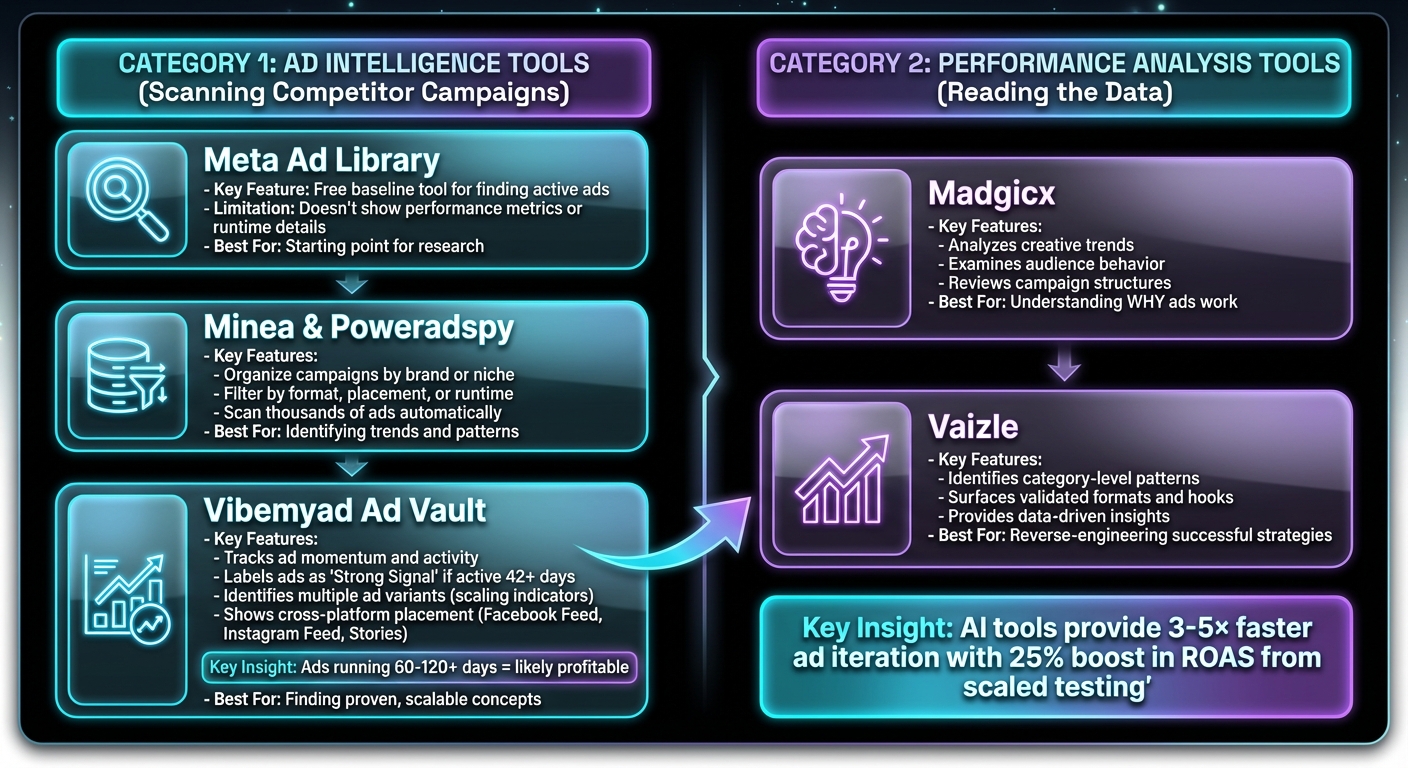
AI Tools for Meta Ad Competitor Research: Features and Benefits Comparison
Manually researching competitors can be a tedious process, often leaving you with incomplete data. Imagine spending hours combing through ads, only to be unsure if the one you saved has been active for a few days or several months. AI tools eliminate this hassle by automating the process, scanning thousands of ads, tracking their performance over time, and revealing key trends. What used to take hours can now be done in minutes, with far more precision.
Ad Intelligence Tools for Scanning Competitor Campaigns
The Meta Ad Library is a helpful starting point for spotting active ads, but it doesn’t tell you critical details like why an ad is performing well or how long it’s been live. That’s where advanced tools come in.
Platforms such as Minea and Poweradspy simplify the process by gathering competitor ads across Meta platforms. These tools organize campaigns by brand or niche and allow you to filter by format, placement, or runtime. They take the guesswork out of identifying trends.
For deeper insights, tools like Vibemyad Ad Vault go a step further by tracking metrics such as ad momentum and activity. For example, if an ad has been running for 60, 90, or even 120 days, it’s a strong indicator that the campaign is profitable - companies don’t keep funding ads that aren’t working. Vibemyad labels ads as “Strong Signal” if they’ve been active for over 42 days and have multiple variants, suggesting the brand is scaling a proven concept.
Spotting multiple versions of the same ad hook? That’s likely a brand refining and doubling down on a winning formula. And if you notice the same ad running across Facebook Feed, Instagram Feed, and Stories simultaneously, it’s a clear sign of a significant budget investment and market validation. Once you’ve identified these patterns, the next step is to analyze why these creatives are performing so well. Applying proven Meta ad copy frameworks can then help you turn these insights into high-converting assets.
Performance Analysis Tools for Reading the Data
Finding successful ads is just the first step. The real challenge lies in understanding why they work. What’s driving conversions? What creative elements are resonating with audiences?
This is where tools like Madgicx and Vaizle come into play. These platforms analyze performance signals by examining creative trends, audience behavior, and campaign structures. They don’t just show you what your competitors are doing; they help you understand the why behind their success.
By identifying trends across brands and surfacing patterns at the category level, these tools enable you to reverse-engineer strategies that are delivering results. Instead of guessing which creative elements matter, you gain data-driven insights into validated formats and hooks that work.
The key to effective competitor research is distinguishing between short-term snapshots and long-term trends. While the Ad Library provides a momentary glimpse, AI tools offer a comprehensive view of patterns over time. This shift from guesswork to informed decision-making can make all the difference in your campaigns.
How to Use Competitor Insights Without Copying
Taking the competitor insights you've gathered, the next step is to turn them into ads that stand out - not by copying, but by understanding why those ads work and applying those principles in your own way. Copying leads to bland, forgettable ads. Instead, dissect their strategy and use it to create ads that are tailored to your brand and audience.
Reverse-Engineering Their Positioning and Messaging
Start by breaking down the key elements of successful competitor ads. Look closely at the benefits they highlight, the objections they address, the social proof they include, and the use cases they promote. These are the building blocks of their messaging, and they can guide you in crafting your own.
For instance, if a competitor emphasizes "time-saving" benefits over "quality", it signals their audience places a premium on speed. Instead of replicating their exact wording, tap into your customer feedback to highlight how your product offers speed in a way that aligns with your brand's voice and values. This ensures your messaging feels genuine and uniquely yours.
The structure of an ad matters just as much as its content. A competitor might frame their product as a solution to a pain point (e.g., "Tired of wasting money on ads that don't work?") or as a way to seize an opportunity (e.g., "Double your ROAS without increasing spend"). Experiment with different ways to frame your message to find the approach that resonates most with your audience.
Once you’ve analyzed these elements, the challenge is to transform them into ads that are unmistakably your own.
Turning Insights Into Original Creatives
After identifying successful patterns - such as problem-solution hooks, demonstration formats, or the use of social proof - treat these as inspiration for your creative brief, not a rigid template. Borrow the structure, but make the execution entirely yours. For example, if competitors are running short-form video demonstrations that have been live for over 90 days, it’s clear that format works. But your version should tell your story, showcase your product, and reflect your unique perspective.
A great example of this approach comes from Fashion Forward Co. In early 2026, under the leadership of CMO Sarah Chen, the company leveraged Aden's Lab to produce over 200 ad variations in just one day. Each ad was built on proven psychological triggers but tailored with their brand's assets and messaging. The result? A 340% boost in ROAS.
"Aden's Lab created 200+ ad variations in one day. Our previous agency took 3 weeks for 10 ads. The AI-created ads outperformed our human-created ones by 340%." – Sarah Chen, CMO, Fashion Forward Co.
The secret lies in volume. Tools like Aden's Lab allow brands to test dozens of variations instantly, with different hooks, layouts, and framings. Meta’s algorithm then identifies which angles connect best with the audience. This method - testing meaningful structural differences rather than minor tweaks - has proven effective. For instance, TechGadget Pro saw a 520% increase in click-through rates and generated $1.8 million in additional revenue in 2026 after switching from a $50,000/month agency to an AI-driven model that better understood their audience's preferences.
This is where the "Drop a link → Get ads → Launch on Meta" approach becomes invaluable. By quickly transforming competitor insights into a variety of brand-specific creatives, tools like Aden's Lab eliminate production delays and combat creative fatigue. The result? You stay ahead, armed with fresh, high-performing ads in minutes instead of weeks.
The Creative Production Problem (And How to Fix It)
Taking a closer look at competitor ads on Meta reveals something interesting: the brands that perform best aren’t necessarily more creative - they’re just faster at producing and launching new ads. The top players crank out 5–10 fresh ad variations every week, while many teams struggle to hit even 20 in an entire month. This gap in production speed is where campaigns falter. Ad fatigue creeps in, performance dips, and ROAS starts to slide. The solution? Keeping up a relentless pace of creative updates.
Why Scaling Requires Constant Creative Refresh
Scaling Meta campaigns beyond $1,000 a day to $10,000 or more isn’t just a matter of scaling your budget with AI. It’s about creative speed. Click-through rates (CTR) on even your best-performing ads can drop by over 50% within just 7–14 days because audiences grow tired of seeing the same messaging. To keep your ROAS above 2×, you’ll need to test anywhere from 20 to 50 new ad variations per campaign. That’s why top-performing brands launch multiple creatives daily, while smaller teams often max out at just a handful per week.
Here’s a real-world example: one performance marketer was losing $50,000 a month due to outdated creatives. His team could only produce 10 ads per week manually, but he needed more than 50 to stay competitive. Poor designs were eating up 30–50% of his ad spend. In another case, a DTC brand spending $100,000 a month managed to maintain a 3.5× ROAS by regularly refreshing ads based on competitor strategies. However, when delays stretched to two weeks, their ROAS plummeted to 1.2×.
How Automation Solves the Creative Bottleneck
Automation can close this gap. Aden's Lab offers a streamlined solution with its "Drop a link → Get ads → Launch on Meta" process. All you have to do is paste your product URL, and within 90 seconds, you’ll have dozens of ready-to-use static Meta ads. This approach directly combats ad fatigue by ensuring a steady stream of fresh creatives.
Compare this to traditional agencies, which can charge over $1,000 for just 10 ads - and take two weeks to deliver them. With Aden's Lab's Apex Mode plan, you can generate 200 ads per month for just $0.90 per ad. That’s enough to outperform entire creative teams at a fraction of the cost. For instance, if you notice a competitor’s "before/after" visual working well on Instagram, you can instantly create 20 customized variations using your own product link. One brand using this method achieved a 2.8× ROAS in just one week.
Automation doesn’t just speed things up - it changes the game entirely. Platforms with automated creative analysis allow for 3–5× faster ad iteration, and users report a 25% boost in ROAS from scaled testing. Manual teams often waste up to 40% of their budgets on outdated ads. By automating, you can generate over 100 creatives each month without exhausting your resources. When 80% of brands produce fewer than 20 ads monthly, being able to test 5–10× that volume gives you a massive advantage. This rapid pace of iteration keeps your ads fresh and your ROAS consistently strong.
Conclusion: Turn Research Into Ads That Perform
Competitor research isn't about copying - it’s about recognizing patterns that work and shaping them to fit your brand. For instance, if you notice an ad running for over 60 days with multiple variations, that’s a strong indicator that the approach resonates with the target audience. The goal is to distill the core strategy behind that success and align it with your brand’s unique message, benefits, and customer language.
Once you’ve identified what works, the next step is execution. And here’s where many teams stumble - not in gathering insights, but in acting on them quickly. While some teams lose precious weeks waiting for creative assets, agile marketers who embrace Meta ad automation can turn insights into test-ready ads in a matter of minutes.
That’s where Aden’s Lab comes in. This tool eliminates the usual production delays. Simply drop your product link, and within 90 seconds, you’ll have dozens of polished Meta ads ready to launch, all built using your brand’s existing assets. For example, if a competitor’s "before/after" visual catches your eye, you can instantly create multiple variations using your own product data - no lengthy prompts or back-and-forth delays. It’s as simple as "Drop a link → Get ads → Launch on Meta."
This kind of speed creates a compounding advantage. Case studies show that quick creative iteration can dramatically improve ad performance while cutting costs. One brand reduced its agency turnaround time from three weeks to just one day, leading to a 340% boost in ROAS. Another brand slashed its creative spend from $50,000 per month to just $500.
At the end of the day, success isn’t just about having the insights - it’s about how quickly you can act on them. The best-performing brands on Meta aren’t necessarily the ones with the biggest budgets or the flashiest ads. They’re the ones who identify what works, adapt it to their voice, and execute faster than their competitors. Competitor research provides the roadmap, and automation gives you the speed to act before the opportunity slips away.
FAQs
How can I tell if a competitor’s ad is profitable?
Profitability isn’t just about racking up likes or comments. The real indicators are conversion rates and ROAS (return on ad spend), which reveal how much revenue an ad brings in compared to what it costs to run. Ads that run for extended periods, often with slight variations, are usually a sign of success - they’re likely being scaled because they’re profitable. Although you can’t always see the exact numbers, consistent ad activity and performance patterns can give you solid hints about profitability.
What parts of a competitor ad can I reuse without copying?
You can take cues from elements like their core message, headline, or hook by reworking how they present their offer or tackle a problem. Pay attention to their ad structure - how they showcase the product or emphasize its benefits - but steer clear of replicating exact phrases, visuals, or layouts. The idea is to use their concepts and approaches as inspiration to create fresh, engaging ads tailored to your audience.
How many new creatives should I launch each week to avoid ad fatigue?
To keep your audience engaged and avoid ad fatigue on Meta platforms, it's a good idea to update your creatives every 2–4 weeks. For platforms with quicker content cycles, like TikTok, you may need to refresh your ads as often as once a week. Consistently refreshing your ads keeps them interesting and helps maintain strong performance over time.
Your next ad batch starts here
Finish with a ready-to-test ad batch
Paste your website to generate static creatives. Drop the link → get ads in about 90 seconds → upload them to Meta → scale.
Free to try No prompt writing