CBO vs ABO for Reach and Awareness Campaigns: Which Structure Wins?
Turn the strategy into creatives
Create Meta ads for your product
Paste your product page. ADEN'S LAB turns the offer, audience, and positioning into complete ready-to-use Meta static ads.
Free to try No prompt writing

When deciding between Campaign Budget Optimization (CBO) and Ad Set Budget Optimization (ABO) for Meta reach and awareness campaigns, the choice boils down to efficiency vs. control:
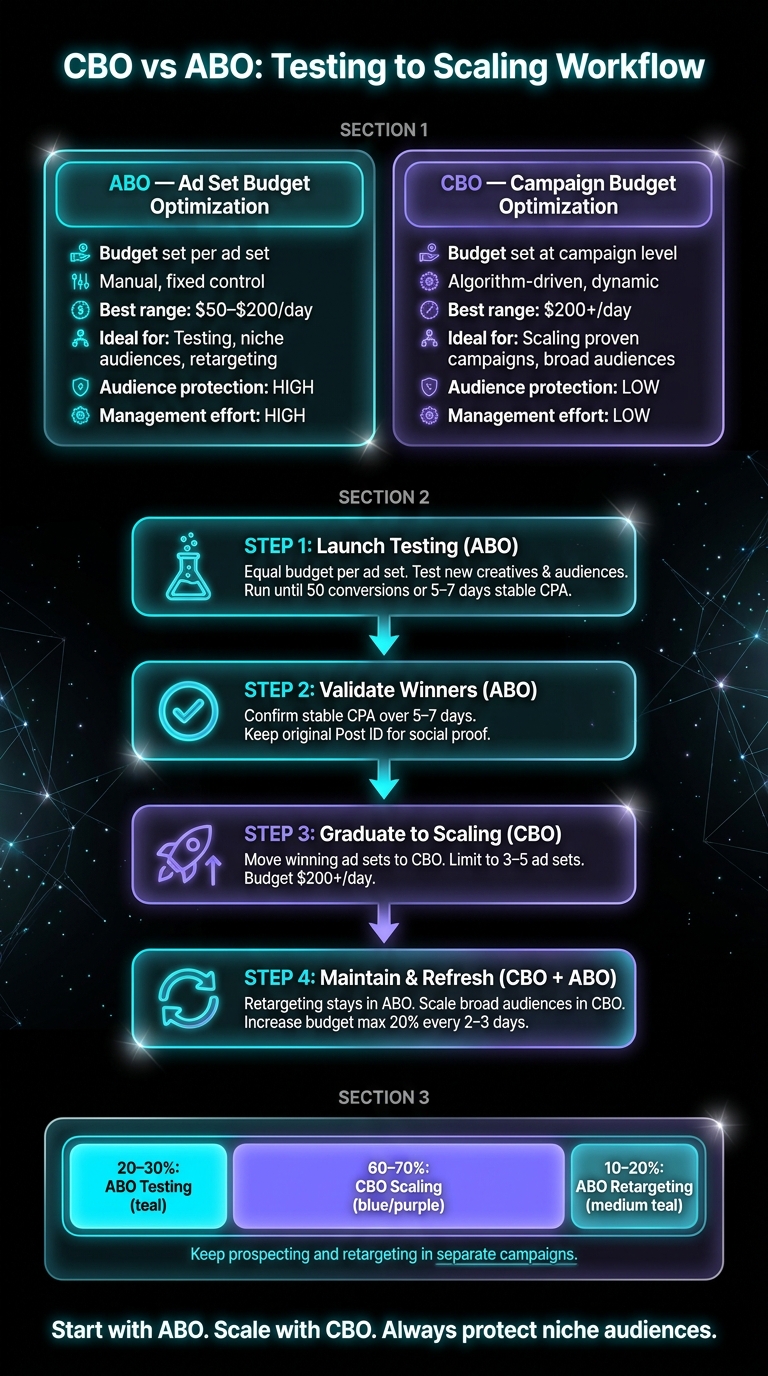
- CBO: Automates budget allocation across ad sets using Meta’s algorithm, prioritizing cheaper impressions and maximizing reach. Best for scaling with larger budgets ($200+/day).
- ABO: Lets you manually control budgets per ad set, ensuring specific audiences receive consistent exposure. Ideal for testing or smaller budgets ($50–$200/day).
Key Takeaways:
- Use ABO for testing new audiences or creatives, especially with smaller budgets or niche segments.
- Switch to CBO for scaling proven campaigns, focusing on broad audiences and efficiency.
- Combine both: Start with ABO for testing, then transition winning ad sets to CBO for scaling.
Quick Comparison:
| Criteria | CBO | ABO |
|---|---|---|
| Budget Control | Dynamic, algorithm-driven | Fixed, advertiser-controlled |
| Best Budget Range | $200+/day | $50–$200/day |
| Audience Focus | Broad audiences | Niche or smaller segments |
| Management | Low effort | High effort |
| Best Use | Scaling proven campaigns | Testing new creatives/audiences |
Start by testing with ABO, then scale efficiently with CBO for the best results.
Facebook Ads ABO vs CBO - Which Should You Use in 2026?
Put the playbook to work
Apply this playbook to your page
Paste your website and the Lab will turn the strategy you are reading into a ready-to-test ads.
Free to try No prompt writing
How CBO and ABO Work for Reach and Awareness Goals
Understanding how CBO (Campaign Budget Optimization) and ABO (Ad Set Budget Optimization) function is key to leveraging them effectively for reach and awareness campaigns. Both methods can support these goals on Meta platforms, but they handle budget allocation very differently.
How CBO Allocates Budgets
CBO, also known as Advantage Campaign Budget in Meta Ads Manager, operates with a single budget set at the campaign level. Meta's algorithm then takes over, dynamically redistributing the budget across ad sets in real time. This redistribution is based on factors like auction prices, historical performance, and predicted delivery efficiency. Essentially, the system prioritizes ad sets that deliver impressions at a lower cost. For optimal results, it's recommended to limit CBO campaigns to 3–5 ad sets.
"With Advantage+ campaign budget, you set one central campaign budget. This budget continuously distributes in real time to ad sets with the best opportunities, throughout the course of your campaign." - Meta for Business
However, larger audiences often receive a bigger share of the budget. To ensure smaller audience segments aren't overlooked, you can set minimum spend limits at the ad set level.
How ABO Controls Budgets
ABO, on the other hand, assigns a fixed budget to each ad set. Once an ad set spends its allocated daily budget, it stops delivering - even if other ad sets still have available funds. This fixed allocation is particularly useful when specific audiences, such as niche demographics, require guaranteed exposure.
As Murat Bock of Adlibrary notes:
"CBO optimizes across ad sets; it doesn't equalize them... ABO keeps the controls with you."
ABO is especially effective for campaigns with smaller budgets, ranging from $50 to $200 per day. To determine your ideal allocation, you can use an ad budget planner to map out your spending strategy. At these levels, Meta's algorithm may struggle to gather enough data for effective optimization, making manual control a better choice in such scenarios.
Despite their differences, CBO and ABO share some common ground.
Shared Features and Settings
Both CBO and ABO share foundational settings that align with the same campaign objectives. Whether you’re using CBO or ABO, you’ll find identical options for selecting objectives (like Reach and Awareness), placement settings (Advantage+ or manual), and evaluation metrics such as CPM, frequency, and unique reach.
CBO has the advantage of pooling optimization signals across all ad sets, which often allows campaigns to exit the learning phase faster. In contrast, ABO requires each ad set to independently achieve around 50 optimization events per week to stabilize delivery.
| Setting | CBO | ABO |
|---|---|---|
| Budget level | Campaign | Ad set |
| Spend distribution | Dynamic, algorithm-driven | Fixed, advertiser-controlled |
| Learning phase | Pooled across ad sets | Independent per ad set |
| Management overhead | Low | High |
| Best fit | Scaling proven audiences | Testing and audience protection |
CBO vs ABO: Key Differences and Performance Comparison
Let’s break down the practical differences between Campaign Budget Optimization (CBO) and Ad Set Budget Optimization (ABO) for reach and awareness campaigns.
Budget Control and Allocation Flexibility
The main tradeoff here is efficiency vs. control.
With CBO, Meta's algorithm takes charge, reallocating your budget hour by hour based on live auction signals. This can be a game-changer when you're scaling a well-performing audience since the system maximizes efficiency. But it also means you're giving up control over where your money goes. On the flip side, ABO allows you to retain that control, which is crucial when you need specific audiences to receive a guaranteed share of the budget - especially if those audiences might not perform well initially.
For U.S. advertisers running awareness campaigns with daily budgets between $50 and $200, ABO often proves to be the safer bet. At this level, Meta's algorithm doesn’t have enough data to make effective real-time decisions. However, CBO works better at higher budgets, where the algorithm has more room to optimize across ad sets.
Reach Efficiency and Cost Metrics
When it comes to raw efficiency, CBO takes the lead. By continuously shifting spend toward the cheapest impressions, it tends to lower your overall CPM (cost per thousand impressions). If your goal is to maximize unique reach at the lowest cost, CBO is built for that.
ABO, however, ensures consistent reach across audience segments. It won’t let the algorithm overlook a niche audience just because a broader one is cheaper to target. This consistency is especially important for campaigns targeting distinct groups - like specific age brackets or geographic regions - where you want each group to receive adequate exposure.
Audience Segmentation and Delivery Stability
The differences become even clearer when considering audience segmentation. CBO tends to favor larger audiences. A broad prospecting group often dominates the budget, leaving smaller, high-value segments with minimal impressions. In fact, it’s common for a single ad set to consume 70–90% of the budget due to temporary cost advantages.
ABO avoids this issue by enforcing fixed budgets per ad set. A great example comes from Sunrun in 2026, where they used ABO to maintain strict audience segmentation by location. With this approach, they tailored messaging for South Carolina ("freedom and independence") and California ("clean energy"), ensuring each audience received a dedicated budget, unaffected by national trends.
Here’s a quick comparison of the two approaches:
| Criteria | CBO (Campaign Budget Optimization) | ABO (Ad Set Budget Optimization) |
|---|---|---|
| Budget control | Algorithm-driven, campaign level | Manual, fixed per ad set |
| Reach efficiency | Higher - shifts to cheapest impressions | Lower - fixed regardless of auction prices |
| Audience protection | Low - risk of starvation | High - spend is enforced |
| Delivery consistency | Dynamic, fluctuates with auctions | Predictable, stable per segment |
| Scaling stability | High - less prone to learning resets | Lower - 20%+ increases reset learning phase |
| Best budget range (U.S.) | $200+/day | $50–$200/day |
How to Choose Between CBO and ABO
CBO vs ABO: When to Use Each & How to Transition
Deciding between Campaign Budget Optimization (CBO) and Ad Set Budget Optimization (ABO) comes down to three main considerations: your spending level, differences in audience size, and whether you're testing or scaling. This choice directly affects how well your campaign reaches and engages its audience.
When to Use ABO
ABO works best when you need to ensure specific audience segments receive dedicated attention. For awareness campaigns with smaller daily budgets, manual control is often more effective because the algorithm doesn't have enough data to make optimal decisions.
ABO is also ideal when your audience sizes differ greatly. For example, a retargeting audience of 10,000 people could lose out on budget allocation to a much larger prospecting audience of 2 million in a CBO campaign. With ABO, each segment gets its own budget, ensuring fair exposure. This setup is especially valuable for testing new creatives or audiences, as it gives every variable a fair chance to perform. Studies have shown that during testing, ABO achieved an average ROAS of 94% for prospecting campaigns, compared to 81% with CBO.
In short, ABO provides precise control for testing, while CBO shines when it’s time to scale.
When to Use CBO
CBO, on the other hand, is all about efficiency. It’s the better choice when you’re ready to scale successful campaigns. With daily budgets exceeding $100, Meta’s algorithm has enough data to allocate budgets effectively across ad sets. This leads to lower blended CPMs and broader reach without the need for constant manual adjustments.
For the best results, limit CBO campaigns to 3–5 proven ad sets. Including too many ad sets can confuse the algorithm and weaken its learning process. Additionally, CBO works best when audience sizes are relatively similar, as it handles balanced segments far better than mismatched ones.
Blended and Sequential Funnel Approaches
Often, combining both strategies delivers the best outcomes. Start by testing new creatives and audiences using ABO. Once an ad set achieves a stable CPA for at least five days and generates over 50 optimization events weekly, move it into a dedicated CBO campaign.
When transitioning winners, keep the original Post ID to retain social proof. A common budget allocation strategy is to spend 20–30% on ABO for testing, 60–70% on CBO for scaling, and 10–20% on retargeting. Retargeting is usually kept in ABO to ensure smaller warm audiences don’t lose budget.
Here’s a quick summary of the recommended structures for each funnel stage:
| Funnel Stage | Recommended Structure | Why |
|---|---|---|
| Top of funnel – testing | ABO | Ensures fair testing with equal budget distribution |
| Top of funnel – scaling | CBO | Maximizes reach and efficiency with proven winners |
| Retargeting (warm audiences) | ABO | Protects smaller segments from budget starvation |
| Broad/Advantage+ audiences | CBO | Gives the algorithm full freedom to find the best users |
Using ADEN's LAB to Support CBO and ABO Campaigns
Keeping Creatives Fresh in High-Volume Reach Campaigns
Creative fatigue is a major obstacle for reach and awareness campaigns, often creeping in unnoticed. Meta's 2026 "Andromeda" system highlights this issue, showing that ad fatigue can set in as quickly as 2–3 weeks. Once frequency surpasses 4, CPMs spike, and click-through rates plummet. The solution? A steady stream of fresh, static creatives.
This is where ADEN's LAB steps in. It generates static Meta ads tailored for Facebook and Instagram, creating new variants in under 90 seconds. Brands running 30+ ad variants simultaneously signal Meta's algorithm that they have a strong creative testing system. This helps maintain reach while controlling costs as audiences saturate. With a cost of just $0.90 per ad in Apex Mode, replacing fatigued creatives becomes a simple, ongoing process. This capability makes ADEN's LAB a key tool for both testing and scaling campaigns.
Using ADEN's LAB with ABO for Creative Testing
Refreshing creatives quickly is essential, and ADEN's LAB simplifies this process by producing multiple ad variants in no time. ABO (Ad Set Budget Optimization) is particularly effective for testing because it ensures equal budget distribution across all ad sets. This guarantees that every creative gets a fair chance to deliver meaningful results.
"ABO gives you the control you need when you're testing. CBO gives you the efficiency you need when you're scaling." - Purva, Vaizle
The strategy is straightforward: launch ADEN's LAB-generated creatives in separate ABO ad sets, each with an equal budget. Let these run until they either hit the 50-conversion mark or maintain a stable target CPA for 5–7 days. This approach ensures clean, reliable data and prevents Meta's algorithm from prematurely favoring one creative based on early, potentially misleading results. By keeping the testing phase structured, you can make informed decisions about which creatives are worth scaling.
Using ADEN's LAB with CBO for Scaling
Once a creative performs well in ABO testing, it moves to a CBO (Campaign Budget Optimization) campaign. At this stage, Meta's algorithm dynamically reallocates the budget to maximize performance. However, scaling requires a constant flow of fresh creatives to prevent fatigue and maintain efficiency as audience saturation increases.
To keep CPMs steady and expand reach, you’ll need to generate dozens of static ads weekly. Limit your CBO campaigns to 3–5 tested and proven ad sets. This ensures the strongest ADEN's LAB variants are prioritized, rather than overloading the campaign with untested creatives. A focused approach helps Meta's algorithm optimize performance without diluting results. By consistently updating creatives, you can sustain reach and efficiency in high-volume campaigns.
| Workflow Stage | Structure | ADEN's LAB Role |
|---|---|---|
| Creative discovery | ABO | Generate and test multiple static variants with equal spend |
| Winner validation | ABO | Confirm stable CPA over 5–7 days before graduating |
| Scaling proven winners | CBO | Supply fresh creative volume to sustain reach and counter fatigue |
Conclusion: Key Takeaways and Recommendations
When it comes to choosing between ABO and CBO, there’s no one-size-fits-all solution. Each approach has its strengths, depending on your campaign goals. ABO is all about precision - it’s perfect for testing audiences, ensuring balanced budget distribution, and gathering clean, actionable data. Meanwhile, CBO is designed for efficiency, leveraging Meta's algorithm to identify the best opportunities in real-time, making it the go-to choice for scaling successful campaigns across broader audiences.
The best strategy? Start with ABO for testing and transition to CBO for scaling. As Cedric Yarish from AdManage puts it:
"ABO is manual transmission, CBO is automatic. ABO tends to win for learning, CBO tends to win for optimizing known quantities."
Here’s how to approach it: Begin with ABO to test creatives and guarantee fair budget allocation. After an ad set stabilizes - usually over 5–7 days or after achieving 50 optimization events per week - switch to CBO to scale what works. A few important tips to keep in mind:
- Avoid combining prospecting and retargeting within a single CBO campaign.
- Limit budget increases to 20% every 2–3 days to prevent disrupting the learning phase.
- Use minimum spend limits in CBO campaigns to ensure critical ad sets maintain visibility.
To simplify your decision-making, here’s a quick reference guide:
| Decision Factor | Choose CBO When... | Choose ABO When... |
|---|---|---|
| Campaign Stage | Scaling proven ad sets | Testing new creatives or audiences |
| Audience Type | 3–5 similar, large audiences | Varying sizes or niche segments |
| Budget Level | $500+/day | $50–$200/day |
| Funnel Position | Single stage (e.g., prospecting) | Mixed stages (prospecting + retargeting) |
| Testing Needs | Not running a controlled test | A/B tests requiring equal spend |
FAQs
How many ad sets should I run in a CBO reach campaign?
When setting up Campaign Budget Optimization (CBO) for reach and awareness campaigns, aim for 3 to 8 ad sets. This range gives the algorithm enough flexibility to distribute your budget effectively across the top-performing segments. Including too many ad sets can spread your budget too thin, making it harder for the algorithm to optimize. To get the best results, ensure all ad sets align with similar objectives.
What’s the easiest way to move winners from ABO to CBO without losing results?
To move successful ad sets from Ad Set Budget Optimization (ABO) to Advantage Campaign Budget (CBO) while maintaining performance, here’s what you need to do:
- Confirm the ad sets are ready: Make sure the ad sets have completed the learning phase. This means achieving at least 50 optimization events per week and staying within 15% of your target CPA for at least five days.
- Duplicate into a new CBO campaign: Copy the winning ad sets into a fresh CBO campaign. Use the original post IDs to retain any social proof, such as likes, comments, and shares.
- Pause the ABO ad sets: Stop the ABO ad sets to avoid audience overlap. Set the CBO campaign budget to match the total budget of the ABO ad sets you're transitioning.
This approach helps ensure a smooth shift while minimizing disruptions to your campaign’s results.
How do I keep small audiences from getting ignored in CBO?
In Campaign Budget Optimization (CBO), smaller audiences often get overshadowed because the algorithm tends to prioritize larger ones. To counter this, you can establish minimum spend limits for certain ad sets, ensuring that smaller groups still receive a portion of the budget. Additionally, applying maximum spend caps to underperforming ad sets can stop them from draining funds that could be better directed toward high-value, smaller audiences.
Your next ad batch starts here
Finish with a ready-to-test ad batch
Paste your website to generate static creatives. Drop the link → get ads in about 90 seconds → upload them to Meta → scale.
Free to try No prompt writing