CBO vs ABO for Creative Testing on Meta: What to Use First
Turn the strategy into creatives
Create Meta ads for your product
Paste your product page. ADEN'S LAB turns the offer, audience, and positioning into complete ready-to-use Meta static ads.
Free to try No prompt writing

Struggling to decide between CBO (Campaign Budget Optimization) and ABO (Ad Set Budget Optimization) for testing on Meta? Here’s the short answer:
- Start with ABO: It ensures equal budget distribution, giving all ad variants a fair chance to perform. Ideal for A/B testing new ideas or when working with limited data and smaller budgets.
- Switch to CBO: Once you’ve identified top-performing ads, CBO helps scale them efficiently by dynamically allocating budgets to maximize results.
Key Takeaways:
- ABO: Fixed budgets per ad set, better for testing as it avoids algorithm bias but requires manual management.
- CBO: Campaign-level budget, faster scaling but risks favoring early winners prematurely.
- Best Practice: Test with ABO, scale with CBO. Use tools like ADEN’s LAB to quickly generate ad variations and maintain a steady pipeline for testing.
Quick Comparison:
| Feature | ABO | CBO |
|---|---|---|
| Budget Control | Manual, set per ad set | Algorithmic, set at campaign level |
| Testing Accuracy | High – equal exposure | Lower – biased toward early signals |
| Management Effort | High – requires monitoring | Low – automated allocation |
| Scaling Speed | Slower – manual adjustments | Faster – real-time reallocation |
| Best Use Case | Testing new ads, low-budget campaigns | Scaling proven ads, high-volume campaigns |
How CBO Works for Creative Testing
How CBO Allocates Budget During Testing
Campaign Budget Optimization (CBO) operates with a single budget at the campaign level. Meta's algorithm then dynamically allocates funds across ad sets based on predicted performance. This process relies on factors like auction dynamics, historical data, and audience behavior to direct spending toward the ad set most likely to achieve the lowest cost per conversion. This dynamic approach highlights both the strengths and challenges of using CBO for creative testing.
Advantages of CBO for Creative Testing
CBO's AI-driven budget allocation brings several benefits when testing creative performance. It automatically shifts spending from underperforming ad sets to those delivering strong results. This is particularly useful for high-volume campaigns where manual budget management would be too time-consuming.
Murat Bock, the Founder of Adlibrary.com, explains:
"CBO optimizes across ad sets; it doesn't equalize them. It allocates funds to the top-performing ad set in real time."
Meta's "Andromeda" update has further refined this process. Now, the learning phase happens at the ad level and rolls up to the ad set level. This change allows CBO to efficiently handle a mix of creative concepts within fewer ad sets, streamlining the testing process. To maintain this efficiency, advertisers often need a steady stream of new creative concepts to test against existing winners.
Limitations of CBO for Creative Testing
Despite its benefits, CBO has some drawbacks in creative testing. One major issue is its tendency to favor certain ad sets too early, often allocating 80–90% of the budget to just one or two ad sets. This can prevent a fair evaluation of all creative options.
Antonio Ventre, Founder of Skaleit Agency, highlights this challenge:
"CBO's forecasting can get biased by the new creatives you add, even if the old winners are still strong."
Additionally, each ad set needs around 50 conversions per week to exit the learning phase and perform optimally. Without sufficient funding, some ad sets may remain in a "Learning Limited" state, making it difficult to assess their true performance. To address this, setting minimum spend limits at the ad set level can ensure all creative variants receive enough exposure for a fair evaluation.
Put the playbook to work
Apply this playbook to your page
Paste your website and the Lab will turn the strategy you are reading into a ready-to-test ads.
Free to try No prompt writing
How ABO Works for Creative Testing
How ABO Allocates Budget During Testing
Ad Set Budget Optimization (ABO) allows you to assign a fixed daily or lifetime budget to each ad set. Unlike Campaign Budget Optimization (CBO), where Meta’s algorithm shifts funds between ad sets based on performance, ABO keeps the budget static for each ad set. This setup ensures that no ad set is prematurely deprived of funds, giving every creative a fair chance to perform, even if it starts slow.
This predictability is especially helpful during the learning phase. Meta’s algorithm requires approximately 50 optimization events per ad set per week to exit the learning phase. To calculate the daily budget needed for this, multiply your target CPA by 50, then divide by 7. For example, with a $10 CPA target, you’d need around $71 per day for each ad set to hit that threshold.
"ABO fixes the budget per ad set. This gives you direct spend control, which is essential during the learning phase, new creative testing, or when running isolated segments that must each accumulate signal." - Murat Bock, Founder, Adlibrary
Advantages of ABO for Creative Testing
ABO’s fixed budget approach ensures that all creative variants are tested under identical conditions. This means the algorithm won’t favor one ad over another by allocating more budget to it prematurely. As a result, you get cleaner, more reliable data to compare performance across creatives.
Another advantage is that weaker-performing creatives can’t consume the budget meant for stronger ones. Each ad set operates independently, which is especially useful for making data-driven decisions. Many industry frameworks suggest dedicating 20–30% of your total ad budget to an ABO testing tier. Once you identify the top-performing creatives, you can move them into a scaling campaign.
ABO also works well for smaller, more specific audiences, such as retargeting segments or custom audiences. In a CBO setup, these smaller groups might lose out to larger prospecting audiences, but ABO ensures they get the attention they need.
Limitations of ABO for Creative Testing
Managing ABO campaigns requires more manual effort. Unlike CBO, ABO won’t automatically pause underperforming ad sets or reallocate budgets to top performers. To avoid wasting your budget, you’ll need to establish clear "kill rules" before launching. These rules often involve real-time bid adjustments to protect your margins. For example, you might decide to pause an ad set if it spends 2–3 times your target CPA without generating a conversion.
Scaling in ABO can also be tricky. If you increase a daily budget by more than 20% at once, it resets the learning phase, often causing CPA spikes that can last 3–7 days. A more cautious approach is to increase budgets by 20–30% every 2–3 days, though this slows down the scaling process.
| Limitation | Impact | Mitigation |
|---|---|---|
| Manual management | Delayed response to performance shifts | Set clear kill rules before launching |
| Learning phase resets | CPA spikes with large budget increases | Limit budget increases to 20% every 2–3 days |
| Static allocation | Budget wasted on poor performers | Pause underperformers based on CPA thresholds |
| Data fragmentation | Requires 50 conversions per ad set | Run fewer ad sets with higher individual budgets |
For advertisers spending less than $100 per day, ABO is often a better choice. At lower budget levels, CBO doesn’t collect enough data to allocate funds effectively, making ABO the safer and more reliable option.
CBO vs ABO: Key Tradeoffs and How to Decide
Core Tradeoffs Between CBO and ABO
As Cedric Yarish explains, "ABO is manual transmission, CBO is automatic." With ABO, you control every dollar, while CBO relies on Meta's algorithm to allocate your budget. This distinction becomes especially important during creative testing. ABO ensures each creative variant gets equal exposure by sticking to fixed budgets. On the other hand, CBO prioritizes early performance signals, which can lead to uneven spending - often favoring early winners over a balanced approach.
ABO delivers cleaner, more balanced data, but it requires constant manual oversight. CBO, while faster and more efficient, risks misallocating budgets based on initial performance signals. In CBO campaigns, it's common for one or two ad sets to soak up 70–90% of the total campaign budget, making it less suitable for unbiased creative testing.
"ABO is for reading the market; CBO is for capitalizing on it." - Murat Bock, Founder, Adlibrary
The industry standard in 2026 reflects this balance: use ABO to test unproven creatives, then shift successful ones to CBO for scaling. Specifically, creatives should "graduate" to CBO after achieving 50+ optimization events in a 7-day period and maintaining a CPA within 15% of your target for five consecutive days.
Comparison Table: CBO vs ABO for Creative Testing
Here’s a quick breakdown of how ABO and CBO stack up when it comes to creative testing:
| Feature | ABO | CBO |
|---|---|---|
| Budget Control | Manual; set per ad set | Algorithmic; set at campaign level |
| Data Quality | High – equal spend across variants | Variable – biased toward early signals |
| Wasted Spend Risk | Requires manual kill rules to limit losses | Algorithm automatically pulls back |
| Scaling Speed | Slower – manual budget adjustments | Faster – real-time reallocation |
| Management Effort | High – needs daily monitoring | Low – set-and-forget once optimized |
| Best Use Case | Creative testing, new launches, low budgets | Scaling proven winners, evergreen campaigns |
Balancing fairness in testing with the need for speed in scaling is critical. ABO’s fixed budgets ensure fair testing but can lead to wasted spend if underperforming creatives aren’t paused quickly. Setting clear kill rules - like pausing any ad set that spends 2–3 times your target CPA without converting - is key to managing this risk. While CBO automates this process, it does so by sacrificing fairness in how creative variants are tested.
For advertisers in SaaS or B2B sectors, where conversion volumes are typically lower, ABO is often the better choice. CBO works best when ad sets generate at least 50 conversions per week, making it less effective in low-volume scenarios.
Facebook Ads ABO vs CBO - Which Should You Use in 2026?
A Practical Framework for Choosing and Sequencing CBO and ABO
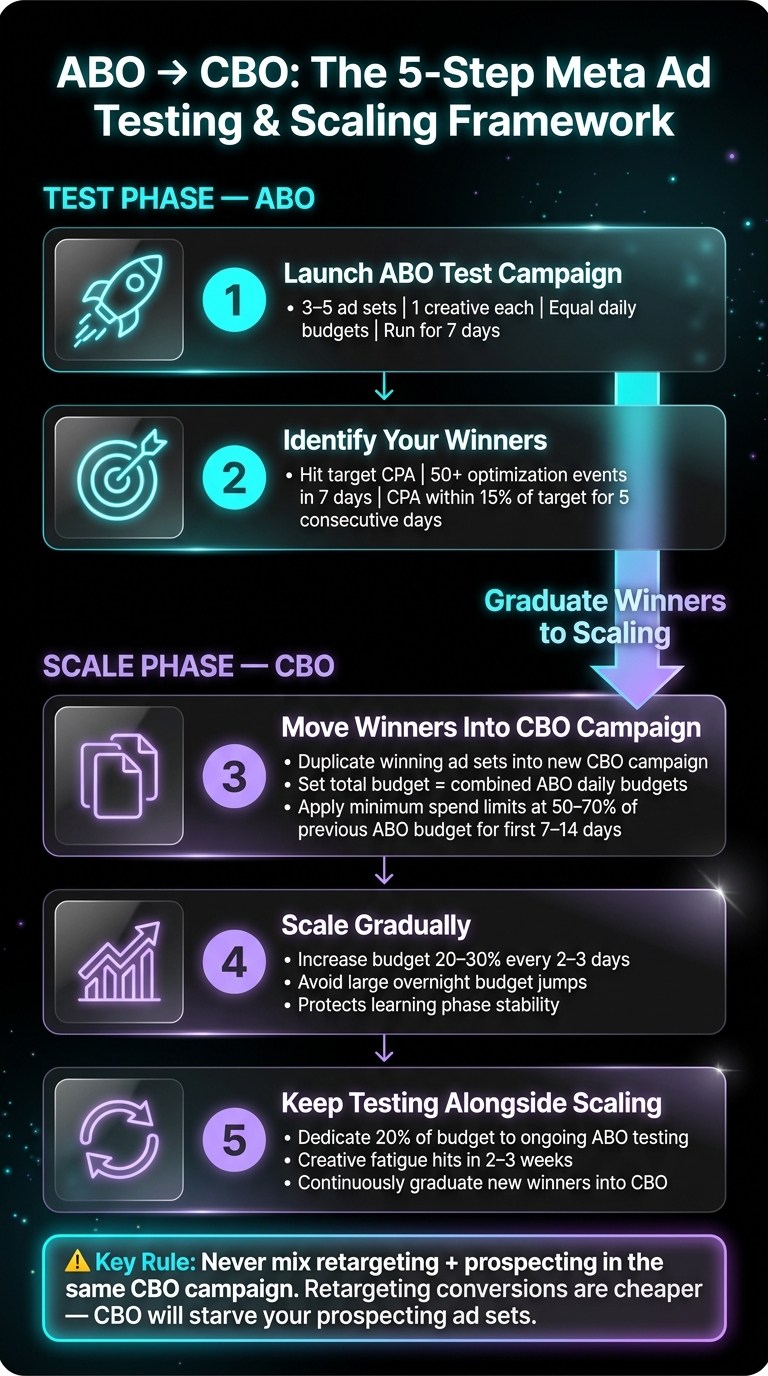
ABO vs CBO: Creative Testing & Scaling Framework for Meta Ads
Deciding between Campaign Budget Optimization (CBO) and Ad Set Budget Optimization (ABO) can feel tricky, but this framework will help you test and scale your creatives effectively.
When to Start With CBO
CBO works best when you already have some performance data to guide your decisions. It’s designed to make scaling more efficient by using proven audiences and managing tighter daily budgets. If you’re producing a high volume of creatives - like dozens of static ad variants each month with tools like ADEN's LAB - CBO becomes essential. Manually adjusting budgets for each ad set at that scale is nearly impossible. CBO simplifies this by automatically directing spend toward the creatives that perform best in real time.
When to Start With ABO
ABO is ideal for testing new creative strategies, especially when you’re working with limited data. This setup is particularly useful for smaller accounts, such as SaaS, B2B, or lead generation campaigns, where weekly conversions might only reach 10–20. Since CBO typically needs about 50 conversions per ad set per week to optimize effectively, ABO gives you the control to gather unbiased data when conversion volume is low.
Once you’ve chosen your starting point, follow this process to move from testing to scaling.
A Step-by-Step Testing and Scaling Process
The best approach for 2026 follows a simple two-step structure: test with ABO, then scale with CBO. Here’s how to do it:
-
Step 1: Launch an ABO Test Campaign
Start with 3–5 ad sets, each featuring a single creative and an equal daily budget. This ensures every ad set gets a fair evaluation. Run the campaign for 7 days to capture performance across both weekdays and weekends. -
Step 2: Identify Your Winners
Keep an eye on performance metrics. Look for ad sets that hit your target CPA and generate at least 50 optimization events within the 7-day period. Stability is key - if an ad set stays within 15% of your target CPA for 5 straight days, it’s likely a solid performer rather than a lucky outlier. -
Step 3: Move Winners Into a CBO Scaling Campaign
Duplicate the successful ad sets into a new CBO campaign. Set the total budget to match the combined daily budgets of the ABO winners. During the first 7–14 days, apply minimum spend limits at 50–70% of the previous ABO daily budget to balance performance across new and existing ad sets. -
Step 4: Scale Gradually
Increase the CBO campaign budget in small increments - 20–30% every 2–3 days. Sudden budget jumps can disrupt the learning phase and hurt performance, so avoid making large changes overnight. -
Step 5: Keep Testing Alongside Scaling
Dedicate about 20% of your budget to ongoing ABO testing. With Meta’s Andromeda delivery system, creatives can experience fatigue within 2–3 weeks. Consistently test new variants, and as soon as one meets your graduation criteria, move it into the CBO campaign and repeat the process.
A Key Rule to Remember
Never mix retargeting and prospecting in the same CBO campaign. Retargeting conversions are usually cheaper, so CBO tends to favor those ad sets, which can end up starving your prospecting efforts. Keep these campaigns separate to maintain a balanced strategy.
Conclusion: Picking the Right Budget Structure for Creative Testing
Choosing between CBO (Campaign Budget Optimization) and ABO (Ad Set Budget Optimization) comes down to a balance between control and efficiency. ABO ensures equal spending across creatives for unbiased testing, while CBO relies on algorithms to dynamically allocate budgets to the best-performing creatives. As the Adligator Team puts it:
"ABO trades efficiency for control. CBO trades control for efficiency. Neither is inherently superior."
Here’s a practical approach: start with ABO for testing creatives in environments where conversions are low. Once ad sets demonstrate consistent performance, transition to CBO. Skipping this progression can lead to problems - untested creatives in CBO might cause the algorithm to favor early, misleading signals, which could limit the effectiveness of your campaigns before other variations have a fair shot.
Beyond balancing control and efficiency, keeping a steady flow of fresh creatives is critical. A strong pipeline of static ads supports both ABO testing and CBO scaling. With Meta's Andromeda delivery system accelerating creative fatigue to as little as 2–3 weeks in high-spend campaigns, the ability to produce large volumes of static ad variations monthly isn’t just helpful - it’s necessary. Tools like ADEN's LAB are built for this, allowing you to generate high-volume Meta ad creatives at minimal cost. This ensures your ABO testing remains consistent and your CBO campaigns always have proven assets ready to scale. Following this method gives every creative the chance to perform fairly and maximizes your ad performance.
FAQs
How many ads should I test at once in ABO?
Testing 3 to 6 ads or ad sets in ABO campaigns strikes the right balance. This range provides enough data for useful comparisons and informed adjustments. Testing fewer ads might not offer enough insights, while testing too many could stretch your budget too thin and distort the outcomes.
What’s the minimum budget needed to test creatives reliably?
To test ad creatives effectively on Meta, you’ll need a budget that aligns with Meta’s learning threshold - around 50 optimization events per ad set each week. Here’s what that means in practice:
If your target cost per acquisition (CPA) is $20, a Campaign Budget Optimization (CBO) campaign would need about $143 per day. Similarly, an Ad Set Budget Optimization (ABO) campaign would require a comparable daily budget per ad set.
Running campaigns with budgets significantly lower than this - like $30 per day per ad set for a $25 CPA - likely won’t generate enough data to exit the learning phase.
When should a creative move from ABO to CBO?
When you're ready to scale, shift a winning creative from Ad Set Budget Optimization (ABO) to Campaign Budget Optimization (CBO). Start with ABO to ensure each variation gets equal budget allocation, allowing you to collect accurate performance data. After running the test for 3-7 days and reaching at least 50 conversions at your target KPI, move the top-performing creatives to CBO. This approach allows Meta’s algorithm to handle budget allocation, ensuring a more efficient scaling process.
Your next ad batch starts here
Finish with a ready-to-test ad batch
Paste your website to generate static creatives. Drop the link → get ads in about 90 seconds → upload them to Meta → scale.
Free to try No prompt writing