AI Static Ad-Maker: Create Scroll Stopping Facebook and Instagram Ads at Scale
Build the ads while the examples are fresh
Turn your product page into static ad creatives
Paste your product URL and generate scroll-stopping images, headlines, and primary text—ready for your next Meta creative test.
Free to try No prompt writing

If you’re spending heavily on Meta ads but can’t maintain performance, the problem isn’t your product - it’s your creative pipeline. Ad fatigue sets in when the same ads are shown repeatedly, driving up costs and reducing click-through rates. The solution? Produce more ads, faster.
Here’s what you need to know:
- Static ads outperform videos in speed, cost, and scalability for high-spend campaigns.
- Brands using AI tools like Aden’s Lab generate 200+ ad variations in minutes, slashing production costs and boosting ROAS by up to 340%.
- Testing high volumes of ads keeps campaigns fresh, combats fatigue, and stabilizes acquisition costs.
- With AI, you can create ads directly from product links, skipping lengthy workflows and saving thousands on production.
Bottom Line: High-volume ad production is the key to scaling Meta campaigns efficiently. AI tools make it possible to test and iterate faster than ever, giving you a competitive edge.
How to Make 100+ Static Ads Using AI (Fastest Method)
Put the playbook to work
Apply this playbook to your page
Paste your website and the Lab will turn the strategy you are reading into a ready-to-test ads.
Free to try No prompt writing
Why Static Ads Still Work on Meta
Static vs Video Ads on Meta: Cost, Speed, and Performance Comparison
Video ads might grab attention, but static ads are the unsung heroes of profitability on Meta. After analyzing millions in ad spend, one thing is clear: static ads are quicker to create, cheaper to test, and easier to scale. Sure, they might not have the flashiness of video, but when you're scaling from $10K to $50K a day, static ads get the job done without overwhelming your creative team. Their efficiency is a game-changer when speed matters most.
Static Ads Are Easier to Scale
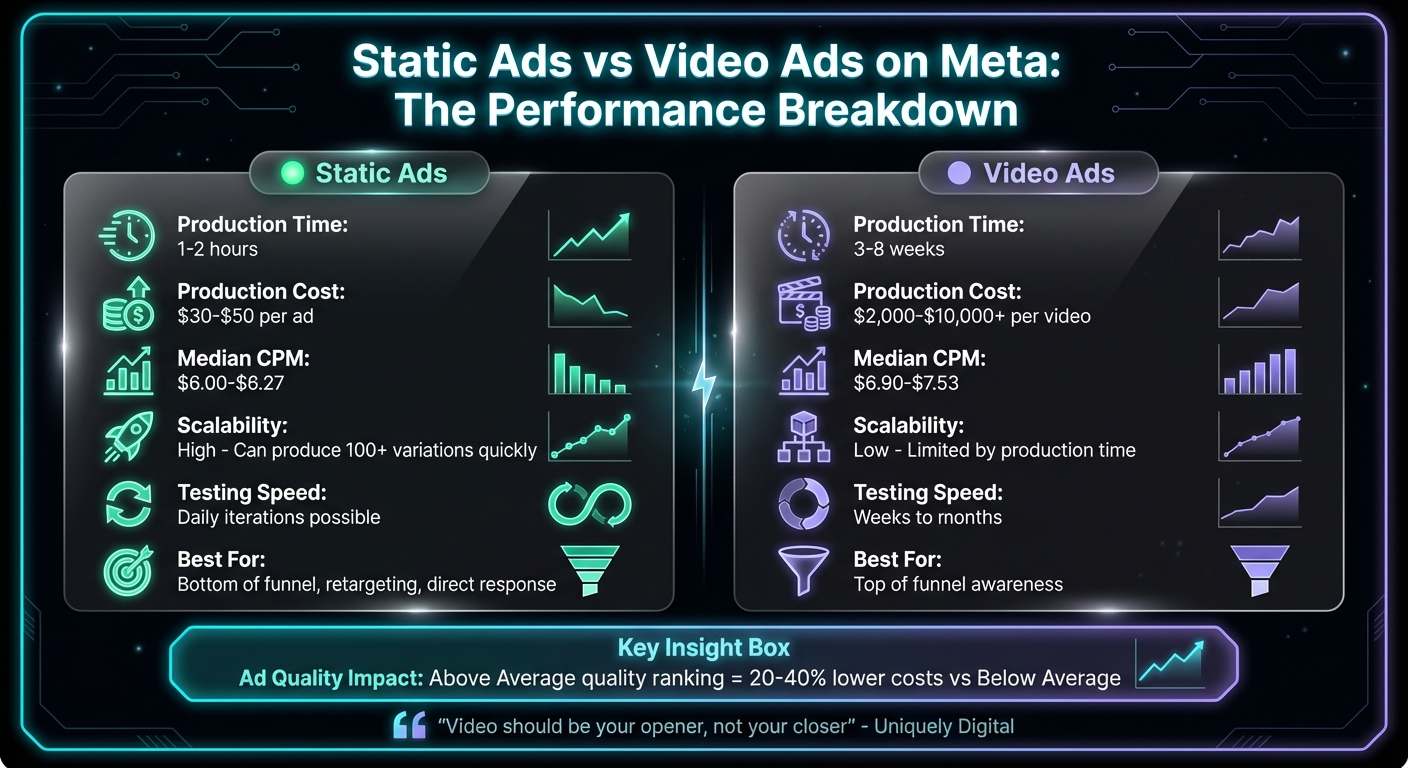
The ability to produce static ads quickly is one of their biggest strengths. While a polished video can take anywhere from 3 to 8 weeks to finalize, a static ad can be created and launched in just 1–2 hours. If you're testing 40+ ad variations, you can't afford to wait months for a single video. Static ads let you iterate daily, adapting to performance trends without getting bogged down by lengthy production cycles.
This speed also helps combat creative fatigue. Because static ads have a shorter lifespan, you can refresh your creative assets more frequently, ensuring your campaigns stay relevant and ahead of shifting market dynamics.
How Meta's Algorithm Treats Static Ads
Meta’s algorithm doesn’t play favorites when it comes to ad format. Instead, it prioritizes engagement and conversion likelihood. It calculates a "Total Value" score based on factors like your bid, estimated action rates, and overall ad quality. In this system, a high-quality static ad can compete head-to-head with video.
Meta’s machine learning has become smarter at recognizing user intent. For example, when someone is seriously comparing prices or considering a purchase, a straightforward static ad with a clear offer often outperforms an autoplay video.
Ad quality matters across all formats. Ads with an "Above Average" quality ranking can lower costs by 20% to 40% compared to "Below Average" ones. This means a well-designed static ad can deliver better results than a subpar video, making quality a key factor in performance.
Static Ads Cost Less to Produce
Static ads are not only faster to produce but also far more cost-effective. The numbers speak for themselves: static ads typically have a median CPM of $6.00–$6.27, compared to $6.90–$7.53 for video. While the per-impression difference might seem small, it adds up quickly when you're managing a monthly ad spend exceeding $100K.
Production costs are another area where static ads shine. A designer might charge $30–$50 to create a static ad, whereas video production can range from $2,000 to over $10,000 for a single asset. When you're testing multiple creative angles, static ads let you allocate more of your budget to media spend instead of production.
"Video should be your opener, not your closer." – Uniquely Digital
Static ads thrive at the bottom of the funnel. Whether it’s retargeting warm audiences, promoting discounts, or driving conversions, their straightforward, distraction-free messaging helps users quickly grasp your offer. This makes them a reliable choice for direct response campaigns. Their low-cost, high-speed production also supports the agile testing frameworks needed to scale Meta campaigns effectively.
The Creative Bottleneck That Kills Scale
Many advertisers don’t fail because their targeting is off or their product doesn’t resonate - they fail because they can’t churn out new ads quickly enough. You might find a winning ad, scale it, and then watch its performance nosedive within a week or so. The delay in producing fresh creative becomes the bottleneck that stops campaigns from reaching their true potential. Let’s dive into how traditional workflows contribute to this issue.
What Traditional Workflows Are Costing You
When you rely on designers or agencies, delays are inevitable. You submit a brief on Monday, receive drafts by Thursday, request changes on Friday, and finally get the finished files by the following Tuesday. That’s 1–2 weeks just to produce a single ad, costing around $30–$50 per ad. Now, if you need 20 variations to properly test, you’re looking at $600–$1,000 in design costs - while your current ads are underperforming.
This lag puts you in a reactive position, constantly trying to catch up to market changes instead of staying ahead. Automated systems, on the other hand, eliminate these delays, ensuring your campaigns stay on pace with market demands.
Creative Fatigue and Its Impact
When audiences see the same ad too often, engagement drops, click-through rates (CTR) decline, and costs shoot up. Meta even flags ads as suffering from "Creative fatigue" when the cost-per-result doubles compared to its usual performance.
A clear warning sign is when ad frequency exceeds 2.0 and CTR dips below 1%. A 2022 Meta study revealed performance declines of up to 45% after an audience sees an ad four times. To combat this, Facebook advises refreshing creative every 1–2 weeks for high-spend campaigns.
"Creative fatigue is often what pushes ads into the 'this-is-becoming-less-worth-it' realm: the land of diminishing returns." – Colin Campbell, Head of Content, Pixis
The key takeaway? Producing a higher volume of creative matters more than obsessing over perfection.
Why Volume Beats Perfection
A common mistake advertisers make is spending too much time perfecting a single ad. The truth is, no amount of polishing guarantees long-term success. Meta’s algorithm rewards a steady stream of new creative. The more variations you test, the faster you discover what works - and what doesn’t.
High-volume production not only combats creative fatigue but also helps stabilize acquisition costs. Research shows that advertisers who generate 3–4 times more creative variations in the same period consistently see better results and cost efficiency. The faster you can test and iterate Meta ads, the less likely you are to get stuck in the bottleneck of outdated workflows.
How AI Static Ad-Makers Work
Switching from traditional creative production to AI automation eliminates the delays that can drain your campaign's momentum. If you're spending heavily on Meta ads and your creative assets aren't performing, waiting even a week for new ads can be costly. Time is of the essence because creative fatigue directly impacts your ad spend. AI static ad-makers address this issue by transforming a single product link into ads in just minutes. The process kicks off as soon as you provide the link.
What Happens When You Drop a Link
When you paste a product URL, the AI instantly pulls relevant details - product images, descriptions, pricing, brand colors, logos, and even customer reviews. There’s no need for setup wizards, manual inputs, or creative briefs. The system analyzes your data using frameworks derived from billions of dollars in Meta ad spend and delivers multiple ad variations in about 90 seconds.
This isn’t just about throwing together random images and copy. The AI identifies key angles like benefit-focused messaging, social proof from reviews, addressing potential objections, and urgency triggers. Each variation tests a unique psychological hook, giving Meta’s algorithm a variety of concepts to work with. For instance, Sarah Chen, CMO of Fashion Forward Co., shared that Aden’s Lab generated over 200 ad variations in one day - a task that previously took their agency three weeks to produce just 10 ads. Even better, those AI-generated ads outperformed their human-created counterparts by 340%.
Automation vs. Prompt-Based Tools
Automated systems like Aden’s Lab stand apart from manual prompt-based tools. With prompt-based platforms, you need to write detailed instructions - such as "create an ad for blue sneakers with urgent sale copy" - and then refine the output repeatedly until it’s usable. This process is time-consuming, requires constant tweaking, and often yields inconsistent results.
Automated systems, on the other hand, only need the product link. The AI takes care of extracting data, identifying the most effective ad angles, aligning the visuals and copy with your brand, and optimizing the format - all without additional input. Mike Rodriguez, Growth Director at TechGadget Pro, explained that his company shifted from spending $50,000 per month on creative agencies to just $500 per month using AI automation. The results? A 520% boost in click-through rates (CTR) and a 45% drop in cost per click (CPC). This level of consistency leads to better performance metrics, including higher CTRs and lower acquisition costs.
Why AI-Generated Ads Perform
AI-generated static ads excel on Meta because they’re built on data, not guesswork. The system ensures ads meet Meta’s platform requirements (like 1200x628 dimensions for feed ads) and incorporates best practices, such as using high-contrast visuals and concise, impactful copy.
High-volume testing is another major advantage. By producing a large number of ads quickly, Meta’s algorithm has more opportunities to identify what resonates with your audience. Dr. Amanda Foster, founder of Wellness Plus, used AI to create health and wellness ads that leveraged emotional triggers. The result? A 280% increase in return on ad spend (ROAS), $3.1 million in additional revenue, and a 72% drop in customer acquisition costs (CAC). With the ability to generate over 100 ads per hour, you can seize conversion opportunities faster than your competitors.
How to Build a Creative Testing Framework
Once you've automated your ad production, the next step is setting up a testing framework that works quickly and efficiently. With AI tools for Meta ads like Aden's Lab, the process becomes straightforward: drop a link, get ads, and launch right away. This means your testing framework needs to focus on speed and scale. Many advertisers make the mistake of launching one or two ads, waiting a week for results, and then repeating the cycle. This method relies too much on guesswork. When you're investing real money on Meta, you need a system that identifies winning ads fast and eliminates underperformers even faster. The goal here isn’t perfection - it’s about creating enough variations for Meta’s algorithm to figure out what resonates with your audience.
Why Testing Volume Matters More Than Perfection
Meta’s algorithm thrives on choices. If you only provide one ad, you’re essentially betting everything on a single idea. On the other hand, offering 30 ads with different angles gives the system 30 chances to find what works. True testing means experimenting with distinct psychological triggers. For example:
- One ad might highlight benefits.
- Another could tackle objections.
- A third might use social proof.
- A fourth could create urgency.
Small changes like tweaking font colors or swapping photos don’t count as real tests. What truly matters are entirely different concepts that the algorithm can learn from.
High-volume testing also ensures your creative pipeline stays fresh. Even the best-performing ad will eventually wear out as your audience sees it repeatedly. Testing dozens of variations at once not only helps you find today’s winner but also builds a reserve of backup creatives, ready to deploy when performance starts to dip. This is why brands producing over 100 ads per month consistently outperform those that only create a handful every few weeks. If options are key, let’s break down how many ad variations you should aim for based on your budget.
How Many Ads Should You Be Testing?
The number of ads you need depends on your monthly ad spend:
- Small brands ($1,000–$3,000/month): Testing at least 30 new ads per month (roughly one per day) provides enough variety to identify trends without overextending your budget.
- Mid-sized brands ($10,000–$30,000/month): Aim for 100 to 150 ads per month. At this level, creative fatigue happens faster because your ads are shown more frequently. A steady flow of fresh concepts is necessary to maintain strong performance.
- Aggressive scalers ($50,000+/month): Testing 200+ ads per month is a must. At this scale, stale creatives can cost thousands of dollars in wasted spend daily, so waiting weeks for new designs simply isn’t an option.
How to Stay Organized and Track Performance
When testing at scale, organization becomes critical to quickly identifying what works. Group your ads by their primary angle - whether it’s benefit-focused, objection-handling, social proof, or urgency-driven. Then, in Meta Ads Manager, use the "Breakdown" menu set to "By Creative" to compare key metrics like CTR (click-through rate) and CPC (cost per click). These numbers will show whether your ad is grabbing attention and driving engagement.
Once you’ve found a winning angle, don’t just increase its budget - create more variations of that concept. For instance, if a social proof ad is performing well, make 10 additional versions using different customer reviews or testimonials. This cycle of "Launch → Kill Losers → Generate Again" is essential for keeping your account healthy. To make this process smoother, set automated rules in Meta to pause any ad that spends 3–7 times your target CPA without converting. This way, you can stop underperforming ads before they drain your budget and focus on scaling the winners.
The beauty of this system lies in its speed and data-driven decisions. By producing ads faster than they can fatigue and basing your choices on metrics instead of opinions, you’ll stay ahead of the competition and maximize your ad spend.
Mistakes to Avoid with AI-Generated Ads
Just because AI can automate parts of your ad creation process doesn’t mean you can switch to autopilot. Relying too heavily on AI without applying critical oversight can lead to wasted budgets and underperforming campaigns. Let’s explore some common missteps that can derail your efforts and how to avoid them.
Launching Too Few Variations
If you’re only creating a handful of ad variations each month, you’re not making the most of AI’s ability to generate a wide range of creative options. Limited variation forces you to rely on guesswork about what will resonate with your audience. Worse, it often leads to recycling old ads until they lose their effectiveness. Tools like Aden's Lab allow you to generate dozens of variations quickly, giving you the chance to test more ideas and identify what works best. The more you test Meta ads, the better your odds of finding winning concepts.
Ignoring Brand Consistency
Even the most eye-catching AI-generated ads can backfire if they don’t align with your brand’s identity. Consistency in tone, colors, and messaging is crucial for maintaining trust and recognition. If your audience can’t immediately identify the ad as yours, it risks falling flat. For instance, a high-end skincare brand should avoid visuals or language that feel too generic or promotional, as it can dilute the brand’s premium appeal. Always ensure the ad reflects your brand’s unique voice and style before hitting publish.
Skipping Human Review
AI is powerful, but it’s not perfect. Launching ads without a human review can lead to embarrassing mistakes, like using outdated product details or showcasing negative reviews as endorsements. While tools like Aden's Lab can pull data from your product pages to create ads, they might misinterpret certain details or miss nuances. A quick human review ensures the copy is accurate, the visuals are aligned, and the call-to-action is clear. It also helps you catch any issues that could violate Meta’s ad policies, saving you from compliance headaches down the line.
How AI Static Ad-Makers Help You Scale
AI static ad-makers do more than save time or cut costs - they remove the creative bottleneck entirely. Imagine dropping a product link and getting a batch of ready-to-launch ads in just 90 seconds. No waiting on designers, agencies, or drawn-out approval processes. This speed fuels high-volume testing, allowing you to try out different angles, identify top performers quickly, and swap out underperforming ads before they eat into your budget.
The numbers speak for themselves: ad creative accounts for 70–80% of Meta performance. If you're only testing a handful of variations each month, you could be missing out on a huge chunk of potential revenue. AI tools let you test dozens - or even hundreds - of ad variations without adding extra team members, keeping you ahead of creative fatigue and competition.
Aden's Lab makes this process effortless. Drop in your product URL, and the AI generates eye-catching static ads tailored for Feed, Stories, and Reels. With the Apex Mode plan, you’re looking at just $0.90 per ad. That means you can churn out more creatives in a week than most brands manage in an entire quarter - all for a fraction of what you'd pay a designer or agency.
FAQs
When should I choose static ads over video on Meta?
When you're aiming for quick, budget-friendly results, static ads are often the way to go. They're perfect for straightforward goals like driving direct sales or collecting leads. Plus, they're faster and less expensive to create compared to video content.
On the other hand, video ads shine when your focus is on building emotional connections, sharing compelling stories, or increasing brand awareness. While they demand more time and resources to produce, they excel in capturing attention and leaving a lasting impression. The choice ultimately depends on what you want to achieve with your campaign.
How can I tell if my ads are fatiguing before performance drops?
Watch out for warning signs such as rising ad frequency (your audience repeatedly seeing the same ad), declining click-through rates (CTR), higher cost-per-click (CPC), and reduced reach. These patterns often indicate creative fatigue. While Meta might alert you to problems like "creative fatigue", staying on top of these metrics in your ad manager allows you to make adjustments before your ad performance takes a hit.
What’s the fastest way to test 100+ ad concepts without a big team?
The fastest way to test over 100 ad concepts without needing a big team is by leveraging AI-powered creative automation. Just input your product link, and the system generates high-quality, conversion-focused ads almost instantly. This method cuts out the need for a large creative team, accelerates ad production, and lets you test numerous ideas at once - making it easier to identify top-performing ads and scale your campaigns efficiently.
Your next ad batch starts here
Finish with a ready-to-test ad batch
Paste your website to generate static creatives. Drop the link → get ads in about 90 seconds → upload them to Meta → scale.
Free to try No prompt writing