How Switching to AI Tools Changed My Meta Ads Performance
Try the workflow instead of comparing it
See what an AI ad generator makes from your product
Paste your product page and get a complete Meta ad batch—creative concepts, images, headlines, and copy—without another tool stack.
Free to try No prompt writing

Meta’s algorithm thrives on variety. Without regular ad updates, campaigns hit performance plateaus fast. AI tools like ADEN's LAB can solve the problem by producing large volumes of ads quickly and cheaply. Here’s what changed when I switched:
- Ad production time dropped: From days to minutes.
- Cost per ad fell: From $30–$50 to under $1.
- Testing capacity increased: From 20–30 ads/week to 200–300 ads/week.
- Performance improved: ROAS doubled, CPA dropped by 30–40%.
ADEN's LAB generates ads instantly by analyzing your product page, saving time and money while keeping campaigns ahead of ad fatigue. No designers, no delays - just fast, efficient ad production. If you’re running Meta campaigns, AI tools like this are a game-changer for scaling and sustaining success.
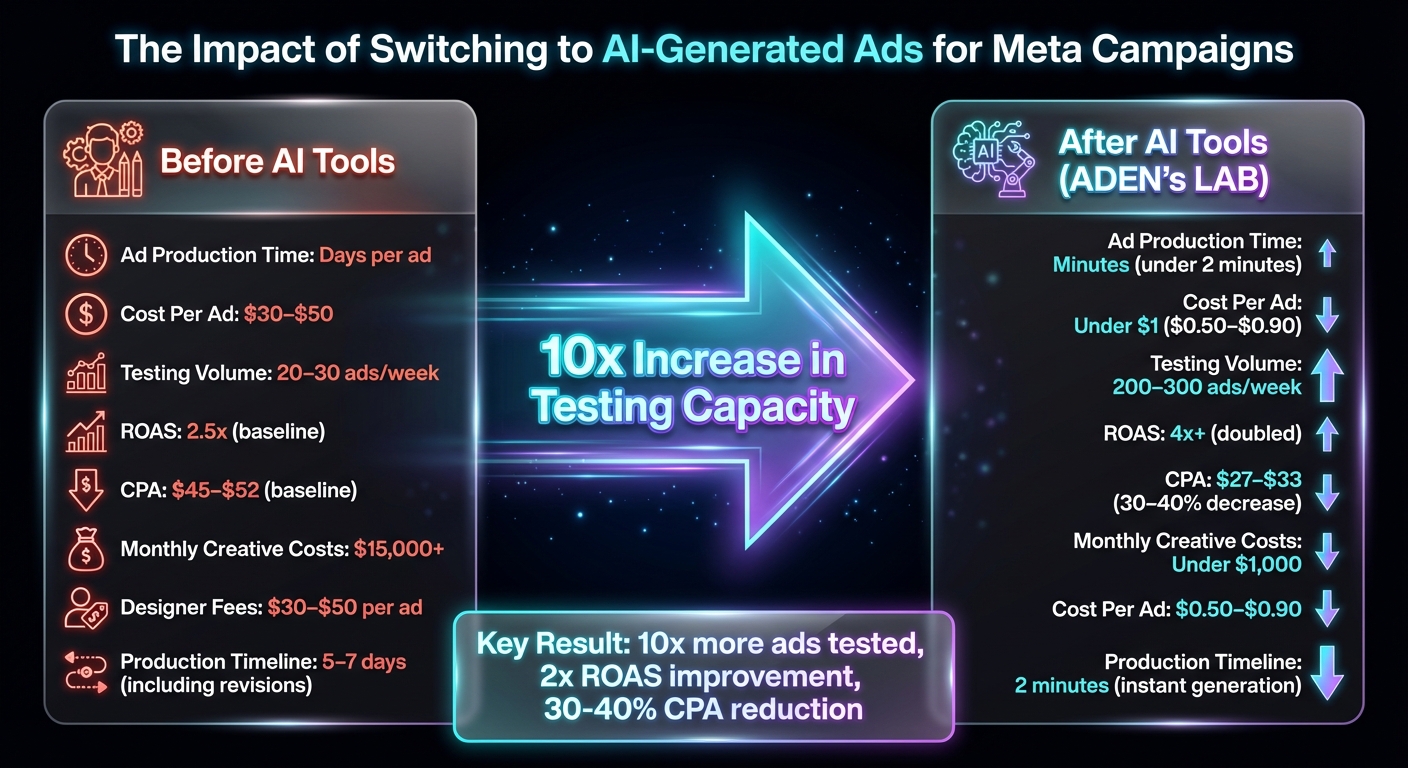
Before vs After: AI-Generated Ads Performance Metrics Comparison
How to Create the Best Facebook Ads with AI
To scale your results further, you can also explore these AI tools for Meta ads to automate your creative workflow.
Put the playbook to work
Apply this playbook to your page
Paste your website and the Lab will turn the strategy you are reading into a ready-to-test ads.
Free to try No prompt writing
The Creative Problem: Why Most Advertisers Can't Scale Meta Ads
Knowing you need a steady stream of ad creatives is one thing. Actually producing them fast enough? That’s where most advertisers hit a wall. It’s not about lacking budget or strategy - it’s about the inability to churn out fresh ads on autopilot quickly. The traditional creative process - briefing designers, waiting for drafts, making revisions - takes days. And by the time your new ads are ready, the old ones are already losing their edge. This lag disrupts Meta's algorithm, which thrives on consistent creative refreshes.
Expensive Designers and Slow Turnaround
Let’s break it down: a skilled designer charges $30–$50 per ad. To keep up with Meta’s demands, you might need 15–30 new creatives every week. That’s $450–$1,500 in weekly costs, or more than $15,000 a month if you build an in-house team. For many advertisers, that’s an unsustainable expense.
Then there’s the timeline. The usual process - creating briefs, waiting for drafts, requesting revisions - can drag on for nearly a week. And delays come with a cost. In November 2025, performance marketer James Williams saw a fashion e-commerce brand’s CPA soar from $28 to $67 in just 11 days because they couldn’t refresh their ads fast enough. While their campaigns hemorrhaged money, the brand was stuck waiting on their designer. This delay doesn’t just hurt - it snowballs, leading to what’s known as creative fatigue.
Creative Fatigue Kills Campaign Performance
Meta’s algorithm doesn’t wait for your production team. Ad performance naturally declines over time: during Days 1–7, your baseline is set; by Days 8–14, CPA typically jumps 30–50%; and after Day 15, CPA can skyrocket by 100–150%. As James Williams explains:
"Creative age is the hidden variable behind most Facebook CPA spikes, yet it's the last thing most advertisers check".
The signs of ad fatigue are clear: CPA climbs far above your baseline, CTR drops, and frequency exceeds 2.5. But by the time you notice these red flags, you’re already behind. You need fresh creatives immediately, but your designer is still working on the previous batch. This gap is why brands relying on just one or two new ads per month end up hitting a performance wall.
Slow Testing Means Missed Opportunities
The delays don’t just cost you in performance - they also limit your ability to test effectively. Meta’s AI thrives on variety, needing 8–10 distinct creatives to identify real winners. If you test fewer than that, the algorithm is essentially guessing. Without enough creative options, you might miss out on a high-performing ad and settle for mediocre results.
And then there’s the cost of testing. To gather meaningful data, you’ll need to spend $2,000–$3,000 per campaign each month. But if your designer can only produce 6–8 ads in that time, you’re wasting your testing budget on a limited sample. Here’s an example: James Williams once managed a B2B SaaS campaign that ran the same four ads for 29 days. The result? CPA spiked to $87, and frequency hit 4.7. But when they introduced fresh creatives, the CPA dropped to $46, and frequency reset to 1.6 - all within 18 days.
How ADEN's LAB Fixed My Creative Production Problem
I was stuck in a cycle: my designer couldn't keep up with the pace of ad production I needed, freelancers charged too much, and endless back-and-forth wasted precious time. Then I found ADEN's LAB. The process? Incredibly simple: drop a link, get ads. No complicated briefs, no style guides, no steep learning curve. Just paste your product or landing page URL, and within seconds, you're looking at dozens of ready-to-use Meta ads. Here's how it completely transformed the way I handle ad production.
Generating Ads in Minutes Instead of Days
The first time I tried it, I dropped a product URL into the platform at 9:00 a.m. By 9:02 a.m., there were 30 static Meta ads waiting for me - ready to download and launch. No waiting on revisions, no delays, and no $50-per-ad price tag. The platform analyzed my link, pulled the brand elements, wrote the copy, and created the visuals - all automatically. What used to take my team five days now happened in less time than it takes to make coffee. This completely eliminated my biggest hurdle: production delays that cost my campaigns money.
Automatic Brand Matching Without Manual Work
I was skeptical about whether AI-generated ads could match my brand’s look and feel. Turns out, I didn’t need to worry. The platform scans your landing page, pulls in your brand’s colors, tone, and messaging, and applies them across every ad it creates. No need to upload logos or write style guides - the system does it all. And since consistent brand colors can boost recognition by up to 80%, this automatic alignment kept my ads cohesive without me lifting a finger. With brand consistency sorted, I could focus on keeping my campaigns fresh.
Producing Fresh Ads Fast Enough to Beat Fatigue
The real game-changer? The ability to refresh ads before fatigue set in. ADEN's LAB generates hundreds of ads per month for as little as $0.90 each, which meant I could swap out creatives daily without breaking the bank. Instead of analyzing a climbing CPA due to stale ads, I stayed ahead of Meta's fatigue curve by launching new creatives every day. This steady flow of fresh ads kept my campaigns running longer and gave Meta’s algorithm more to work with. I stopped scrambling to fix ad fatigue and started preventing it entirely.
How to Add AI-Generated Ads to Your Meta Campaigns
If you're already running Meta campaigns, integrating AI-generated ads into your workflow is simpler than you might think. There's no need for a major overhaul. Instead, you’re just replacing the slow-moving parts - like waiting on designers or dealing with endless revisions - with a faster, more efficient system. Here’s a step-by-step guide to seamlessly add AI-generated ads into your campaigns.
Step 1: Generate Ads in Minutes
Start by heading to ADEN's LAB. All you need to do is paste your product or landing page URL into the input field and hit "generate." In under two minutes, you’ll have 10–20 static ad variants ready to download. The tool automatically pulls key elements from your page - images, descriptions, brand colors, and messaging. For example, when I tested it with a fitness gear page, I entered the URL at 10:15 a.m. By 10:17 a.m., I had ads like "Burn Fat Fast – 40% Off Dumbbells", complete with bold visuals and urgency-driven copy. No back-and-forth, no delays - just instant ad options.
Step 2: Select and Test Your Ads
Once you’ve generated a variety of ads, it’s time to narrow them down. Choose 5–8 ads that stand out based on direct-response principles: clear headlines, benefit-driven copy (like "50% off" or "free shipping"), attention-grabbing visuals, and strong calls-to-action. Don’t overanalyze - trust your instincts and pick the ones that catch your eye immediately. After downloading, upload the selected ads into Meta Ads Manager as new ad sets and set small test budgets - $20–50 per day works well. For example, from my fitness gear batch, I chose three ads, launched them as ABO tests at $30 each, and saw CTRs between 1.8% and 2.5% within 48 hours - well above the 1% baseline I aim for.
Step 3: Monitor Performance and Identify Winners
Let your ads run for 24–72 hours or until they hit 50–100 clicks before making decisions. In Ads Manager, focus on three key metrics: CTR (anything above 1–2% is promising), CPA (compare it to your usual benchmarks), and ROAS (aim for at least 2x early on). Use Ads Manager’s breakdown views to see how ads perform across placements - Instagram Stories might excel while Feed underperforms, or vice versa. Pause ads with a CTR below 0.5% or a CPA that’s 1.5 times higher than your target. Keep the ads showing 20–30% better metrics than the rest. For example, I follow a simple rule: if an ad gets 50 clicks with a CPA under my target, it gets more budget. If not, it’s paused. This approach keeps spending efficient and data clean.
Step 4: Scale What Works and Keep Testing
Once you’ve identified your winning ads, gradually increase their daily budget every 2–3 days, as long as ROAS remains stable - for instance, from $50 to $100 a day. But here’s the key: don’t rely on winners indefinitely. Use ADEN's LAB to generate and test 10 new ad variants every week. Refresh your creatives every 7–14 days to avoid ad fatigue, which typically sets in when frequency climbs above 3–5. By consistently rotating fresh ads, I’ve seen CPAs drop by 30–40% while maintaining strong performance. The goal isn’t to find one perfect ad - it’s to create a system that’s always testing, always refreshing, and always staying ahead of audience fatigue. That’s how you scale effectively without hitting a plateau.
sbb-itb-628c49f
What Changed After Switching to AI-Generated Ads
The results were nothing short of dramatic. Within weeks of adopting ADEN's LAB for creative production, the performance metrics shifted significantly - even with six-figure monthly ad spends.
ROAS Doubled and CPA Dropped 30–40%
Before implementing AI-generated ads, the average ROAS (Return on Ad Spend) for e-commerce campaigns hovered around 2.5x. Respectable, but far from extraordinary. After switching to ADEN's LAB to produce high-volume static ads, ROAS consistently climbed to 4x or higher, essentially doubling returns without changing targeting or budgets. For instance, a client spending $500,000 monthly saw revenue jump from $1.25 million to over $2 million, which, in turn, boosted Meta’s algorithm to deliver even better returns.
At the same time, CPA (Cost Per Acquisition) saw a significant drop. A fashion brand reduced its CPA from $45 to $27–$31, representing a 30–40% decrease, simply by testing dozens of tailored static ads for each product instead of relying on the same five creatives. Similarly, a direct-to-consumer (DTC) supplement campaign experienced a CPA drop from $52 to $33 in just two weeks. Rapid testing surfaced high-performing ads that converted better with only minor adjustments. These performance gains opened up opportunities to scale creative testing like never before.
10x More Ads Tested in the Same Time
Previously, manual processes limited my team to testing 20–30 ads per week per campaign due to bottlenecks with designers and revision cycles. Enter ADEN's LAB: we were suddenly able to test 200–300 ads weekly in the same timeframe - a 10x increase - by automating ad production from a single link. This speed allowed us to identify winning ads much faster. For example, a skincare campaign discovered a top-performing ad with a 3.2% CTR (Click-Through Rate) within just two days, compared to the usual two weeks. This quick turnaround enabled us to scale spending from $10,000 to $50,000 daily, avoiding creative fatigue.
The advantage compounds over time. While competitors might test five ads, you’re testing fifty. When they find one winning creative a month, you’re identifying ten. This kind of volume gives you a competitive edge that’s hard to beat.
Cost Per Ad Dropped to Under $1
The cost savings were just as impressive. Previously, designer fees averaged $30–$50 per static ad, which added up to over $15,000 monthly to meet the required volume. With ADEN's LAB, the cost per ad plummeted to under $1 - often between $0.50 and $0.80, depending on the plan. This shift saved more than $14,000 monthly and fueled the rapid testing cycles that drove performance.
For a portfolio managing $100 million in ad spend, this meant producing 10x more creatives while staying profitable, enabling budgets to scale to $1 million+ daily without eroding margins. For example, during a gadget launch, we created 500 ads for just $400, tested aggressively, and achieved 4.5x ROAS on $2 million in spend. Achieving this manually would have been cost-prohibitive, with creative production alone eating into profits. The math is straightforward: when each ad costs mere pennies, you can test relentlessly and let Meta’s algorithm do the heavy lifting to find the winners.
Why Static Ads Work Better on Meta Right Now
Static ads are currently stealing the spotlight on Meta, and it's not just because they're cheaper to produce. They fit perfectly with Meta’s evolving ad delivery systems and reward advertisers who can consistently pump out fresh creatives. After managing over $100 million in ad spend on the platform, I’ve seen how Meta prioritizes high-volume, fatigue-resistant creatives - and static ads hit the mark better than any other format.
How Meta's AI Systems Favor Static Ads
Meta’s ad delivery systems, like Andromeda for auction optimization and GEM (Generalized Engagement Model) for creative evaluation, are designed to favor ads that load quickly and scale efficiently. Static images have a clear advantage here - they load instantly, allowing Meta to test them across placements faster than video ads. Videos, by contrast, demand more user interaction, which can drag out the learning phase.
Another key factor? Static ads tend to perform longer before showing signs of fatigue. While videos often lose their effectiveness after just a few exposures, static ads demonstrate 20–30% less frequency decay, according to Meta's internal benchmarks. This resilience helps sustain return on ad spend (ROAS) even as campaigns scale.
Lower Production Costs Enable More Testing
Producing static ads is not only faster - it’s dramatically cheaper. With tools like ADEN's LAB, creating a static ad can cost under $1, compared to $50–200 for manually crafted ads. This cost difference opens the door to testing far more variants without breaking the bank. Instead of running a handful of tests, you can run hundreds, identifying winning creatives faster and scaling more efficiently.
This streamlined production process transforms ad creation from a bottleneck into a competitive edge. By slashing production costs, you maintain a steady flow of fresh creatives, keeping your campaigns ahead of the curve. What used to take weeks can now be accomplished in days, giving you a clear advantage over competitors stuck in slower, manual workflows.
Outproducing Competitors Wins on Meta
Meta’s algorithm thrives on fresh data, and the more creatives you feed it, the better it performs. By testing 5–10 times more static ads than your competitors, you speed up the learning phase and uncover high-performing combinations of audience, placement, and creative. This includes optimizing your Meta ad scheduling to ensure your best creatives reach users at peak times. This isn’t about random testing - it’s a systematic approach that manual methods simply can’t match.
The benefits multiply over time. While your competitors might test 50 ads in a month, you could test 500. They might find one winning ad, but you’ll find several. And when creative fatigue sets in - usually after about two weeks - you’ll already have fresh variants ready to go. This approach has even enabled brands to sustain daily ad spends exceeding $1 million without hitting diminishing returns. It’s this rapid, systematic iteration that gives ADEN's LAB campaigns their edge, allowing for high-volume, high-performance results on Meta.
Conclusion: How AI Removes the Creative Bottleneck
Traditional ad production often hits a wall with high costs and slow turnaround times. Think about it - creating just one ad can take days and cost $30–$50. That pace simply doesn’t cut it in today’s fast-moving, competitive landscape. This is where AI steps in, slashing production time from days to mere minutes and bringing the cost per ad down to less than $1.
Tools like ADEN's LAB completely change the game. All it takes is dropping a link, and you’re ready to roll with ads on Meta. No complicated prompts, no lengthy setup, and no steep learning curve. This streamlined process means you can churn out a batch of ads in minutes, giving Meta’s algorithm the variety it needs to optimize effectively. Plus, you can rotate creatives faster, keeping your audience engaged and uncovering top-performing combinations before your competitors even catch up.
The impact is hard to ignore. Doubling ROAS, cutting CPA by 30–40%, and testing 10x more ads aren’t just lucky breaks. These gains stem directly from AI’s ability to remove production delays and lower costs, allowing you to scale successful ads faster than ever.
Now, imagine this: if you’re currently producing five ads a week manually, switching to AI could ramp that up to 50 per week. That’s a tenfold increase in your testing capacity. Every extra week spent coordinating with designers or waiting on revisions is a week your competitors are outpacing you - testing more, learning faster, and scaling smarter. The bottleneck isn’t going to fix itself; it’s up to you to break through it.
FAQs
How can AI-generated ads improve my Meta Ads performance?
AI-generated ads can supercharge your Meta Ads campaigns by making the creative process faster and more streamlined. Instead of spending days (or even weeks) crafting ad visuals and writing copy manually, AI tools can whip up high-quality, attention-grabbing creatives in just seconds. This speed means you can test a wider variety of ad variations quickly, giving you a better chance of finding the ones that truly resonate with your audience.
These tools don’t stop at speed - they also help keep your ads optimized. AI can automatically fine-tune elements like brightness, contrast, and layout to make your ads more engaging. This helps combat creative fatigue, where ads lose their effectiveness over time, ensuring your campaigns stay fresh and effective. The payoff? Higher click-through rates (CTR), lower costs per acquisition (CPA), and campaigns that deliver results without the delays and guesswork of traditional workflows.
How can AI tools help reduce ad creation costs?
AI tools have made ad creation more budget-friendly by simplifying the process and cutting out inefficiencies. Take tools like Aden's Lab, for example. With just a product link, you can generate high-quality ad creatives instantly - no need for manual design work, lengthy instructions, or hiring extra creative teams. This not only saves you time but also reduces costs, freeing up resources for other priorities.
Another advantage? AI helps cut down on wasted ad spend. Instead of pouring money into multiple manual revisions, you can use AI to quickly test and tweak ads at a fraction of the cost. This streamlined approach allows advertisers to scale campaigns faster while keeping expenses in check. For businesses aiming for long-term growth, AI tools offer a smart way to maximize both time and budget.
How does AI help reduce ad fatigue in Meta campaigns?
AI plays a key role in keeping Meta campaigns engaging by automatically creating new ad variations, testing them, and analyzing performance to pinpoint what connects best with your audience. This means your ads stay fresh and interesting without needing constant hands-on adjustments.
By ensuring your campaigns evolve and stay relevant, AI helps prevent audience fatigue, keeps performance steady, and saves both time and advertising budget.
Your next ad batch starts here
Finish with a ready-to-test ad batch
Paste your website to generate static creatives. Drop the link → get ads in about 90 seconds → upload them to Meta → scale.
Free to try No prompt writing