How to Raise Cost-Caps Safely and Still Win the Auction
Turn the strategy into creatives
Create Meta ads for your product
Paste your product page. ADEN'S LAB turns the offer, audience, and positioning into complete ready-to-use Meta static ads.
Free to try No prompt writing

In Meta's ad auctions, increasing your cost cap lets you bid higher, compete in more auctions, and potentially get more conversions. But doing this carelessly can waste your budget and drive up costs. The key is a step-by-step approach that ensures stability and efficiency. Here's what you need to know:
- Understand Cost Caps: They set an average target cost per acquisition (CPA), not a strict limit. Meta uses real-time bid adjustments to stay near this average.
- When to Increase Caps: Only after ensuring steady conversion volume (at least 50 per week), reliable tracking, and consistent CPA over 7–14 days.
- How to Increase Caps: Start with a 20–40% higher cap than your current CPA, then make 10–20% increases every 48–72 hours, monitoring performance closely.
- Creative Quality Matters: Strong ads help win auctions without overspending. Tools like Aden's Lab can quickly generate new ad variations to avoid fatigue.
- Know When to Stop: If higher caps only slightly increase volume or hurt CPA, focus on new audiences, better tracking, or improving return on ad spend (ROAS).
Scaling responsibly means balancing cost caps, ad quality, and data insights to grow without overspending.
How Meta's Cost Cap Auctions Actually Work

What Cost Caps Tell Meta
When you set a cost cap, you're defining an average target - not a hard limit. For example, Meta's algorithm might bid $50 on one conversion and $30 on another, as long as the average stays around your cap, say $40.
This flexibility allows Meta to bid more aggressively when a conversion seems likely and scale back bids when the chances are lower. However, there's a catch: if the algorithm can't find enough lower-cost conversions to balance out the pricier ones, it will stop spending rather than exceed your average target.
"Facebook would rather underspend than risk going over your average cost target." - Kristian Larsen
This explains why ad sets sometimes end up with unspent budgets. It's not a glitch; it's Meta's way of ensuring your average CPA stays intact. If your cost cap is too restrictive for the current auction environment, Meta won't enter enough auctions to use your full daily budget.
Grasping this mechanism is key to understanding why increasing your cost cap can change how your campaigns perform in the auction system.
Why Raising Cost Caps Changes Results
Meta decides auction winners based on a Total Value score, which includes three factors: your bid amount, the likelihood of a conversion, and your ad's quality (measured by user engagement). Raising your cost cap boosts the bid portion of this score, making it possible for your ads to compete in - and win - more expensive auctions that were previously out of reach.
Higher cost caps can open the door to better placements and more potential customers. However, this also means entering auctions where competitors are bidding aggressively. If your creative or sales funnel isn’t strong enough to convert this traffic, you could end up paying more without seeing better results.
Take this example: in September 2025, Wupscale Marketing ran a campaign that spent $3,000 over two weeks, yielding 19 purchases at a $55 CPA and a 1.7x ROAS. To stabilize performance, they applied a $40 cost cap. Within four days, ROAS climbed to over 3x, and by the end of the month, the ad set delivered 99 purchases at a $30 CPA. The cap didn’t just limit costs - it pushed the algorithm to prioritize higher-quality conversions.
Increasing your cost cap signals Meta to explore more auction opportunities, but scaling effectively depends on the strength of your creative and conversion process.
Put the playbook to work
Apply this playbook to your page
Paste your website and the Lab will turn the strategy you are reading into a ready-to-test ads.
Free to try No prompt writing
The Exact Cost Cap Facebook Strategy We Use to Help Clients Hit $10m (and Over)
How to Know If You're Ready to Raise Cost Caps
Before increasing cost caps, ensure you have enough conversion volume and clean, reliable data. Without these, the algorithm won’t perform optimally, and you’ll end up spending more for underwhelming results.
Baseline Performance: Stability and Volume
Start by evaluating whether your ad set generates enough conversions. Meta recommends at least 50 conversion events per week to exit the learning phase. Falling short of this number means the algorithm is still making rough predictions, and raising your cap could lead to wasted budget.
Focus on your average CPA (cost per acquisition) over a 7–14 day period instead of daily fluctuations. Consistency is key here - if your CPA is all over the place, it’s a sign you’re not ready to scale.
Take a close look at your click-through rate (CTR) and ad engagement. If CTR is declining while your frequency climbs above 8–10, your audience is likely experiencing creative fatigue, not a bidding problem. In this case, raising your cap would just mean paying more to push stale ads to the same viewers. Refresh your creative assets first.
Compare your ad set’s average CPA to the CPA of your top-performing ads. A big gap suggests there’s room for optimization before increasing caps. On the other hand, if they’re already close, it might be a good time to test higher bids.
Once you confirm stable conversion volume and CPA, the next step is to ensure your tracking and signal quality are up to par.
Signal Quality and Event Setup
Before making any big moves with cost caps, audit your tracking setup. If your pixel or Conversions API (CAPI) isn’t functioning properly, the algorithm lacks the data it needs to optimize effectively.
Look for warnings in Ads Manager, such as "Learning Limited" or "Limited by bid strategy." These indicate your current setup isn’t producing enough events for the system to work efficiently. If you spot these warnings, focus on improving your budget allocation, audience targeting, or event selection before raising caps.
If your primary conversion event, like purchases, is too infrequent to hit the 50-per-week threshold, try optimizing for a higher-frequency micro-conversion instead. For example, you could focus on "Add to Cart" actions or signups. Once the system gathers enough data and stabilizes, you can switch back to your main conversion event and consider raising caps.
"Fix tracking before making big bid moves." - Segwise.ai
Step-by-Step Process to Increase Cost Caps Safely
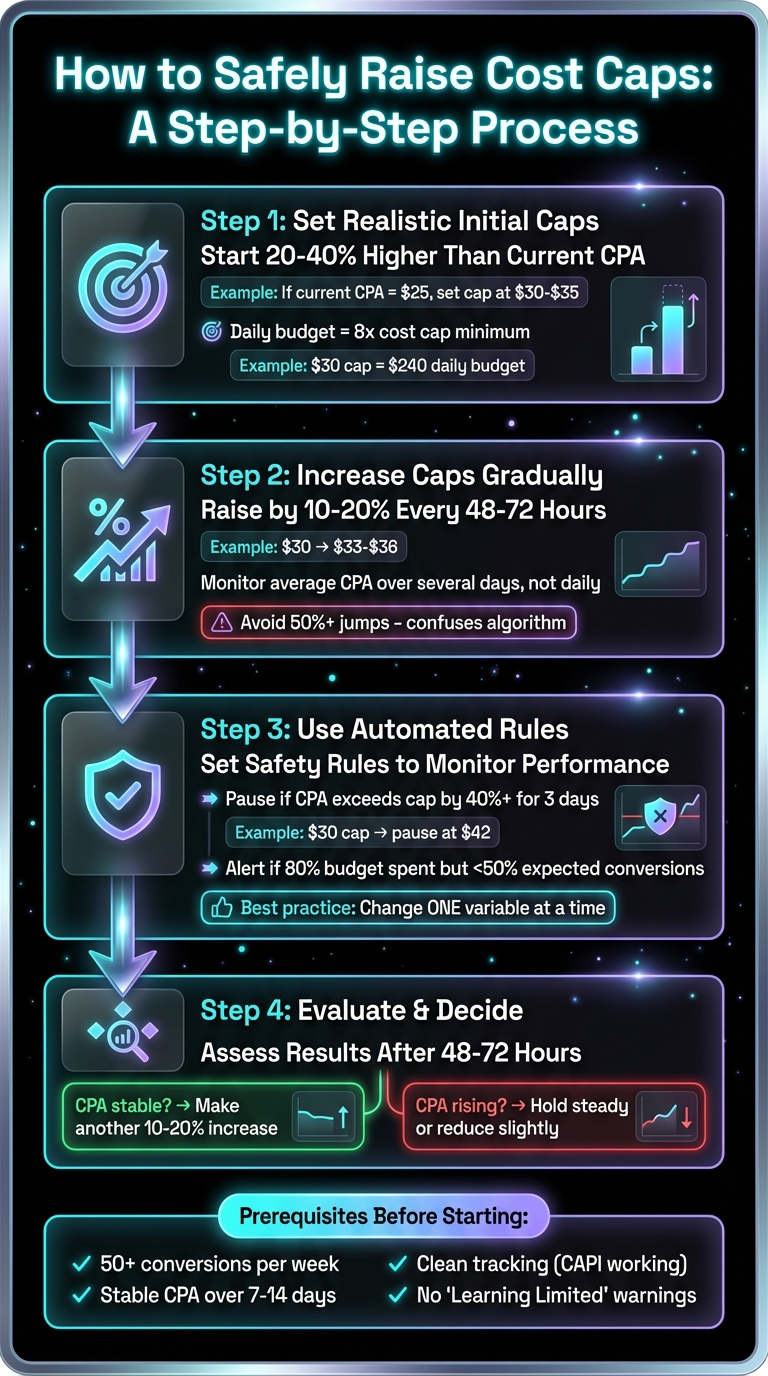
Step-by-Step Guide to Safely Raising Meta Ad Cost Caps
Once you've confirmed your account has steady conversion volume and reliable tracking, you can begin raising cost caps. The aim is to increase spending and scale results without disrupting the algorithm or letting your CPA spiral out of control.
Set Realistic Initial Caps
Your initial cost cap needs to reflect what Meta can realistically deliver - not just your ideal CPA. Setting the cap too low will throttle delivery or even stop spending altogether, as the algorithm avoids exceeding your target.
Start by using your average CPA from the past 7–14 days. Then, set your initial cap 20–40% higher than that number. This creates a buffer that allows the system to bid competitively while still learning. For example, if your recent CPA is $25, set your cap between $30 and $35. Once delivery stabilizes and the algorithm has a better understanding of your audience, you can tighten the cap.
Your daily budget should be at least 8 times your cost cap. For instance, if your cap is $30, set a daily budget of at least $240. This ensures the system has enough room to achieve the 50 conversions per week needed to exit the learning phase and maintain consistent performance.
Once your initial caps and budgets are set, the next step is to make gradual adjustments to avoid disrupting the system’s learning process.
Increase Caps Gradually
When scaling, avoid making large jumps in your cost cap. Doubling it or increasing it by 50% overnight can confuse the algorithm, leading to erratic performance or a return to learning-like behavior.
Instead, raise your cap by 10–20% and give it 48–72 hours to assess performance. For example, if your current cap is $30, increase it to $33 or $36.
During this period, focus on tracking the average CPA over several days, not just daily spend. The key is ensuring your CPA remains within an acceptable range. If it does, you can make another small increase. If your CPA starts climbing too high, hold the cap steady or dial it back slightly.
This gradual approach strikes a balance between giving the system more bidding power and maintaining cost control, allowing you to scale effectively without losing efficiency. For more advanced techniques, follow a proven FB ad scaling blueprint to maintain compliance while expanding reach.
Use Rules to Monitor Performance
As you adjust caps incrementally, automated rules can help you monitor performance and catch problems early. These safeguards act as a safety net while you scale.
Set a rule to pause any ad set where the CPA exceeds your cap by more than 40% for three consecutive days. For instance, if your cap is $30, pause the ad set if the CPA consistently hits $42 or higher over three days. This prevents unnecessary overspending while allowing for normal fluctuations.
Another helpful rule is an efficiency alert: set up a notification if an ad set spends 80% of its daily budget but delivers less than 50% of expected conversions. This signals a potential issue with delivery or targeting that needs attention before increasing the cap further.
Finally, avoid changing multiple variables at the same time. Whether you're adjusting the cap, budget, or creative, make one change at a time to clearly identify what’s affecting performance. This focused approach ensures you can scale confidently while maintaining control over results.
How Better Creative Helps You Scale at Higher Cost Caps
Why Creative Quality Matters in Auctions
Meta’s "Total Value Auction" system doesn’t just look at your bid - it evaluates several factors, including your bid amount, predicted action rates, and ad quality based on user feedback and engagement. This means that even if a competitor bids higher, strong creative can still win auctions by delivering better overall value.
When you raise cost caps, you’re entering more competitive auctions. If your creative isn’t engaging enough, the algorithm has to bid more aggressively to secure impressions. This can lead to exceeding your cap, which disrupts delivery. As you scale spending and your ad frequency for cold audiences climbs above 2–3, saturation kicks in. This often results in lower click-through rates and higher costs. That’s why improving your creative isn’t just helpful - it’s essential when adjusting your bid strategy.
Using Aden's Lab to Maintain Creative Freshness
Once you recognize the importance of creative quality, the next challenge is maintaining a steady flow of high-performing ads. At higher cost caps, The real bottleneck isn’t your budget - it’s how quickly you can produce fresh, effective creative using AI tools for Meta ads. Relying on designers can take days or weeks, and by then, your existing ads may already be fatigued.
Aden's Lab solves this problem by creating high-converting static ads for Meta in under 90 seconds - all from a single website link. Just drop your link, and the platform generates ready-to-launch ads designed specifically for Meta’s algorithm. These ads are built using tested direct-response frameworks to maximize conversions without manual effort.
Scaling with higher cost caps requires both speed and volume in your creative production. Aden's Lab enables you to produce dozens or even hundreds of ads each month, allowing for rapid testing and rotation before fatigue sets in. This ensures you maintain the strong signal quality Meta needs for efficient spending. By eliminating design delays, your ability to test and iterate quickly becomes the only limiting factor. That’s how you avoid hitting a wall and scale effectively.
Knowing When to Stop Increasing Cost Caps
Signs You've Hit the Ceiling
One clear indicator that you've reached the limit is when increasing your cost cap results in only a small uptick in volume. For example, if raising the cap by 20% only gives you a 5% boost in volume while also driving up your CPA, it likely means you've exhausted the pool of high-intent buyers at that price point. At this stage, the system starts pulling in less efficient audience segments just to hit your target.
Pay close attention to how your campaigns are pacing. If you notice under-spending despite having budget available - or if you see the dreaded "Learning Limited" status - it’s a sign your cap is too restrictive for the current auction environment. Meta's system prioritizes staying within your target cost over spending your full budget. Additionally, if you see rising frequency paired with declining engagement, that's a sign of creative fatigue, not a bidding issue, and adjusting your cost cap won’t solve that problem.
"When you spend more, the platform starts buying from less efficient pockets of audience, or your creative loses impact. That raises the average CPA." - Segwise.ai
Another red flag is if your cap is consistently hit but doesn't yield any volume gains, or if the quality of traffic declines. This can show up as accidental clicks, poor placements, or users who drop off before engaging meaningfully - like leaving the landing page without taking any action. These signs suggest you've maxed out the high-intent audience at your current cap, making further increases inefficient. At this point, it’s time to explore other scaling strategies.
Alternatives to Increasing Caps
When raising cost caps no longer leads to higher-quality conversions, it’s time to shift gears. Instead of pushing caps higher, consider scaling horizontally. This means duplicating your most successful ad sets and targeting new audience segments - different age groups, regions, or interest combinations. For example, breaking campaigns into geographic clusters (North, South, East, West) can help you avoid oversaturating high-competition metro areas while reaching new users at lower CPMs.
Another option is to improve your unit economics. By increasing your average order value (AOV) through bundles or upsells, or enhancing your lifetime value (LTV) by improving retention, you can afford a higher CPA without cutting into profitability. This lets you grow revenue without needing to lower acquisition costs or stretch your caps further. Alternatively, you can optimize for a more frequent micro-conversion, such as "Add to Cart" instead of "Purchase", if your primary event isn’t generating enough data to exit Meta’s learning phase (≈50 conversions per week).
Lastly, keeping your creative fresh is essential. A steady flow of new, high-performing ads can help maintain engagement and performance while you test new audiences. Platforms like Aden's Lab can simplify this process by generating dozens of static ads from a single link in under 90 seconds. By rotating in fresh angles and hooks regularly, you can keep your CTR high and your CPA steady - without needing to touch your cost cap.
Conclusion: Scaling Responsibly with Data and Creative Support
Raising cost caps isn’t about blindly increasing numbers - it’s about building a steady foundation and scaling thoughtfully, step by step, while keeping an eye on the right indicators. If your campaigns are hitting 50+ conversions per week, your tracking is reliable, and your creative is still capturing attention, you’re in a good position to test higher caps. But if any of those elements are off, address them first by optimizing your Meta acquisition costs before adjusting your bids. This method ties together data, creative quality, and incremental testing to enable smarter scaling.
This approach reinforces the earlier point about the critical role of creative quality in competitive auctions. Treating cost caps as a shortcut to higher volume is a common mistake. The truth is, success in the auction depends heavily on the strength of your creative assets. Signals like rising frequency and dropping CTR are clear signs that it’s time for a creative refresh.
"Scaling is not just about increasing budgets. It's about finding what works, optimizing the right levers, and extracting maximum revenue without killing your ROAS." - Shifa Islam, Performance Marketer, Marketing Lab
This is where many teams hit a roadblock. Generating 20–30 creative variations per campaign isn’t practical when you’re dependent on designers or agencies. That’s the bottleneck. Aden’s Lab addresses this by creating high-converting static Meta ads in under 90 seconds - just from a single link. No prompts, no back-and-forth, and no learning curve. Simply drop a link, get your ads, and launch them on Meta. With this kind of speed, you can test more aggressively, replace outdated creatives, and scale without the usual holdups.
Scaling responsibly means knowing when to push forward and when to pull back. If your CPA stays consistent, maintain cap increases. If it spikes, either pull back or shift to horizontal scaling. And when creative fatigue sets in, don’t waste time tweaking bids - refresh your ads and let the auction do the heavy lifting for you.
FAQs
Will raising my cost cap reset learning?
When you raise your cost cap, it doesn’t automatically trigger a reset of the learning phase. Instead, it shifts how Facebook’s algorithm works to optimize your campaign, tweaking bids and spending to align with your updated cost target. The learning phase usually resets only after major changes, like altering your targeting, creative, or budget - not just from changes to the cost cap. That said, increasing the cap can cause spending patterns to fluctuate as the algorithm adjusts to the new target.
Should I raise my cost cap or budget first?
When scaling your campaign, it's often a good idea to increase your budget first. This approach allows Meta’s algorithm to gather more data and fine-tune delivery effectively. Once your campaign has stabilized and accumulated sufficient data, you can then tweak the cost cap to better manage expenses while scaling. Adjusting the cost cap too early, however, might restrict spending and disrupt optimization - especially if the campaign hasn’t reached a stable point yet.
How do I tell bid issues from creative fatigue?
Sudden drops in delivery or ad spend can often be traced back to bid-related issues or creative fatigue. If your bid is too low, your ads may lose auctions, causing a noticeable dip in performance - even if your audience targeting and budget seem solid. On the other hand, creative fatigue occurs when engagement metrics like click-through rate (CTR) or conversions start to decline, even if your ad spend remains consistent.
Here’s a quick way to tell the difference: If spend drops sharply while engagement metrics hold steady, the problem is likely tied to your bid. However, if engagement metrics like CTR or conversions are falling, creative fatigue is probably the culprit.
Your next ad batch starts here
Finish with a ready-to-test ad batch
Paste your website to generate static creatives. Drop the link → get ads in about 90 seconds → upload them to Meta → scale.
Free to try No prompt writing