Meta CPM Trends: What Drives Costs in 2026
Turn the strategy into creatives
Create Meta ads for your product
Paste your product page. ADEN'S LAB turns the offer, audience, and positioning into complete ready-to-use Meta static ads.
Free to try No prompt writing

Meta CPMs are up 28% year-over-year in Q1 2026. Why? Increased competition, Meta's Andromeda engine, and the rising importance of ad quality. Here’s what you need to know:
- Auction competition: Real-time bidding drives costs higher, especially during peak times like Black Friday.
- Ad quality matters more than ever: Meta now penalizes low-performing ads with higher CPMs. Ads with better engagement rankings cost less.
- Targeting shifts: Meta's AI prefers broad targeting. Narrow targeting often raises costs.
Key insights for 2026:
- High CPMs often signal ad fatigue or poor engagement.
- Campaigns with fewer conversions (under 50/week) face higher costs.
- Testing 20+ ad concepts monthly boosts ROAS by 65%.
To lower CPMs:
- Use broad targeting and fewer campaigns to avoid audience overlap.
- Refresh ad content every 2–4 weeks to avoid fatigue. You can also [produce ads on autopilot] to maintain a fresh creative pipeline.
- Focus on vertical placements (Reels, Stories) for lower costs.
The takeaway? Better ads and smarter campaign setups are essential to manage rising CPMs. Keep reading for [essential Meta ad metrics], strategies, and tools to optimize your campaigns.
Meta Ads 2026 Update: Campaign Structure Doesn't Matter Anymore
Put the playbook to work
Apply this playbook to your page
Paste your website and the Lab will turn the strategy you are reading into a ready-to-test ads.
Free to try No prompt writing
Key Factors That Drive Meta CPM in 2026
Meta CPMs in 2026 are shaped by three main factors: auction competition, creative quality, and targeting efficiency. Each of these directly impacts the cost of your campaigns.
Auction Competition and Industry Trends
Meta's ad platform relies on real-time auctions, meaning increased competition naturally pushes CPMs higher. For instance, Q1 tends to be expensive as advertisers pour new annual budgets into the platform, creating a surge in demand. Similarly, peak shopping periods like Black Friday can cause CPMs to jump by 40–80% compared to quieter months.
Another factor driving up CPMs is internal competition from overlapping campaigns. If more than 30% of your audiences overlap, you’re essentially bidding against yourself, which inflates costs. A simple way to reduce this issue is by consolidating campaigns into fewer, more data-rich setups.
Creative Quality and Relevance
With Meta's Andromeda engine, creative quality has become one of the most important factors influencing CPM. According to Meta, creative quality accounts for 47% of ad performance variability and can increase purchase intent by 56%.
Meta evaluates creative quality using its Engagement Rate Ranking, which compares your ad’s engagement to similar ads targeting the same audience. Ads with higher rankings enjoy broader reach and lower costs, while those ranked below average face direct CPM penalties.
"If an ad is converting well but has below-average engagement ranking, you are paying a CPM penalty that no amount of bid optimization will fix. The lever is the creative itself." - Antonio Ventre, Founder, Skaleit Agency
Creative fatigue can also drive up CPMs. When ad frequency for cold audiences exceeds 3.5, click-through rates drop, and Meta shifts spending toward less efficient inventory. Advertisers using 5 or more creative variants per ad set report 20–30% lower CPAs than those relying on just one or two. Tools like ADEN's LAB help automate Meta ad production, ensuring ads stay fresh and costs stay manageable.
Targeting and Audience Optimization
Targeting structure plays a major role in determining CPMs. Under the Andromeda system, Meta's AI now interprets your ad creative to decide who should see it.
"Your creative is now your targeting signal." - Murat Bock, Founder, AdLibrary
This change has shifted the dynamics of targeting. Narrow, manual targeting limits Meta’s AI, often leading to higher and less predictable CPMs. On the other hand, broad targeting gives the AI a larger audience pool, resulting in lower and more stable costs.
Additionally, campaigns that don’t hit at least 50 conversion events per week remain stuck in the learning phase. This state is marked by higher volatility and inefficient CPMs.
| Strategy | CPM Impact | Why |
|---|---|---|
| Fragmented (multiple ABO campaigns) | Higher CPM | Causes audience overlap and internal competition |
| Consolidated (CBO or Advantage+) | Lower CPM | Allows Meta to reallocate spend to cost-effective opportunities in real-time |
| Narrow/manual interest targeting | Higher/fragile CPM | Limits the algorithm’s ability to find efficient matches |
| Broad targeting | Lower/stable CPM | Expands the AI’s pool to locate cost-efficient inventory |
Meta CPM Benchmarks You Should Know
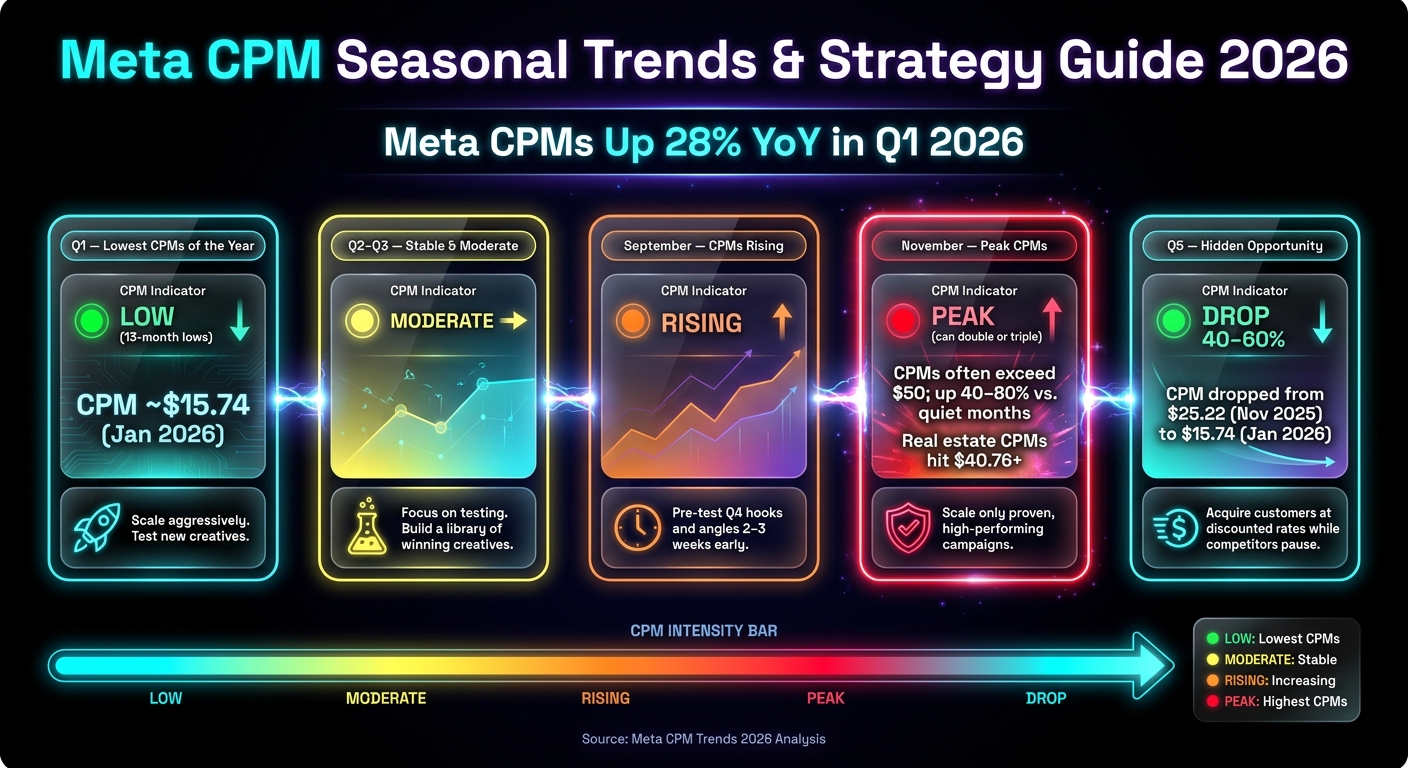
Meta CPM Seasonal Trends & Strategy Guide 2026
Understanding how your CPM compares to industry norms is key to identifying whether you're dealing with platform-wide changes or issues specific to your campaigns. For instance, in Q1 2026, Meta CPMs jumped by 28% year-over-year, surprising many advertisers. Having clear benchmarks helps you distinguish between broader trends and account-specific challenges. These benchmarks reflect how auction dynamics, creative quality, and targeting efficiency influence costs.
CPM Benchmarks by Campaign Objective
Your campaign objective plays a major role in determining CPM. For example, conversion campaigns often have higher CPMs because they target high-intent buyers, making the competition fierce. However, these campaigns tend to yield better ROI, as Meta prioritizes delivering ads to users likely to convert. Lead generation campaigns usually fall into a mid-range CPM, while engagement and awareness campaigns are the most budget-friendly.
The takeaway? A higher CPM in a conversion campaign isn’t necessarily a problem. What matters most is your cost per result, not just the CPM.
CPM by Industry and Region
CPMs can vary widely depending on your industry. For example, real estate is among the priciest sectors, with CPMs hitting as high as $40.76 during year-end spikes. In the U.S., typical CPMs range between $15 and $25 during standard periods, with significant increases in Q4. U.S. advertisers generally face higher CPMs compared to other regions because of the intense competition.
Seasonal and Cyclical CPM Patterns
CPMs tend to follow predictable patterns throughout the year, and understanding these cycles can help you make the most of your ad budget. Implementing a strategic timing strategy ensures you aren't overspending during peak competition hours. Here’s a breakdown of seasonal trends and how to strategize around them:
| Period | CPM Trend | What to Do |
|---|---|---|
| Q1 (Jan–Feb) | Lowest of the year (13-month lows) | Scale aggressively; test new creatives |
| Q2–Q3 | Stable/moderate | Focus on testing; build a library of winning creatives |
| September | Starting to rise | Pre-test Q4 hooks and angles 2–3 weeks early |
| November (BFCM) | Peak - CPMs can double or triple, often exceeding $50 | Scale only proven, high-performing campaigns |
| Dec 26 – Jan 15 ("Q5") | Drops 40%–60% as major brands pull back | Acquire customers at discounted rates |
One overlooked opportunity is the Q5 period. For example, CPMs dropped from $25.22 during November 2025 to just $15.74 by January 2026. This dramatic decline offers a cost-effective window for advertisers who stay active while competitors pause their campaigns.
"CPM isn't a price tag - it's an algorithm thermometer. When your CPM is high, Meta is telling you: 'Your ad doesn't deserve cheap impressions.'" - Adfynx Team
Benchmarks are most useful when paired with an understanding of why your CPM is at its current level. Up next, learn actionable strategies to reduce and stabilize your Meta CPM in 2026.
How to Lower and Stabilize Meta CPM in 2026
With benchmarks in place, the next step is implementing strategies to keep CPM low and steady. The good news? CPM is more manageable than many advertisers think. The key lies in focusing on creative quality, campaign structure, and tactical adjustments - rather than just throwing more money at the problem.
Creative Approaches That Lower CPM
Creative quality is now the biggest factor in CPM efficiency. Under Meta's Andromeda model, the algorithm evaluates your ad's visuals, hooks, and tone to determine its audience and cost. Ads that grab attention and drive engagement are rewarded with broader reach and lower CPMs. On the flip side, ads that fail to engage are penalized - no matter how much you're willing to spend.
Here’s a striking stat: Creative quality drives 56% of purchase intent lift in 2026 campaigns. Brands testing 20 or more distinct ad concepts each month see a 65% higher ROAS compared to those testing fewer than 10. This isn’t just a small edge - it’s a game-changer.
But keeping your creative pipeline fresh comes with challenges. Creative fatigue sets in quickly, and maintaining a steady flow of new ideas can feel like an uphill battle. Hiring designers is costly and slow, with traditional creatives costing $30–$50 per ad and long turnaround times that drag down testing speed.
Enter ADEN'S LAB, an AI-powered tool that solves this problem. It generates eye-catching Facebook and Instagram ads in minutes, directly from your product or landing page URL. Plans start at $59/month, and the Apex Mode plan reduces the cost per ad to just $0.90. This makes it possible to produce hundreds of static ads every month without needing a designer or agency. For brands aiming to outpace creative fatigue, this kind of output is a direct lever for lowering CPM.
One critical point to remember: Meta uses "entity clustering" to group visually similar ads into a single entity. Small tweaks, like changing colors, won’t count as new tests. To genuinely lower CPM, focus on conceptually distinct variants - ads that feature different hooks, angles, and value propositions.
While creative plays a starring role, refining your targeting and bidding strategies is just as crucial for keeping CPMs in check.
Targeting and Bidding Tactics
Fragmenting your audience across too many ad sets weakens optimization signals and increases CPM due to audience overlap. The solution? Consolidation. Fewer campaigns with more data per campaign allow Meta’s Andromeda model to optimize more effectively. Aim for at least 20+ conversions per week per campaign to avoid signal fragmentation. If your campaigns fall short, consolidating them is often the quickest way to lower CPM.
When it comes to bidding, mixing strategies within a single campaign can hurt performance. Stick to one approach - either highest volume (lowest cost) or cost cap - and avoid switching mid-flight. For most advertisers, a single campaign with one ad set using highest volume bidding is the cleanest and most effective structure. For those spending $5,000–$10,000 per day, combining an ABO testing campaign with a CBO scaling campaign provides more control without fragmenting data.
Broad targeting paired with specific creative hooks consistently outperforms narrow interest targeting in 2026. The creative itself acts as the targeting signal. For instance, a static ad with a hook like "Running a DTC brand?" helps the algorithm find the right audience more effectively than manually stacking interests.
To further reduce CPM, pay attention to where your ads run and how your funnel is structured.
Placement and Funnel Adjustments
Ad placements play a big role in determining cost. Reels and Stories placements, particularly in 9:16 vertical format, often deliver lower CPMs than standard feed placements. This is partly due to their design and partly because fewer advertisers optimize for them effectively. Designing for vertical placements first (9:16 or 4:5 aspect ratios) is now essential. With over 60% of impressions happening on mobile and sound-off, ads that aren’t tailored to this format lose attention quickly.
On the funnel side, rigid prospecting/retargeting splits are becoming outdated. Meta’s Andromeda system can identify users at different stages of awareness within a single campaign. This makes Advantage+ Shopping Campaigns (ASC) - which combine funnel stages - more effective. On average, ASCs improve ROAS by 22% compared to traditional split structures. Allowing Meta’s system to allocate across the funnel typically lowers blended CPM while boosting overall efficiency.
When scaling budgets on successful campaigns, increase your spend by no more than 20% every 48–72 hours. Larger jumps force the algorithm to recalibrate, temporarily raising CPM and disrupting delivery. Gradual scaling helps preserve the efficiency you've worked hard to achieve.
How to Monitor and Manage Meta CPM Over Time
Keeping CPM low over time isn't just about implementing strategies - it demands a consistent and repeatable system. Without regular checks, issues like creative fatigue and audience saturation can creep in unnoticed, driving up costs. By combining strategic adjustments with ongoing monitoring, you can ensure your campaigns remain efficient.
Building a CPM Monitoring Framework
To get a clear picture of CPM trends, pair it with Hook Rate (3-second views ÷ impressions) and Hold Rate (ThruPlay ÷ 3-second views) at the creative level. These metrics help pinpoint why CPM might be fluctuating. For example, a Hook Rate below 25% suggests your ad isn't grabbing attention, while a Hold Rate under 40% indicates viewers are dropping off before the call to action.
Additionally, track Engagement Rate Ranking and compare each ad's CPM to your account average. This makes it easier to spot underperforming ads and identify which ones are excelling in auctions. To avoid making hasty decisions, evaluate performance using 7- to 14-day rolling averages. This approach smooths out short-term fluctuations caused by Meta's learning phase and market volatility.
Diagnosing Rising CPM
When CPM starts climbing, the first step is figuring out whether the issue lies with the market or your campaign. Begin by checking frequency - if cold audiences have seen your ad too many times, engagement can drop, causing CPM to spike. If frequency looks fine, examine your Engagement Rate Ranking. As Antonio Ventre, Founder of Skaleit Agency, explains:
"If an ad is converting well but has below-average engagement ranking, you are paying a CPM penalty that no amount of bid optimization will fix. The lever is the creative itself."
Another key step is a creative similarity audit. Meta's Andromeda algorithm groups ads that look too similar into a single "entity", which limits distribution and creates internal competition. To avoid this, keep your active ads' similarity score below 40%. This ensures each creative gets a fair chance in the auction.
Here's a quick breakdown of common diagnostics and actions:
| Diagnostic Step | What to Check | Action |
|---|---|---|
| Frequency above 3.5 | Creative fatigue | Launch new, conceptually distinct variants |
| Below Average Engagement Ranking | Low relevance penalty | Rework the hook or reframe the offer |
| High creative similarity score | Entity clustering | Introduce ads with different angles and visuals |
| Campaign below 50 conversions/week | Stuck in learning phase | Consolidate ad sets or gradually increase budget |
A Repeatable CPM Optimization Workflow
To keep CPM stable over the long haul, brands need a consistent process. Start with angle research: explore the Meta Ad Library to uncover creative gaps, then craft briefs highlighting hooks, claims, or proof points your competitors aren't using.
Next, maintain a creative reserve of 15–30 new ad variants each week. Testing a high volume of conceptually distinct ads pays off - brands evaluating 20 or more ads per month see a 65% higher ROAS compared to those testing fewer than 10. Tools like ADEN'S LAB make this more manageable. For instance, their AI can generate static Meta ads in minutes from a product URL, with costs as low as $0.90 per ad on the Apex Mode plan.
Once new ads are live, monitor Hook and Hold Rates on a weekly basis. Move top-performing ads into scaling campaigns using Post IDs, and increase spend gradually - by no more than 20% every 48–72 hours - to avoid temporary CPM spikes. Following this cycle of research, production, testing, diagnosing, and scaling is what separates campaigns that grow steadily from those that stagnate.
Key Takeaways for Managing Meta CPM in 2026
Meta CPMs surged 28% year-over-year in Q1 2026, and this trend shows no signs of slowing. The takeaway? Creative quality has become the most critical factor for controlling ad costs. Ads that achieve higher engagement rankings benefit from wider distribution and lower CPMs, while poorly performing creatives - those with weak hooks or repetitive visuals - face penalties that no bidding strategy can overcome. To keep CPMs steady, focus on meeting key creative benchmarks like similarity scores, Hook Rate, and regular content refreshes.
Targeting and account structure are just as important. Consolidating campaigns, ensuring at least 50 conversion events per week, and scaling budgets slowly - by no more than 20% every 48–72 hours - help maintain clean data flow and prevent expensive algorithm resets. Data also shows that brands testing 20 or more unique ad concepts each month achieve 65% higher ROAS compared to those testing fewer than 10. This highlights the competitive advantage of high production volume.
To address the challenge of creative production, [tools like ADEN'S LAB offer a solution](https://www.adenslab.com/blog/ai-platforms-meta-ads). With the ability to generate static Meta ads from a product URL for as little as $0.90 per ad (on the Apex Mode plan), brands can realistically produce the 15–30 fresh ad variants per week needed to stay competitive. While creative diversity is essential, it must be paired with strategic targeting and gradual scaling to sustain performance. For most brands, the real driver of CPM increases is a lack of creative variety - not budget or targeting issues.
The overarching principle here is clear: the algorithm rewards accounts that provide it with more to work with - whether that’s creative diversity, consistent testing, or robust conversion data. By following these strategies, you can build a data-driven ad system that keeps CPMs in check and delivers lasting results.
FAQs
How can I tell if high CPM is market-wide or specific to my ads?
To figure out if your high CPM (Cost Per Thousand Impressions) is part of a broader market trend or unique to your campaigns, start by comparing your data to industry benchmarks.
Market-wide factors, such as increased competition or platform updates, often cause CPMs to rise - especially during high-demand periods like the first quarter of the year. However, if your campaign's CPMs are significantly higher than industry averages or your own historical data, the issue may lie within your ads.
Common culprits include ad fatigue, where your audience has seen the same creative too many times, poor targeting, or irrelevant messaging. Keep a close eye on metrics like CTR (Click-Through Rate) to identify where things might be going wrong. A low CTR could signal that your ads aren’t resonating with your audience, leading to higher costs.
What’s the fastest way to improve Engagement Rate Ranking?
To see a quick boost in your Engagement Rate Ranking on Meta ads in 2026, prioritize crafting high-quality and relevant ad creatives. Keep your ads fresh by updating them every 4–6 weeks - this helps avoid creative fatigue and keeps your audience interested.
Pay close attention to key metrics like Hook Rate, Hold Rate, and Link CTR to fine-tune your messaging and improve performance. You can also leverage dynamic creative tools to test multiple variations of your ads. This approach allows you to pinpoint which assets perform best, helping you optimize engagement signals more effectively.
How can I achieve 50 conversions per week with a small budget?
To achieve 50 conversions per week on Meta with a limited budget, prioritize creative testing and a well-organized campaign structure. Start by testing 3-5 creative variations for each angle, ensuring enough diversity to identify what resonates best. Run these ads for at least 7 days to gather meaningful data, and refresh your creatives every 2-4 weeks to avoid ad fatigue.
For quick and effective static ad creation, consider using tools like ADEN'S LAB to streamline the process. When it comes to budget allocation, aim for $50 per day per ad set. This approach helps Meta's algorithm learn effectively, boosting both performance and results.
Your next ad batch starts here
Finish with a ready-to-test ad batch
Paste your website to generate static creatives. Drop the link → get ads in about 90 seconds → upload them to Meta → scale.
Free to try No prompt writing