How AI Lowers Ad Spend Waste
Turn the strategy into creatives
Create Meta ads for your product
Paste your product page. ADEN'S LAB turns the offer, audience, and positioning into complete ready-to-use Meta static ads.
Free to try No prompt writing

AI is transforming digital advertising by cutting wasted spending and boosting returns. On average, 35–40% of ad budgets are wasted globally, costing the industry $120 billion annually. Issues like creative fatigue, audience overlap, and inefficient bidding drain budgets, while manual optimization often reacts too late to prevent losses.
AI fixes this by making real-time decisions:
- Budget Forecasting: Predicts campaign performance and reallocates funds to maximize ROI.
- Real-Time Adjustments: Identifies underperforming ads in minutes, saving advertisers up to $2,400 monthly on a $20,000 budget.
- Creative Fatigue Management: Detects early signs of ad fatigue to avoid performance drops.
- Audience Optimization: Reduces overlap and prioritizes high-conversion segments.
- Anomaly Detection: Spots inefficiencies 24/7, stopping losses before they escalate.
AI’s success also depends on having a steady stream of ad variations to test and scale. Platforms like ADEN's LAB produce low-cost, high-volume Meta ads, ensuring campaigns stay effective. By combining AI with efficient ad production, advertisers can reduce waste and achieve better results.
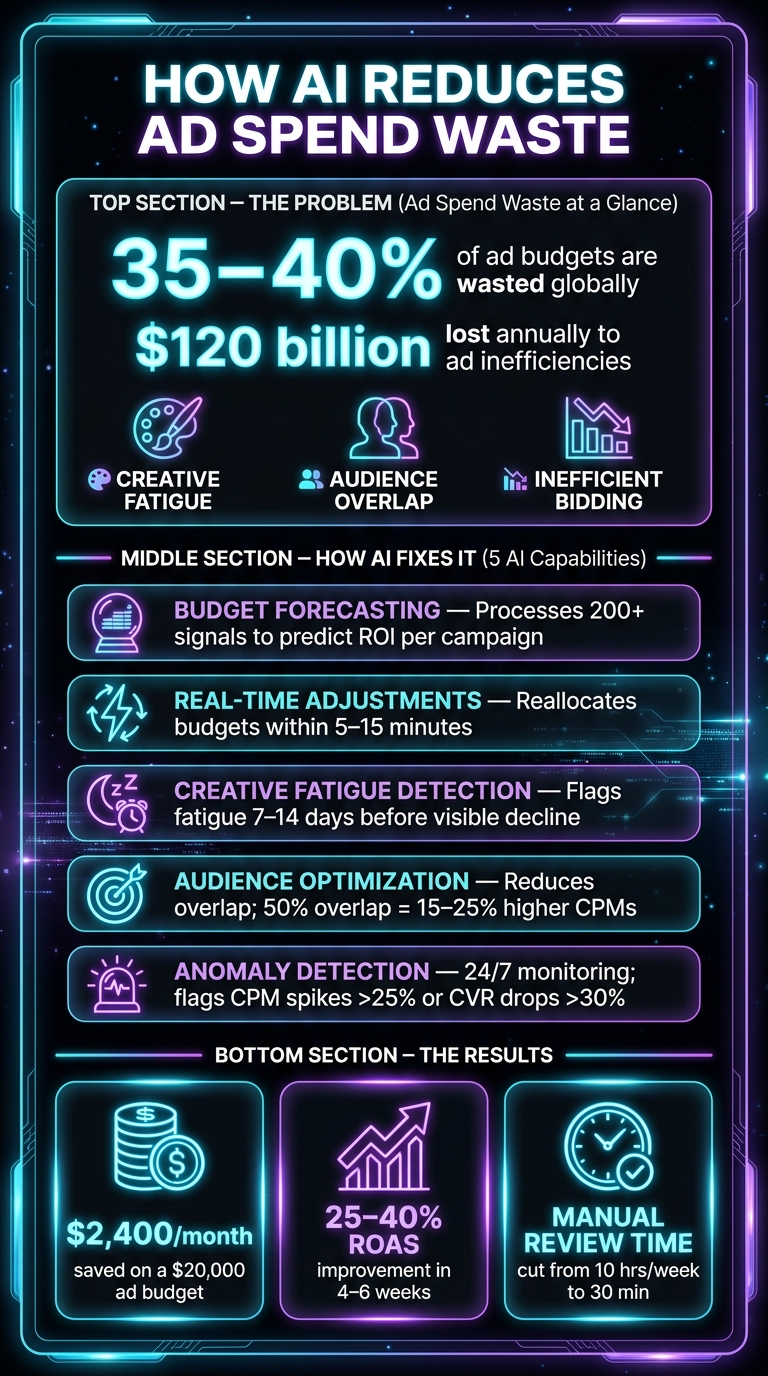
How AI Reduces Ad Spend Waste: Key Stats & Savings
How AI-Driven Budget Forecasting Cuts Wasted Spend
What AI Budget Forecasting Actually Does
Traditional budgeting methods often rely on historical data, which means inefficiencies are only spotted after the damage is done. AI, on the other hand, predicts near-future performance in real time. Using machine learning, it processes over 200 data signals - like CTR, CPA, conversion velocity, audience overlap, lifetime value, and seasonal demand patterns - to estimate the return on the next $100 spent per campaign. This approach shifts budgets toward campaigns with the highest potential return, rather than simply rewarding what worked in the past.
Some advanced systems even take it a step further, forecasting which campaigns will drive the most conversions in the next 4–6 hours. This allows advertisers to make proactive adjustments, reallocating budgets before underperforming campaigns waste funds. The result? Smarter, faster decisions that maximize returns.
How AI Reallocates Budgets in Real Time
When AI spots an opportunity or a problem, changes are made fast - usually within 5 to 15 minutes. For example, if a campaign’s CPA exceeds its target, the system quickly pulls funds from that campaign and redirects them to those performing better. This process has shown to improve ROAS by 25–40% within 4–6 weeks, saving advertisers around $2,400 per month on a $20,000 ad spend.
Here’s how a paid media manager described the impact:
"We went from spending 10 hours a week on bid management to maybe 30 minutes reviewing Ryze's recommendations. Our ROAS went from 2.4x to 4.1x in six weeks." - Sarah K., Paid Media Manager, E-commerce Agency
To ensure stability, AI systems follow two key rules. First, no single campaign should automatically take more than 60% of the total budget, as even top performers can quickly exhaust their audience. Second, budgets are scaled gradually - by no more than 20–30% every 3–4 days - to maintain campaign stability and avoid disrupting a platform’s learning phase.
Put the playbook to work
Apply this playbook to your page
Paste your website and the Lab will turn the strategy you are reading into a ready-to-test ads.
Free to try No prompt writing
How AI Identifies and Removes Ad Spend Inefficiencies
AI-driven budget reallocation is a powerful way to boost ROI, but it’s not the whole story. Issues like creative fatigue, audience overlap, and unnoticed campaign misfires can quietly drain a budget, even when spending seems well-distributed. Here’s how AI tackles these challenges head-on.
Detecting and Managing Creative Fatigue
Creative fatigue is a sneaky and costly problem. It happens when ads lose their effectiveness over time, leading to wasted spending. The good news? AI can spot the early signs of fatigue by analyzing leading indicators instead of waiting for performance metrics like ROAS or CPL to take a nosedive. For instance, fatigue is often flagged when CTR drops by 15% or more, and CPM rises by 10% or more compared to a 7-day rolling baseline. This early detection can happen 7 to 14 days before the ad's performance visibly declines.
Frequency also plays a role. Fatigue tends to appear when users see the same ad too often - 3.5+ impressions per user in prospecting campaigns or 2.5+ impressions in retargeting campaigns are common thresholds.
"Creative fatigue is the slow, expensive death of an ad. CPMs drift up, CTR slips, conversions thin out, and by the time the dashboard turns red, you have already lost two weeks of spend." - Lokeshwaran Magesh, Hawky AI
AI doesn’t just stop at identifying a fatigued ad - it pinpoints the specific element causing the problem. It analyzes components like the hook, visuals, body copy, and CTA to determine what’s faltering. For example, a fintech brand used AI to address hook fatigue in their top-performing video ads. Instead of producing entirely new videos, they generated 12 new hooks for the existing footage. Three of these variations outperformed the original, leading to a 24% ROAS recovery in just seven days - all without additional production costs.
| Signal | Healthy Range | Warning Zone | Confirmed Fatigue |
|---|---|---|---|
| CTR Decay (vs. 7-day baseline) | 0% to -5% | -6% to -14% | -15% or more |
| CPM Creep (vs. 7-day baseline) | 0% to +5% | +6% to +9% | +10% or more |
| Frequency (Prospecting) | Under 2.5 | 2.5 to 3.4 | 3.5 or more |
| Hook Rate Decline | 0% to -10% | -11% to -19% | -20% or more |
Audience Scoring and Overlap Reduction
Overlapping audiences are another major source of inefficiency. When multiple campaigns target the same users, they end up competing against each other, driving up bid prices and wasting impressions. For instance, 50% audience overlap between campaigns can increase CPMs by 15% to 25%.
AI steps in by mapping the targeting parameters across all active campaigns. It calculates overlap percentages and suggests solutions like excluding certain audiences or merging campaigns. Beyond reducing overlap, AI also evaluates audience quality by focusing on conversion potential, not just click volume. This ensures that budgets are directed toward segments most likely to generate revenue.
Once overlap and audience quality are addressed, AI continues to monitor campaigns, preventing inefficiencies from creeping back in.
Real-Time Anomaly Detection
Manual campaign reviews are typically done once a day, which means problems can go unnoticed for 7 to 14 days. AI, on the other hand, operates 24/7, processing thousands of signals at once and flagging anything that falls outside normal patterns.
For example, a performance marketing agency managing $350,000 per month on Meta and Google used XPath Labs' AI. Within just one week, the system uncovered $40,000 in wasted spend due to fatigued creatives and exhausted audiences - issues that manual reviews had missed entirely. When anomalies hit certain thresholds, like a CPM spike above 25% or a conversion rate drop exceeding 30%, the AI can automatically pause underperforming campaigns and notify the team, stopping losses before they escalate.
This constant monitoring lays the groundwork for combining budget optimization with automating Meta ad production for more efficient creative workflows.
Pairing AI Budget Optimization with Creative Production
AI's ability to detect anomalies in real time is impressive, but its true potential shines when paired with agile creative production. Why? Because even the best budget optimization tools are only as good as the creative assets they have to work with. Without a steady stream of fresh ads, even the smartest AI systems hit a wall, leaving potential returns on the table.
Creative production plays a direct role in ensuring budget efficiency. By maintaining a consistent supply of optimized creatives, AI-driven systems can operate at full capacity, eliminating downtime and avoiding unnecessary waste. This is where AI-powered creative platforms step in, providing the fuel that keeps the optimization engine running.
How AI-Powered Creative Platforms Drive Budget Efficiency
AI budget tools thrive on data, constantly reallocating spend toward the highest-performing creatives. But for this process to work, there needs to be a constant flow of fresh ad variations. The more variations available, the better the AI can pinpoint which assets deserve more investment and which ones should be retired.
Take, for example, platforms like ADEN's LAB. By allocating around 15% of the budget to testing and using tools like their Apex Mode plan, which produces static Meta ads for just $0.90 per ad, advertisers can ensure a steady supply of new creatives. This strategy keeps the testing budget productive and prevents the optimization loop from stalling.
ADEN's LAB simplifies the process further by generating high-performing Meta ads for Facebook and Instagram in minutes. All it takes is a product or landing page URL, and the platform churns out a large volume of creatives - quickly and at a fraction of the cost of traditional designer-made ads, which typically range from $30 to $50 per ad. This rapid production ensures that AI systems always have fresh content to test, learn from, and scale effectively.
With this kind of creative pipeline in place, the next challenge is speeding up production workflows to minimize wasted spend.
Faster Creative Workflows to Avoid Wasting Budget
Slow production times can compound the problem of ad fatigue. Click-through rates (CTR) can drop 20–40% within just 3–7 days of showing the same creative. This makes it essential to refresh ads quickly to maintain performance.
"AI agents detect early signals of creative exhaustion and recommend refreshes before CTR and conversion rates degrade measurably." - XPath Labs
Conclusion: Using AI to Spend Less and Scale More
AI goes straight to the root of ad spend inefficiencies. By analyzing over 200 performance signals every 5–30 minutes, AI systems identify and address waste, leading to a 35% boost in ROAS and recovering about $2,400 monthly on a $20,000 ad budget.
But here's the thing: optimization by itself won't cut it. Without a steady flow of fresh ad creatives, creative fatigue can creep in fast, increasing CPAs by 20–30% in just a few days. So, achieving consistent ROAS improvements takes a mix of smart budget management and a constant supply of new ad variations.
"The goal isn't to spend more, it's to spend with purpose." - Alagar R, Digital Marketing Professional, Eflot
That’s where ADEN's LAB steps in. They simplify the process of producing high-volume static Meta ads, ensuring AI systems always have fresh creatives to test. With their Apex Mode plan pricing ads at just $0.90 each, they make scaling creative production not only possible but affordable - bridging the gap between smart budget strategies and creative execution.
"AI doesn't eliminate wasted time, effort, or budget, but it amplifies and maximizes every high-value touchpoint." - Cube AI
Reducing wasted ad spend isn’t a one-and-done task - it’s a continuous process. AI takes care of the heavy lifting by predicting trends, reallocating resources, and spotting anomalies, while scalable creative production keeps the momentum going. Together, these tools transform advertising from a game of trial and error into a precise, data-driven system that grows over time.
FAQs
What data does AI use to forecast ad budget performance?
AI predicts how ad budgets will perform by diving into critical metrics like click-through rate (CTR), cost per action (CPA), audience behavior, and past spending patterns. It doesn’t stop there - it also evaluates real-time campaign data and market trends, using predictive models to fine-tune spending strategies. With machine learning, these systems can handle massive datasets, allowing for precise budget tweaks that cut down on waste and boost return on ad spend (ROAS).
How do I know when an ad is hitting creative fatigue?
Creative fatigue occurs when an ad's performance starts to drop over time. You might notice this through decreasing click-through rates (CTR), fewer conversions, or lower engagement, often accompanied by rising costs per action (CPA). Another red flag is high ad frequency - when the same audience sees your ad too many times - leading to reduced interaction.
To stay ahead of this, AI tools can be incredibly helpful. They can detect early signs of fatigue, giving you the chance to refresh your creative assets before performance takes a bigger hit.
How much creative testing budget should I set aside?
Allocating 10-20% of your total ad budget to creative testing is a smart move. It allows you to experiment with different ad variations without tying up too much of your budget in unproven ideas. Tools like ADEN'S LAB make this process more affordable, offering plans starting at just $59 per month, with some ads costing under $1. By regularly testing your ads with AI-powered tools, you can quickly identify what works best while keeping unnecessary spending to a minimum.
Your next ad batch starts here
Finish with a ready-to-test ad batch
Paste your website to generate static creatives. Drop the link → get ads in about 90 seconds → upload them to Meta → scale.
Free to try No prompt writing