Why Most Brands Never Fix Their Meta Ads Problem
Turn the strategy into creatives
Create Meta ads for your product
Paste your product page. ADEN'S LAB turns the offer, audience, and positioning into complete ready-to-use Meta static ads.
Free to try No prompt writing

Most brands fail to solve their Meta ads issues because they focus on surface-level tweaks like targeting and bid strategies, rather than addressing deeper problems. Here's the truth: your ad performance depends on the entire customer journey, not just the ad itself. Poor landing pages, slow load times, and mismatched messaging after the click can silently sabotage results. Frequent changes to campaigns and fragmented ad sets also confuse Meta’s algorithm, keeping it stuck in the learning phase.
Key takeaways:
- Stop over-tweaking: Frequent adjustments reset Meta’s learning process, harming performance. Limit changes to once or twice a week.
- Simplify campaign structure: Fewer ad sets with larger budgets improve data flow and boost optimization.
- Fix post-click issues: Match your landing page to ad promises, simplify checkout, and ensure fast load times.
- Keep ads fresh: High-performing brands test 10–15 new ads weekly to avoid audience fatigue.
- Use tools to generate ads faster: Platforms like Aden's Lab streamline ad production, saving time and cutting costs.
If your Meta ads aren’t delivering, the problem isn’t just your ads - it’s your system.
How to Win with Meta Ads in 2026: The Complete Blueprint
Put the playbook to work
Apply this playbook to your page
Paste your website and the Lab will turn the strategy you are reading into a ready-to-test ads.
Free to try No prompt writing
Why Your Meta Ads Stop Working
Frequent changes can derail your Meta ad campaigns. The issue isn’t about effort - it’s that constant adjustments disrupt Meta's ability to learn and optimize effectively.
How Constant Changes Break the Algorithm
Meta’s machine learning thrives on consistency. When you pause, restart, or tweak budgets frequently, you reset its learning process. To exit the learning phase and deliver stable results, Meta needs at least 50 optimization events per ad set each week.
Think of Meta’s algorithm like a cargo ship - it takes time to change direction. As Sam Tomlinson, an expert who has managed millions in ad spend, puts it: "Meta is a cargo ship. You cannot operate it like a speedboat. Bucket your changes, allow the algorithm to adjust and stabilize, then push the next set."
However, many advertisers do the opposite. They monitor performance daily, see a dip, and immediately start tweaking - pausing ad sets, raising budgets, or duplicating campaigns. Every adjustment resets the learning phase, keeping the account from reaching its full potential.
The fix? Less intervention. Limit changes to one or two sessions per week, giving the algorithm time to complete its learning cycle. Over-tweaking not only disrupts learning but also weakens your campaign structure.
Why Too Many Ad Sets Hurt Performance
Spreading a $500 daily budget across 20 ad sets does more harm than good. Each ad set ends up underfunded, resulting in insufficient data and auction overlap, which hinders performance. For example, if your cost per acquisition (CPA) goal is $40, this setup might generate less than one conversion per ad set per day - far below the 50 optimization events needed weekly.
Jon Loomer explains it well: "If you're generating five conversions per week because you're spending $20 per day, the algorithm is mostly going blind. It won't exit the learning phase, and you'll end up in learning limited."
Audience size also matters. Meta works best with audiences between 100,000 and 500,000 people. Smaller audiences (like 5,000–20,000) often lead to limited optimization, higher CPMs, and stalled campaigns.
The solution? Focus on fewer ad sets with adequate budgets. This gives Meta the concentrated data it needs to identify your best customers. Avoid overcomplicating strategies with excessive tests, as they fragment data and slow progress.
Doing More Work Doesn't Mean Better Results
More tweaks and tests don’t guarantee better outcomes. Meta’s algorithm performs best with stability and focused data.
Take the example of a supplement e-commerce brand in late 2024. Their campaign was running steadily with a 1.35 ROAS and a $48 CPA. Hoping to scale quickly, they launched six new ads at once. Within four weeks, their ROAS dropped to 0.75, and CPA soared to $87. The new ads generated high engagement but failed to convert. By pausing all campaigns for 24 hours and restarting a single ad set with 10 proven concepts, they saw a dramatic recovery - achieving a 2.50 ROAS and a $29 CPA after letting it run untouched for seven days.
This shows that grouping adjustments and consolidating tests lead to better results. Stability provides an edge in a competitive environment where many brands constantly tinker. Instead of daily manual changes, try Campaign Budget Optimization (CBO) to let Meta automatically allocate your budget to top-performing signals. For creative testing, follow the 60-30-10 rule: allocate 60% of your budget to proven winners, 30% to variations of those winners, and 10% to new ideas.
The Creative Speed Problem: Why You Need More Ads, Faster
Even the best campaigns can falter when your ad creative becomes stale. No matter how well-structured your strategy is, it won’t hold up once your creative stops resonating - and on Meta platforms, that happens quicker than many advertisers expect.
How Ads Lose Effectiveness and Why It Happens Quickly
Let’s face it: the competition for attention on Instagram is intense. The average user scrolls through about 303 feet of content daily - that’s the length of an entire football field. Your ad has less than two seconds to grab their attention before they scroll past. And here’s the kicker: the more frequently someone sees an ad, the less effective it becomes. Research shows that users who view an ad 6–10 times are 4.1% less likely to make a purchase compared to those who see it just 2–5 times.
This decline in performance isn’t necessarily because the creative itself is bad. Often, it’s due to audience saturation. Once an ad converts the most likely buyers, Meta starts pushing it to less qualified users at a higher cost. At the same time, if metrics like click-through rates, scroll speed, or watch time drop, Meta deprioritizes the ad to maintain a positive user experience. The result? Higher CPMs, rising CPAs, and campaigns that grind to a halt. To keep campaigns alive, brands need to continuously refresh their creative.
How Top Brands Stay Ahead
The brands thriving on Meta aren’t banking on a few “perfect” ads. They’re creating 10–15 new ad concepts every single week. This isn’t about throwing ideas at the wall and hoping something sticks - it’s about systematically testing enough variations to identify what works. Most ads won’t succeed, but the goal is to find those rare winners, scale them, and then keep the pipeline fresh with new ideas.
"Creative velocity is the primary driver of creative value, and creative value is the single-most-impactful lever you have to move the needle on Meta." - Sam Tomlinson
Interestingly, highly polished ads often struggle. Why? They immediately come across as traditional advertisements, which can reduce user engagement. What’s working now is content that feels native to the platform - think casual iPhone videos, user-generated content, or quick how-to clips. These formats blend seamlessly into users’ feeds while addressing specific needs. In this environment, speed matters more than perfection. If you’re spending weeks crafting a handful of polished ads, you’re already falling behind competitors who are testing dozens of variations in the same timeframe. The key to staying ahead is constant innovation, not relying on static strategies.
How Aden's Lab Solves the Creative Production Bottleneck
To keep up, brands need a faster, more efficient way to refresh their creative. Unfortunately, traditional production processes are slow and costly. Writing briefs, coordinating with designers, and waiting on revisions all take time. By the time the ads are ready, the market may have shifted.
That’s where Aden's Lab comes in. With their streamlined process, you can skip the usual back-and-forth. Just drop in your product or landing page link, and within minutes, you’ll receive high-performing static ads tailored for Facebook and Instagram. No prompts, no setup, no delays. These ads are optimized for Meta’s algorithm, designed to catch attention, stop the scroll, and drive conversions at scale. Whether you need dozens of ads per week or hundreds per month, Aden's Lab makes it possible - all at a fraction of the cost of hiring a designer.
The goal isn’t to replace great creative - it’s to produce enough volume to consistently discover what works. By testing and iterating faster than your competitors, you’ll always be ready with the next winning ad when creative fatigue sets in.
What Happens After the Click: The Conversion Problems You're Missing
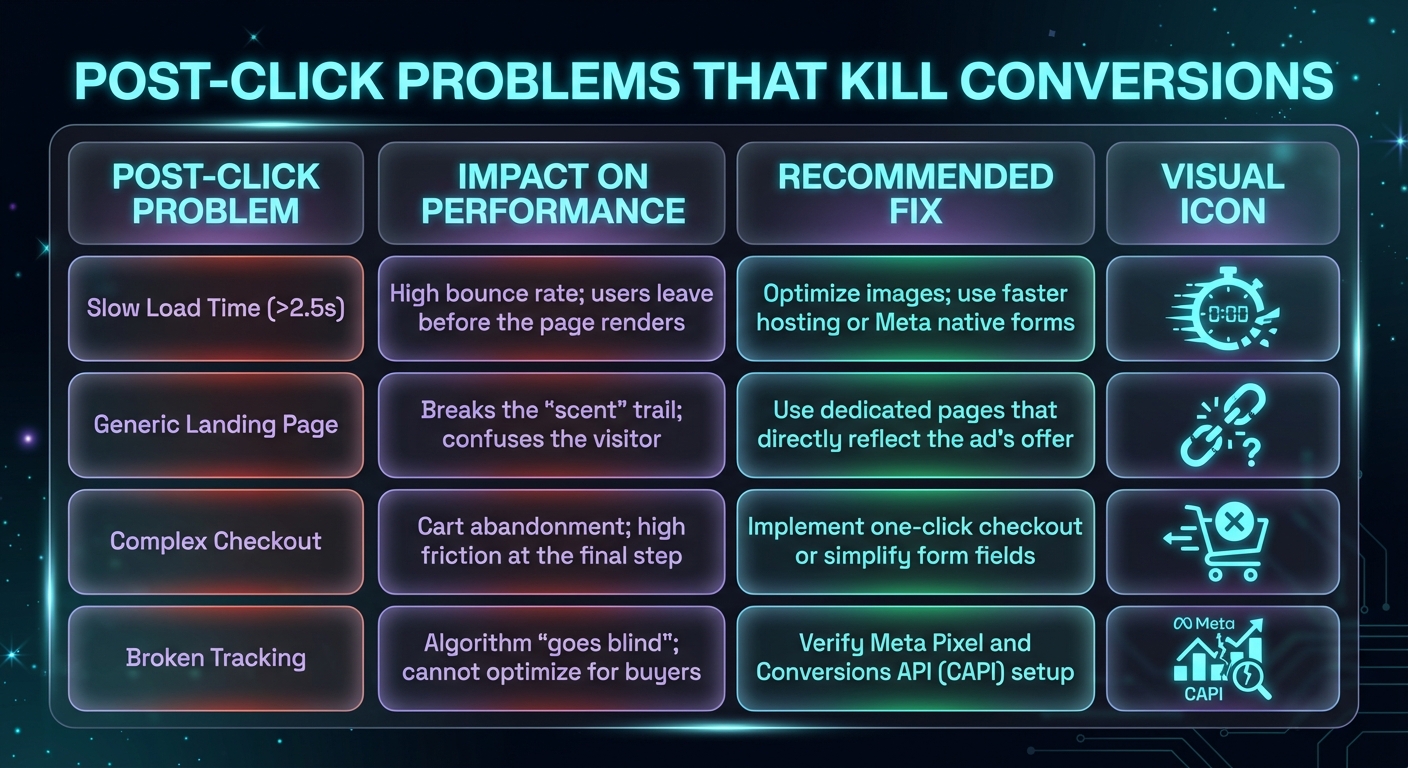
Post-Click Problems That Kill Meta Ad Conversions and How to Fix Them
Getting a click is only part of the equation. What happens in the seconds that follow determines whether that click turns into a conversion.
When Your Ad and Landing Page Don't Match
If your ad makes a promise that your landing page fails to deliver, you're setting yourself up for failure. This disconnect breaks the psychological "scent" that guides a customer from the ad to the final purchase. Imagine clicking an ad offering a 20% discount and landing on a generic homepage with no mention of the deal. Most people won't stick around - they'll leave without a second thought.
Meta’s algorithm pays close attention to what happens after the click. If users consistently leave without converting, your Estimated Action Rate takes a hit. Meta interprets this as a sign that your audience isn’t interested, leading to higher CPMs and ads shown to less effective audiences. It’s not just lost conversions - you’re actively teaching the algorithm to make your ads costlier.
For example, in 2025, a professional services firm directed ad traffic to a homepage cluttered with 12 navigation links and an 8-field form. The result? A meager 1.2% conversion rate. By switching to a focused landing page with no navigation, a 3-field form, and a video testimonial above the fold, they achieved a 5.7% conversion rate. That’s 375% more leads without increasing ad spend. The game-changer wasn’t the ad itself - it was the experience after the click.
The Post-Click Problems That Drive People Away
Most landing pages fail for predictable reasons. At the top of the list is slow load time. If your page takes longer than 2.5 seconds to load, visitors often leave before they even see your offer. Considering that over 70% of Meta traffic comes from mobile devices, a page that isn’t mobile-friendly means losing most of your potential customers.
Another silent issue is tracking failures. Roughly 40% of ROAS crashes happen because Meta can’t properly track conversions. Without accurate data, the algorithm targets the wrong audience - people who click but never buy. This creates a vicious cycle: your ads become pricier and less effective.
Then there’s the issue of checkout friction. Forms with more than three fields or landing pages with navigation menus give users too many opportunities to leave without completing the purchase. Even small distractions, like a cluttered header or an unclear call-to-action, can create enough hesitation to kill a sale.
| Post-Click Problem | Impact on Performance | Recommended Fix |
|---|---|---|
| Slow Load Time (>2.5s) | High bounce rate; users leave before the page renders | Optimize images; use faster hosting or Meta native forms |
| Generic Landing Page | Breaks the "scent" trail; confuses the visitor | Use dedicated pages that directly reflect the ad's offer |
| Complex Checkout | Cart abandonment; high friction at the final step | Implement one-click checkout or simplify form fields |
| Broken Tracking | Algorithm "goes blind"; cannot optimize for buyers | Verify Meta Pixel and Conversions API (CAPI) setup |
Simple Fixes That Improve Conversion Rates
To boost conversions, start with message matching. The headline on your landing page should mirror the message in your ad. If your ad says, “Get 30% Off Today Only,” that exact phrase should be the first thing users see when they land on your page. This immediate confirmation reassures them they’re in the right place.
Eliminate distractions. Remove navigation menus, footers, and any links that don’t lead directly to checkout. Your landing page should focus on one goal: the conversion. Every extra link is an exit ramp for potential customers.
Simplify your forms. For lead generation, stick to three fields or fewer - name, email, and maybe phone. Each additional field adds friction and reduces your conversion rate. For e-commerce, enable one-click checkout options and cut out unnecessary steps between adding an item to the cart and completing the purchase.
Lastly, fix your tracking. Use the Conversions API (CAPI) to bypass iOS privacy restrictions and ensure Meta can see who’s buying. If your Event Match Quality score is below 6.0, it’s a red flag that your tracking isn’t working properly. Tools like Elevar or Triple Whale, which cost around $50–$200 per month, can help resolve these issues. It’s a small investment compared to the money lost on untracked conversions.
The bottom line is simple: even the best ads can’t save a broken post-click experience. Improve your landing page, and your ad performance will naturally follow.
How to Structure Campaigns That Actually Scale
To achieve long-term success with Meta campaigns, proper campaign structure is just as crucial as creative updates and conversion tweaks. Many advertisers make the mistake of overcomplicating their accounts by creating separate campaigns for every audience segment, interest group, or product category. While this might seem like a way to maintain control, it often leads to budgets being spread too thin, making it harder for Meta's algorithm to gather the data it needs to optimize performance.
Why Fewer Campaigns Work Better Than Many Small Ones
Meta's algorithm thrives on data volume. When budgets are divided across numerous micro-campaigns, each ad set struggles to gather enough data to optimize effectively. Meta recommends at least 50 optimization events per ad set per week to exit the learning phase and stabilize delivery. For instance, if your target cost per purchase is $40 and you’re running five ad sets with $50 daily budgets, none will generate the necessary data for proper optimization.
The solution? Consolidation. Instead of managing multiple small campaigns, focus your budget into fewer, larger campaigns. For example, one campaign with a $250 daily budget will give Meta’s algorithm the concentrated data it needs to identify what’s working. This streamlined approach not only helps the algorithm perform better but also avoids wasting money - something that often happens when campaigns are overly fragmented.
"Meta is a cargo ship. You cannot operate it like a speedboat. Bucket your changes, allow the algorithm to adjust and stabilize, then push the next set."
– Sam Tomlinson, Founder, SamTomlinson.me
Another issue with fragmented campaigns is auction overlap. When multiple campaigns target similar audiences, your ads can end up competing against each other, driving up CPMs and undercutting performance. High-performing accounts tend to stick to just 2–3 campaigns: one broad prospecting campaign, one retargeting campaign, and possibly one for testing new creatives. Anything beyond that often adds unnecessary complexity.
Once you’ve simplified your structure, the next step is ensuring that Meta’s algorithm gets the data it needs to optimize effectively.
Why Meta Needs Concentrated Data to Optimize
Meta’s algorithm is essentially a prediction engine, relying on a steady flow of conversion data to determine which users are most likely to take action. The term "signal density" refers to the volume of data funneled into a single campaign. Consolidating campaigns strengthens this signal, while fragmented efforts scatter data, making it harder for the algorithm to draw clear patterns.
Meta’s Estimated Action Rate, which predicts the likelihood of user conversions, is entirely based on historical data. If an ad set logs only 10 conversions in two weeks, the algorithm struggles to optimize effectively. It may resort to overly broad targeting, which increases costs and reduces conversions. On the other hand, an ad set with 100 conversions in the same timeframe gives the algorithm a clear pattern to follow.
The 2026 Andromeda algorithm update extended the learning phase to 2–4 weeks, compared to the previous 5–7 days. This means campaigns now require sustained, concentrated data for nearly a month before stabilizing. Fragmented campaigns repeatedly restart this learning phase, disrupting performance.
To calculate your minimum daily budget, multiply your target cost per acquisition (CPA) by the required weekly events, then divide by 7. For example, if your CPA target is $30, you’ll need a $214 daily budget to hit the required data threshold.
Once your campaigns are consolidated and delivering consistent data, you can focus on selecting the right campaign types for your goals.
When to Use Dynamic Product Ads and Advantage+ Campaigns
Different campaign types serve different purposes. Dynamic Product Ads (DPAs) are ideal for retargeting users who’ve already engaged with your site. These ads automatically showcase the exact products users viewed, added to their cart, or abandoned at checkout. While DPAs are excellent for re-engagement, they’re not designed for finding new customers.
For businesses with solid pixel data and at least 50 monthly purchases, Advantage+ Shopping Campaigns (ASC) offer an automated approach. These campaigns use AI to handle targeting, creative testing, and budget distribution. To get the best results, avoid micromanaging. Adding tight audience restrictions or manual bid caps can slow down optimization.
Here’s an example: In December 2023, a supplement brand struggling with low ROAS paused all campaigns for 24 hours. They then launched a single ad set with 10 proven creatives. Within five days, their ROAS jumped from 0.75 to 2.50, while their CPA dropped from $87 to $29 - all without introducing new creative. The turnaround wasn’t due to added complexity but to radical simplification.
| Campaign Type | Best Use Case | Key Requirement |
|---|---|---|
| Broad Prospecting | Finding new customers | High budget, proven creative, clean pixel data |
| Retargeting (DPA) | Re-engaging site visitors and cart abandoners | Product catalog and active traffic for retargeting |
| Advantage+ Shopping | Automated prospecting for e-commerce | 50+ monthly purchases, broad targeting, no manual overrides |
Simplifying your campaign structure and consolidating data gives Meta the clarity it needs to drive results.
How to Actually Fix Your Meta Ads Problem
What Actually Matters for Long-Term Success
Many brands focus on tweaking bids or targeting audiences, hoping for a quick fix. But these adjustments often ignore the bigger picture. To truly succeed with Meta Ads, you need to consistently focus on a few core strategies.
First, simplify your campaigns to improve data flow. Instead of spreading your efforts thin with multiple fragmented ad sets, consolidate into 2–3 main campaigns. This way, Meta's algorithm gets the data it needs to optimize effectively.
Second, keep your creatives fresh. Top-performing brands don’t rely on a single winning ad - they continuously test and launch new angles before their current ads start losing traction. Creative fatigue is real, and staying ahead of it is key.
Third, focus on what happens after someone clicks your ad. Your landing page should deliver on your ad’s promise, load in under 2.5 seconds, and avoid distractions like unnecessary navigation links. Small changes here can make a big difference in conversions.
Long-term success comes from consistency. Refresh your creatives every 7–14 days, use the Conversions API to maintain accurate tracking, and let the algorithm do its job with clean, quality data. These adjustments aren’t just about improving performance - they also set you up for a smoother, faster creative process.
How Aden's Lab Fixes the Creative Speed Problem
One of the biggest challenges in Meta advertising is slow creative production. Hiring designers to create ads can cost between $500 and $1,500 per batch, with a turnaround time of 5–7 days. By the time you get the ads, your current ones might already be losing their effectiveness.
Aden's Lab eliminates this bottleneck. All you need to do is drop in your product or landing page link, and within 90 seconds, you’ll have high-converting static Meta ads ready to go. There’s no back-and-forth, no revisions, and no waiting. The platform uses proven direct-response frameworks to generate ads that are optimized for Meta’s delivery system.
With the Apex Mode plan, each ad costs just $0.90, allowing you to produce up to 200 ads per month. This speed and volume far surpass traditional designer workflows. While your competitors are stuck waiting days for a single concept, you’ll already be several testing cycles ahead. Solving the creative bottleneck isn’t just convenient - it’s essential for staying competitive. Automated tools like Aden’s Lab give you the edge you need to maintain that momentum.
FAQs
Why should you avoid making frequent changes to your Meta ad campaigns?
Frequent changes to your Meta ad campaigns can throw off the algorithm's ability to learn and perform well. Meta's system depends on steady data to spot trends and deliver ads to the right audience. When you keep adjusting things - like budgets, targeting, or creative - it forces the algorithm to reset its learning process. This can lead to inconsistent results and wasted ad spend.
To achieve better outcomes, take the time to carefully plan your campaigns from the beginning and allow the system to collect enough data to optimize. By doing this, you'll not only see more stable performance but also gain clearer insights to make smarter decisions moving forward.
How do I make sure my landing page works seamlessly with my Meta ads?
To make sure your landing page matches your Meta ads, focus on keeping things consistent and straightforward. If your ad highlights a specific offer - like a 50% discount - that same offer should be front and center on the landing page. This not only reinforces trust but also avoids any confusion or frustration for visitors.
Streamline the experience by eliminating distractions such as unnecessary menus or links. Your goal is to guide users toward one clear action, whether that’s making a purchase, signing up, or booking a service. Since most Meta ad traffic comes from mobile devices, it’s crucial to have a mobile-friendly page. This means fast load times, easy navigation, and bold, attention-grabbing call-to-action buttons.
Incorporate trust signals like customer reviews, testimonials, or security badges to increase confidence and encourage conversions. And don’t forget to regularly test elements like headlines, visuals, and CTA placement. Tweaking these details can help improve your landing page’s performance and make the most of your ad budget.
How can I keep my Meta ad creatives fresh and effective?
Keeping your Meta ad creatives engaging and effective means staying ahead of ad fatigue - that point when your audience has seen the same ad too many times and stops interacting with it. Signs to watch for include falling click-through rates (CTR), higher ad frequency (how often the same person sees your ad), or a noticeable drop in engagement. These are clear signals that it’s time to refresh your ads.
To tackle this, have multiple variations of your ads ready. Mix things up with different images, headlines, and messaging. This gives Meta’s algorithm something new to work with, keeping your ads relevant and improving performance. You can also use tools that generate high-quality creatives from a single link, making it easier to swap out underperforming ads quickly. The secret? Regularly test, update, and diversify your creatives to keep your results strong.
Your next ad batch starts here
Finish with a ready-to-test ad batch
Paste your website to generate static creatives. Drop the link → get ads in about 90 seconds → upload them to Meta → scale.
Free to try No prompt writing