Meta Ad Prompts for Supplement Brands: Benefits, Proof, and Compliance
Use the prompts on your real offer
Generate these ad angles for your product
Skip the blank prompt box. Paste your product page and ADEN'S LAB applies the angles to your offer, images, headlines, and copy.
Free to try No signup No prompt writing

Supplement ads on Meta fail for three main reasons: bad claims, weak proof, and copy that sounds too personal. I’d fix that with one simple rule set: use structure/function language, add one clear proof point, and keep the wording broad so it doesn’t imply I know the reader’s health status.
Here’s the short version:
-
Say support, not cure.
Use lines like “supports immune health” instead of disease claims like “prevents the flu.” -
Keep the copy general.
Meta can reject lines like “Are you dealing with anxiety?” because they point to a personal trait or condition. -
Ask for proof in every ad draft.
That can include review counts, third-party testing, GMP details, or an ingredient note tied to the claim. -
Use safe visuals.
Skip before-and-after images, body comparison shots, and medical-style visuals. Stick with packaging, lifestyle scenes, and clear labels. -
Add the FDA disclaimer every time.**
“This statement has not been evaluated by the Food and Drug Administration. This product is not intended to diagnose, treat, cure, or prevent any disease.”
What I take from the article is simple: the best supplement ad prompt is not about hype. It’s about writing ads that are clear, supported, and less likely to get rejected. In practice, that means building each ad around one benefit, one proof layer, and one compliance check before it goes live.
Meta’s New Health and Supplement Ad Rules: How to Stay Compliant
Put the playbook to work
Apply this playbook to your page
Paste your website and the Lab will turn the strategy you are reading into a ready-to-test ads.
Free to try No signup No prompt writing
The Compliance Baseline for Supplement Ads on Meta
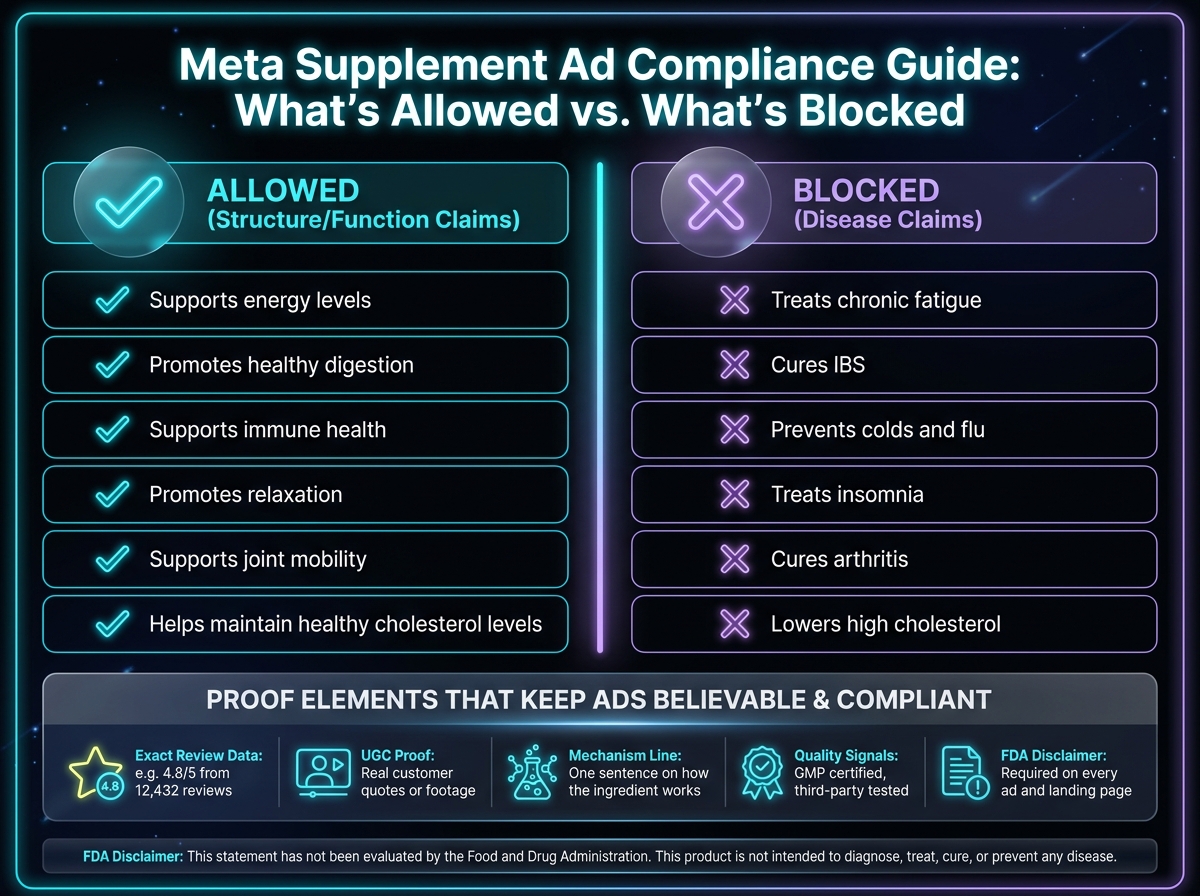
Meta Supplement Ad Compliance: Allowed vs. Blocked Claims & Proof Elements
Use this baseline to keep every prompt review-safe.
The main rule is simple: supplements can talk about supporting normal body functions, but they can't say they treat, cure, or prevent a disease. That's the plain-English line between structure/function claims and disease claims. If you're writing AI prompts, this line needs to be built in from the start.
| Allowed structure/function claim | Blocked disease claim |
|---|---|
| "Supports energy levels" | "Treats chronic fatigue" |
| "Promotes healthy digestion" | "Cures IBS" |
| "Supports immune health" | "Prevents colds and flu" |
| "Promotes relaxation" | "Treats insomnia" |
| "Supports joint mobility" | "Cures arthritis" |
| "Helps maintain healthy cholesterol levels" | "Lowers high cholesterol" |
Treat these as prompt constraints, not something you fix after the copy is written.
Audience framing matters just as much as the claim itself. Meta's Personal Attributes Policy can flag copy that sounds like you know the viewer's health status. For example, "For people with joint pain" points to an assumed condition and can lead to rejection. A safer move is to speak to a broad audience. Put that direction right into the prompt so the copy stays general instead of personal.
The same goes for visuals. Before-and-after photos, medical or injectable imagery, and any setup that suggests a visible transformation are common rejection triggers. Lifestyle scenes are usually the safer lane: someone out for a morning run, making breakfast, or simply looking naturally energized. Add visual direction as a prompt variable so the first draft starts in a safer place.
Claims also need proof before they go live. The FTC standard calls for competent and reliable scientific evidence behind health-related statements. That can mean peer-reviewed studies, expert input, ingredient data, or brand clinical data tied to the exact formula. In prompt writing, ask for the proof type up front so the output points to support instead of making unsupported statements.
Build compliance into the brief, not the review stage.
Use the standard FDA disclaimer:
"This statement has not been evaluated by the Food and Drug Administration. This product is not intended to diagnose, treat, cure, or prevent any disease."
Include the FDA disclaimer in the ad and on the landing page. Make it part of your creative workflow so it shows up in both the ad copy prompt and the landing page copy brief. That way, your benefit, proof, and compliance prompts all start from the same rules.
How to Write AI Prompts That Stay Persuasive and Policy-Safe
Build compliance into the prompt from the start so the first draft stays inside Meta's rules on personal attributes, structure/function claims, and disclaimers. The aim is simple: stronger ads with fewer rejections. This setup works well for energy, sleep, gut health, and immunity prompts.
Start with framing, not claims - and tie it to a routine. Tell the AI to use first-person phrasing or broad lifestyle framing instead of second-person copy. Also position the supplement as a swap inside a habit someone already has, not one more thing on their to-do list. Phrases like "For those who hit a 4pm energy crash..." are safer than "Struggling with low energy?" or "Do you have trouble sleeping?", which can trigger Meta's Personal Attributes Policy.
Lead with the ingredient, mechanism, or routine, not the promise. Ask the AI to explain the how behind the product first - the ingredient, sourcing, or science - before it gets into any benefit statement. For a sleep formula, that means leading with the ingredient and the nighttime routine before mentioning the result.
Embed a banned word list directly in every prompt. Block terms like "cure", "treat", "heal", "reverse", "guaranteed", "eliminate", "fat burning," and "breakthrough". Then give the AI safer alternatives such as "supports", "promotes", "helps maintain," and "may contribute to" so it has language it can actually use.
Require the standard FDA disclaimer in every output. Treat it like a CTA or brand name. It belongs in the brief every time.
| Prompt Instruction | What It Prevents |
|---|---|
| Use first-person or general lifestyle framing | Personal attribute violations |
| Lead with ingredient name and mechanism | Unsupported outcome claims |
| Prohibit: cure, treat, heal, guarantee, eliminate | Disease claims and absolute promises |
| Require one proof signal per ad: certification, review, ingredient quality, or study reference | Vague, unsubstantiated benefit language |
| Include FDA disclaimer in every output | Missing required regulatory language |
Next, turn these prompt rules into benefit, proof, and guardrail ad blocks.
Using ADEN'S LAB to Scale Static Meta Creatives for Supplement Brands
Once your prompt rules are locked in, the next job is scale. You need a lot of static variants, and you need them fast, without drifting out of compliance. For supplement brands, that matters because creative fatigue hits hard, and testing stalls when the pipeline dries up. That’s where ADEN'S LAB comes in.
ADEN'S LAB is an AI-powered static ad engine made for Facebook and Instagram. Add a product page URL or offer details, and it creates static ad variants in under 90 seconds, built for direct-response testing. Lift Off works well for early tests, Hyperstream fits brands scaling what’s already working, and Apex Mode is built for high-volume iteration. No matter which plan you use, the key is the same: keep the same prompt guardrails baked into every output.
Use the same prompt rules in every ADEN'S LAB brief. Set up a saved prompt template with your benefit framing, banned-word list, and required disclaimer so each output starts from the same compliant base. That also helps connect the engine to your reusable benefit, proof, and guardrail blocks. For visuals, stick with clean packaging, real certifications, and lifestyle scenes. Skip before-and-after layouts.
Before anything goes live, do a quick scan for distorted labels, fake badges, and garbled text. Those are common AI tells, and they can lead to rejections if they slip through. After that, build each creative around one benefit angle.
1. Benefit Angle
Build each ad around one clear benefit. The goal is simple: take an everyday moment and turn it into a compliant hook that feels specific, not vague.
Use one benefit angle per ad. And treat these as prompt starters, not finished ads. Each one should become a single, promptable moment.
- Energy - Target the 4 a.m. crash: Write to the moment instead of making a generic fatigue claim. "The 4 PM crash when focus fades but the workday keeps moving." Use phrasing like "supports daily vitality" or "helps maintain energy throughout the day."
- Sleep - Speak to the 3 a.m. wake-up: Frame the benefit as "supports restful sleep" rather than anything that implies treatment.
- Gut health - Describe the feeling, not the fix: "Post-meal comfort" or "supports healthy digestion" works better than "fixes bloating." Add a simple mechanism line: how the ingredient supports digestion.
- Immunity - Lean on seasonal and daily resilience: "Maintains immune health" and "seasonal support during busy months" are both safe and meaningful. Avoid anything that suggests the product prevents or fights a specific illness.
- Daily wellness - Sell the swap, not the add-on: "Swap your afternoon coffee for a 30-second ritual."
Keep each angle centered on how the user feels. Then turn that feeling into proof and compliance swaps below.
sbb-itb-628c49f
2. Proof Element
Once the benefit is clear, proof makes the ad believable.
After the benefit angle, add 2–3 proof signals that support the claim. The goal is simple: stack proof behind one clear benefit. Each proof element should back up that same benefit, not pull the ad in a new direction. Think small, concrete signals instead of one oversized claim.
Here are the proof elements to use:
- Progress logs: Ask for short timeline updates instead of before-and-after imagery. For example: "Week 1: better routine. Week 2: calmer mornings."
- Exact review data: Use exact review counts and star ratings, such as "4.8/5 from 12,432 reviews."
- UGC proof: Ask for real customer footage or quotes instead of polished studio visuals.
- Mechanism line: Add one sentence on how the ingredient works, then pair it with a customer quote.
- Quality signals: Ask for GMP, third-party testing, and sourcing details in the caption or overlay.
A simple stack often works best: UGC, ratings, and a quality badge can work well together.
Use these proof cues as the wording source for the compliant message swaps below.
3. Compliance Guardrail
Once your benefit angle has proof behind it, the next step is simple: make sure the ad clears Meta's rules before a reviewer ever sees it. These guardrails help turn prompts into policy-safe ad drafts.
- Ban disease verbs and hype language: Block cure, treat, heal, prevent, reverse, diagnose, breakthrough, revolutionary, and any time-bound results. Swap those for structure-function language like "supports", "promotes", or "maintains."
- Block personal attribute hooks: Keep the copy general, not aimed at the viewer's health status. "Supporting a calm mind during a busy day" is safer than copy that suggests you know something personal about the person reading it.
- Describe the experience, not the promise: Say "designed for easier sleep routines" instead of "helps you sleep faster." That small shift matters.
- Require the FDA disclaimer in every output: Put it in the ad footer or caption. Don't hide it.
- Audit visuals alongside copy: Meta also bans before-and-after images, loose pills, and body-comparison imagery. Ask for clean lifestyle scenes instead.
Use these guardrails to rewrite the messaging swaps below.
Compliant Messaging Swaps Readers Can Reuse
You can turn the guardrails above into simple prompt swaps your team uses again and again.
| Angle | Avoid (Risky/Prohibited) | Use Instead (Compliant) |
|---|---|---|
| Energy | "Cures fatigue" / "Ends the 4 PM crash" | "Supports daily energy levels" |
| Sleep | "Ends insomnia" / "Guaranteed sleep" | "Supports restful sleep" / "Supports sleep cycles" |
| Gut Health | "Treats IBS" / "Fixes bloating" | "Supports digestive comfort" |
| Immunity | "Prevents illness" / "Cures colds" | "Supports immune health" |
| Mood | "Eliminates anxiety" / "Are you struggling with anxiety?" | "Supports a sense of calm" / "For a calmer routine" |
The core move is simple: swap medical verbs for support language.
Just as important, frame benefits in broad lifestyle terms instead of making health assumptions about the reader. So rather than using second-person health language, say "For those seeking relaxation".
"Post-meal comfort" is another good example. It keeps the benefit clear without drifting into claim-heavy wording.
Use these swaps first. Then add proof, reviews, and disclaimers on top.
How to Use Proof Without Creating Claim Problems
Proof should back up quality and customer experience. It should not drift into guaranteed results or disease claims. That line matters a lot, and testimonials are usually where brands cross it first.
Stick with experiential testimonials, not medical claims. A line like > "I noticed better focus during my 3 PM meetings", works well in ad copy because it sounds persuasive without sounding clinical. And honestly, balanced reviews can feel more believable than a wall of perfect 5-star praise. After that, tie the message to plain product facts.
For example, > "Contains 50mg of CoQ10 to support cellular energy" gives the reader something concrete without turning the ingredient into a promise. It shows what the product includes and what that ingredient is used for, without claiming it will fix a medical condition. Then make sure each proof point appears with the required disclaimer.
Quality signals help here too. Phrases like > "Manufactured in a GMP-certified facility" and > "Third-party tested for purity." can strengthen the page. Just don’t use them as a stand-in for product benefit language.
Include the standard FDA disclaimer on every health-related ad and landing page: "This statement has not been evaluated by the Food and Drug Administration. This product is not intended to diagnose, treat, cure, or prevent any disease." Treat that as a required field in your prompt templates.
Here’s the same proof idea shown in a safe way and in a blocked way:
| Proof Element | Compliant Framing | Prohibited Framing |
|---|---|---|
| Testimonials | "I noticed better focus during my 3 PM meetings." | "This supplement cured my ADHD." |
| Ingredients | "Contains 50mg of CoQ10 to support cellular energy." | "This CoQ10 formula prevents heart disease." |
| Certifications | "Manufactured in a GMP-certified facility." | "FDA-approved to treat chronic fatigue." |
| Results | "Individual results may vary. Supports steady energy." | "Guaranteed to lose 10lbs in 7 days." |
When you build prompts, include fields for:
- Testimonials
- Product facts
- Certifications
- Disclaimers
Conclusion
The best Meta supplement ads follow a simple system: one structure/function benefit, one proof signal, and one compliance guardrail.
Think of these prompts as modular templates. Swap in a new testimonial, ingredient detail, or CTA, then run another test. The aim is a repeatable prompt system that helps you produce compliant, ad-ready copy faster.
Use this framework to generate, test, and refine compliant Meta ads at scale.
FAQs
How do I turn a health claim into compliant Meta ad copy?
Shift the message away from named medical results and toward general wellness and day-to-day support.
Use function-based wording instead of hard claims. So rather than saying a product can cure, treat, heal, or guarantee an outcome, say it supports, promotes, helps maintain, or encourages normal body function.
Put the spotlight on everyday lifestyle benefits people care about, such as:
- steady energy
- mental focus
- healthy digestion
- daily balance
- overall well-being
It also helps to explain why the product may help. Point to the ingredients, how they work in the body, or the role they play in normal wellness. That kind of detail builds trust and makes the copy feel grounded instead of overhyped.
Include clear disclaimers in the copy, such as Results may vary and not intended to diagnose, treat, cure, or prevent any disease.
What proof elements make supplement ads more believable and safer to run?
Use clear, evidence-based proof instead of vague promises. Lean on structure-function claims like “supports energy,” then back them up with research, clinical data, or expert-backed ingredient notes. Say “supported by research” instead of “scientifically proven.”
It also helps to make trust signals easy to spot. Show certifications, third-party testing, full ingredient lists, and plain disclaimers like “These statements have not been evaluated by the FDA” and “Results may vary.” Add verified reviews and honest testimonials, and skip before-and-after images or medical props.
Where should the FDA disclaimer appear in a Meta supplement ad?
The FDA disclaimer needs to be clear and easy to see anywhere you mention health benefits.
For text ads, put it at the bottom of the copy in a readable font. For image ads, place it inside the creative where people can spot it without hunting for it. For video ads, show it on screen long enough to read, or add it to the description. It should also appear on your landing page.
Your next ad batch starts here
Finish with a ready-to-test ad batch
Paste your website to generate static creatives. Drop the link → get ads in about 90 seconds → upload them to Meta → scale.
Free to try No signup No prompt writing