Meta Ad Prompts for Fashion and Apparel Brands: 25 Creative Angles
Use the prompts on your real offer
Generate these ad angles for your product
Skip the blank prompt box. Paste your product page and ADEN'S LAB applies the angles to your offer, images, headlines, and copy.
Free to try No signup No prompt writing
If your Meta ads for clothing start slipping, the fix is simple: test different ad angles, not tiny copy changes. For fashion brands, ad fatigue can show up fast, so I’d rotate assets every 2–3 weeks, keep 10–15 ads live, and map each angle to funnel stage.
Here’s the short version:
- Cold traffic: use new drop, try-on, fabric, and lifestyle angles to win the click
- Warm traffic: use fit notes, styling ideas, reviews, and return policy cues to cut doubt
- Hot traffic: use low-stock, free shipping, and short-term offers to close the sale
- Best-performing concepts: resize for Feed, Stories, and Reels, and add bold on-screen text
- Benchmarks to watch: around 1.71% CTR for clothing/accessories and 1.84% median CVR for apparel
The article breaks the full list into the main jobs fashion ads need to do:
- Launch new arrivals and seasonal drops
- Show fit, comfort, and sizing
- Help shoppers picture when to wear the item
- Use reviews and customer footage to back up the pitch
- Add offer and shipping cues when people are close to buying
- Use performance data to decide what to test next
The big idea is simple: if one ad shows fit, another shows styling, and another leans on reviews or a sale, Meta has a better chance of finding different shopper groups instead of sending near-identical ads after the same people.
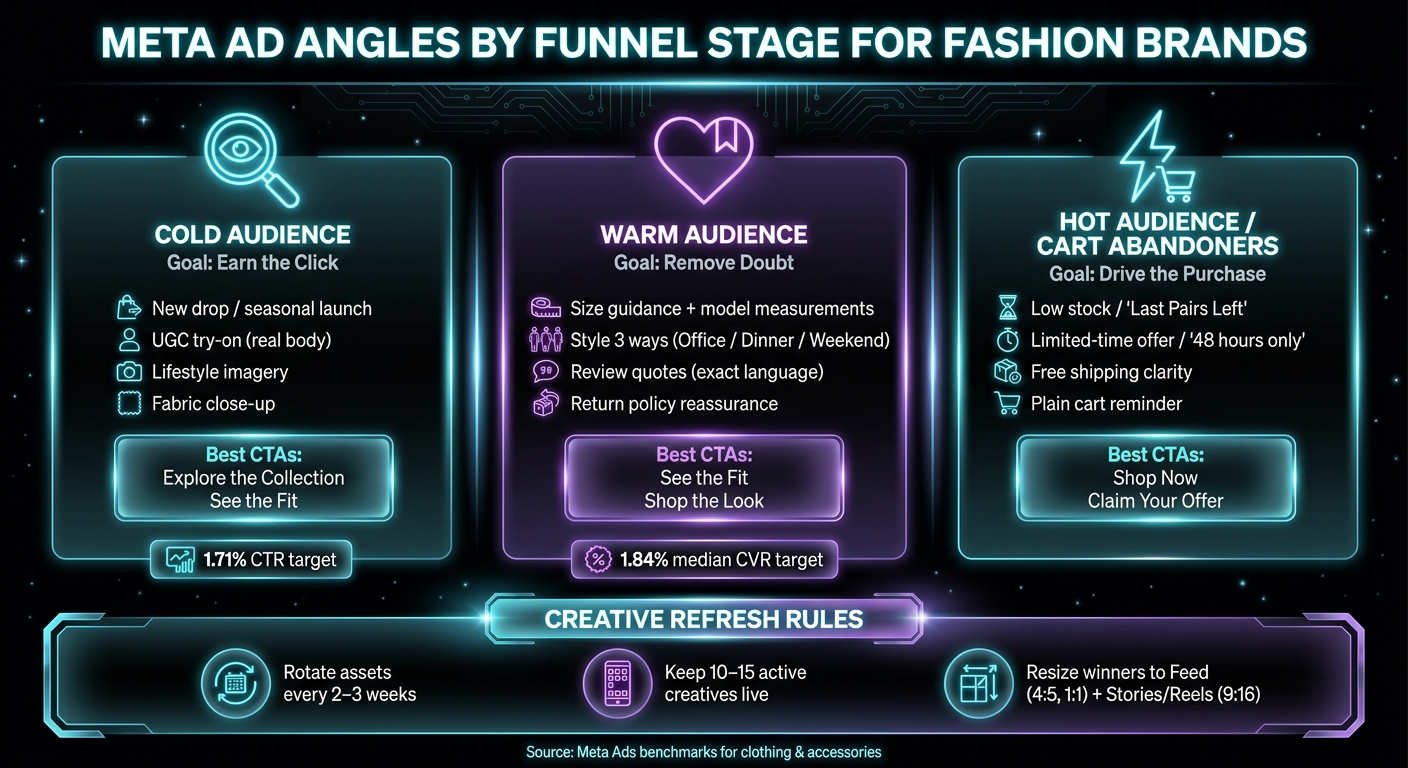
Meta Ad Angles by Funnel Stage for Fashion Brands
I Found A BETTER WAY To Market Clothing Brands Using Meta
Put the playbook to work
Apply this playbook to your page
Paste your website and the Lab will turn the strategy you are reading into a ready-to-test ads.
Free to try No signup No prompt writing
Quick Comparison
| Funnel stage | What I’d show | Main goal |
|---|---|---|
| Cold | New drop, try-on, lifestyle, fabric close-up | Get the click |
| Warm | Size guidance, style 3 ways, review quotes | Cut hesitation |
| Hot | Free shipping, low stock, limited-time deal | Get the order |
If you sell apparel on Meta, this gives you a simple testing library: 25 angles built for launches, fit, styling, proof, and conversion.
How to Use These Meta Ad Prompt Angles
Each angle in this list has a different role. Use cold-audience angles to build desire, warm-audience angles to ease doubt, and hot-audience angles to push the sale. Think of each one as a prompt framework for static ads or AI-generated ads. Start with the angle, then add your product, audience, and offer.
Cold audiences need desire and identity. Show the product on a real person. Lead with fabric quality. Or lean into the kind of lifestyle your buyer wants. Warm audiences need certainty. Speak to fit anxiety, point to your return policy, or show the same item styled three different ways. Cart abandoners need urgency. A limited-time offer, a low-stock note, or a plain reminder about free shipping can help close the gap.
The key is to test angles that are meaningfully different, not a bunch of near-copy versions of the same ad. That stage-by-stage mapping makes it easier to pick the best angle for each campaign.
When a static concept starts showing strong CTR and conversion rate, carry it across placements. Rework the winning idea into a 4:5 or 1:1 ratio for Facebook and Instagram Feeds, then turn it into 9:16 for Stories and Reels. Add bold text overlays so video ads still make sense with the sound off.
Use the table below to match each angle with the right audience stage before you write the ad.
| Funnel Stage | Best Prompt Type | Primary Goal |
|---|---|---|
| Cold (Prospecting) | UGC try-on, fabric hero, lifestyle | Earn the click |
| Warm (Retargeting) | Testimonial, styling versatility, comparison | Remove doubt |
| Hot (Conversion) | Limited-time offer, shipping clarity, low stock | Drive the purchase |
1. Launch & Seasonal Demand
Use the Drop angle for new arrivals and seasonal launches. Start with what just arrived and why it matters right now. This should be your first prospecting angle when a product is new or tied to a specific season.
Lead with the season, the product name, and a clear time limit. Phrases like "48 hours only" work well. Pair that with seasonal visuals - like autumn tones for a fall collection - so the launch feels current and tied to the moment.
Prompt angle: "The [Season] Collection has landed. Shop the new arrivals before they're gone."
For cold audiences, use softer CTAs like:
- Explore the Collection
- See the Fit
As interest grows, use the same angle for warmer audiences but add tighter scarcity. In retargeting, layer in catalog labels like "Last Pairs Left" or "Almost Gone". Start teaser creatives 4–6 weeks before peak season begins.
2. Fit, Comfort & Product Confidence
Use the Real-Body Try-On angle to cut fit uncertainty. Your ad needs to do the job of a fitting room. Show a real person wearing the item, not a polished studio model, and put the model's height, weight, and exact size right on screen.
A 10–20 second UGC try-on clip that shows the garment from a few angles can answer the questions shoppers usually have fast: How high is the rise? How does it drape? What does it look like when the person moves? Flat-lays just can't do that.
Clothing ads with real-people imagery often see a 30% to 50% lower CPA than studio shots. That’s a big deal. Then support the visual with one clear trust signal in the copy.
Prompt angle: "Show a real person wearing the item, with height, weight, and size visible on screen."
Add a text overlay like "True-to-size" or "Size up for an oversized look" so shoppers get a sizing cue right away. You can also mention free exchanges to lower purchase hesitation. For cold audiences, use "See the Fit" as the CTA.
Once fit is clear, shift into styling angles that show how the piece looks in day-to-day wear.
sbb-itb-628c49f
3. Styling & Brand Positioning
Use this angle when shoppers need help picturing the product in everyday life. Take one hero product and style it for three occasions, like Office, Dinner, and Weekend. It gets at the main buying question: when would I wear this? If the style is bold, that bit of context can turn interest into clicks. And it’s worth treating this as its own test bucket, not just another version of fit-focused or product-shot creative.
Make the idea clear even with the sound off. Add bold text overlays like Date Night, Office Ready, and Casual Sunday. Then pair that with casual phone-shot footage in a street or coffee shop setting instead of polished editorial visuals. The use case should be obvious in a split second.
For discovery-stage viewers, softer CTAs tend to fit better, such as:
- See the Fit
- Explore the Collection
Prompt angle: "Show one [product] worn three ways - label each look by occasion using text overlays, and film in an everyday wear context."
After the product starts to feel easy to wear, shift into proof and offer-led angles.
4. Social Proof & Conversion Offers
Once you've answered "when would I wear it?", the next question is simple: "why should I trust it?" That's where social proof comes in. If the outfit already feels easy to picture in real life, trust becomes the next step.
UGC + Offer Pairing: A real customer try-on can show fit, drape, and movement in a way a studio image often can't. It feels more grounded. Then pair that with a risk-reducing offer, like "Dress like you mean it" plus "Free returns on every order." The message does two jobs at once: it builds desire and lowers purchase hesitation.
Use exact review wording like "true to size" or "most comfortable hoodie I own". That kind of language feels direct and believable. Add a visible review count such as "12,000+ reviews" right on the image to show scale, not just one-off praise.
Prompt angle - visual: "Show a real customer mirror try-on of [product], overlay a five-star review with a fit phrase, and display the review count."
Prompt angle - overlay/offer: "Add a limited-time offer in the caption with free returns or free exchanges as the risk reducer."
Applying the Angles to Faster Creative Testing
Once you have the 25 angles, the next step is turning them into a testing system you can run again and again. A simple way to do that is to build each prompt around four layers: hook, proof, offer, and confidence. This setup makes it easier to produce on-brand static variants fast and keep things moving without a creative bottleneck.
From there, build repeatable test series you can cycle through each week. Good examples include:
- Try-ons
- Fabric detail shots
- Style 3 ways
- Reviews
This gives you a steady flow of ads without starting from scratch every time. It also helps you test different buying triggers. Pair product-benefit angles with emotional hooks and offer-based messages so you can reach different groups of shoppers.
Performance data should guide what you test next. Don’t guess. Look at the numbers and use these baselines: 1.71% CTR for clothing and accessories, and 1.84% median CVR for apparel. If something feels off, the metrics usually show where the problem is.
| Metric Status | Cause | Action to Take |
|---|---|---|
| Low CTR | Weak hook | Tighten the headline and test a new on-body visual |
| High CTR / Low CVR | Purchase hesitation | Add size notes, model measurements, and reviews |
| High CVR / Low ROAS | Margin, AOV, or shipping costs | Adjust pricing, margins, or audience segments |
| Rising frequency / sliding returns | Ad fatigue | Rotate angles and launch fresh creatives |
Keep the account moving by refreshing creative assets every 2–3 weeks. At the same time, keep 10–15 active creatives live so you’re not relying on just a few ads to do all the work.
Conclusion
Winning Meta campaigns don’t come from saying the same thing five different ways. They come from testing different angles and seeing what lands.
The best fashion ads tend to do one of four jobs:
- Create demand
- Reduce fit doubt
- Show styling value
- Add proof
Use these 25 prompts as a go-to library for faster testing across launch, fit, styling, and proof-led ads. This isn’t about churning out more ads just to fill the queue. It’s about getting to winning hooks, proof, and offers faster.
Structured testing is what turns variety into performance. Pick five angles, launch them, and scale the winners.
FAQs
How many ad angles should I test first?
Start with five distinct ad angles. Not five small tweaks on the same idea, but five different ways into the offer. That gives Meta more room to match your ads with different audience groups, without your creatives stepping on each other.
From there, work up to 10 to 15 active creatives. Then rotate them every two to three weeks to help cut down on ad fatigue.
Which angles work best for low-budget campaigns?
For low-budget campaigns, put your energy into high-trust creative that can work without a big production budget.
A good place to start:
- Best-sellers, because they’ve already shown they can convert
- UGC, which often brings lower acquisition costs than studio images
- Simple giveaways to build community and brand awareness
Start with small daily budgets, like $5–$20, and test before you scale.
How do I know when to replace a fashion ad?
Replace a fashion ad when ad fatigue starts to show up. You’ll usually spot it in two places: frequency creeping up and returns starting to slip.
A good rule of thumb is to refresh your creative every 2 to 3 weeks.
Keep a close eye on frequency. Once it climbs past 3 to 4 times, it’s time to swap in something new. It also helps to keep 10 to 15 active creatives in rotation, because apparel audiences tend to burn through ads fast.
Your next ad batch starts here
Finish with a ready-to-test ad batch
Paste your website to generate static creatives. Drop the link → get ads in about 90 seconds → upload them to Meta → scale.
Free to try No signup No prompt writing