Meta Ad Prompts for Fitness Equipment and Workout Products
Use the prompts on your real offer
Generate these ad angles for your product
Skip the blank prompt box. Paste your product page and ADEN'S LAB applies the angles to your offer, images, headlines, and copy.
Free to try No signup No prompt writing
Most fitness Meta ads fail for one simple reason: they try to say too much at once.
If I had to sum up the article in a few lines, it would be this:
- Pick one pain point
- Show one proof point
- Lead with one clear offer
- Match the message to one audience
That’s the core playbook.
The article gives prompt ideas for the ad formats fitness brands use most, including:
- Primary text
- Headlines
- Descriptions
- Image ideas
- Video hooks
- UGC angles
- Offer-led ads
- Audience-based variants
It also shows how to shape ads by product type, like:
- Dumbbells
- Resistance bands
- Treadmills
- Rowers
- Home gym systems
- Yoga mats
- Recovery tools
A few numbers stand out. The fitness equipment market reached $46.7 billion in 2024. Video ads in fitness can bring in 3x more leads than static images. And ads built around one value proposition can lift conversion rates by 52%.
What works best? In plain terms:
- Start with a pain buyers know, like small spaces, high gym costs, or lack of time
- Show the product in use, fast
- Add buyer proof, like reviews, UGC, or a short result story
- Reduce friction with offers like free shipping, bundle pricing, or financing
The article also breaks down which angle fits which buyer. For example, apartment shoppers want compact storage and quiet use. Beginners want simple setup and less pressure. Strength buyers care more about weight limits, durability, and full-body use.
If I were using this guide, I’d treat it like a test bank: mix a hook, a demo style, a trust angle, and an offer, then test each one on Meta with tight copy and a direct CTA.
That’s the full idea of the piece: write simpler ads, test faster, and build around what fitness buyers already care about.
How to Use These Meta Ad Prompts Effectively
Use each prompt as a starting point. Then swap in the exact product details: weight range, dimensions, bundle contents, price in USD, financing, shipping, and review count. If the product needs setup, add clear use instructions. That helps the output lower buyer friction right away.
Each ad part does a different job:
- Primary text: emotional hook, under 125 characters
- Headline: core benefit or offer, under 40 characters
- Description: urgency or objection handling, under 30 characters
- Image concepts: product in context
- Video hooks: product in motion, setup, or customer proof in the first three seconds
Once those format rules are set, use Meta ad copy frameworks to match the message to the audience.
For cold traffic, test primary text with one to three lines that opens with a problem people know well. If buyers need more room to understand setup, space, or results, use four to seven lines instead. Keep the ad centered on one value proposition. That matters more than most advertisers think. Ads built around a single value proposition outperform feature-heavy copy by 52% in conversion rate. In plain English: don’t stuff every selling point into one ad.
These prompts can help improve CTR, conversion rate, and CAC when you give them enough direction. Personalized ads on Facebook achieve 40% higher conversion rates than generic ones. And AI prompts with specific audience and format instructions produce 33% higher engagement than vague prompts. More detail usually leads to better ad relevance and cleaner tests.
Use these rules to build the core angles that top fitness ads lean on. If you need more inspiration, try an ad copy idea generator to scale your creative output.
Next, identify the ad elements that consistently drive clicks and conversions for fitness buyers.
sbb-itb-628c49f
Put the playbook to work
Apply this playbook to your page
Paste your website and the Lab will turn the strategy you are reading into a ready-to-test ads.
Free to try No signup No prompt writing
What High-Converting Fitness Ads Usually Need
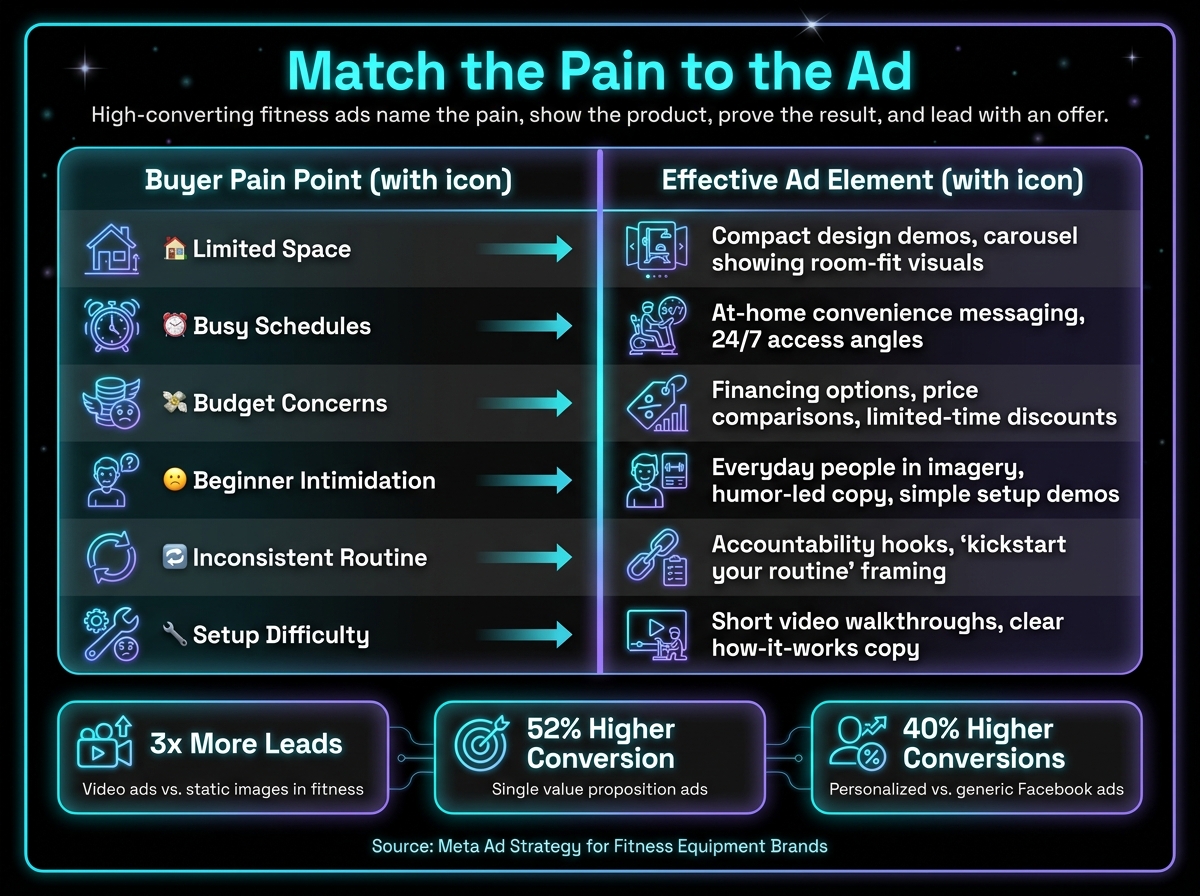
Fitness Buyer Pain Points vs. Winning Ad Elements
High-converting fitness ads usually do four things: name the pain, show the product, prove the result, and lead with an offer. Those four pieces give you a simple way to pick the right prompt angle for each ad format below.
Problem-solution framing is the best place to start. Most buyers respond to a pain point, not a spec sheet. They’re tired of starting over, missing workouts, dealing with small spaces, or feeling out of place as beginners. Ads that open with that frustration instead of a list of features are more likely to stop the scroll.
Sell the outcome, not the spec sheet.
Visible product demos make it easier for people to picture the equipment in their own routine. Video ads that show the equipment in action, plus setup and in-use footage, tend to persuade more than static images. In the health and fitness category, video ads generate 3x more leads than static image ads. Even a short setup demo or a home workout clip can ease worries about space and assembly.
Believable proof matters just as much as polished visuals. Real customers, creator demos, and before-and-after results help the ad feel convincing instead of staged.
Offers reduce purchase risk. Financing options like Klarna, money-back guarantees, limited-time bundles, and intro pricing can lower the barrier on a bigger purchase. The key is simple: match each pain point to one main creative element.
| Buyer Pain Point | Effective Ad Element |
|---|---|
| Limited space | Compact design demos, carousel showing room-fit visuals |
| Busy schedules | At-home convenience messaging, 24/7 access angles |
| Budget concerns | Financing options, price comparisons, limited-time discounts |
| Beginner intimidation | Everyday people in imagery, humor-led copy, simple setup demos |
| Inconsistent routine | Accountability hooks, "kickstart your routine" framing |
| Setup difficulty | Short video walkthroughs, clear how-it-works copy |
Use the table above to choose the right prompt angle before moving into the prompt lists below.
1. Problem-first hooks
Problem-first hooks work because they go straight at the pain buyers want to get rid of. Use them as the first line in ad copy or the opening line in a video.
"The best way to get someone's attention is to solve a frustration or problem in their life."
- "Tired of paying for a gym you never use?" - Use this for home gyms, treadmills, and rowing machines. It positions home training as the cheaper, easier option.
- "Small space. No problem." - Use this for compact, foldable, or multi-use gear made for small apartments.
- "What if you actually liked working out?" - Use this for beginner-friendly products like bands, yoga mats, and starter bundles.
- "Stop training wrong." - Use this for guided bundles or equipment that helps people improve form and follow a better plan.
- "Train before the kids wake up." - Use this for parents who need short workouts early in the morning.
- "No crowds. No wait. Just your workout." - Use this for shoppers who want a home-gym option instead of busy facilities.
After the hook, show the product fixing that problem in action.
2. Product-demo creatives
Once the hook does its job, the demo needs to show one thing fast: the product works. This is where you cut doubt and make the offer feel more concrete.
Here are 6 demo angles worth testing:
- The silent operation proof - Show the equipment running quietly next to a sleeping partner or child. This tends to work well for cardio equipment, where noise can be a deal-breaker.
- The space-saving split-screen - Show the equipment folded into a closet, then cut to it fully set up and being used. It answers the space objection without saying much.
- The component carousel - For more complex gear like multi-station home gyms or leg presses, use a carousel ad to walk through each part one card at a time. That gives buyers a closer look before they decide.
- The form-correction demo - Show the equipment auto-adjusting so users can stay locked in on the workout. This angle fits smart equipment and guided training tools well.
- The muscle-group callout - Use motion graphics or text overlays to show proper form and label the target muscle groups. This is especially helpful for equipment where technique matters.
- The unboxing-to-first-rep clip - Show delivery, setup, and first use in 15 seconds. Use this as the visual proof layer before moving into UGC angles.
Build every demo for muted viewing. Most mobile users watch without sound, so text overlays and visual cues need to do the heavy lifting on their own. Keep videos around 15 seconds. After the demo, trust-based creative can take it from there.
Next, use UGC to make that same proof feel more believable.
3. UGC and trust angles
UGC turns product proof into social proof people can believe. These prompts work best when the ad needs proof from a person, not just proof from the product.
Use these six angles to make the product feel real instead of overly polished.
- The specific transformation story - Use clear results, like "Sarah lost 22 lbs in 12 weeks with three sessions a week."
- The everyday-person visual - Show someone who looks like your buyer using the equipment, not a competitive athlete.
- The verified buyer overlay - Anchor the bottom of the ad with a star rating and one short review quote. A "Verified Buyer" badge helps cut perceived risk while someone is still scrolling.
- The small-space setup video - Film unboxing and assembly in a real apartment or living room. Showing the equipment in an actual home answers the space objection before it even comes up.
- The micro-influencer review - Partner with niche creators in the 10,000–100,000 follower range for honest feedback and realistic demonstrations.
- The community challenge post - Use a branded hashtag to encourage buyers to share short clips of themselves using the equipment. Social challenges featuring UGC get 33% higher engagement than standard branded posts, and that content can feed your next round of ad creative.
Reach for these angles when you need proof that feels personal, not produced.
Start with these UGC angles, then test them against offer and audience variants.
4. Offer and audience variants
Generic “get fit” messaging usually fades into the background. Ads tend to do better when they connect one clear offer to one clear buyer situation. Once you’ve chosen the proof angle, the next step is simple: match the offer to the buyer’s biggest objection.
Here are six prompt angles that do that job well.
- The bundle starter kit - Carousel ads fit this angle nicely. Group treadmills, dumbbells, bands, or recovery tools together and present the mix as a full home gym setup. Use the prompt: "Turn one machine into a full home gym."
- The financing hook - For high-ticket equipment, put the monthly payment front and center instead of the total price: "Build your home gym for low monthly payments - no gym membership needed."
- The seasonal urgency push - Use deadline-based offers tied to seasonal shopping windows. In fitness, seasonal discounts that perform well often fall between 30% and 55% off
- The free shipping angle - With heavy equipment, delivery cost is a real sticking point. Testing "Fast & Free Delivery" as the main hook can cut friction for this type of purchase
- The niche audience variation - Write for a specific group instead of everyone. That can mean copy like "strength training for women 40+" or "24/7 workouts for night-shift workers."
- The B2B lead ad - If you sell commercial-grade equipment, run a separate campaign for gym owners or studio managers. Lead ads built around bulk-order discounts or grand-opening offers tend to bring in more qualified leads from buyers focused on facility specs and order volume, not personal fitness goals
The key idea is straightforward: match the offer to the buyer’s main objection, then shape the prompt around the product itself. A $3,000 treadmill, a recovery bundle, and a commercial rack system shouldn’t sound like the same ad.
Tips for Adapting Prompts by Product and Audience
Use a plug-and-play structure: keep the core angle, then swap in the product name, main benefit, and audience. That gives you a simple way to turn the prompt types above into product-specific ads without starting from scratch every time.
For cardio equipment like treadmills and rowing machines, phrases like "ultimate in-home cardio," "no crowds," and "train on your time" fit naturally. For strength gear like dumbbells, resistance bands, and home gym systems, lean on terms like "muscle groups" and "durability," along with practical specs like rubber hex construction or weight capacity. Yoga mats and recovery tools usually do better with a softer tone: "mobility," "wellness," "longevity," and "feeling good."
"Fitness audiences are driven by personal goals, not product specs. Generic ad copy gets ignored. Niche-specific copy converts." - Coinis Editorial Team
Think of audience language as a rewrite layer. The base prompt stays the same, but the wording shifts based on who you're talking to. Beginners tend to respond to low-risk framing. Apartment dwellers care about compact design and quiet operation. Strength-focused buyers look for weight capacities and proof of quality. Weight-loss shoppers respond to transformation language. Mobility and recovery audiences care more about pain relief and "recover faster" than personal records or calorie burn.
Match the offer to the main objection. If the buyer is worried about space, lead with storage. If they're worried about price, lead with financing or bundle value. If they're worried about results, lead with proof.
| Product | Audience | Main Proof | Offer to Lead With |
|---|---|---|---|
| Treadmill | Busy professionals | No crowds, train anytime | Financing from $49/mo |
| Resistance bands | Apartment dwellers | Lightweight, under-bed storage | Free shipping |
| Home gym system | Strength-focused buyers | Full rack setup, weight capacity | Bundle pricing |
| Yoga mat | Wellness seekers | Non-toxic materials, grippy surface | Money-back guarantee |
| Recovery tools | Mobility/recovery audiences | Vibration levels, guided stretching | Free shipping or add-on trial |
| Dumbbells | Beginners | Rubber hex, lower upfront price | Starter bundle pricing |
Lead with the strongest product benefit in the first 125 characters, then check the rest of the copy against that promise.
Conclusion
Strong Meta ads for fitness equipment usually do three things well: they hit one pain point, back it up with one proof point, and give people one clear offer. That simple setup makes each prompt easier to build, test, and judge as its own ad.
Think of these prompts as a test bank. Mix each hook with one visual style, one offer, and one audience. That can mean problem-first hooks, demos, UGC, or offer-led versions. Then put each one up against a product-demo ad and see what holds up.
The goal is simple: build tests faster, tighten the angle, and scale the ads that bring down CAC.
FAQs
How many ad angles should I test first?
Start with 3 to 5 ad variations, and make each one come from a different angle. Change the hook, the emotion, or the main benefit so you can see what your audience responds to.
When one angle starts to win, build 3 to 5 more variations around that idea. Fine-tune the message, but keep every creative closely tied to your target customer’s needs and pain points.
What should I include in a fitness ad prompt?
Include three core parts: the audience’s struggle, the exact fix, and the action you want them to take. Start by defining the buyer persona: their pain points, goals, and demographic interests. Then open with a hook that stirs emotion or asks a direct question.
Set clear format rules too:
- Primary text: under 125 characters
- Headline: 40 characters or less
- Description: one line
Add social proof, a clear CTA, and a copy framework like AIDA to shape the message.
Which ad format works best for expensive equipment?
For expensive, high-ticket fitness equipment, Facebook Lead Ads are often the best way to bring in inquiries from gym owners and studio managers. The big reason is simple: people can send their contact details without leaving the platform. That cuts extra steps, which usually means more leads.
For retail consumers, take a different approach. Use longer ad copy with carousel ads to walk people through the value, show why they should trust you, highlight key features, and ease buying concerns with financing, warranties, and free installation.
Your next ad batch starts here
Finish with a ready-to-test ad batch
Paste your website to generate static creatives. Drop the link → get ads in about 90 seconds → upload them to Meta → scale.
Free to try No signup No prompt writing