The Best Lookalike Audiences for Ecommerce Meta Ads
Built for your product category
Turn your product page into category-specific Meta ads
Paste your URL and generate angles, visuals, headlines, and copy grounded in the offer customers will actually see.
Free to try No prompt writing

Lookalike audiences are one of the most effective tools for e-commerce ads on Meta. They help you target new customers who closely resemble your best existing customers. This approach consistently reduces costs and boosts returns compared to traditional interest-based targeting.
Key insights:
- A 1% lookalike audience delivers the most precise targeting, ideal for conversions.
- Use high-quality source data, like repeat buyers or high-value customers, for better results.
- Gradually expand to 2-5% audiences for scaling without losing too much precision.
- Avoid common mistakes like audience overlap and poor-quality seed data.
For the best results, focus on refining your seed audience, testing multiple ad creatives, and scaling slowly. Tools like ADEN's LAB can help you quickly generate ads to keep campaigns performing well.
How to Create a Lookalike Audience on Meta in 2026 (The Right Way)
Put the playbook to work
Apply this playbook to your page
Paste your website and the Lab will turn the strategy you are reading into a ready-to-test ads.
Free to try No prompt writing
Best Source Audiences for Creating Lookalikes
When building lookalike audiences on Meta, the quality of your seed audience matters far more than its size. A group of 3,000 high-value customers will outperform a pool of 30,000 low-value or infrequent buyers because it provides clearer patterns for Meta's algorithm. If your source audience includes one-time discount shoppers or accidental visitors, the algorithm will simply replicate those behaviors.
"Seed audience quality trumps size: 3,000 high-LTV customers outperform 30,000 mixed-quality purchasers for Lookalike creation." - Benly.ai
To achieve the best results, focus on well-defined tiers of source audiences. Tier 1 includes top customers by lifetime value, repeat buyers with multiple orders, and those with high average order values. Tier 2 focuses on recent purchasers (last 30 days) and users who added items to their cart in the past week, particularly useful for businesses with fewer transactions. Tier 3 relies on engagement-based audiences, such as video viewers (75% or more) and Instagram engagers, which use platform-native data unaffected by privacy restrictions like iOS updates.
For optimal performance, aim for 1,000 to 5,000 matched users in your seed audience. Email-only lists tend to match at 40–60%, but adding phone numbers, names, and locations can boost match rates to 70–85%.
Here’s a breakdown of the most effective source audiences and tips for refining each to maximize your lookalike performance.
Top Purchasers
Using repeat purchasers as your seed audience filters out one-time buyers and helps Meta's algorithm focus on high-intent customers. These are the people who are more likely to return and make additional purchases, rather than those who only buy during sales or discounts.
To refine this audience, export your customer data from platforms like Shopify or WooCommerce and filter for customers with at least two or three orders. This ensures your seed audience reflects consistent buying behavior.
High Lifetime Value Customers
Including a "value" column in your seed audience upload allows Meta to prioritize high-spending customers. This strategy can improve return on ad spend (ROAS) by 15–30% compared to using a broader customer base.
To create this audience, export the top 25% of your customers based on total spend. Make sure your list includes key details like email, phone number, name, and location, along with a "customer_value" field that reflects their total purchase amount. Once uploaded to Meta Ads Manager, the algorithm will focus on finding users with similar high-value purchasing habits.
"Your 'all purchasers' seed gets dominated by one-time discount hunters, clearance buyers, and returned orders. Meta finds more people who behave exactly like that." - Ali Puglianini, Lucky Penny
Cart Abandoners
Shoppers who have added items to their cart in the past week show strong intent to purchase, making them an excellent source audience. This is especially useful for businesses with lower transaction volumes or when promoting new products.
To create this group, build a custom audience based on "Add to Cart" events from the past seven days. Once you’ve reached at least 1,000 matched users, use this seed to help Meta identify others with similar shopping behaviors.
Engaged Website Visitors
Not all website visitors are created equal. Instead of targeting general traffic, focus on those who spent significant time on your site or viewed key pages like pricing or product details. This ensures you're reaching people with genuine interest, not accidental clicks.
To refine this audience, target the top 25% of visitors by time spent on site or those who viewed high-value pages. If privacy changes have affected your pixel data, consider using alternative signals like 75%+ video viewers or Instagram engagers for a more stable source.
How to Choose Lookalike Audience Size
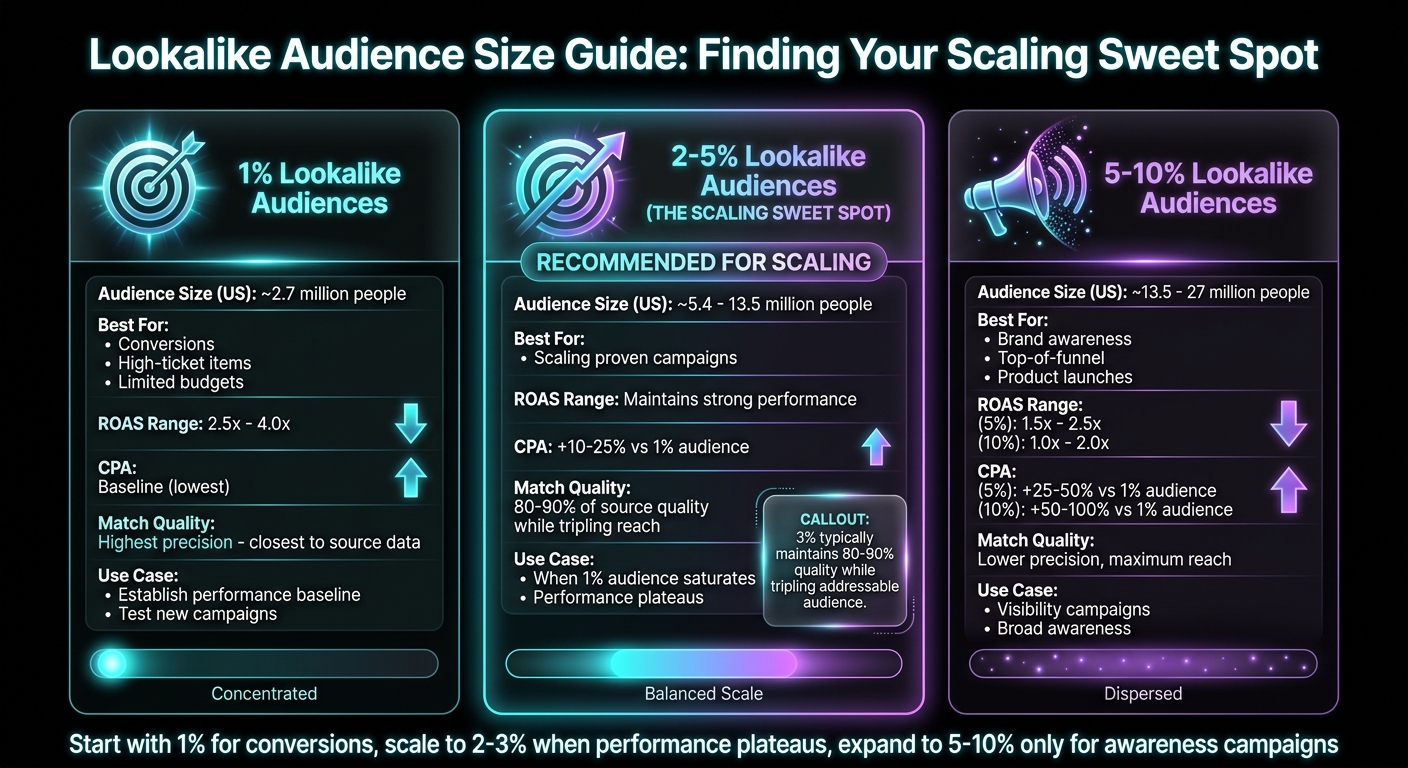
Lookalike Audience Size Comparison: Performance Metrics by Percentage
Finding the right lookalike audience size is all about balancing precision with reach. In the United States, a 1% lookalike audience includes roughly 2.7 million people who closely match your source audience. On the other hand, a 10% lookalike expands that reach to about 27 million people. The size you choose depends on your campaign goals - whether you're aiming for precise conversions or casting a wider net for awareness. Once you've built a strong seed audience, selecting the right lookalike size helps fine-tune your targeting.
Your campaign objective should guide this decision. If you're focused on conversions or working with a tight budget, start with a 1% lookalike to target the most likely buyers. This is especially effective for high-ticket or niche products, where precision is key. Once your 1% audience starts to show signs of saturation - like performance plateauing despite increased spending - you can shift to a 2-3% range. This range often preserves 80-90% of the quality of your source audience while tripling your potential reach.
"The 3-5% range represents the scaling sweet spot for most advertisers... expanding to 3% typically maintains 80-90% of the quality while tripling your addressable audience." - Benly
Testing audience sizes often reveals that smaller lookalikes deliver lower acquisition costs and higher returns. Broader audiences, though, trade some efficiency for greater reach. As you scale beyond a 1% lookalike, expect your CPA to rise because the match to your source data becomes less precise. For example, moving to a 3% lookalike may increase your CPA by about 10-25%.
1% Lookalike Audiences
A 1% lookalike audience is the narrowest option and provides the closest match to your source data. It's perfect for campaigns focused on conversions, where precision is critical. These audiences typically deliver ROAS between 2.5x and 4.0x. Use this tier to establish a performance baseline before scaling.
This size works well for promoting high-ticket items, testing new campaign ideas, or managing a limited budget. While the reach is smaller, the high-quality traffic often makes up for it.
2-5% Lookalike Audiences
The 2-5% range is ideal for scaling. A 2-3% lookalike audience offers a good balance between reach and similarity to your core customers. It can triple your audience size while increasing CPA by about 10-25% compared to a 1% audience.
This range is a smart choice when your 1% audience becomes saturated or performance stagnates despite higher spending. It allows you to expand proven campaigns without losing too much targeting precision.
5-10% Lookalike Audiences
Broader audiences, like 5-10% lookalikes, focus on reach rather than precision. These are best suited for top-of-funnel campaigns, such as brand awareness or new product launches. For example, a 5% lookalike might raise your CPA by 25-50% compared to a 1% audience and typically achieves ROAS between 1.5x and 2.5x. Expanding to a 10% lookalike could push CPA increases to 50-100%, with ROAS dropping to around 1.0x to 2.0x.
These larger audiences are great for maximizing visibility. You can refine them with broad interest filters, but avoid overly restricting the audience, as this can limit delivery.
How to Create Lookalike Audiences in Meta Ads Manager
Setting up a lookalike audience in Meta Ads Manager is quick and straightforward. The key is to fine-tune your settings to get the best results for your campaigns.
Selecting Your Source Audience
Start by navigating to the Audiences section in Meta Ads Manager (located under the "All tools" menu). Click on "Create audience" and choose "Lookalike audience" from the dropdown. Then, select your source audience. This could be:
- A Custom Audience (like an uploaded customer list)
- A Meta Pixel event (such as "Purchase" or "Add to Cart")
- A Facebook Page
For the best results, aim for a seed audience of 1,000 to 5,000 people. This range gives Meta's algorithm enough data to work with while maintaining a strong signal. Although Meta only requires a minimum of 100 people from the same country, using a larger, high-quality source improves performance.
If you're uploading a customer list, include multiple identifiers - such as email, phone number, name, and location - to increase match accuracy. Additionally, stick to users from a single country to keep the data focused and clean.
Once your source audience is ready, you’ll move on to defining the size of your lookalike audience.
Setting Lookalike Audience Sizes
With your source audience in place, you can now define the size of your lookalike audience. First, select the country or region where you want to find similar users. Then, use the slider to adjust the size between 1% and 10%. You can even create up to six different percentage ranges simultaneously, which is helpful for testing.
Here’s a quick example: In the United States, a 1% lookalike audience includes approximately 2.5–2.7 million people. A 10% lookalike audience, on the other hand, expands to about 27 million. For campaigns focused on conversions, it’s best to start with a 1% audience. Once you see consistent performance, you can gradually scale to 2–3%.
Adding Lookalike Audiences to Campaigns
Once your lookalike audience is set up, adding it to your campaigns can significantly improve performance by reducing acquisition costs and increasing ROAS.
Click "Create Audience" to finalize your setup. While it may take 6–24 hours for the audience to fully populate, you can start using it right away. Meta also refreshes lookalike audiences every 3 to 7 days as long as they remain active in your campaigns.
To get the most out of your lookalike audience, exclude the original source audience from your targeting - especially if it includes current customers. This ensures your ads focus on reaching new prospects. Additionally, you can use your lookalike audience as an "Audience Suggestion" in Advantage+ campaigns. This approach gives Meta’s AI a strong signal while allowing it to expand reach when better opportunities arise.
For optimal results, refresh your source audience every 30–90 days. Also, avoid creating a "lookalike of a lookalike." Always rely on first-party data to keep your targeting precise and effective.
Testing and Scaling Lookalike Audiences with ADEN's LAB
Once your lookalike audiences are live, the next step is to test your creatives and scale efficiently to maximize the impact of successful ads. Many e-commerce brands face challenges when it comes to producing creatives quickly and maintaining scaling momentum. That’s where ADEN's LAB steps in - delivering high-performing static Meta ads in under 90 seconds. This streamlined process allows for rapid testing and scaling, helping to lower CPAs and improve ROAS with your fine-tuned lookalike audiences.
Testing Multiple Creatives Quickly
The success of lookalike audiences often hinges on testing a variety of creative approaches. For instance, a 1% lookalike audience built around high lifetime value customers might respond differently to product-focused ads compared to creatives that emphasize benefits. The key to finding what works? Test multiple angles quickly and let the results guide your strategy.
ADEN's LAB makes this process seamless by allowing you to generate up to 200 ads monthly, starting at just $59. All you need to do is provide your product or landing page link, and the platform takes care of the rest, producing static ads designed to grab attention and align with Meta's algorithm. This rapid testing process helps identify top-performing combinations of headlines, visuals, and CTAs, which in turn lowers CPA and drives better ROAS.
Once you’ve pinpointed the winning creatives, scaling them becomes straightforward - without the usual delays tied to producing new assets.
Scaling Without Creative Delays
Scaling campaigns effectively requires keeping your creatives fresh. When ads become stale, performance drops - ROAS decreases, and CPAs climb. This is where ADEN's LAB proves invaluable.
With the Apex Mode plan, you can generate up to 200 ads per month for $179, which breaks down to just $0.90 per ad. This ensures you always have a steady supply of refreshed creatives, allowing you to maintain strong performance as your ad spend grows. By continuously updating your ads, you can counter creative fatigue and keep your campaigns running at their best, even as budgets increase.
Common Mistakes and How to Maximize ROAS with Lookalikes
Even the most carefully planned lookalike audience strategy can stumble if certain pitfalls aren't avoided. The difference between a campaign that achieves a 2.5x ROAS and one that barely breaks even often boils down to steering clear of three major missteps: audience overlap, poor-quality source data, and unbalanced testing methods.
Preventing Audience Overlap
When your ad sets target overlapping users, they end up competing against each other in Meta's auction. This drives up both your CPM and CPA, while also confusing the algorithm. On average, this internal competition can increase costs by 32% compared to campaigns with well-segmented audiences. Meta typically prioritizes the ad set with the strongest performance history, effectively sidelining the others. In essence, you're bidding against yourself.
To avoid this, use exclusions to create distinct audience segments. For example, if you're running a 1% and a 3% lookalike audience, exclude the 1% from the 3% ad set. Similarly, when running prospecting campaigns, exclude recent purchasers from the past 30 days to avoid wasting ad spend on people who’ve already bought from you. Meta’s Audience Overlap tool, available in Ads Manager under "Audiences", can help identify where your segments intersect. Keep in mind, though, that this tool requires at least 10,000 accounts to generate meaningful insights.
Once you've addressed overlap, the next step is ensuring your source data is optimized for success.
Using Quality Source Data
The effectiveness of your lookalike audience hinges on the quality of the source data you provide. Instead of using broad, low-quality data that creates noise, focus on high-value seeds. Poor data forces Meta to target people who resemble a mix of casual browsers and buyers - not your ideal customers.
Build your source audience from the top 20% of your customers based on lifetime value, prioritizing those who’ve purchased within the last 60–90 days. Exclude refund requesters, one-time discount shoppers, and low-value buyers to ensure the data is as clean as possible. Refresh your source list every three months to account for shifts in customer behavior. When uploading customer lists, include a column for purchase value. This helps Meta’s algorithm prioritize finding high spenders, which can boost ROAS by 15–30%.
Once your source data is solid, the challenge becomes finding the right balance between testing and scaling.
Balancing Testing and Scaling
Advertisers often fall into one of two extremes: either they stick to 1% lookalikes and limit their reach, or they scale too quickly by jumping to 10% audiences, sacrificing targeting precision. The key is gradual, data-informed expansion. Start with a 1% lookalike to test your offer and creative. Once you identify winning combinations, expand to 2–3%. Move to 5% or broader only when you're ready for higher-volume scaling and can tolerate less precision.
When increasing budgets, do so incrementally - around 20% every 3–5 days - to avoid resetting your campaigns into the learning phase. Keep an eye on your frequency. If it exceeds 3–4x within a week, your audience may be too small, signaling it's time to expand the lookalike percentage to reduce ad fatigue. The goal is to scale effectively while maintaining the integrity of your lookalike targeting.
Conclusion
Lookalike audiences continue to be one of the strongest tools for targeting in e-commerce Meta ads heading into 2026. When these audiences are built using high-quality customer data - like the top 20% of your customers by lifetime value or recent purchasers - they can deliver performance that’s 2–3× better than interest-based targeting. To get the most out of them, focus on using top-notch seed data and carefully selecting audience percentages to strike the right balance between precision and scale.
"The advertisers achieving the best Lookalike performance in 2026 understand that these audiences are only as good as the data feeding them." – Gaultier D'Acunto, Co-founder, Benly.ai
However, success with lookalike audiences goes beyond just setting them up. Regular optimization is key. For example, managing audience overlap can help you avoid wasting ad spend on internal competition, while scaling gradually ensures you maintain precise targeting. Value-based lookalikes, which include purchase amount data, are particularly effective - boosting ROAS by 15–30% compared to standard customer lists. These should be a core part of any serious e-commerce advertising strategy.
But there’s another challenge: keeping your creative assets fresh. Even the best lookalike audience won’t perform well if your ads fall victim to creative fatigue. This is where tools like ADEN's LAB become a game-changer. With its ability to produce high-performing static Meta ads in under 90 seconds, you can test dozens of creatives each week without delays. At just $0.90 per ad on the Apex Mode plan, it ensures you can maintain the creative output necessary to scale profitably.
FAQs
What seed audience should I use if I don’t have enough purchases yet?
If you're short on purchase data to build a strong seed audience, focus on engagement-based audiences instead. This means targeting individuals who have interacted with your content, watched your videos, or visited your website within the past 7 days. For a solid starting point, aim for website visitors or page engagement audiences with at least 100 people - though having 500 to 1,000 is even better. This approach can bridge the gap until you collect enough purchase data to create more precise lookalike audiences.
How do I know when my 1% lookalike is saturated?
When your 1% lookalike audience stops growing noticeably and ad performance levels off, it’s a clear sign the audience is likely saturated. This suggests you've already reached the most relevant users, and trying to scale further could lead to weaker results. Keep an eye on key metrics like engagement and conversion rates to pinpoint this tipping point. From there, it’s time to rethink your approach and tweak your strategy.
Should I use value-based lookalikes or standard lookalikes?
Value-based lookalikes are a smart option when your goal is to attract high-value customers and boost ROI. These audiences are built using purchase data, helping you identify people who closely resemble your top buyers. This approach can often lead to a 15-30% improvement in ROAS. On the other hand, standard lookalikes rely on demographic and behavioral similarities, making them more effective for broader prospecting efforts. If you're focused on targeting high-LTV customers, value-based lookalikes are the way to go.
Your next ad batch starts here
Finish with a ready-to-test ad batch
Paste your website to generate static creatives. Drop the link → get ads in about 90 seconds → upload them to Meta → scale.
Free to try No prompt writing