Broad vs Interests vs Lookalikes: Which Meta Audience Wins in 2026?
Turn the strategy into creatives
Create Meta ads for your product
Paste your product page. ADEN'S LAB turns the offer, audience, and positioning into complete ready-to-use Meta static ads.
Free to try No prompt writing

Broad audiences dominate Meta advertising in 2026, offering the best scalability and cost efficiency with an average ROAS of 113%. Lookalike audiences excel in precision, particularly for SaaS and lead generation, while interest-based targeting plays a smaller, niche role. The choice depends on your business goals:
- Broad: Best for e-commerce and high-volume campaigns. Scales easily and delivers the lowest CPA.
- Lookalike: Ideal for high-value prospecting using quality seed data. Strong for SaaS and niche markets.
- Interest-based: Useful for new accounts or industries with specific buyer profiles but less reliable overall.
Key takeaway: Success on Meta now relies heavily on AI and ad creative performance. Broad targeting leads for scale, while Lookalikes work for precision. Interest targeting is fading but still relevant in specific cases. Creative testing is the real differentiator.
How to Target the Best Audience for Facebook Ads (2026 Strategy)
Put the playbook to work
Apply this playbook to your page
Paste your website and the Lab will turn the strategy you are reading into a ready-to-test ads.
Free to try No prompt writing
Broad Audiences: How They Perform
Broad targeting hands over the reins to Meta's AI, allowing it to comb through the entire platform's user base with just a few basic guidelines - like age, gender, and location. From there, Meta's Generative Ads Recommendation Model (GEM) and Meta Lattice take over. GEM analyzes how users engage across Facebook and Instagram, while Meta Lattice unifies ad placement across surfaces like Stories and Feed. This unified approach has already shown a 12% improvement in ad relevance during recent tests. These AI-driven systems, which excel at predicting user behavior, are key to boosting metrics like ROAS and CPA.
Instead of relying on static interests, the system learns from how users interact with content over time. It uses this behavioral data to predict which users are most likely to convert. This method, often called "creative as targeting," ensures that the right ad message attracts the right audience, while the AI fine-tunes delivery on its own. For example, in Q1 2026, a mid-sized athletic apparel brand consolidated 12 campaigns into just three Advantage+ Shopping campaigns using Broad targeting. The results? Their CPA dropped from $42 to $28, and their ROAS surged from 2.8x to 4.6x within just 21 days.
Why Broad Audiences Work
Broad targeting is known for delivering lower CPMs and higher ROAS compared to more restrictive audience options. The data speaks for itself: Broad campaigns achieve an average ROAS of 113%, while Lookalike audiences hover around 76%. Plus, CPMs for Broad targeting are 45% lower. No wonder Advantage+ Shopping Campaigns now account for 62% of e-commerce conversion spending, up from 34% in 2024.
Broad audiences work because they give the algorithm the volume it needs to identify high-intent users and avoid creative fatigue. In the supplements category, for instance, Broad targeting (based only on age and gender) outperformed detailed interest targeting by 29% in ROAS. Similarly, for baby and kids' products, targeting new parents aged 25-40 with Broad settings proved 37% more efficient than narrow, interest-based approaches.
"The algorithm is better at finding buyers than you are at guessing who they are. Feed it good creative, good conversion data, and get out of its way." - NUVIX
Broad targeting also scales easily. Because it doesn’t limit the audience pool, you can increase budgets without worrying about hitting a ceiling. Campaigns with streamlined structures and budgets over $50/day show a 34% better CPA compared to fragmented, smaller campaigns.
Where Broad Audiences Fall Short
While Broad targeting has its perks, it does come with trade-offs - starting with the fact that you’re fully dependent on Meta's AI. This means you lose control over exactly who sees your ads. If the AI misinterprets signals or your creative falls flat, you could end up wasting ad spend.
The system also demands high data density to perform well. Campaigns typically need at least 50 conversion events per week to stay in the algorithm's priority queue. For new accounts without conversion history, Broad targeting can be a challenge since the AI lacks a baseline to optimize from. Similarly, niche B2B products with small target markets often struggle because the algorithm needs a large volume of data to learn effectively.
Another downside? Creative fatigue hits hard with Broad audiences. Because your ads are shown to a wide but finite pool of users, you’ll need to refresh your creative assets frequently - typically every 14-21 days. For industries like beauty and cosmetics, this means testing 20 or more new creatives each month to keep engagement strong.
Broad Audience Performance Data
When it comes to performance, Broad targeting consistently outshines other audience types across key metrics. For instance, in 2026, Advantage+ Shopping Campaigns delivered a 17% lower CPA and a 16% higher ROAS compared to manually managed campaigns. Meta's incremental attribution model, often used with Broad campaigns, also drove a 24% increase in incremental conversions by late 2025.
| Vertical | Broad/Advantage+ ROAS | Manual/Interest ROAS | Efficiency Gain |
|---|---|---|---|
| Supplements & Health | 4.5x | 3.5x (est) | +29% |
| Baby & Kids | 3.5x | 2.5x (est) | +37% |
| All E-commerce (Avg) | 3.7x | 3.2x | +16% |
Source:
A significant update in March 2026 shifted Meta’s algorithm from auction-based placements to prioritizing downstream conversions and lifetime value predictions. While this led to CPM increases of 15% to 40%, advertisers found that these higher costs reflected higher-intent impressions, which converted more efficiently. Meta's predictive AI models now boast an impressive 87% accuracy in forecasting conversion likelihood.
To make Broad targeting work for you, ensure you have 15-20 active creatives at any given time so the algorithm has enough data to optimize effectively. Once a campaign is launched, allow 3-7 days for it to exit the learning phase without manual interference. Instead of focusing on micro-managing bids, shift your efforts toward crafting compelling creative stories - the AI will handle the rest.
Interest-Based Audiences: When They Still Matter
Interest-based targeting isn't as prominent in 2026, but it hasn’t completely vanished. While Meta's AI-driven systems dominate advertising strategies, there are still situations where selecting interest categories manually can be effective. Today, this method serves more as a flexible starting point for audience expansion rather than a strict boundary.
Meta’s Advantage Detailed Targeting feature treats selected interests as suggestions rather than limits, allowing the AI to expand beyond them if better conversion opportunities emerge. This shift highlights a broader trend: relying on ad messaging to filter audiences instead of solely depending on predefined categories. Let’s dive into when interest targeting still delivers value.
When Interest Targeting Works Best
Interest targeting continues to shine in niche markets. For industries with limited appeal, like specialized B2B software or high-ticket items targeting specific buyer profiles, interest categories provide initial guidance that helps algorithms find the right audience. Layering interests with a 1–3% Lookalike audience can increase relevance in such cases.
This approach also benefits lead generation and B2B campaigns, which frequently aim to reach users in specific job functions or industries. Interest-based signals offer necessary boundaries, with lead generation campaigns using this method achieving an average CPC of $1.92.
For new ad accounts or those with fewer than 500 conversions, interest targeting is a helpful tool for early-funnel testing. It establishes initial signals before transitioning to broader or lookalike strategies. Similarly, awareness campaigns at the top of the funnel often perform well with broad interest categories.
"Interest targeting works best when you use broader categories rather than stacking multiple narrow interests, which can shrink your audience without proportionally improving quality." - Gaultier D'Acunto, Co-founder, Benly.ai
A key tip: avoid stacking too many narrow interests. Stick to broader categories to give the algorithm room to operate effectively. If Meta’s Audience Overlap tool shows more than 30% overlap between interest stacks, consolidate them into one ad set to avoid internal competition.
Still, interest targeting has its challenges.
Why Interest Targeting Struggles
The decline in interest targeting’s effectiveness stems from major changes in Meta’s algorithm. In March 2026, Meta shifted from auction-based placement to outcome-based optimization, prioritizing downstream conversions and lifetime value over basic engagement metrics like clicks. This change made overly specific interest stacks less effective, as they clash with Meta’s preference for broader, AI-driven pools.
Additionally, interest targeting relies on weak signals. Just because someone likes a page or follows an account doesn’t mean they’re ready to buy. These engagement-based signals are less reliable than modern behavioral modeling. Privacy changes have further weakened the accuracy of interest categories.
Campaigns with fewer than 50 weekly optimization events often face higher CPMs, with costs increasing by 15–40%. For prospecting campaigns, keeping ad frequency below three is critical, as exceeding this limit can raise CPA by 10–25%. These limitations have pushed advertisers toward AI-driven targeting methods that align with broader trends in algorithmic optimization.
Interest Targeting Performance in 2026
While broad and lookalike audiences often yield better ROAS, interest targeting still has a role in specific scenarios. Broad targeting achieves an average ROAS of 113%, while lookalike audiences deliver around 76%. Interest-based campaigns, particularly those with narrow stacks, tend to lag due to higher CPMs and limited reach.
| Audience Type | Best Use Case | Average ROAS | CPM Comparison |
|---|---|---|---|
| Broad | Mass-market, high budgets, mature pixels | 113% | Baseline (lowest) |
| Lookalike | Scaling and high-value prospecting | 76% | 45% higher than Broad |
| Interest | Niche products, B2B, early-stage accounts | Lower than Lookalikes | Higher than Lookalikes |
Source:
On Meta platforms, the global average CPM ranges from $10 to $15, with an average CPC of $1.14 (e-commerce averages $1.07). However, interest-based campaigns often come with higher costs due to reduced reach and friction with AI systems. Lookalike audiences, by contrast, can lower CPA by 20–40% and improve ROAS by 15–35% compared to narrow interest stacks.
For those sticking with interest targeting, consolidation is key. Combine similar interest-based audiences into one ad set to hit the 50-event-per-week threshold required for optimal AI performance. Enable Advantage Detailed Targeting to let Meta expand beyond your chosen interests when better opportunities arise. And don’t forget: your creative matters more than ever. Focus on raw, native-style content - like user-generated videos and handheld clips - to drive the engagement signals that fuel Meta’s AI-powered distribution.
Lookalike Audiences: Performance and Requirements
Lookalike audiences offer a data-driven way to target potential customers by using your existing customer data to find people with similar behaviors and traits. Unlike broad or interest-based targeting, this method relies on real customer information, making its effectiveness directly tied to the quality of the data you provide. In 2026, Lookalike audiences remain a go-to tool for marketers who have robust customer datasets.
Why Lookalike Audiences Deliver Results
Lookalike audiences stand out because they use actual customer behavior to identify new prospects. For instance, uploading a list of your top buyers - like your top 10% by lifetime value (LTV) - enables Meta’s algorithm to find users with comparable traits. This often results in performance that’s 2–3 times better than interest-based targeting because it’s grounded in real purchase data.
The secret lies in using value-based seeds. A smaller, high-quality list of 3,000 top-LTV customers will consistently outperform a larger, mixed-quality list of 30,000 buyers. By focusing on high-value customers, Meta prioritizes finding similar "whales" rather than average spenders, which can boost return on ad spend (ROAS) by 15–30% compared to standard Lookalikes.
"Seed quality matters more than quantity: 3,000 high-LTV customers outperform 30,000 mixed-quality purchasers for Lookalike creation." - Benly.ai
Practical examples highlight the power of Lookalikes. In March 2026, a fashion brand tested three audience types. Their 1% Lookalike, based on 2,847 repeat buyers (excluding those inactive for 90 days), achieved a 4.2x ROAS and a $19 cost per acquisition (CPA). By comparison, their 5% Lookalike yielded a 2.5x ROAS ($32 CPA), while interest-based targeting lagged with a 1.8x ROAS ($45 CPA).
Lookalikes are particularly effective in specific scenarios, such as:
- New ad accounts with limited data: Ideal when you have fewer than 500 conversion events for broad targeting to optimize.
- Niche B2B markets: Useful for industries like cybersecurity SaaS, where broad targeting might attract irrelevant users.
- High-ticket products: A well-optimized 1% Lookalike can lower CPA by 34% compared to interest-based audiences.
Despite their advantages, Lookalikes are not without challenges.
Lookalike Audience Limitations
The effectiveness of Lookalike audiences is entirely dependent on the quality of the seed data. Including low-value buyers, refunded customers, or support complainers in your seed list can misguide Meta’s algorithm, leading to poor results.
"Lookalikes are only as strong as the seed audience behind them. When seed data is noisy, low-intent, or outdated, performance drops and costs rise." - EasyInsights
Seed size also plays a role. While Meta recommends a minimum of 100 users, a range of 1,000–5,000 matched users is ideal for reliable results. In some cases, broad targeting has outperformed Lookalikes, achieving a 113% ROAS compared to 76% for Lookalikes. This highlights that Lookalikes work best as starting points rather than rigid boundaries.
To maintain effectiveness, refresh your seed audiences regularly - ideally every quarter or monthly for fast-growing brands. Additionally, use country-specific seeds to avoid mixed signals, and consider implementing the Conversions API (CAPI) for accurate data collection and to mitigate tracking limitations on iOS devices.
Lookalike Audience Metrics
Performance varies depending on the size of your Lookalike audience. A 1% Lookalike, representing about 2.7 million people in the U.S., offers the highest match quality and is ideal for testing, limited budgets, and high-ticket products. As the percentage expands, reach increases, but so does the CPA:
| Lookalike % | ROAS Range | CPA Increase from 1% Baseline | Best Use Case |
|---|---|---|---|
| 1% | 2.5x – 4.0x | Baseline | Testing, high-ticket, limited budgets |
| 2–3% | 2.0x – 3.5x | +10–25% | Primary scaling audience |
| 5% | 1.5x – 2.5x | +25–50% | High-volume scaling |
| 10% | 1.0x – 2.0x | +50–100% | Broad awareness |
Optimized Lookalikes can reduce CPA by 35–50% compared to default settings. This improvement often depends on seed quality, value-based weighting, and proper exclusions. Always exclude existing customers and recent converters from prospecting campaigns to avoid wasted ad spend.
For the best results, prioritize seed audiences with the following characteristics:
- Top 10% LTV customers: Provides the strongest signal.
- Repeat purchasers (3+ orders): Indicates high intent.
- Recent purchasers (last 90 days): Offers fresh data.
- Add-to-carts or leads: Medium signal strength.
Avoid using all website visitors as a seed, as this introduces too much noise for the algorithm to identify meaningful patterns.
In 2026, Lookalikes are increasingly seen as "audience suggestions" rather than strict boundaries. With tools like Advantage+, Meta uses your Lookalike as a starting point but expands beyond it to find better prospects. This evolution makes ad creative the real filter - your messaging and hooks determine which leads convert within the Lookalike pool.
"In 2026, your ad creative is the targeting... The Lookalike helps you find the first batch of people, but the Creative ensures that only the qualified leads actually click." - Ankit Agarwal, Head of Marketing, Gracker.ai
Broad vs Interest vs Lookalike: Performance Comparison
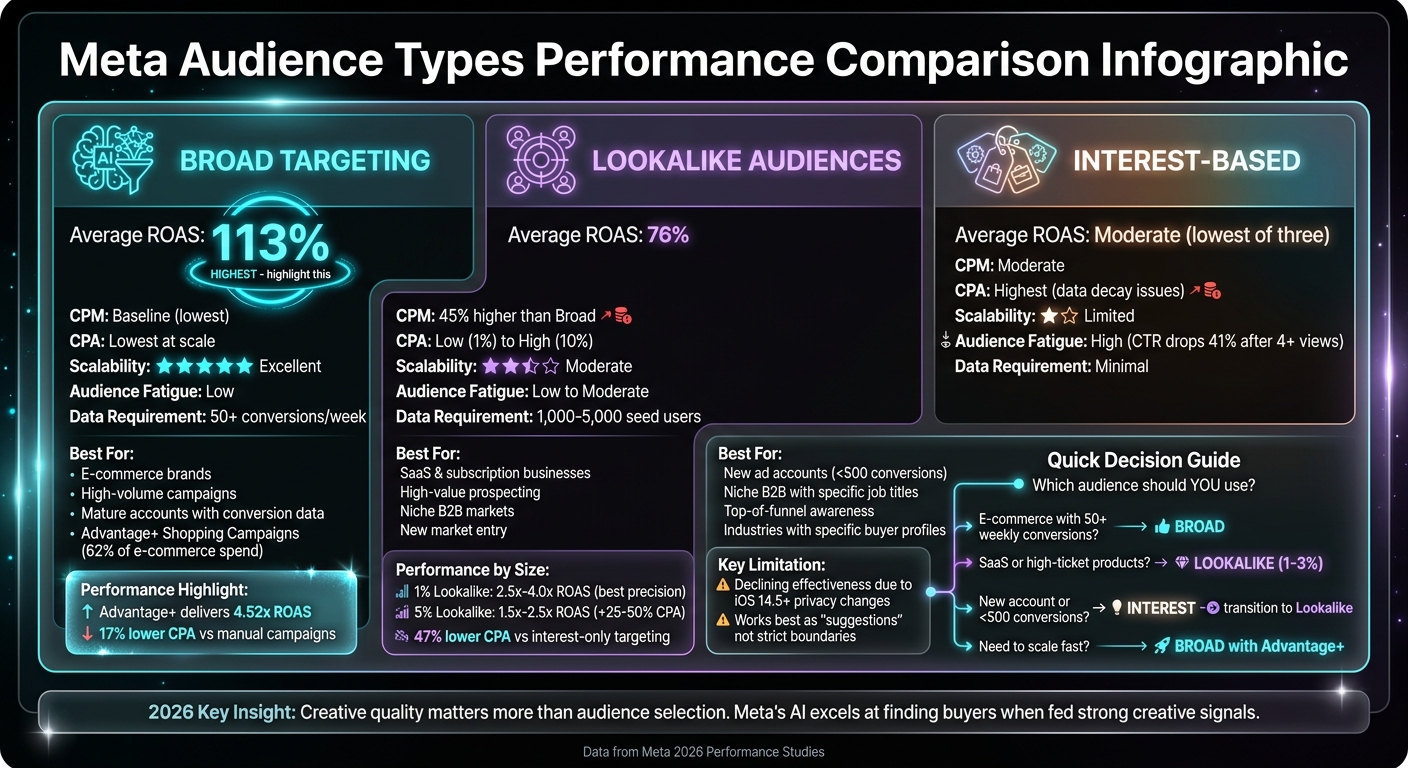
Meta Audience Types Performance Comparison 2026: Broad vs Lookalike vs Interest-Based
Performance Data Comparison
Each audience type comes with its own set of pros and cons, especially when it comes to cost and scalability - key factors for e-commerce, SaaS, and lead generation campaigns. Broad targeting leads the way with an average ROAS of 113%, compared to 76% for Lookalike audiences. This reflects how effective Meta's AI can be when given the freedom to explore larger audiences.
But there's more to the story when you look at costs. Lookalike audiences have a CPM that’s 45% higher than Broad targeting. This higher cost per impression partly explains why their ROAS doesn’t measure up, even with their more precise targeting. Interest-based audiences, on the other hand, tend to fall somewhere in the middle for CPM but have become less dependable due to iOS 14.5+ privacy changes, which have impacted interest data reliability.
| Metric | Broad | Interest-Based | Lookalike |
|---|---|---|---|
| Average ROAS | 113% | Moderate | 76% |
| CPA | Lowest at scale | Highest (data decay) | Low (1%) to High (10%) |
| CPM | Baseline | Moderate | 45% higher than Broad |
| Scalability | Excellent | Limited | Moderate |
| Audience Fatigue | Low | High (CTR drops 41% after 4+ views) | Low to Moderate |
| Data Requirement | 50+ conversions/week | Minimal | 1,000–5,000 seed users |
This table highlights the key trade-offs between audience types. For instance, while Broad targeting shines in scalability and cost efficiency, Lookalike audiences can deliver more precise results but at a higher cost. Meanwhile, interest-based targeting struggles with data decay, making it less reliable over time.
Across all Meta advertisers in 2026, the median CPA stands at $38.17. However, this varies significantly depending on the audience type and campaign setup. Campaigns leveraging Custom Audiences (the foundation for Lookalikes) achieve a 47% lower CPA compared to interest-only targeting.
Which Audience Type for Each Business
The best audience strategy depends on your business model and goals. Here’s a breakdown of what works for different industries:
E-commerce Brands
Broad targeting paired with Advantage+ Shopping Campaigns has become the go-to approach in 2026. This isn’t surprising, given that 35% of US retail ad spend now flows through Advantage+ Shopping Campaigns, marking a 70% year-over-year increase in adoption. These campaigns deliver a 4.52x ROAS, outperforming manual setups by 22%. The key here is ensuring your campaigns generate 50+ conversions per week to give Meta's AI the data it needs to optimize effectively.
SaaS and Subscription Businesses
For SaaS, Lookalike audiences built from high-value customers are the way to go. Start by uploading your top 20% highest-LTV customers (around 2,000–5,000 users) and create a 1–3% Lookalike audience. These value-based Lookalikes often boost ROAS by 15–30% compared to standard Lookalikes, making them ideal for businesses with high-ticket offerings.
Lead Generation Campaigns
Lead generation calls for a more tailored approach. Interest targeting still has its place for reaching specific job titles or professional demographics, but the real game-changer is building Lookalikes from converted leads - actual customers - not just form-fills. Meta’s average cost per lead for B2B campaigns is $27.66, significantly lower than Google’s average of $70.11.
For new accounts without much pixel data, starting with a 1% Lookalike audience based on CRM or email data is a smart move. Once you achieve 50+ conversions per week, transitioning to Broad or Advantage+ targeting can help reduce CPMs and scale your campaigns more effectively.
How AI Tools Improve Audience Performance
AI's Impact on Audience Targeting
Meta advertising has shifted gears, relying heavily on ad creative as the main tool for targeting. By 2026, AI tools are redefining the way advertisers connect with their audience. Instead of manually selecting interest categories, the focus is on how well the ad's message resonates with users.
"In 2026, your ad creative is the targeting." - Ankit Agarwal, Head of Marketing, Gracker.ai
AI platforms like ADEN's LAB take this a step further by creating AI-optimized static ads that act as strong signals for Meta's algorithms. These ads, combined with data-driven performance insights and robust conversion signals via the Conversions API, allow the AI to pinpoint high-intent users. Whether targeting a broad audience, interest-based groups, or Lookalike segments, the creative itself becomes the driving force behind audience selection. This approach not only enhances precision but also lays the groundwork for rapid testing, which is explored in the next section.
Fast Creative Testing with ADEN's LAB
With AI improving targeting accuracy, speed becomes a crucial factor. Rapid creative testing is key to harnessing AI's predictive capabilities fully. ADEN's LAB makes this possible by generating dozens of AI-optimized static ads in just minutes - far faster than traditional methods. This enables marketers to test the same offer across Broad, Interest-based, and Lookalike audiences simultaneously, letting the data determine the most cost-effective combination.
The platform uses proven direct-response strategies and buyer psychology to design creatives that perform. For B2B or SaaS campaigns, this involves crafting technical, highly specific hooks that resonate with niche audiences. For e-commerce, the focus shifts to transaction-driven messages that attract serious buyers rather than casual browsers.
At scale, ADEN's LAB users can generate over 200 ads per month at just $0.90 per ad. This drastically reduces production costs compared to traditional designer fees, which range from $30 to $50 per ad. The ability to produce fresh, high-quality creatives at this volume is essential for combating ad fatigue. In 2026, the brands that succeed on Meta aren’t necessarily the ones with the largest budgets - they're the ones that consistently outproduce competitors with engaging and effective creatives. By combining AI-powered creative production with precise audience targeting, marketers can achieve both optimal performance and cost efficiency.
Conclusion: Which Audience Type Wins in 2026?
After analyzing the data, one thing is clear: there’s no universal winner when it comes to audience types. The best choice depends entirely on your business model and how mature your account is.
Broad targeting stands out with an average ROAS of 113%, making it a go-to for scalability - especially for e-commerce brands achieving 50–100 weekly conversions. By leveraging Meta's AI, this approach taps into billions of data points to identify buyers, without requiring manual input or restrictions.
Lookalike audiences, on the other hand, shine when precision is key. They’re perfect for quality-driven prospecting, lead generation, or entering new markets - assuming you’re building them from high-value seed lists. For instance, a seed list of 3,000 top-tier customers can yield exceptional results. SaaS and subscription businesses particularly benefit when Lookalikes are built from long-term, low-churn customers, offering the precision needed to find similar high-value users. Keep in mind, though, that Lookalikes come with a 45% higher CPM.
Interest-based audiences fill a more niche role. They’re best for new accounts with limited pixel data or for highly specific B2B campaigns targeting particular job titles or industries. Beyond those scenarios, interests act more as "guidelines" for Meta’s AI rather than strict targeting parameters.
Each audience type has its strengths, tailored to different business models - whether it’s scaling e-commerce or running precision-focused SaaS campaigns.
But here’s the kicker: audience selection alone isn’t enough. Rapid creative testing is what truly sets campaigns apart. As Piotr Zabuła, CEO of Cropink, explains:
"Meta is often better at predicting buyer behavior than most advertisers are at targeting. That's why keeping things simple and signal-rich usually wins".
This is where tools like ADEN'S LAB come into play. By generating over 200 AI-optimized static ads monthly at just $0.90 per ad, it enables advertisers to test creatives across all audience types simultaneously. The takeaway? Success on Meta in 2026 won’t just depend on audience targeting - it’ll hinge on how quickly you can test and optimize creative. Meta’s algorithm thrives on fresh, high-performing signals, so the real advantage lies in efficiency and quality.
FAQs
How many conversions per week are needed for Broad targeting to work?
There isn’t a magic number of weekly conversions needed for Broad targeting to work well. Its effectiveness hinges on several factors, including your campaign goals, the quality of your ads, and how you’ve set up optimization. The best way to gauge its suitability is by testing it out and closely reviewing performance metrics to see if it supports your objectives.
What’s the best seed list for a high-performing Lookalike?
For a high-performing Lookalike audience, start with a focused, high-quality seed list - think around 3,000 customers with high lifetime value or recent purchasers. Avoid using overly large or mixed-quality lists, as they dilute effectiveness. Use 1% Lookalikes for more precise targeting or 3-5% Lookalikes when you want to expand your reach while maintaining some level of accuracy.
When should I still use interest-based targeting in 2026?
Interest-based targeting continues to hold value in 2026, especially for connecting with niche audiences, experimenting with new market segments, or pairing it with methods like lookalike audiences and broad targeting. This strategy is particularly useful for fine-tuning your audience reach and boosting campaign performance when accuracy is a priority.
Your next ad batch starts here
Finish with a ready-to-test ad batch
Paste your website to generate static creatives. Drop the link → get ads in about 90 seconds → upload them to Meta → scale.
Free to try No prompt writing