Ugly-Ad Prompts for Meta: How to Generate High-Contrast Static Creatives Fast
Build the ads while the examples are fresh
Turn your product page into static ad creatives
Paste your product URL and generate scroll-stopping images, headlines, and primary text—ready for your next Meta creative test.
Free to try No prompt writing
Ugly ads work better on Meta. Why? They stop the scroll. Unlike polished designs, these ads use bold colors, raw visuals, and direct messaging to grab attention quickly. Meta’s Andromeda AI prioritizes engagement - likes, shares, and comments - over perfection. That’s why these low-cost, high-contrast ads outperform traditional ones in certain cases, boosting clicks, conversions, and action intent.
Here’s the key takeaway:
- Why they work: They disrupt scrolling patterns and feel less like ads.
- How to create them: Use AI tools for Meta ads like ADEN's LAB to generate raw, high-contrast designs in seconds.
- When to use them: Test new offers, counter creative fatigue, or revive engagement.
This approach isn’t about looking pretty - it’s about driving results fast.
How To Make Ugly Meta Ads That Convert Like CRAZY (12+ Examples)
Put the playbook to work
Apply this playbook to your page
Paste your website and the Lab will turn the strategy you are reading into a ready-to-test ads.
Free to try No prompt writing
Core Principles of High-Contrast Static Meta Ads
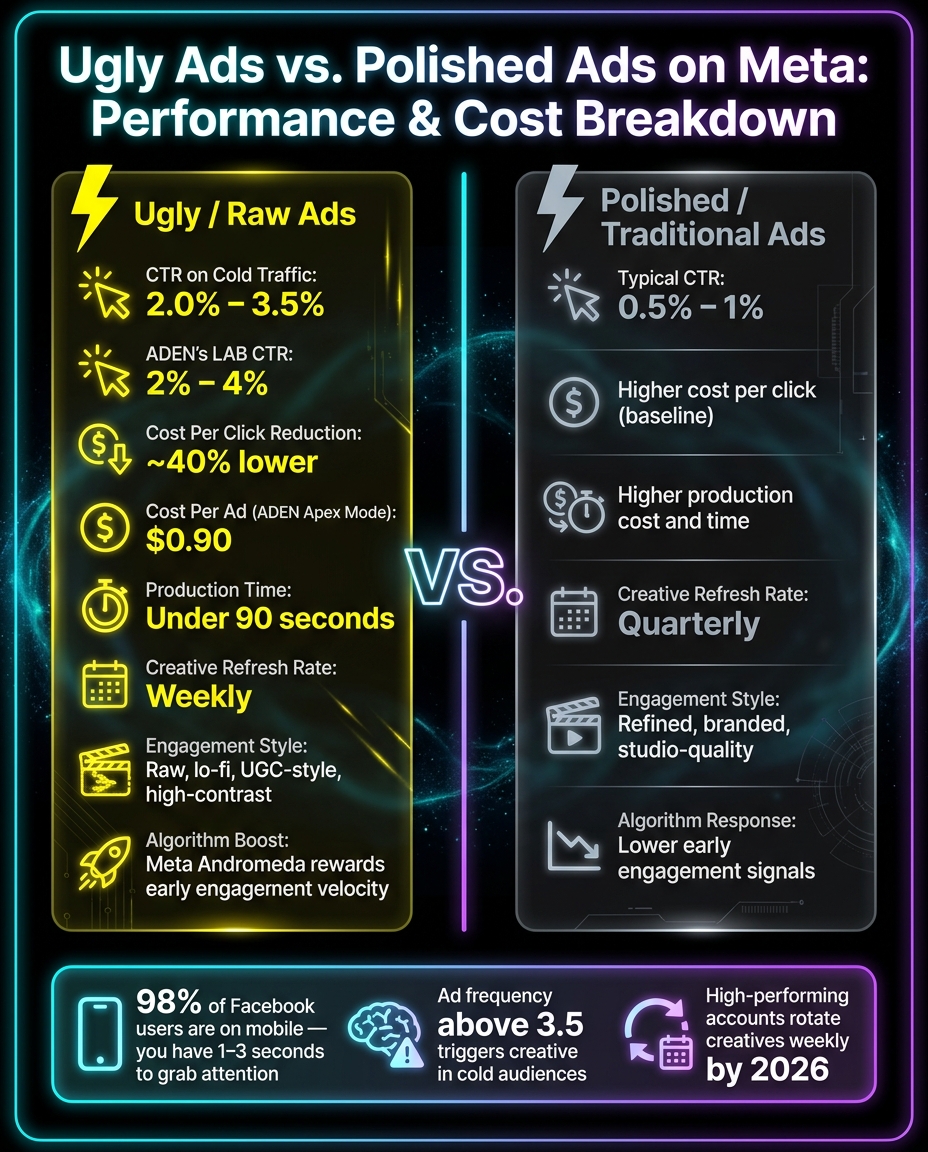
Ugly Ads vs. Polished Ads on Meta: Performance & Cost Breakdown
Design Principles for Meta Static Ads
The secret to a winning static ad on Meta? Clarity is king. With more than 98% of Facebook users accessing the platform via mobile devices, you have just 1 to 3 seconds to capture their attention. This means cutting the clutter and delivering a single, focused message.
Here’s how to do it: stick to one message - one standout visual, one key benefit, and one clear call to action. Use bold, sans-serif fonts (at least 24-point equivalent) to ensure readability on mobile screens. The 4:5 format (1,080 x 1,350 pixels) is ideal, giving you extra vertical space and more visibility in the mobile feed. While Meta no longer enforces strict text overlay rules, keeping text minimal still works best.
"Creative is the new targeting." - CreativeOS
Once you’ve nailed clarity, you can experiment with the unconventional: the "ugly ad" formula.
The Ugly Ad Formula: Breaking Standard Design Rules
The "ugly ad" approach flips traditional design on its head to grab attention fast. Forget polished layouts and perfect brand colors - this formula thrives on bold color blocking, oversized text, raw images, and lo-fi framing. Why? It feels more authentic and less like a polished sales pitch, reducing the subconscious resistance people often have toward overtly commercial content.
These ads lean heavily on direct-response tactics. For example:
- Price anchoring: Use clear pricing cues like "$29" or "Starting at $49" to pre-qualify clicks.
- Social proof: Highlight trust signals like "4,800+ orders shipped" or star ratings.
- Urgency: Add phrases like "Today Only" or "Only 3 Left" to drive immediate action.
"Pretty does not convert. Clarity does." - CEDM
When Ugly Ads Outperform Polished Creatives
So, when should you ditch polished designs for these raw, attention-grabbing ads? Ugly ads aren’t a one-size-fits-all solution, but they excel in specific situations. They’re perfect for quickly testing new offers or creative angles since their low production cost allows for rapid experimentation. Additionally, they can revive engagement during creative fatigue - when your audience has seen your polished ads too many times. This typically happens when ad frequency climbs above 3.5 for cold audiences.
In fact, UGC-style and raw static ads often achieve click-through rates between 2.0% and 3.5% on cold traffic, outperforming their polished counterparts. Meta’s Andromeda AI even boosts ads that gather early engagement (likes, comments, shares), helping them reach wider audiences.
AI Prompt Frameworks for Generating Ugly Ads
The raw, high-contrast aesthetic has proven its worth in Meta ads, and these AI prompt frameworks are designed to help you create ads that stand out.
Prompt Structures for E-Commerce, SaaS, and Lead Gen
To get the best results from AI, avoid vague instructions. Instead, provide a clear, structured brief that sets precise expectations for the output.
Here’s a solid framework you can use: [Product Type] for [Target Audience], featuring [Core Visual Focus], in a lo-fi style, with [Color Palette], under [Raw/Natural Lighting], using handheld framing, background: [Minimal or Contextual Environment], mood: [Emotional Trigger], designed for [Meta Feed Format].
Each vertical benefits from tailoring the inputs:
- E-Commerce: Highlight the product’s texture or material. Use prompts that focus on macro close-ups, raw visuals, and sensory appeal.
- SaaS: Start with a pain point and close with a reassurance-based CTA. Pair bold headlines with outcome-driven copy.
- Lead Gen: Incorporate urgency and social proof. Prompts should include direct CTAs, star ratings, or time-sensitive phrases like "today only."
This structured approach blends design principles with practical AI-driven execution.
| Vertical | Key Prompt Input | Visual/Copy Direction |
|---|---|---|
| E-Commerce | Product material/texture | Macro close-ups, raw visuals, sensory tone |
| SaaS | Pain point + reassurance | Bold headlines, outcome-driven messaging |
| Lead Gen | Urgency + social proof | Direct CTAs, ratings, time-sensitive cues |
How to Define High Contrast and Clarity in Prompts
High-contrast visuals grab attention, so be specific in your prompts. Use phrases like "bold color background", "cinematic lighting contrast," or "dramatic spotlight on product" to ensure the AI prioritizes eye-catching imagery over softer, more polished styles.
For copy, clarity is key. Guide the AI to focus on one benefit, one CTA, and headlines under 8 words. Be just as clear about what to avoid, such as "no gradient backgrounds", "no lifestyle stock photos", or "avoid generic before/after layouts." These constraints help steer the AI away from producing forgettable, overly polished content.
"The marketer who runs AI-assisted Meta ads well in 2026 isn't the one who uses the most tools - it's the one who writes better briefs than the people who don't." - Murat Bock, Founder, Adlibrary
Psychological triggers also play a role. AI can craft headlines using eight different mechanisms: curiosity gap, social proof, negative reversal, specificity anchor, identity claim, pain-first, outcome-first, and contrarian. Including the mechanism in your prompt (e.g., "write a pain-first headline for a 35-year-old with lower back pain") results in sharper, more targeted copy than a generic request for "an attention-grabbing headline."
Using ADEN's LAB to Speed Up Ad Generation
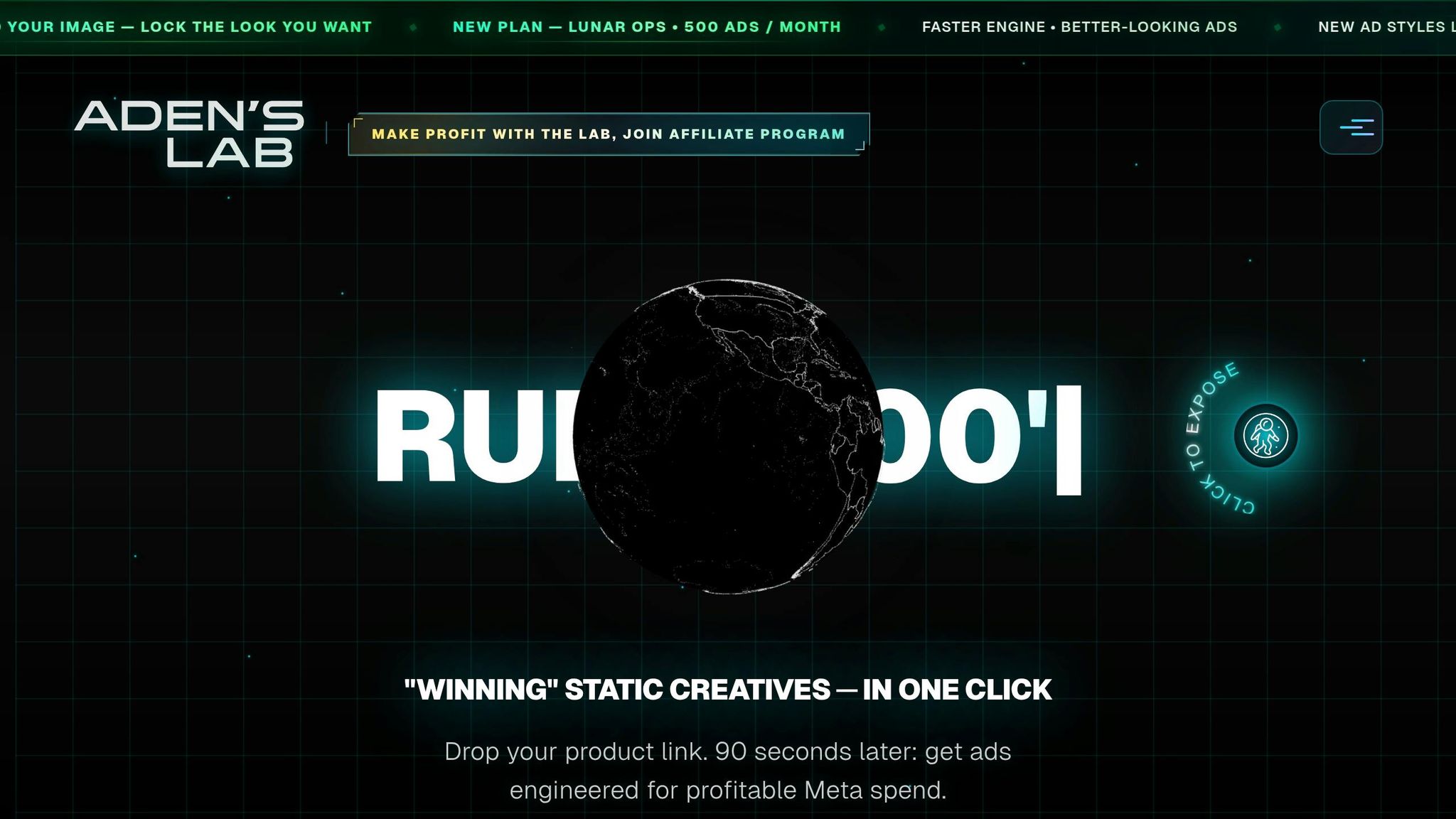
Once your prompts are fine-tuned, AI tools for ad creation like ADEN's LAB can streamline the process of creating effective ads. ADEN's LAB simplifies ad production by pulling your brand and product data directly from your URL. It then applies proven direct-response frameworks - aligned with the high-contrast and direct messaging principles discussed earlier - to generate static creatives in under 90 seconds.
These lo-fi, native-style ads integrate seamlessly into feeds and deliver impressive results: 2–4% CTR compared to the usual 0.5–1% for polished ads, all while cutting costs by roughly 40% per click. At just $0.90 per ad with the Apex Mode plan, it’s a cost-effective way to conduct high-volume testing that drives real results.
How to Create, Test, and Improve Ugly Ads
Step-by-Step: From Offer to Live Ad with ADEN's LAB
Before diving into tools, it’s crucial to define your unique selling proposition (USP) and map out your buyer journey. For example, top-of-funnel audiences are more likely to engage with low-cost introductory offers, while bottom-of-funnel buyers often respond better to discounts or time-sensitive deals. A clear and compelling offer sets the stage for effective testing and fine-tuning.
Once your offer is nailed down, head to ADEN's LAB. Start by entering your product URL, allowing the platform to automatically pull in your brand details. Next, use your prompt framework to choose from unlimited creative concepts - options like "raw", "handheld", or "native-looking" are available. The platform can generate multiple static creatives in under 90 seconds. To maximize your chances of finding a winning ad, aim for 3–5 distinct creative concepts per campaign. This variety helps you test without overcommitting your budget to a single idea. With your creative assets ready, it’s time to move on to structuring your Meta campaigns.
Setting Up Meta Campaigns for Creative Testing
The way you structure your campaign is just as important as the creative itself. A good starting point is to test 3 creatives across 2 audience groups and 2 offers, ensuring budgets are consistent. This setup allows engagement metrics to guide your next steps. It also aligns with ADEN's LAB’s promise of delivering quick, high-performing ad options.
Keep your audience targeting broad. Meta’s algorithm thrives when it has room to work, and engagement velocity - how quickly users interact with your ad - plays a key role in determining whether Meta will scale or suppress your campaign. Overly narrow targeting can restrict the algorithm’s ability to locate the right buyers.
Using Performance Data to Refine Your Prompts
Once your campaigns are live, the next step is to use performance data to improve your ad prompts. After your ads have gathered enough data, dive into the metrics to identify where adjustments are needed. Pinpoint issues and make targeted changes based on the following:
| Weak Metric | Likely Creative Issue | Prompt/Creative Adjustment |
|---|---|---|
| Low CTR | The hook or visual didn’t grab attention | Try a stronger pattern interrupt; use raw lighting or handheld framing |
| High CPC | Relevance is low, or the creative is wearing out | Refresh with new variations; explore a different audience segment |
| Low conversion rate | Offer doesn’t align with the audience’s needs | Test a new offer using the 3-2-2 method; simplify your USP in the copy |
| Low engagement velocity | Ad feels too polished or traditional | Switch to "ugly" creative styles; focus on founder-led or UGC-style prompts |
To stay ahead, establish a quick feedback loop: launch, analyze, tweak, and relaunch. With ADEN's LAB offering creatives at just $0.90 each on the Apex Mode plan, this low-cost approach makes frequent testing and iteration accessible for most teams.
Scaling and Sustaining High-Performing Ugly Ads
Building a Repeatable Ad Production System with ADEN's LAB
Once you’ve identified winning creative angles, the next step is to shift gears from discovery to systematization. The goal? Build a repeatable process to automate Meta ad production so you can consistently churn out, test, and update assets without missing a beat.
A modular production approach works wonders here. Break your ads into interchangeable pieces - like hooks, visuals, proof elements, copy, and calls to action. For example, if a hook is performing well, try pairing it with a new visual. If a call to action isn’t delivering, swap it out without having to overhaul the entire ad. This method allows you to quickly generate dozens of variations without starting from scratch every time.
"Creative is no longer a single asset. It is a data engine." - Favoured
ADEN's LAB makes this process scalable, producing up to 200 ads per month at just $0.90 per ad. This allows for consistent weekly updates across campaigns. By 2026, high-performing accounts are rolling out creative updates weekly, not quarterly. Establishing a fixed schedule - like generating new ads every Monday - ensures your campaigns stay fresh and avoids the manual hassle of ad-hoc updates. This structured approach helps combat creative fatigue while keeping your ad pipeline full of fresh ideas.
Managing Creative Fatigue and Rotating Ad Variants
Creative fatigue can bring even the most promising campaigns to a halt. Meta's Andromeda AI prioritizes early engagement velocity - the speed and intensity of interactions during an ad's first few hours. When engagement slows, the algorithm cuts distribution. The solution? It’s not about increasing your budget; it’s about introducing fresh creative.
"The algorithm cannot reward signals it does not receive. And it cannot detect patterns if variation is too narrow." - Favoured
To stay ahead, monitor for early signs of fatigue: sudden drops in click-through rates, rising cost-per-click, or declining engagement within the first 24 hours of launch. When you spot these red flags, it’s time to rotate in a new ad variant. Here’s a quick guide to creative angles, their best use cases, and how often they should be refreshed:
| Creative Angle | Primary Use Case | Refresh Frequency |
|---|---|---|
| Raw/Handheld UGC | Stands out in crowded feeds | Weekly |
| Founder-Led/Direct-to-Camera | Builds trust and authenticity | Every 1–2 weeks |
| High-Contrast Static | Clear messaging and offers for direct response | Weekly |
| Modular Variations | Tests hooks or calls to action | Continuous/Weekly |
Data adapted from.
The key takeaway? Organize your creatives by angle and style, then rotate them on a structured schedule. This way, you’re not scrambling for new ideas - you’re simply working through a well-planned library of proven formats, ensuring your campaigns stay fresh and effective.
Conclusion: Faster Ad Production, Better Meta Results
Here’s the takeaway: By 2026, Meta prioritizes signal over polish. Ads that feel raw, unfiltered, and direct outperform professionally crafted ones because they spark quick engagement - precisely the kind of data Meta's Andromeda AI uses to decide which ads deserve broader reach. This approach emphasizes speed and authenticity, creating a recipe for ads that perform.
"The brands that win are not the ones producing the prettiest ads. They are the ones producing the most testable, diverse and performance-driven creative." - Favoured
This so-called "ugly-ad" strategy isn’t random; it’s intentional. Ads with bold contrasts, sharp messaging, and visuals that disrupt scrolling patterns grab attention and generate immediate interaction. These early engagement signals are exactly what Meta’s algorithm looks for to push ads further.
What makes this sustainable? A high-speed production system. With ADEN's LAB churning out up to 200 ads per month at just $0.90 per ad, brands can keep up with the relentless pace of Meta campaigns without breaking the bank. This approach means more experiments, quicker insights, and long-term success.
The formula is simple: produce fast, test often, rotate frequently, and let the data lead the way. By using ADEN's LAB for rapid ad creation, brands can sidestep creative fatigue and stay ahead of the game on Meta.
FAQs
Will ugly ads hurt my brand?
Intentionally creating "ugly ads" might sound counterintuitive, but they can actually work in your favor. These ads often outperform sleek, polished designs by sparking quicker engagement - think comments, shares, and reactions. And since Meta’s algorithm prioritizes engagement, this can give your content a big boost.
That said, their success isn’t random. For these ads to work, they need to feel relatable and blend in naturally with the platform. When done right, they can drive strong engagement without damaging your brand’s credibility. The trick is finding the sweet spot where authenticity meets your brand’s core message, ensuring everything aligns with your marketing objectives.
What should I include in an ugly-ad prompt?
An 'ugly-ad' prompt is all about crafting ads that feel raw, unpolished, and genuine - like something a regular user might post. These ads are designed to blend in with casual social media content, making them appear more natural and relatable. Instead of sleek, polished designs, the focus is on simplicity and authenticity.
For example, you might instruct: "Create a casual, unpolished ad that looks like everyday content shared by users." This style taps into the growing trend of audiences favoring real, down-to-earth visuals over overly produced ones.
How do I know when an ad is fatigued?
When an ad's performance starts to dip, it’s likely experiencing fatigue. Key signs to watch for include a declining click-through rate (CTR), a higher cost per acquisition (CPA), and a frequency exceeding 3-4 impressions per user per week. These metrics suggest that your audience has been exposed to the ad too many times, which often results in lower engagement.
Your next ad batch starts here
Finish with a ready-to-test ad batch
Paste your website to generate static creatives. Drop the link → get ads in about 90 seconds → upload them to Meta → scale.
Free to try No prompt writing