Static Ad Variations From One Product Page: A Step-by-Step AI Workflow
Build the ads while the examples are fresh
Turn your product page into static ad creatives
Paste your product URL and generate scroll-stopping images, headlines, and primary text—ready for your next Meta creative test.
Free to try No prompt writing

Creating ads takes too long? Here's the fix: AI tools for Meta ads can now turn a single product page into dozens of ad variations in minutes. This process saves time, cuts costs, and helps you test more ads to improve performance.
Key Takeaways:
- Why it matters: Meta's 2026 "Andromeda" algorithm demands 30–50 new ad creatives weekly to stay competitive. Without frequent updates, ad costs rise by 23%, and click-through rates drop by 18%.
- The solution: AI platforms like ADEN's LAB generate ready-to-use static ads from a product page URL, tailored to different buyer mindsets (e.g., problem-aware, social proof, urgency).
- The process:
- Extract key info from your product page (e.g., benefits, audience, reviews).
- Write a focused creative brief for the AI.
- Use ADEN's LAB to produce ads for different psychological angles.
- Organize and test the variations in Meta Ads Manager.
The result? Faster ad creation, lower costs (as low as $0.90 per ad), and better performance through high-volume testing. Perfect for teams looking to scale without hiring a large creative team.
How I Create Meta Static Ads at Scale Using AI (Full Workflow)
Put the playbook to work
Apply this playbook to your page
Paste your website and the Lab will turn the strategy you are reading into a ready-to-test ads.
Free to try No prompt writing
Getting Started: What You Need Before Creating Ads
Before diving into ADEN's LAB and dropping in a URL, a little preparation can make a big difference. By organizing your materials and insights ahead of time, you’ll set yourself up for sharper, more effective ad results. Think of it as connecting the dots between your product page and ADEN's LAB's ad generation process.
Pulling Key Information from Your Product Page
Your product page is a treasure trove of details that fuel ad creation. Extract and organize information into four key categories:
| Extraction Layer | Assets | Why It Matters |
|---|---|---|
| Visual | Hero shots, lifestyle images, logos, brand colors | Ensures visual variety and keeps branding consistent |
| Content | Pricing (in USD), reviews, benefits, differentiators | Supplies raw material for compelling copy and hooks |
| Structural | Product category, price point, demographic signals | Helps refine audience targeting |
| Brand Identity | Logo files, hex color codes, font style, visual tone | Keeps ads aligned with your brand’s personality |
Customer reviews are particularly valuable. They often contain emotional language straight from real buyers - phrases that describe problems or outcomes in a way that resonates deeply with your audience. These words often outperform anything a copywriter could invent.
Writing a Simple Creative Brief for AI Tools
A well-crafted brief is the bridge between your extracted details and high-performing ad variations. The clearer your brief, the better the results. For AI tools, the best format is an "Input Block" - a concise, four-line framework:
- What it does - the main functional benefit of the product
- Who it’s for - a specific target audience (avoid vague demographics)
- Why it’s different - one or two standout features
- The end result - the emotional or practical impact for the customer
In addition to these four points, make sure to include the brand’s tone (e.g., confident and direct, or friendly and conversational), any visual guidelines, and the Meta placements you’re targeting. Remember, different aspect ratios like 1:1, 4:5, and 9:16 work best in different contexts. To avoid off-brand results, include negative constraints in your brief - this ensures the AI doesn’t generate ads with incorrect colors or distorted text.
"The mistake most teams make is testing variations of the same angle... Real creative testing requires distinct angles - different entry points into the buyer's psychology." - Ahad Shams, Founder, HeyOz
Organizing Your Assets Before You Start
When you’re producing dozens of ads every week, good organization becomes essential. Without it, you risk wasting time on duplicate uploads, mismatched assets, or confusion - undermining the efficiency ADEN's LAB is built to provide.
A straightforward naming convention can save a lot of headaches. Use a format like: [Product Name] + [Hook Type] + [Messaging Angle] + [Format Ratio]. For instance: FoamRoller_Question_BenefitFocused_1x1. This makes it easy to identify each file at a glance and keeps your testing process streamlined as your volume grows.
Before generating ads, ensure your brand asset folder is ready. Include your primary logo (in SVG or PNG format), hex color codes, approved fonts, and at least five to eight lifestyle photos. Having these prepared upfront allows ADEN's LAB to create on-brand ads right from the start.
Step-by-Step: How to Generate Static Ad Variations with ADEN's LAB
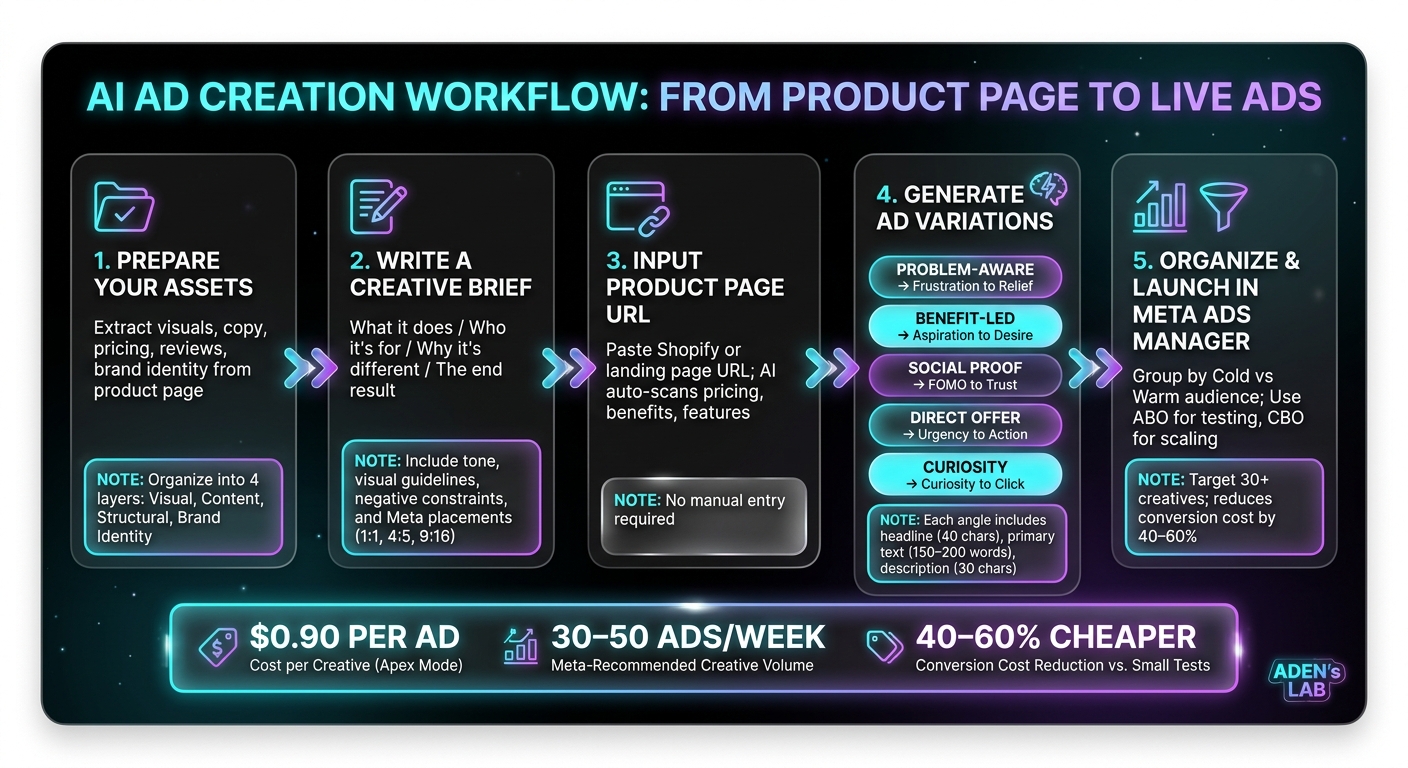
AI Ad Creation Workflow: From Product Page to Live Ads
Once your assets and creative brief are ready, head over to ADEN's LAB. The process unfolds in three straightforward steps, each building on the last. This structure ensures a smooth transition from organizing your assets to creating effective ads.
Step 1: Input Your Product Page URL into ADEN's LAB
Start by copying the URL of your product page - whether it’s a Shopify listing or a dedicated landing page - and pasting it into the input field on ADEN's LAB. The platform takes it from there, automatically scanning the page to pull essential details like pricing, key benefits, and standout features. There’s no need for manual entry. With Meta recommending 30–50 creative tests weekly to keep ad delivery costs competitive, this automated process keeps your workflow efficient and on pace.
Step 2: Generate Ad Variations for Different Angles
After processing the URL, ADEN's LAB generates ad variations tailored to five psychological approaches: Problem-Aware, Benefit-Led, Social Proof, Direct Offer, and Curiosity.
| Angle | Target Mindset | Emotional Trigger |
|---|---|---|
| Problem-Aware | Knows the problem, not the solution | Frustration → Relief |
| Benefit-Led | Comparing outcomes | Aspiration → Desire |
| Social Proof | Seeks validation from others | FOMO → Trust |
| Direct Offer | Price-sensitive or ready to buy | Urgency → Action |
| Curiosity | Not actively shopping | Curiosity → Click |
For each approach, the AI generates complete ad copy, including:
- Headlines: Limited to 40 characters
- Primary Text: Between 150–200 words
- Descriptions: Under 30 characters
All content adheres to Meta’s specifications and is scored on metrics like hook strength, brand alignment, and predicted thumb-stop rate. To keep outputs distinct, generate each angle separately. Once you have variations, you can refine them further to align with buyer intent at various stages of the funnel.
Step 3: Tailor Ads for Each Stage of the Sales Funnel
Fine-tune your ads to fit each audience segment. ADEN's LAB allows you to adapt angles and messaging based on where buyers are in their decision-making process. For cold audiences, Problem-Aware and Direct Offer angles work well - they grab attention and give people a reason to stop scrolling. For retargeting, Social Proof and comparison-based angles are more effective, as they address objections and build trust with those already familiar with your product. At the retention stage, Outcome and Urgency angles encourage action from buyers who are close to purchasing.
| Funnel Stage | Recommended Angle | Primary Goal |
|---|---|---|
| Prospecting | Problem-Aware / Direct Offer | Awareness & initial click |
| Retargeting | Social Proof / Comparison | Overcoming objections |
| Retention | Outcome / Urgency | Repeat purchase / conversion |
Studies show that testing 30 creatives instead of just 5 can reduce conversion costs by 40–60%. ADEN's LAB makes high-volume testing achievable, even for small teams. With its Apex Mode plan, you can generate up to 200 ads per month at $0.90 per ad, making it easier to cover every stage of the funnel without needing a full design team.
How to Organize and Structure Ad Variations in Meta Ads Manager
Once ADEN's LAB produces your AI-generated ad variations, the next step is keeping everything organized in Meta Ads Manager. Without a clear system, it’s easy to lose track of which creative angle is targeting which audience. This can lead to confusion and make it tough to draw meaningful insights from your campaigns. A structured approach ensures you can turn insights from AI-generated ads into measurable performance gains.
Group Ads by Angle and Audience Type
Think of audience segments and creative angles as separate variables. Start by dividing your variations into two main groups: Cold (broad targeting, interest-based audiences, Lookalikes) and Warm (website visitors, video viewers, or customer lists). Within each group, further organize ads by creative angle - like pain points, social proof, or urgency. This method helps you track how specific angles perform across different audience types.
Initially, use Ad Set Budget Optimization (ABO) to ensure equal spending across variations. This approach gives each variation a fair chance to perform. Once you’ve identified top-performing ads, switch to Campaign Budget Optimization (CBO) so Meta can automatically allocate more budget to the winners.
For structured testing, it’s a good idea to turn off Advantage+ creative enhancements at the ad level. These automated features - like text repositioning or image filters - can interfere with the integrity of AI-generated ads and obscure what’s driving performance.
After grouping your ads, a consistent naming system will help keep everything clear and easy to analyze in Meta Ads Manager.
Naming Conventions and Folder Structure for Ad Variations
A clear naming system is essential for tracking performance efficiently in Meta Ads Manager. It eliminates the need to open each ad individually to understand its setup.
"The naming convention is the difference between a build you can analyze and a build you have to open one by one." - adlibrary.com
Use a format like this for ad names: [Objective]-[Audience]-[AngleCode]-[HookType]-[Format]-[Version]. For example, CONV-COLD-SOCPR-Q-IMG-v1. To maintain consistency, create an Angle Code Dictionary - a simple reference sheet with abbreviations like PAINPT (Pain Point), MECH (Mechanism), and URGCY (Urgency).
Extend this logic to your creative files as well. For instance, name a file product-cold-socpr-v1.jpg so anyone can quickly match it to its performance data. Use tags in the Meta Business Manager library to label assets by format, aspect ratio (e.g., 1:1, 9:16), and hook type. This makes it easier to locate creatives when you need to swap them out.
Once your assets are clearly labeled, you can focus on choosing the right campaign structure for testing and scaling.
Campaign Structuring Approaches
The structure of your campaigns will depend on what stage of testing you’re in. Here’s a breakdown of the main approaches:
| Approach | Pros | Cons | Best For |
|---|---|---|---|
| One Campaign / Many Ad Sets (ABO) | Ensures equal spend per creative; produces clean data for each variant | Requires more manual management; can lead to audience overlap | Best for initial creative testing and angle validation |
| Fewer Ad Sets / More Creatives (CBO) | Allows Meta to shift budget to top performers automatically; reduces management effort | New creatives might not get enough spend to gather data | Ideal for scaling proven winners and evergreen campaigns |
| Advantage+ Shopping (ASC) | Automates audience and creative testing; simplifies campaign setup | Limited control; harder to attribute results to specific angles | Great for scaling e-commerce campaigns with established assets |
When testing new angles from ADEN's LAB, start with ABO. To exit Meta’s learning phase, each ad set generally needs about 50 optimization events within a 7-day period. Once you’ve identified high-performing ads, move them to a CBO campaign for efficient scaling. Use the existing Post ID to carry over social proof - like likes and comments - to reach new audiences.
How to Evaluate and Improve AI-Generated Static Ads
Once your campaigns are live and structured, the next step is figuring out what’s working and why. This is where tracking and refining become essential.
Tracking Key Metrics in Meta Ads Manager
When it comes to static ads on Meta, two metrics stand out early: CTR (Click-Through Rate) and CPC (Cost Per Click). These indicators tell you if your ad is grabbing attention and driving clicks, even before you gather enough purchase data to make broader conclusions.
Here’s a practical tip: set a kill threshold. Pause any ad that spends 1.5x your target CPA without converting. This helps you avoid wasting budget during testing and keeps your data clean. For cold audiences, aim for a Link CTR between 1.5% and 2.5% as a benchmark.
Another metric to watch is frequency - how often your ad is shown to the same audience. If this climbs above 2.5–3.0 for cold audiences, CTR tends to drop. This is a clear sign to refresh your creatives before performance declines further.
Instead of focusing on a single "winning" ad, look for trends within an angle cluster. For example, if pain-point ads outperform social proof ads, that’s a pattern worth leveraging. Use these insights to guide your next steps.
Using Top Performers to Build New Variations in ADEN's LAB
Once you’ve identified a winning angle cluster, you can use ADEN's LAB to create new variations. Keep the same structural elements - like the hook type, emotional appeal, or offer framing - but update the visuals or copy. This iterative process helps maintain and even improve performance over time.
"The paid media buyers winning in 2026 are not the ones with the biggest budgets or the best audiences. They are the ones who iterate fastest." - Daniel Rozin, CMO and Co-founder, AdGPT
A good rule of thumb: refresh your best-performing static ads every 14 days by tweaking the hook or overlay text. If you notice a week-over-week CTR drop of more than 25%, it’s time to generate new variations immediately. ADEN's LAB makes this process quick, allowing you to avoid creative fatigue and keep your campaigns running smoothly.
Next up, let’s compare testing strategies to see which approach maximizes efficiency.
Testing Fewer Ads vs. High-Volume Testing: A Comparison
One common question is whether to focus on a few polished ads or test a high volume of variations. The data strongly supports high-volume testing - but only if you test one variable at a time.
| Feature | Fewer, Polished Variations | High-Volume Rapid Testing |
|---|---|---|
| Primary Goal | Maintaining strict brand aesthetics | Finding winning ads and gathering data |
| Learning Rate | Low (fewer data points monthly) | High (up to 4x faster data collection) |
| Fatigue Resistance | Low; performance drops after 7–14 days | High; consistent rotation avoids rising CPMs |
| Conversion Efficiency | Standard baseline | Often 40–60% cheaper per conversion |
| Primary Constraint | Creative production time | Media budget for testing |
| Risk | High opportunity cost; missing potential winners | Budget risk without strict kill thresholds |
High-volume testing - launching 30 or more creatives - often uncovers ads that are 40–60% cheaper per conversion compared to smaller tests. The main challenge has always been production capacity, not the strategy itself.
"The constraint isn't budget or audience - it's throughput. An AI ads generator attacks exactly that constraint." - Daniel Rozin, CMO and Co-founder, AdGPT
With ADEN's LAB, producing ads becomes far more economical. On the Apex Mode plan, you can generate creatives for less than $1.00 each. Previously, creating 30 ads manually could cost $1,500–$4,500. Now, brands with even modest budgets can afford to test at the scale needed to drive meaningful results.
Conclusion: How ADEN's LAB Speeds Up Static Ad Creation
The process outlined here revolutionizes creative production through Meta ads automation, cutting out the delays and high costs of traditional workflows. With just a single product page URL, ADEN's LAB pulls audience insights, crafts distinct ad angles based on psychological principles, evaluates concepts before spending on production, and delivers ready-to-use assets - all in about 15 minutes. This efficiency translates into notable savings and improved performance.
In comparison, conventional workflows can run up to $10,000 per month in strategist, copywriter, and designer costs, producing far fewer assets. ADEN's LAB eliminates the need for such a large creative team, offering ads at just $0.90 each under the Apex Mode plan. This means more creatives can be tested, winners can be identified faster, and the overall cost per conversion drops significantly.
"The full stack replaces $10,000/month in creative strategist, copywriter, and designer costs for $65/month." - Ahad Shams, Founder, HeyOz
But it’s not just about speed - it’s about diverse ad angles. Accounts that test a broader range of angles, rather than small tweaks to existing ones, see a 34% improvement in ROAS. ADEN's LAB is designed to deliver that variety effortlessly, starting from just one URL and without the need for a full creative team.
The result is a self-sustaining system: input a product page URL, generate structured ad variations, categorize them by angle in Meta Ads Manager, track performance, and recycle top-performing concepts back into ADEN's LAB for the next round. This approach not only simplifies ad creation but also ensures campaigns evolve and improve based on real-world data. ADEN's LAB turns ad production into a fast, scalable, and results-driven process.
FAQs
What makes a good AI creative brief?
A well-crafted AI creative brief acts as a roadmap, offering clear and structured guidance for generating effective ad variations. It should outline key elements like the product’s benefits, target audience, positioning, and visual style. Concise descriptions of the product’s value and the intended audience segments help ensure the AI stays focused on the campaign’s goals.
To maintain consistency and relevance, include details such as brand voice guidelines, visual identity rules, and specific instructions for formats or emotional tones. These elements work together to align the generated ads with your brand’s overall identity and messaging.
How many ad variations should I test each week?
Testing the right number of ad variations each week hinges on your specific goals and the resources available to you. A good rule of thumb is to aim for 8–40 ad variations per product each month, which breaks down to roughly 2–10 variations per week.
To keep your testing effective, try creating 4–6 variants for each variable you want to test. If you have a high-performing team with ample resources, you can push this further to 20–40 variations monthly.
Don’t forget to refresh your creatives frequently - introducing new ads every 7–10 days can help combat ad fatigue and keep performance metrics on track.
How do I know when to refresh static creatives?
Refreshing static creatives regularly is crucial to keeping your ads effective and engaging. For platforms like Facebook, aim to update them roughly every 14 days to prevent creative fatigue. On TikTok, a faster pace works better - introduce new variants every 7-10 days.
Keep an eye on essential metrics like CPM (Cost Per Thousand Impressions), CTR (Click-Through Rate), and ROAS (Return on Ad Spend). If you notice CPM climbing or CTR and ROAS dropping, it’s a clear sign your creatives need a refresh.
To make this process smoother, consider using AI tools. They can help generate fresh variations quickly, ensuring your ads stay relevant and continue to perform well.
Your next ad batch starts here
Finish with a ready-to-test ad batch
Paste your website to generate static creatives. Drop the link → get ads in about 90 seconds → upload them to Meta → scale.
Free to try No prompt writing