The Speed Hack for Mass Ad-Production and Profitable Meta-Ads Scaling
Turn the strategy into creatives
Create Meta ads for your product
Paste your product page. ADEN'S LAB turns the offer, audience, and positioning into complete ready-to-use Meta static ads.
Free to try No prompt writing

Meta advertisers face a big challenge: keeping ads effective while costs rise and performance drops. Ads lose impact fast - often within 2–3 weeks - while ad fatigue can cut conversions by 45%. To stay profitable, you need a constant flow of new, diverse ads that align with Meta’s algorithm. Here’s the solution:
- Meta’s ad system relies on variety. The algorithm selects audiences based on ad content, not manual targeting, so repetitive or weak ads hurt performance.
- AI tools like ADEN's LAB make ad production faster and cheaper. Generate up to 200 ads per month for $0.90 each - far less than hiring designers.
- High-volume testing is key. Following a structured A/B testing guide ensures these tests yield actionable data. Brands testing 20+ ads monthly see 65% higher ROAS. Use frameworks like the 3-3-3 approach (3 concepts, 3 hooks, 3 formats) to create meaningful variations.
- Speed reduces costs. Faster production allows quick replacement of underperforming ads, lowering CAC and stabilizing ROAS.
Bottom line: Faster, high-volume ad production powered by AI lets you scale profitably, avoid fatigue, and improve performance.
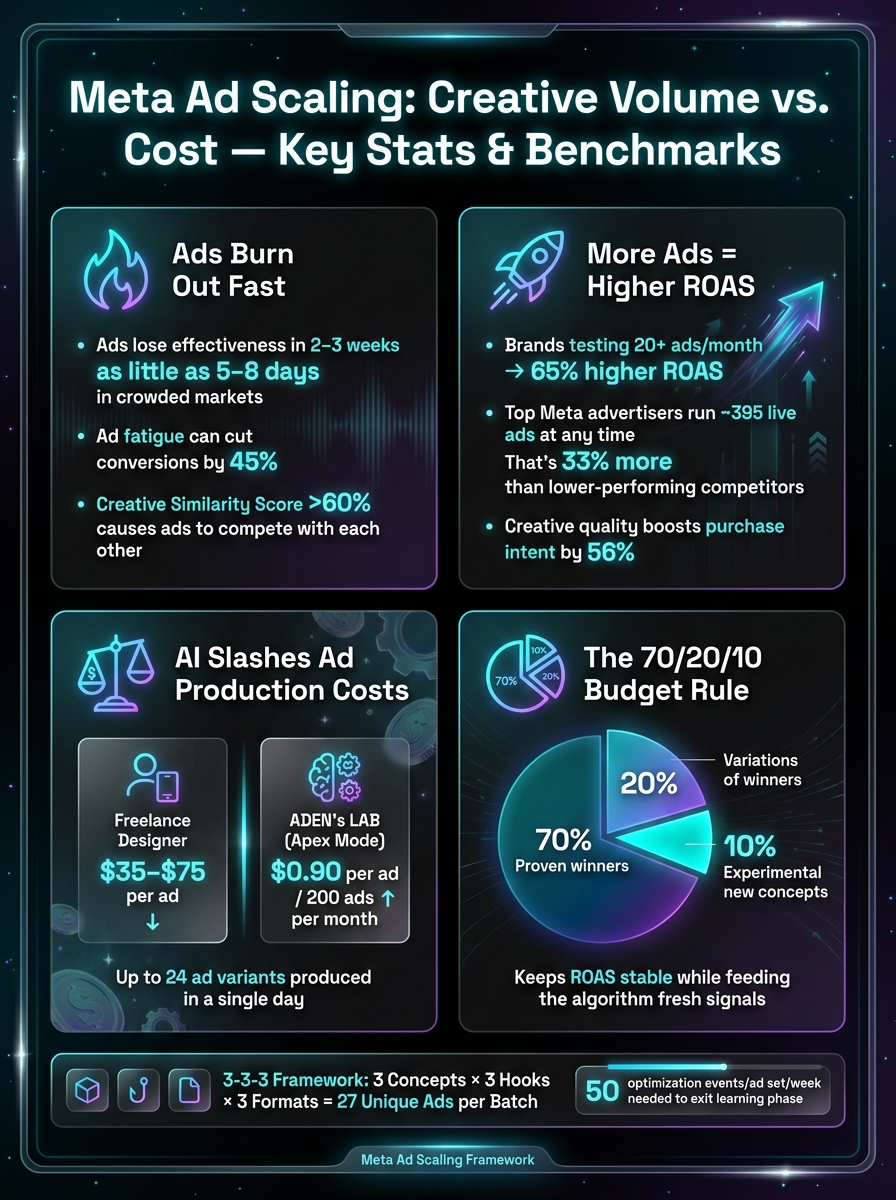
Meta Ad Scaling: Creative Volume vs. Cost - Key Stats & Benchmarks
Core Principles Behind Profitable Meta Ad Scaling
How Meta's Algorithm Works and What Creative Fatigue Means
Meta’s ad algorithm functions in two key phases: Retrieval and Ranking. During Retrieval, the Andromeda system sifts through millions of ads to narrow down potential candidates. In the Ranking phase, it selects the best ad for each user based on their likelihood to take action.
Here’s where it gets interesting: Andromeda evaluates your ad’s visuals, audio, and text using computer vision and semantic analysis. This means the content of your ad essentially becomes your targeting. Instead of relying on audience parameters you manually set, the algorithm determines your audience based on the message and design of your ad. If your creatives are weak or repetitive, the algorithm struggles to match them effectively to users.
Creative fatigue is another challenge. Under Andromeda, ads can lose their effectiveness in just 2–3 weeks - and in crowded markets, a winning ad might burn out in as little as 5–8 days. When an ad fatigues, its reach drops, CPMs increase, and your cost per acquisition (CPA) skyrockets. And here’s a hidden pitfall: uploading ads that are too similar can backfire. If the Creative Similarity Score exceeds 60%, Andromeda lumps them into a single "Entity ID", causing your ads to compete with each other, which reduces their reach. Minor tweaks like changing a background color or headline won’t fool the algorithm - it recognizes these as superficial changes.
This underscores an important takeaway: keeping a steady flow of truly unique creatives is essential for maintaining ad performance.
Why Creative Volume Drives Ad Performance
Because the algorithm thrives on creative diversity, the number of ads you test directly impacts results. Brands testing 20 or more new ads per month achieve 65% higher ROAS compared to those testing fewer than 10. The most successful advertisers on Meta typically run around 395 live ads at any given time - 33% more than their less successful counterparts.
But sheer volume isn’t enough. What matters is meaningful variety. Each ad should explore a distinct angle, such as social proof, urgency, or transformation stories. This way, you’re gathering actionable insights instead of generating random data. A helpful framework to start with is the 3-3-3 approach: test 3 unique concepts, each with 3 hooks, across 3 formats (static, video, carousel). This gives you 27 unique ads per batch.
"The new media buying job is creative ops. The buyer who ships 80 ads a week is going to destroy the buyer who ships 8, regardless of which one is 'smarter.'" - Andrew Foxwell, Founder, Foxwell Digital
How Faster Creative Production Lowers CAC and Stabilizes ROAS
Speed in creative production isn’t just a luxury - it’s a necessity for keeping costs down and performance steady. Slow production cycles lead to wasted ad spend on fatigued creatives. Every extra day an underperforming ad stays live, your CPCs rise, conversion rates drop, and your customer acquisition cost (CAC) increases.
By producing creatives faster, you tighten the testing loop. This allows you to replace failing ads quickly, minimizing wasted budget and getting successful creatives into rotation sooner. To manage this process effectively, consider the 70/20/10 rule for budget allocation: dedicate 70% of your budget to proven winners, 20% to variations of those winners, and 10% to testing entirely new concepts. This approach keeps ROAS stable while continuously feeding the algorithm fresh signals. The faster you can rotate through that 10% experimental bucket, the quicker you’ll uncover your next high-performing ad.
| Monthly Spend | New Ads/Month | Strategy Focus |
|---|---|---|
| $0–$10K | 5–10 | Testing bold, high-impact concepts |
| $10K–$50K | 20–40 | Regular refreshes with a basic creative system |
| $50K–$250K | 50+/week | Creative production becomes a core focus |
| $250K–$1M+ | 100+/week | Involves multiple teams; 25–50% of budget allocated to testing |
Put the playbook to work
Apply this playbook to your page
Paste your website and the Lab will turn the strategy you are reading into a ready-to-test ads.
Free to try No prompt writing
An AI-Powered Framework for Mass Ad Production
Step-by-Step Workflow for AI-Driven Ad Creation
Quickly create Meta ads that are ready to launch - without sacrificing quality.
Start by researching ad angles and copy frameworks. A great resource is adlibrary.com, where you can find competitor ads that have performed well over time. Once you've gathered insights, input your ideal customer profile, their key pain points, product benefits, and proof points into Claude. Then, request a "Headline Matrix" that categorizes creative angles by psychological triggers like social proof, transformation, or curiosity gap.
For ad generation, use ADEN's LAB by entering your product or landing page URL to create ad creatives. If you need custom visuals, tools like Midjourney v7 or Nano Banana can help. Once your assets are ready, upload them to Ads Manager in PAUSED status using a CSV bulk upload or the Meta Marketing API. This allows for a final review before going live. To avoid sudden CPM spikes, roll out your ads gradually in waves of 3–5 ad sets, spacing them about 48 hours apart.
The secret to efficiency lies in batching tasks: dedicate one session to briefing all angles, another to sourcing imagery, and another to designing variants. This approach minimizes context switching and enables AI-assisted teams to produce up to 24 ad variants in a single day. ADEN's LAB integrates seamlessly into this process, enabling rapid ad production.
How ADEN's LAB Speeds Up Ad Production
ADEN's LAB specializes in creating static Meta ads. Simply provide a product or landing page URL, and the platform generates eye-catching Facebook and Instagram creatives in under 90 seconds using a mix of direct-response frameworks and buyer psychology. This speed not only accelerates production but also helps reduce CAC and stabilize ROAS.
Freelance designers typically charge $35–$75 per ad, but ADEN's LAB's Apex Mode can produce 200 ads per month at just $0.90 per ad. This makes it possible for even small teams to test a high volume of creatives without breaking the bank.
| Plan | Monthly Ads | Cost per Ad | Best For |
|---|---|---|---|
| Lift Off | 30 | $1.97 | Early-stage testing, offer validation |
| Hyperstream | 50 | $1.78 | Consistent creative flow to combat ad fatigue |
| Apex Mode | 200 | $0.90 | Aggressive scaling for agencies and media buyers |
ADEN's LAB also ensures brand consistency. Copy tone, visual style, and formatting remain uniform across all generated ads. For those using Figma, you can connect AI directly to your design system via a Figma MCP (Model Context Protocol) server. This allows the AI to automatically apply your brand's colors, fonts, and components.
"Creative is the new targeting. Meta's algorithm will find the right audience for you, but only if you feed it enough creative variations to test." - Ahad Shams, Founder, HeyOz
Speed alone isn't enough; your creatives need to be structured properly to work with Meta's algorithm.
How to Structure Creatives for Meta's Algorithm
Producing a large number of creatives is only half the battle. Each ad also needs to send a clear, strong signal to Meta's algorithm to reach the right audience effectively.
Start by establishing a strong visual hierarchy within the first 1.5 seconds. Use high-contrast colors and include a clear benefit or problem statement. For example, placing social proof like "4,800+ orders shipped" near the headline can quickly build trust.
Since 85% of Meta videos are viewed without sound and 98% of users access the platform on mobile, static ads must visually communicate the entire message.
Keep layouts clean by sticking to a single call to action - such as "Shop Now", "Get Started", or "Learn More" - to avoid confusing users. Ensure your assets are tailored to each placement: use a 1:1 ratio for the Feed, 9:16 for Stories and Reels, and 1.91:1 for Landscape formats. Also, make sure key text and visuals stay within safe zones to prevent cropping issues.
For teams using Figma, streamline editing by setting up master templates with Auto Layout and clear layer labels like HeroImage, Headline, and CTAButton.
Testing and Optimization for High-Volume Campaigns
Campaign Structures Built for Frequent Creative Testing
A well-organized account structure is key to speeding up learning and isolating tests effectively. Start by creating one campaign per primary objective and pairing it with one ad set per creative angle. Keep prospecting and retargeting campaigns separate to avoid mixing performance signals. For creatives, group them into 5–8 clusters (think categories like "social proof" or "FOMO") to generate distinct performance insights.
To maintain control over your testing budget, use Ad Set Budget Optimization (ABO). This ensures each creative cluster gets adequate spend, preventing any single hypothesis from being overlooked. Once you identify a winner, transition it to Campaign Budget Optimization (CBO) or an Advantage+ Shopping campaign. These setups let Meta's algorithm dynamically allocate your budget for maximum efficiency.
Meta's system requires about 50 optimization events per ad set per week to exit the learning phase. For example, if your target CPA is $40, you'll need to allocate at least $285 per week per ad set to gather enough data. Planning your budget with these numbers in mind ensures your tests are both valid and actionable.
How to Run Creative Testing and Iteration Loops
High-volume testing only works if every ad is tied to a clear hypothesis. Throwing out 50 random ad variations without a plan isn’t testing - it’s gambling. As Murat Bock of adlibrary.com explains:
"100 ads per week without 100 hypotheses per week is not a testing engine. It's a dynamic creative optimization (DCO) lottery. You might get lucky. You won't learn." - Murat Bock, Founder, adlibrary
To stay systematic, use a Hypothesis Card to document key details like the hook, audience, format, and a pre-set threshold for pausing underperforming ads. This approach removes emotion from decision-making and keeps your process data-driven.
For organization, adopt a standardized naming convention such as:
[BRAND]_[CLUSTER]_[FORMAT]_[WEEKCODE]_[VARIANT#]. This makes it easier to filter and analyze performance, especially when managing dozens of active ads.
In the first five days of testing, focus on early performance metrics like:
- Hook Rate: (3-second views ÷ impressions) – aim for over 25%.
- Hold Rate: (ThruPlay ÷ 3-second views) – aim for over 40%.
These metrics reveal whether your creative is grabbing attention and keeping viewers engaged. Avoid jumping straight to CPA analysis during this phase. Follow a 5-Day Kill Rule: if an ad doesn’t hit its learning-phase benchmarks or CPA goals by day five, pause it to prevent wasted spend.
| Metric | Calculation | Target |
|---|---|---|
| Hook Rate | 3s Views ÷ Impressions | >25% |
| Hold Rate | ThruPlay ÷ 3s Views | >40% |
| Link CTR | Clicks ÷ Impressions | >0.8% (cold audiences) |
| Fatigue Signal | Avg frequency per person | >3.5 (within 14 days) |
By setting clear hypotheses and using these early metrics, you can make quick decisions and keep your testing process efficient.
Using Automation to Scale Winners and Cut Losers
Once you’ve identified a winning ad, scale it up while retaining its social proof. Use the Post ID when duplicating the ad into a CBO or Advantage+ campaign. This keeps likes, comments, and shares intact, which can lower CPMs and build trust with your audience.
To manage scaling efficiently, take advantage of Meta's automated rules. For example, set rules to pause ads that exceed 2x your target CPA in the first week. Once the ad is validated, tighten the threshold to 1.3–1.5x your target CPA.
Always keep a reserve of untested creatives ready to replace fatigued ads. Tools like ADEN's LAB can produce up to 200 ads per month at just $0.90 per ad, making it simple to maintain a steady pipeline. When metrics like frequency climb too high or CTR drops, you’ll have fresh creatives on hand to swap in, ensuring your campaigns keep running smoothly.
"Meta's ad algorithm has become remarkably efficient at finding buyers - given one precondition: enough creative signal." - Tal Yeger, AdGPT
How I Create New Meta Ad Concepts at Scale Using AI (Full Workflow)
Scaling Playbooks by Business Model
Scaling strategies aren’t one-size-fits-all. What works for a direct-to-consumer (DTC) supplement brand won’t necessarily apply to a B2B SaaS company or a local lead-generation operation. Below, we’ll dive into tailored playbooks for E-Commerce, SaaS, and Lead Generation, each building on core creative strategies.
Scaling Strategies for E-Commerce
In 2026, Advantage+ Shopping Campaigns (ASC) have become the go-to for e-commerce. These campaigns merge prospecting and retargeting into a single automated system, delivering an average 22% higher ROAS (4.52x vs. 3.70x) and up to 32% lower CPA compared to manual setups.
The secret? Creative volume. For example, a supplements brand generating $8M annually boosted its creative output from 5 to 35 assets per week. The result? Their blended ROAS jumped from 2.8x to 4.1x in just 90 days. Their approach followed a three-phase roadmap:
- Phase 1: Build signal depth with at least 50 purchase events per ad set per week.
- Phase 2: Expand horizontally by testing 2–3 new creative variants weekly based on winning angles.
- Phase 3: Scale budgets vertically using AI-driven budget allocation, increasing by 20–30% per week to avoid resetting the algorithm’s learning phase.
"The algorithm looks at your creative first - the images, the hooks, the offers - and then finds the people most likely to respond. Your audience settings are suggestions. Your creative is the instruction." - Alex Neiman, Ad Budget Manager
A useful metric here is creative velocity: aim for one new creative per $10,000 in weekly ad spend to maintain cost efficiency as you scale. Tools like ADEN’s LAB make this achievable without needing a full design team. By automating creative production, brands can scale profitably while keeping customer acquisition costs (CAC) in check.
Scaling Strategies for SaaS
SaaS businesses, with their longer sales cycles and abstract value propositions, require a more targeted approach. The key is tribal segmentation - creating content clusters tailored to specific pain points or use cases rather than broad demographics. For instance, messaging for remote workers will differ from messaging for team managers, even if both fit your ideal customer profile (ICP).
The 70/20/10 budget allocation works well here:
- 70% for proven winners.
- 20% for iterative variations of those winners.
- 10% for testing experimental concepts.
New messaging angles can be validated quickly with low-cost, AI-generated static ads. If a hook rate exceeds 25% and a hold rate surpasses 40%, it’s worth investing in full creative production.
"The biggest gap between a $10M brand and a $100M brand isn't product. It's creative volume. The $100M brand tests what the $10M brand tests in a month, in a single day." - Barry Hott, Creative Strategist
Effective strategies for SaaS include showcasing the product UI ("ingredient transparency"), leveraging social proof like customer testimonials, and using hooks that challenge assumptions in the industry ("negative reversal"). These tactics resonate better with Meta’s Andromeda algorithm, as they signal relevance and specificity. While the buying journey may be longer, the core principle remains the same: high-volume creative testing, powered by AI, is critical for scaling.
Scaling Strategies for Lead Generation
Lead generation hinges on signal quality and streamlined campaign structures. Before scaling, make sure your Conversions API (CAPI) is set up correctly and your Event Match Quality (EMQ) score in Events Manager is at least 7.0. Without clean server-side signals, the algorithm trains on flawed data, driving up your cost per lead unpredictably.
For lower budgets (under $2,000/day), a "One Campaign, One Ad Set" structure often outperforms fragmented setups. This approach concentrates optimization events, helping the algorithm exit the learning phase faster. On the creative side, UGC-style videos tend to deliver the best click-through rates (CTR) for cold traffic (2.0%–3.5%), while static images remain a cost-effective way to test new angles. Hooks that create curiosity - like "Most lead-gen strategies fail because..." - perform better with cold audiences than straightforward benefit-driven messaging.
If your ICP is narrow (e.g., specific job titles or company sizes), stick to manual targeting. While Advantage+ Audience may find cheaper leads, they might not align with your actual buyer profile, inflating the cost per qualified lead.
"Post-Andromeda testing rewards consolidation, not fragmentation." - Antonio Ventre, Founder, Skaleit Agency
Whether you’re scaling e-commerce, SaaS, or lead generation, the core principle remains: an AI-driven, high-volume creative process - combined with disciplined testing and iteration - powers profitable Meta ad scaling across all business models.
Conclusion: Automate, Test, and Scale with Confidence
Top Meta advertisers are shifting gears with a fresh creative system - one that tackles ad fatigue head-on and emphasizes a structured approach to testing. The secret? Combining speed, volume, and data-driven insights to drive scalable success.
Here's a game-changer: Creative quality boosts purchase intent by 56% in a typical Meta campaign. That number alone highlights how crucial your creative assets are. Sure, audience targeting matters, but it's your creative that carries the real weight. If you don't automate Meta ad production to keep up, you'll face ad fatigue, climbing CPMs, and stagnant ROAS.
Consider ADEN's LAB - a tool that transforms a product or landing page into Meta-ready ads in just minutes, costing only $0.90 per ad. Compare that to the $35–$75 per ad you'd typically pay freelancers. The savings and speed are hard to ignore.
But scaling isn't just about cranking out ads. Without disciplined testing, you're essentially gambling with your campaigns. The real magic lies in combining high-volume production with a rigorous testing framework. Think clear hypotheses, strict 5-day kill rules, and a feedback loop that refines winning strategies for the next wave of ads. Over time, these incremental improvements add up. For example, in a 12-week automated pipeline, ad survival rates can climb from 15% to 24%, while average CPAs drop from $47.20 to $31.40 as the system becomes more efficient. This isn't a one-and-done strategy - it's an evolving process that keeps getting better.
FAQs
How do I know when an ad is fatigued?
You can spot signs of ad fatigue by keeping an eye on specific performance metrics. Look out for a 15%+ drop in CTR over a 7-day period, a 10%+ increase in CPM without any external factors, a 20%+ decline in hook rate, or a frequency higher than 3.5 in prospecting campaigns. If these patterns continue, it’s time to update your creative to keep performance steady and avoid a further dip in ROAS.
How many new creatives should I launch each week?
For campaigns focused on performance, try rolling out 15–30 new creatives every week. This approach generates enough data to pinpoint which ads perform best before exhausting your budget. By testing a variety of creatives, you can fine-tune your campaigns and achieve better results more efficiently.
What’s the fastest way to test new angles without wasting budget?
The quickest route to better ad performance? AI-powered creative automation combined with structured testing methods. Tools like ADEN'S LAB make it easy to churn out high-quality ad creatives in no time, letting you test multiple messaging angles efficiently.
Here’s a straightforward approach:
- Produce 20-30 creative variations every week.
- Test 5-8 distinct angle clusters with controlled budgets - think $20-30 per day for each ad set.
- Track performance for 3-5 days. Pause any underperforming ads and gradually scale the ones that show promise.
This method ensures you’re continuously refining your strategy, focusing on what works, and maximizing results.
Your next ad batch starts here
Finish with a ready-to-test ad batch
Paste your website to generate static creatives. Drop the link → get ads in about 90 seconds → upload them to Meta → scale.
Free to try No prompt writing