The “Creative Volume” Strategy: Scale Spend Without Touching Your Targeting
Turn the strategy into creatives
Create Meta ads for your product
Paste your product page. ADEN'S LAB turns the offer, audience, and positioning into complete ready-to-use Meta static ads.
Free to try No prompt writing

Scaling ad spend on Meta isn’t about tweaking targeting anymore - it’s about producing more ads with variety. The “Creative Volume” strategy focuses on creating a high number of diverse ads to let Meta’s algorithm match the right creative to the right individual. This approach works better than traditional audience segmentation, especially after iOS 14 privacy changes weakened manual targeting.
Here’s the key takeaway: Meta’s algorithm thrives on variety and volume. To scale effectively, you need 200–500 distinct ads per month, testing different hooks, formats, angles, and styles. This keeps performance stable, prevents ad fatigue, and lowers costs like CPA (Cost Per Acquisition). Automation tools, like Aden's Lab, can help produce ads faster and cheaper, ensuring your campaigns stay competitive.
Key Insights:
- iOS 14 Impact: Privacy updates reduced targeting precision, making creative diversity more important.
- Meta’s Algorithm: Matches ads to individuals based on behavior, not predefined audience groups.
- Ad Fatigue: High ad frequency increases costs and lowers engagement; new ads solve this.
- Budget Allocation: Use the 60-30-10 rule - 60% proven winners, 30% variations, 10% new ideas.
- Automation Benefits: Tools like Aden’s Lab cut production costs to $0.90 per ad, enabling faster scaling.
Bottom line: Scaling Meta ads today requires more ad variations, not more targeting tweaks. Focus on producing a steady stream of new ads to stay ahead.
Why Targeting Stopped Working
How Targeting Lost Its Power
The privacy updates introduced with iOS 14 in 2021 dealt a major blow to Meta's targeting capabilities. The precision that advertisers once relied on is now a thing of the past.
For apps on iOS 14 and later, Meta imposes strict limitations: advertisers are capped at 18 campaigns, each with just five ad sets. This makes the old approach of granular audience segmentation impossible. Even if you wanted to create dozens of narrowly defined audience groups, the platform simply won't allow it.
But here's the bigger issue: the algorithm no longer prioritizes your manual targeting settings. Meta's system now clusters similar creatives together and decides which ones to promote, often ignoring the specific audience you assigned to them. If your ad isn’t getting traction, it’s likely because the algorithm determined it wouldn’t appeal to the users available - not because your targeting was off.
Another challenge is audience saturation. Narrowly defined segments have a limited pool of people. When you try to scale your budget within these small groups, you quickly run out of qualified prospects. This forces the algorithm to bid more aggressively for the same audience, which drives up CPMs and kills your return on investment. This is why so many advertisers hit a ceiling when trying to scale with traditional targeting methods.
With these restrictions in place, the focus has shifted. Creative quality now plays a much larger role in driving audience engagement.
Why Creative Now Does What Targeting Used to Do
Meta has embraced what industry experts call "One-to-One" advertising. Instead of targeting broad demographics like "women aged 25-34", the algorithm now matches specific creative assets to individual users based on their real-time behavior. It tracks who clicks, who converts, and who scrolls past - and then delivers the ad creative most likely to resonate with each person. This shift means individual engagement with creative has taken over as the key driver, compensating for the loss of precise targeting.
"Advertising is no longer about reaching audiences. It's about reaching individuals. And that shift has broken almost every creative workflow that exists." - Luke Jonas, Co-Founder, Nest Commerce
In this new landscape, the creative itself acts as the targeting tool. If a particular ad resonates with a specific type of user, Meta’s algorithm identifies that pattern and serves the ad to more people with similar behavior. There’s no need for you to define the audience - the algorithm figures it out by testing which creative performs best.
To adapt, leading brands have shifted their approach by running 200 to 500 distinct creative assets. This gives Meta’s algorithm the variety it needs to match the right creative to the right user at scale. And no, this isn’t about making 500 slight variations of the same ad. It’s about experimenting with different hooks, formats, and value propositions so the algorithm can uncover audience segments that your original ads couldn’t reach.
Meta’s machine learning thrives when given broad parameters, a high volume of conversion data, and diverse creative options - not when constrained by manual audience segmentation. Brands that have aligned their creative production with performance data have reported performance increases of 30% or more. This is exactly why the Creative Volume strategy succeeds where old-school targeting methods now fall short.
Put the playbook to work
Apply this playbook to your page
Paste your website and the Lab will turn the strategy you are reading into a ready-to-test ads.
Free to try No prompt writing
Why Most Teams Can't Produce Enough Ads
Why Meta Needs More Ads to Test
Meta's algorithm thrives on variety. It matches your creative assets to user behaviors, but it needs more than 20 options to work effectively. To truly optimize, the system requires anywhere from 200 to 500 distinct creatives.
For Meta to exit the learning phase and stabilize performance, it needs about 50 optimization events per week. If you're only running a handful of ads, the algorithm doesn't get enough data to learn quickly or perform well. The result? Slower adaptation and weaker outcomes.
And here's where it gets tricky: it's not just about quantity. If your ads all share the same hook or look, Meta treats them as practically identical. You might assume you're testing 30 ads, but the algorithm sees only three distinct options. The rest? They sit idle while your budget is funneled into the same few "winners" until they burn out. This lack of variety creates a production bottleneck - a challenge that many teams struggle to overcome.
What Slows Down Creative Production
Now that we know Meta demands a high volume of diverse creatives, the next hurdle is clear: production delays. The process of turning insights into live ads is painfully slow for most teams. Here's why: by the time you've analyzed performance, briefed a designer, produced the assets, secured approvals, and uploaded everything into Ads Manager, the original insight is often outdated. The algorithm has moved on. Audiences have shifted. What seemed like a winning concept two weeks ago might no longer resonate.
Traditional workflows can't keep up. Freelance designers, for example, charge $500–$2,000 per month and typically need 5–7 days to deliver. That kind of turnaround time doesn't scale when you need dozens of fresh ads every week. The cost-per-asset model simply breaks down under the volume that modern algorithms demand.
Even with an in-house designer, the manual work involved in launching campaigns becomes a major bottleneck. Setting up a single campaign in Ads Manager - duplicating ad sets, uploading assets, and configuring parameters - takes 20–30 minutes. Multiply that by the 100+ variations you need each month, and it becomes impossible for one person to manage without automation.
The outcome? Teams start rationing creativity. Instead of experimenting with bold, fresh ideas, they churn out minor tweaks just to meet volume goals. But these small variations don't give Meta's algorithm the diversity it needs - they're just more of the same. While teams are stuck in this production bottleneck, their existing "winning" ads are dying out faster than they can replace them. This inefficiency not only hampers new testing but also drags down overall campaign performance.
How To Build a Meta Ad Creative Machine (Step-by-Step)
How to Build a High-Volume Creative System
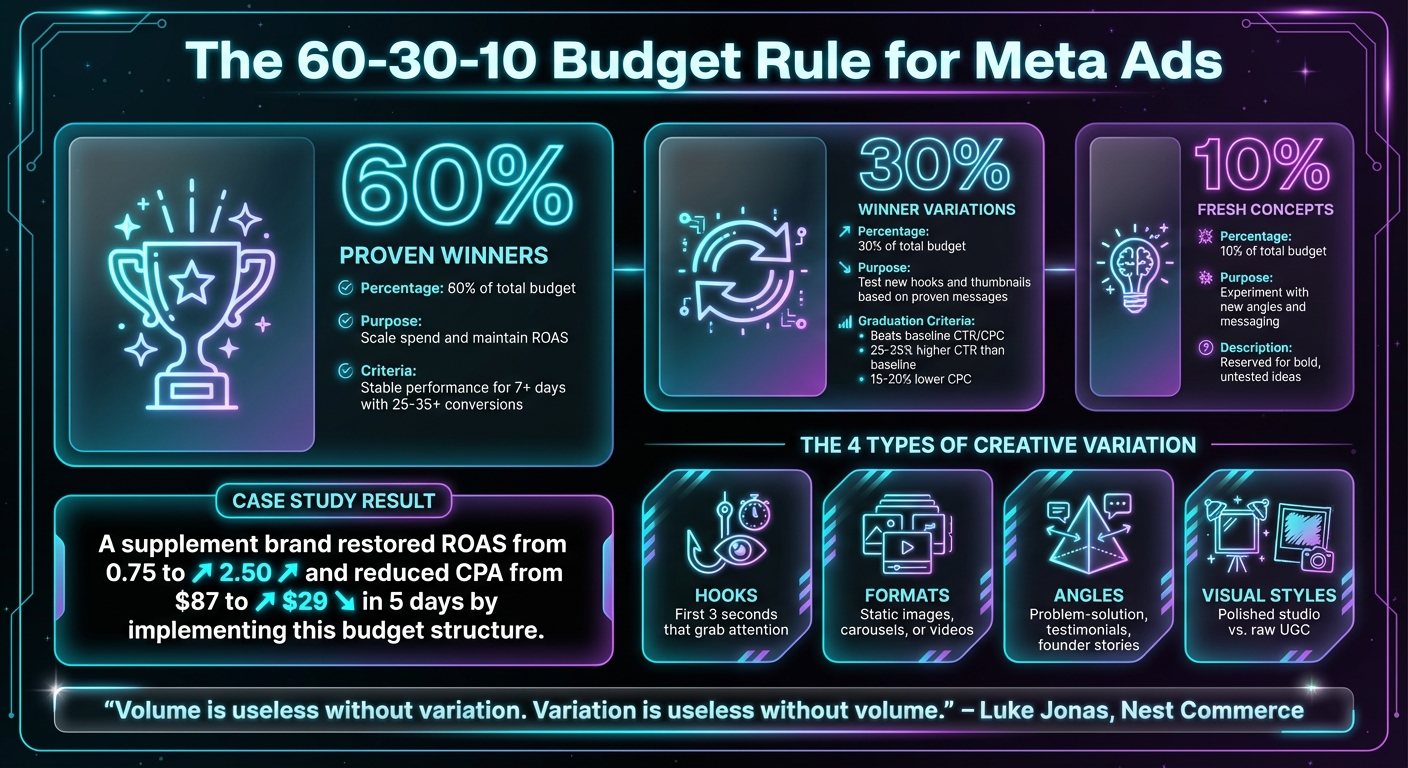
Creative Volume Strategy Budget Allocation Framework for Meta Ads
If you want to produce enough ads to keep Meta’s algorithm happy without overwhelming your team, you need a structured approach. Let’s break down the critical types of creative variations and strategies for managing budgets effectively.
The 4 Types of Creative Variation That Matter
Meta’s algorithm treats ads with similar hooks or visuals as nearly identical. So, if you upload 30 ads that look and feel the same, Meta might only recognize a small handful of them as distinct. To truly test variations, focus on meaningful changes in these areas:
- Hooks: The first three seconds that grab attention (e.g., “Smells like luxury” vs. “Perfume that lasts 10 hours”).
- Formats: Experiment with static images, carousels, or videos.
- Angles: Position the product differently, such as problem-solution, testimonials, or founder stories.
- Visual Styles: Compare polished studio shots to raw, user-generated content.
For example, Bellavita tested two hooks in 2025 - “Smells like luxury” versus “Perfume that lasts 10 hours” - and found the benefit-driven hook increased click-through rates by 1.6×. Meanwhile, Moxie Beauty discovered their carousel ads outperformed Reels by 40% for haircare combo products.
Surface-level tweaks, like changing a button color or slightly adjusting a headline, often go unnoticed by Meta’s algorithm. Instead, focus on changes that genuinely impact user behavior.
The guiding principle here is "Explore vs. Expand." Dedicate 20–30% of your creative production to testing bold, new ideas - those risky experiments that may or may not work. Use the remaining 70–80% to scale winning creatives by adapting winning messages across different hooks, formats, and styles.
"Volume is useless without variation. Variation is useless without volume." – Luke Jonas, Nest Commerce
How to Split Budget Between New Tests and Proven Ads
Once you’ve got a variety of creatives, the next step is allocating your budget wisely. Many accounts either underfund experimental ads or let untested ideas drain too much money.
Use the 60-30-10 budget rule:
- 60% of your budget goes to proven winners - ads with stable performance over at least seven days and 25–35+ conversions.
- 30% is for variations of those winners, like testing new hooks or thumbnails based on messages you know resonate.
- 10% is reserved for fresh, untested ideas, such as new angles or messaging.
For instance, a supplement brand in December 2025 saw their ROAS drop from 1.35 to 0.75 after launching six new ads without proper budget structure. The algorithm prioritized high-engagement ads that didn’t convert, resulting in a $18,000 loss. By pausing all ads for 24 hours and relaunching just 10 proven winners, they restored their ROAS to 2.50 and reduced CPA from $87 to $29 within five days.
To manage budgets effectively, use Ad Set Budget Optimization (ABO). This allows you to manually control spending for each ad set, ensuring fresh concepts don’t overshadow proven performers. Automated systems like Campaign Budget Optimization (CBO) can leave new ads underfunded until they gather enough conversion data.
Ads should only move from the 10% “Fresh Concepts” tier to the 30% “Winner Variations” tier after exceeding your account baseline by 25–35% on click-through rate (CTR) and achieving 15–20% lower cost per click (CPC).
| Budget Tier | Allocation | Purpose | Graduation Criteria |
|---|---|---|---|
| Proven Winners | 60% | Scale spend and maintain ROAS | Stable performance for 7+ days |
| Winner Variations | 30% | Test new hooks and thumbnails | Beats baseline CTR/CPC |
| Fresh Concepts | 10% | Experiment with new angles and messaging | 25–35% higher CTR than baseline |
Using Meta’s Dynamic Creative Features
Producing separate ads for every combination can bottleneck your team, especially if you aim to test 100+ variations per month. That’s where Meta’s dynamic creative tools come in. These tools let you upload multiple assets - headlines, text, images, and videos - and the algorithm automatically tests different combinations to find the best performers. For example, uploading five hooks with four images results in multiple combinations tested automatically.
Dynamic creative works best in the 30% “Winner Variations” tier, where you’re refining proven concepts. For the 10% “Fresh Concepts” tier, stick to ABO with one creative per ad set to get clear performance data.
But even with dynamic creative, production speed can be a challenge. If it takes a week to produce five new hooks, you’ll still lag behind. Tools like Aden’s Lab can help. By simply entering a website link, Aden’s Lab generates dozens of high-performing static Meta ads in minutes. This allows brands to go from testing 10 ads a month to testing 100.
"The goal of creative testing is to find new winners. It's not about hitting an arbitrary number of creatives tested." – Nathan Hudson, Perceptycs
One men’s accessories brand saw a jump from 12 ads per month (with a 28% approval rate) to 80 ads per month, improving their approval rate to 68% and cutting customer acquisition costs (CAC) by 23%. This system not only sped up production but also ensured consistency by embedding brand standards into the creative process.
How Creative Volume Prevents Ad Fatigue
What Happens When Ads Get Stale
Ad fatigue happens when your audience has seen your ad so many times that they’ve started tuning it out. They scroll past without a second thought - no clicks, no engagement, just wasted impressions.
The first red flag? Frequency - the average number of times each person sees your ad. For cold audiences, once frequency hits 2–3, performance often starts to decline. Your click-through rate starts to drop, cost per click rises, and cost per acquisition can increase by 15–20% in just one quarter. For a brand spending $500,000 a month, that’s a staggering $75,000–$100,000 in wasted spend every single month.
Lower engagement doesn’t just hurt your ROI; it signals to Meta that your ad is irrelevant, which drives up CPMs and lowers conversions. This creates a vicious cycle: fewer conversions starve the algorithm of data, making it harder to optimize, and performance nosedives. An ad that was a top performer two weeks ago can suddenly become a money pit. This is why keeping your creative fresh is non-negotiable.
As you scale, the lifespan of an ad shrinks. An ad that performs well for three weeks at $500 per day might burn out in just seven days if you increase the budget to $1,500 per day. The more you spend, the faster your audience saturates. Without fresh creative, you’ll hit a wall - and fast.
How Fresh Ads Keep Performance Stable
The solution? Consistently launch new ads. Don’t wait - keep a steady stream of fresh creative ready to go. This prevents frequency from climbing too high, gives Meta new material to test, and keeps engagement strong while costs remain steady.
Brands that quickly turn performance data into new creative see measurable improvements. The algorithm thrives on variety, not just a handful of options. If you’re only providing 20 ad variations, you’re limiting its ability to find the right match for your audience. To operate at full capacity, it needs closer to 200–500 distinct assets.
This steady flow of new ads is at the core of the Creative Volume strategy. It doesn’t just prevent fatigue - it feeds the algorithm’s learning process. When you allocate your budget wisely, the 10% you spend on fresh creative today can turn into the 30% of winning variations next week, which eventually form the 60% of proven performers. Without this pipeline, your account risks bleeding money.
Tools like Aden’s Lab make it easy to keep your creative pipeline full. Instead of waiting a week for a designer to produce a handful of new hooks, you can drop in a product link and generate dozens of high-performing static Meta ads in minutes. This kind of speed allows brands to go from testing 10 ads a month to testing 100, giving them the volume needed to maintain stable performance while scaling.
"The algorithm can't find the perfect match if you're only giving it 20 options. It needs more like 200-500. It needs genuine variety across hooks, formats, angles, and styles." – Luke Jonas, Nest Commerce
How to Set Up a Production System That Scales
Why Manual Workflows Can't Keep Up
Manual creative production tends to max out at around 30–45 active ads before the system starts to crumble. Take a media buyer earning $75,000 a year, spending 15 hours a week on repetitive tasks like uploading assets, duplicating ad sets, and labeling campaigns. That adds up to about $27,000 annually wasted on tasks that automation could easily handle. This isn’t a staffing issue - it’s a structural one.
The real choke point isn’t coming up with ideas or creating the content. It’s the launch throughput - the tedious, manual process of setting up campaigns in Ads Manager. Each campaign setup takes 20–30 minutes: selecting objectives, uploading creatives, writing ad copy, and organizing ad sets. Testing 10 ads a month might be feasible, but scaling to 100 ads? That’s a logistical nightmare unless you hire more people, which only increases complexity and coordination.
"The loop between performance insight and creative production is broken. At every handoff – from data to strategy to brief to production to approval – there's delay, translation loss, and missed signal." – Luke Jonas, Co-Founder, Nest Commerce
These inefficiencies make it clear: a faster, automated system is the only way forward.
How Automation Solves the Production Problem
Automation is the key to breaking through these bottlenecks. Instead of waiting days for a designer to create a few ad variations, automation lets you generate dozens of high-quality static ads in minutes - and launch them the same day.
Take Aden's Lab, for example. By simply inputting a product or landing page link, it produces static Meta ads optimized for conversions - no manual steps required. This allows brands to scale from 10 ads to 100 ads effortlessly, giving Meta’s algorithm the creative diversity it needs. At just $0.90 per ad on the Apex Mode plan, this system replaces the $50-per-ad designer costs, all while eliminating the need to expand your team. This streamlined approach not only speeds up production but also ensures sustained campaign performance.
Consider the 2025 case of Adacted, an agency working with a men’s accessories brand that was stuck producing just 12 ads per month, with a grueling 3–4 week approval cycle. By implementing a "Brand Operating System" with automated processes and approval tiers, the brand scaled up to 80 ads per month. Their First-Pass Approval Rate jumped from 28% to 68%, and their Cost Per Acquisition dropped by 23% within six months.
The results aren’t just incremental - they’re transformative. Brands that integrate performance data directly into their creative production process often see 30%+ performance gains and, in some cases, 3–4x ROAS improvements. Automation eliminates delays, turning today’s performance data into tomorrow’s creative ideas - not in weeks, but in hours. This continuous flow of data and creative output drives the consistent ad volume that Meta’s platform thrives on.
How to Measure Creative Volume Performance
Track Winners and Win Rate
When it comes to creative testing, the main objective is simple: find winning ads that can scale and improve your performance. It’s not about the number of ads you launch or the variations you test - it’s about how many of those turn into winners.
Here’s how you calculate win rate: divide the number of winning creatives by the total number of creatives tested. For example, if you test 100 ads in a month and 8 of them are scalable winners, your win rate is 8%. Ideally, this percentage should either stay steady or improve as you increase testing volume. If your win rate drops as you test more, it’s a sign that quality is slipping - you might be cranking out repetitive or low-effort variations instead of experimenting with fresh ideas.
"The goal of creative testing is to find new winners. It's not about hitting an arbitrary number of creatives tested." – Nathan Hudson, Founder, Perceptycs
To keep tabs on performance, track two metrics side by side every week: the number of ads tested and the win rate. If you see volume increasing but win rate dropping, it’s time to pause, reassess your creative strategies, and focus on producing varied concepts rather than just boosting output.
Calculate Cost-Per-Winner and Production Efficiency
Another critical metric to watch is Cost-Per-Winner (CPW), which you can calculate using this formula:
(Total Testing Spend + Total Production Costs) ÷ Number of Winning Creatives.
Let’s say you spend $6,000 in a month - $5,000 on testing and $1,000 on production - and end up with 10 winning ads. Your CPW would be $600. If this number climbs to $800 the following month, it’s a red flag: you’re spending more but getting fewer results.
Your CPW should always stay below your profit margin per customer. For instance, if your average order value is $80 and your product cost is $30, your margin is $50. A CPW of $600 means each winner needs to generate at least 12 conversions just to break even on testing costs. That’s not sustainable. A healthy CPW is one that allows you to cover costs and still generate profit on the back end.
Production efficiency is another piece of the puzzle. Tools like Aden's Lab can help cut costs significantly. For example, if you’re on the Apex Mode plan, producing 200 ads costs just $180 (at $0.90 per ad). Compare that to hiring a designer at $50 per ad - now you’re looking at $10,000 for the same output. By keeping production costs low, you can allocate more of your budget to testing, which keeps your CPW in check and helps manage your overall CPA and CAC.
What Good Numbers Look Like and When to Worry
To maintain a healthy creative system, aim for these benchmarks:
| Metric | Healthy Benchmark | Warning Sign |
|---|---|---|
| Win Rate | Stable or increasing with volume | Declining as volume rises |
| Cost-Per-Winner | Stable or decreasing | Climbing higher |
| Testing Ratio | 30%–50% | Below 10% |
Your testing ratio reflects how many new variations you’re launching weekly compared to your total active ads. Top-performing advertisers keep their testing ratios between 30% and 50%, ensuring they’re consistently refreshing their creative lineup to avoid ad fatigue. If your ratio dips below 10%, it’s a sign you’re not testing enough to stay competitive.
Another handy metric is First-Pass Approval Rate (FPAR) - the percentage of ads approved without needing revisions. A high FPAR, around 71%, suggests your process is running smoothly. On the other hand, a low FPAR (e.g., 30%) means you’re spending too much time revising ads instead of creating new ones, which points to inefficiencies in your workflow rather than a lack of volume.
Keep an eye out for warning signs like rising CPW, a declining win rate despite higher output, or a testing ratio stuck in the single digits. If you spot any of these, it’s time to revisit your creative strategies, improve quality control, or temporarily scale back until you regain stability.
How to Scale Meta Ads with Creative Volume
Scaling Meta ads without altering your targeting strategy means focusing on creative diversity. Meta's algorithm now tailors ads to individual users rather than broad audience groups, which means you need anywhere from 200 to 500 unique creative assets to give it the flexibility it needs to find the best match for each user. Many advertisers hit a spending limit not because of poor targeting but because they run out of fresh creatives to test.
Brands that connect their performance data directly to creative production have seen 3–4x increases in ROAS and performance boosts of over 30%. Top-performing teams roll out 50 to 200+ ads every month, ensuring a steady stream of new angles and hooks. This isn't about making small tweaks to existing ads - it's about delivering both high volume and variety to keep the algorithm exploring and optimizing. These results make it clear: manual creative production simply can’t keep up with the demands of scaling.
Why does creative diversity matter so much? The algorithm needs a large pool of options to effectively match ads to individual users. Without enough variety, you limit its ability to discover new audience segments and maintain consistent performance as you increase your ad spend. Automation has become the game-changer here, revolutionizing the way creatives are produced.
Traditional workflows often fall short due to high costs and slow turnaround times. For example, manual design costs about $50 per ad, meaning 200 ads could cost $10,000. In contrast, automation tools like Aden's Lab can produce ads for as little as $0.90 each under the Apex Mode plan. This means you could generate 200 ads for just $180. By dramatically reducing both time and costs, automation allows you to test more ads faster, refresh creatives before they fatigue, and scale your campaigns without sacrificing performance.
When your ad spend hits a plateau, the solution is simple: you need more ads. With Aden's Lab, you can replace slow, expensive manual workflows with instant, low-cost creative generation, ensuring your campaigns stay fresh and scalable. Keep an eye on your winners and manage your Cost-Per-Winner effectively. That’s how you break through the bottleneck and scale profitably.
FAQs
How many new ads do I need each week to scale?
Scaling on platforms like Meta now demands a much larger volume of ad variations than ever before. Advertisers often target hundreds of fresh ads every week to align with algorithm requirements, avoid creative fatigue, and improve testing opportunities. While the exact number of ads needed can differ, one thing is clear: producing a high volume of ads - often with the help of automation - is essential for staying competitive and achieving growth.
How do I know when an ad is fatigued on Meta?
You can tell if your Meta ads are hitting a wall by keeping an eye on performance trends. A few red flags to look for: your click-through rate (CTR) or engagement starts dropping, even though your spending stays the same - or goes up. Meta’s creative reporting tools, especially the "Fatigue" metric, can also clue you in if your audience is being overexposed to the same ad. Staying on top of these metrics can help you decide when it’s time to switch things up with fresh creative.
When should I use ABO vs. dynamic creative?
If you're looking for precise control over how your budget is distributed across specific audiences or creatives, ABO (Ad Set Budget) is the way to go. It’s especially useful when you're testing multiple options and need to pinpoint clear winners.
On the other hand, if you'd rather let Meta’s AI handle the heavy lifting, consider using dynamic creative. This feature automatically tests and optimizes different combinations of images, videos, and text. It’s perfect for scaling campaigns and minimizing creative fatigue.
In short: ABO gives you control, while dynamic creative focuses on automation.
Your next ad batch starts here
Finish with a ready-to-test ad batch
Paste your website to generate static creatives. Drop the link → get ads in about 90 seconds → upload them to Meta → scale.
Free to try No prompt writing